Tag Archives: grace

If you can! Really? Bring it! Mark 9 First Saint Johns September 13, 2015

[To hear the audio version of this sermon click on the above link]

We make our beginning in the Name of God the Father and in the Name of God the Son and in the Name of God the Holy Spirit and all those who know that Jesus can said … AMEN!

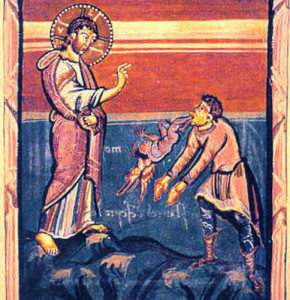
We often read Scripture in sort of bland/vanilla terms. In today’s Gospel reading we have a father whose son has been tormented, tortured, used, abused, just completely beaten down. No doubt the father is absolutely beside himself with fear and, complete hopelessness. My mother has had issues with epilepsy. The symptoms have been under control for many years, but I remember as a child that she had severe seizures. You can imagine as a child these episodes were very distressing for me and certainly very upsetting experience for my mother. There was only so much I could do as a child. But in this pericope I’m sure the father felt severe dejection. Dads are supposed to take control, fix things and you can imagine how helpless and hopeless the father felt. My mother’s symptoms were serious, but the description that we see of the son’s symptoms were even more serious. Some were classical symptoms of seizures, but there were far more serious issues with the son. He was being literally picked up and thrown down, I played football in my youth, tight end, basketball, basic military training and a little martial arts, I know full well how it feels for someone to put me to the ground. But we were usually fairly equal and I often had padding and was conditioned for it, it hurt, but it wasn’t continuous, or someone trying to seriously injure or kill me. I don’t think they were. The Greek word used to describe the son is paidi,on which means not just a child, but a young child. We’d probably guess no more than ten/eleven years old. So this probably physically small child is literally getting bounced off the walls and the demon even tries to throw him into the fire to burn him or into the water to drown him. In addition to being mute. This little boy was being treated hellaciously and dad was constantly a witness to this, no doubt trying to wrestle his son away from this supernatural power, do doubt failing most of the time and probably being hurt himself in the process. We can imagine the pain the child is going through, quite possibly to the extent of broken bones, stitches, maybe even more serious and the parents trying to protect and restore to health.

We should certainly empathize with the father, he was in a very difficult situation, which he says had been going on since the boy was a child, the Greek isn’t specific here, but perhaps since he was a toddler. Either way we would have to suppose that it had been going on for probably years. So we can certainly understand that the father is at his wits end. Jesus has just come down from the Transfiguration, this momentous event that we celebrate every year. It is coming down to the end of Jesus’ incarnational ministry, He is focused on the Cross, so perhaps in a way He is a little distracted, but also affirmed and glorified by God the Father. The boy’s father seems to know who Jesus is, He tells Jesus straight out that he has brought his son to Him for healing. So certainly the father is aware of what Jesus has done. According to Mark, Jesus has taught new teachings, that only God could introduce. Jesus and God the Father have made it clear who Jesus is. Mark has recounted how Jesus has freed others from Satan and his demons. Jesus has calmed the storm, He has raised the dead, healed many, fed over 5,000, walked on the water, healed the lepers, given faith to many, forgiven the sins of many, healed blind and deaf men, Peter has confessed who Jesus is and now this father brings his son and says: “But if you can do anything and have compassion on us and help us.” Jesus must have been a little put out and his response seems to indicate a little irritation: “If you can!” Jesus’ isn’t asking a question, He’s making what seems to be an incredulous declaration. In the Driskell translation I’m seeing Jesus saying: “Really? If I can! I know that you are weary and desperate and have gone through a terrible situation, but obviously you’ve heard all the other things. You couldn’t come to me and say; ‘I know you can heal my son who has gone through so much affliction, You have given me the faith I need to bring my son to You and I am trusting that according to Your will do what is necessary relating to my son.” And certainly the father does respond, that he does have faith, he did bring his son, “but please help me to have and keep faith in You and in Your will.” But let’s face it, too often we do put limits on what God can do in our lives. We need to remember that it is always according to His will.

Does faith mean that God is always going to act according to our will, that He is always going to heal, or that He is going to provide for us according to our agenda? Faith is trusting in His will, faith is looking for what His plan is according to what is happening. A Wisconsin fishing guide points out: “The only thing that casts doubt on the miracles of Jesus is that they were all witnessed by fishermen.”[1] That’s not true. We have God’s inspired Word in the Gospel, He inspired men to write about the miracles that Jesus did and we know through our faith that Jesus continues to heal, not always the body, but for those He leads He heals the soul and gives us the faith we need to trust and be led by Him, to have the hope and promise that only He gives us. Sure our human weakness gets in the way. When that happens let’s look back at the beleaguered father’s example and pray: “I do believe; help me overcome my unbelief.” St Augustine observes: “If one can pray so that one may cast out another demon, how much more should one pray that one’s own demons be cast out.”[2] Jesus told His disciples they needed to pray to cast out the demon afflicting this boy, certainly He is telling us, His disciples, to pray, in faith, that He will cast out the demons that afflict ourselves and always to pray for healing for others. Jesus can! He died to save us to everlasting salvation, He died to save us who are sinners and sin in our own will and who are led to sin by evil beings. He can and does save us and heal us, through His grace, His people who He does give faith to believe and to trust in His will.

The peace of God which surpasses all understanding keep your hearts and minds through Christ Jesus. Amin and Shalom.

[1] Rowell and Steffen   “Humor for Preaching and Teaching” p 57

[2] Simonetti, Manlio  quoting St Augustine “Ancient Christian Commentary NT 1b” p 59
You cannot “earn” your way to salvation in Jesus, it is a gift through grace.

When Dr Martin Luther started to raise issues with the Roman Catholic Church (remember he was an Augustinian monk), he wasn’t trying to undermine the church, he was trying to reconcile his Biblical studies and the teachings of the church. The church emphasized what we are supposed to do in order to be “worthy” of salvation. Dr Luther said, No! What can we add to what Jesus did? He was the sacrifice that paid for our sins. What else can we add through anything we could do to Jesus’ full payment for our sins? Are we fully forgiven in Jesus? Yes, we know Him as our Savior, we are baptized into new life in Jesus, we take His Body and Blood, we hear His preached word, we are saved. We are led to salvation by the Holy Spirit, not by anything we do. All of these things are given to us as part of the Body of Christ, His church. We receive baptism, we receive His Body and Blood, we receive/hear His preached Word. Nothing we did, all of what He did.

Dr Luther tries to lead the Christian church back to the original understanding that we are only forgiven and saved in what Jesus does, nothing that we do. Do we do good works? Absolutely, but these are works that are done through us by the Holy Spirit. Any works we do don’t get us any more saved. When we are baptized, the old/dead man is drowned and we are born again, we are a new creature in Jesus. We are now children of God the Father and are His. Nothing that we did, everything that Father, Son and Holy Spirit did for us.

So there were new Christian churches, teaching and preaching that we are wholly saved by what Jesus does and nothing about what we do. But along comes these Americanized Christians who decide that there must be something that we need to add to Jesus’ works in order to assure us of our salvation. “Yet with salvation comes the responsibility to work out our salvation.” (Henry, Richard Blackaby Experiencing God Day by Day p 205). This is referred to as “works righteousness” in other words, it’s our works that make us righteous in addition to what Jesus did. There has to be both what Jesus did and what we add to that.The Blackaby’s are great Christian brothers, but there are too many in Christiandom that continue to try to stress what we do and undercut what Jesus has done and does do for His people. The extreme examples being Mormons and Jehovah’s Witnesses who try to put our salvation entirely on our efforts and try to undercut Jesus entirely. I’ve always wanted to ask one of them, what if I am just not capable of doing anything? Then what? Too bad for me?

In the July 17 devotional (p 199), the issue is that not only are there works that need to be done by us, but we also seem to achieve almost sinlessness. Don’t get me wrong, I am not preaching antinomianism (the belief that since we’re saved in Jesus, then we can pretty much sin at will because our forgiveness is already assured because of our redemption in Jesus). Reality is this, we are never going to be sinless, we just aren’t. Sure I hope that in Jesus the Holy Spirit is going to make me completely pure, holy and sinless. I am completely righteous through Jesus! But I’m not through me, or some bizarre idea that I have achieved sinless perfection. I’m just never going to make that level

The Blackaby’s say “It is exhilarating to be set apart by God, knowing that God observes your consecrated life and is pleased with what He sees.” Sure, absolutely! I do want to lead a God pleasing life and I should not be committing gratuitous sins. But the fact of the matter is that I will be. At the beginning of every Lutheran worship we start with Confession and Absolution. Well if we have just been perfect in our selves for the past week, what do we need that for? Because the reality is that we need forgiveness, as often as possible. We aren’t going to make it through a week without sin. Sure sometimes they’re acts of omission vs commission, but sin nonetheless and we want to be absolved, to be forgiven and not by virtue of having “a special place in God’s heart!” We do! By virtue of what Jesus did, nothing we’ve done. Not by virtue of our works or our sinlessness, solely through redemption in Jesus’ sacrifice.

I’ve talked to many people who have experienced Reformed Christianity (various types of Calvinism, Arminianism), that feel they’ve had to jump through hoops to be “saved”. There’s of course the “accepting” Jesus, Walking down the aisle during worship to declare that you have some how “chosen” Jesus. Ya…, no! “You didn’t chose me, I chose you.” Jesus tells us. Martin Luther put it forthrightly, you are saved by grace, sola gratia, nothing you did, everything Jesus did. Stop fretting whether you’ve done enough works, or too much sin. Jesus died for your sins, you are saved in Him. If He has chosen you to be saved, you are saved! Done deal, lead pipe guarantee, nothing you did, everything He did. That should be incredibly reassuring. If God has done it, it’s done! If part of it is up to us, oh boy, that is a problem! It’s not, you’re saved in Him. Not in you. Praise God, Father, Son and Holy Spirit for that! Sola Fide, Sola gratia, Sola Scriptura, Sola Christi. If you don’t know what that means drop me a message.

The “S” Word Ephesians 5 Mark 7 First St Johns Church Aug 23, 2015

[For the audio version, please click above link]

We make our beginning in the Name of God the Father and in the Name of God the Son and in the Name of God the Holy Spirit and those who hear and respect God’s Word and not man’s said … AMEN!

God’s plan is just so perfect, it’s a circular sort of situation, that doesn’t mean, as always, that we get what we want all the time, we seem to not understand that relationship is not “hey you jump through hoops for me and then maybe I will love you”. This is what we have in society today and why there is this widespread and deep unhappiness and even resentment. We all submit to Jesus. Submit to your husband, because he is the one that is called to love his wife and not just our squishy kind of love, but the same love Jesus had for the church! Jesus died for the love of His church, men are called to love their wives, agape love, to the point of sacrificing themselves. If your husband will do that for you, doesn’t that suggest respect and submission to him?

Oh baby, anyone preaching on Ephesians 5: 21-33 can just feel the ice cracking around his feet. The “S” word! OHHHHH, no one likes to “S”, S being of course “submit, submission”. Oh no! In today’s world, everyone is an expert, everyone knows it all, we are the most equalitarian society in the history of the earth. Apparently if you are born an American, you are an immediate expert on everything and anything. More and more I’m beginning to see that attitude rather cynically. At my age, you’d think that I would have become pretty much irreparably cynical and yet, more and more I find myself realizing that when I submit to God as His minister, to His people, He does work it out according to His will. Romans 8:28 does seem to get a workout, “And we know that for those who love God all things work together for good, for those who are called according to his purpose.” Isn’t this part of what the Christian life is all about?

When we say “for those who love God”, doesn’t loving someone mean submitting to Him in order for the good of all concerned? Submission doesn’t mean, just throwing in the towel and mindlessly following. It does mean, at some point you just have to trust that the person.

Certainly the military and corporate environments are a lesson in those areas. There are plenty of times where you’re not sure about something that has to be done, you want to fuss over it a little more, but at some point it’s obvious you have to do what you’re entrusted to do, do it to the best of your ability, so that there will be success. If this is what you’re led to do, it may not be perfect, but it becomes your responsibility to make it as perfect as it can be.

Professor Jeffrey Oschwald observes the shift from chapter 6 to chapter 7. People are running to Jesus, the people: “ran about the whole region and began to bring the sick people on their beds to wherever they heard he was. ESV Mark 6:56 And wherever he came, in villages, cities, or countryside, they laid the sick in the marketplaces and implored him that they might touch even the fringe of his garment. And as many as touched it were made well.” Oh yeah, they wanted Jesus then. Last week’s sermon after Jesus fed thousands and then said OK, now that you have a full stomach, let’s talk real stuff, you have to eat my body and drink my blood to fill your soul, to have real life. Yea, they weren’t so much into that and decided to pick up and leave. In today’s reading, the people are flocking to him and Jesus has healed a number of people, what happens? The Pharisees and the scribes confront Him over a ticky-tack little issue about the disciples washing their hands. Obviously these guys are trying to provoke a confrontation. It’s about 90 miles from Jerusalem, where they’ve come from, to the northern part of the Sea of Galilee, they’re not going to make that trip lightly, they feel threatened and have decided to find any little thing they can in order to pick a fight with Jesus, to somehow discredit Him. You can certainly see Jesus’ frustration. “Here I am, God the Son, look at all these things I’ve done. I’m trying to get you to see real life and what are you doing? Getting up in my grill about a ticky-tack little issue about washing hands? Really?”: “ESV Mark 7:6 And he said to them, “Well did Isaiah prophesy of you hypocrites, as it is written, “‘ This people honors me with their lips, but their heart is far from me; ESV Mark 7:7 in vain do they worship me, teaching as doctrines the commandments of men.’ ESV Mark 7:8 You leave the commandment of God and hold to the tradition of men.” ESV Mark 7:9 And he said to them, “You have a fine way of rejecting the commandment of God in order to establish your tradition!” Jesus is referring to the quote in today’s reading from Isaiah: “ESV Isaiah 29:13 And the Lord said: “Because this people draw near with their mouth and honor me with their lips, while their hearts are far from me, and their fear of me is a commandment taught by men, ESV Isaiah 29:14 therefore, behold, I will again do wonderful things with this people, with wonder upon wonder; and the wisdom of their wise men shall perish, and the discernment of their discerning men shall be hidden.”

Obviously Jesus is frustrated and is telling them to get a grip. Are you going to stick to your quibbling little traditions or are you going to see what’s going on here. God the Son is here! It’s time to submit to His will, quit worrying about the petty stuff and see what’s really happening!”

Dr Oschwald observes: “If you had the opportunity for a private audience with Jesus, would you argue about the proper way to wash up before a meal?… Jesus’ opponents seem to have completely lost sight of what really matters before God. The way they ask their question suggests that the root of the problem is that they’ve begun to put human concerns before and above what’s important in God’s eyes. Our initial sympathy with the Pharisees’ concern over clean hands at the table goes right down the drain when we begin to see the real problem in all its seriousness.”[1] We, you and I, often have to stop and ask ourselves; are we going to pick a fight over the trivial stuff or do we look around us and see what Jesus is doing, what great things are happening around us. How to point to, contribute to, focus on what the Holy Spirit is doing and do it to His glory, to the glory of Jesus’ church. How do we proclaim to the world what is going on in His service, to His glory?

The peace of God which surpasses all understanding keep your hearts and minds through Christ Jesus. Amin and Shalom.

[1] Rev Dr Jeffrey Oschwald   Concordia Pulpit Resources Vol 25, Part 3, Series B p 39

God isn’t going to push, He will encourage

Rev Ken Klaus – Lutheran Hour Ministries: “Years ago I called on a man, a member of my church, who was a good man, at least in the eyes of the community. By that I mean the fellow was honest in his dealings with others; he took good care of his family, didn’t drink, gamble, or swear. He was always faithful and conscientious in paying his bills and taking care of his other debts. During our visit I asked, ‘Tell me, you pay all your other debts, but I never see you in church; I never see you at Communion, and the church offering plate never sees a dollar from your account. Why are you faithful in paying your debts to others, but not to the Lord?” He thought for a minute and then, without being flip, he replied, “Well, pastor, I don’t pay so much attention to God, because He doesn’t push as hard as everybody else.”

Listeners, that guy had it right. The Lord is not going to push; He is not going to beg; He is not going to twist your arm. What He is going to do is say, “Look at My Son who gave His life to save your soul. With faith in Him You will be in heaven; without faith, you are headed for hell. Jesus is the best thing which has ever happened to you and for you. Don’t turn your back on Jesus. Be ready for the day when He will say to this world, ‘enough is enough.’ When that day arrives, I want everyone to be glad to see Me.”

Pastor Klaus is one of my favorites, you have to check out  wwwlhm.org to hear the audio versions of these sermons from Pastor Klaus and also Pastor Greg Seltz.

Have to consider his point. No God’s not going to get up in your face, not normally. To those who don’t know Jesus, yes the Holy Spirit is going to keep tugging at you, getting in your head sometime, continuously pointing to God. But, wow, we really give the world carte blanche, “entre” into our head, never thinking an hour ahead of time. Then we have the arrogance to decide, when we really have to, “well God’s just going to have to take me as I am, I’m good enough.” No you’re not, I’m not, no one is, God accepts us under very simple conditions. We follow the leading of the Holy Spirit, we are baptized in the Name of God the Father, Son and Holy Spirit. We receive the true Body and Blood of Jesus, what was sacrificed as payment for our sins and we hear His Word preached. No heavy lifting, all for your benefit, yet too often, because God doesn’t push, we think the nonsense around us is more important.

True life is in God the Father, His Son Jesus, guided by the Holy Spirit. It is a life of meaning, “life, life more abundant”, of joy, promise and hope. Do you get that in the world? Ya, no, just more grind, more gimmee, gimmee, and in the end, we all know death, hopelessness, complete loss and eternal condemnation. I have yet to have anyone give me any other possible outcome. True life in Jesus and then we die, we go to be in His presence, but then true, eternal, perfect, abundant challenging life in Jesus in the resurrection. Gotta tell you, seems logical, it is God who leads you into salvation, but you can resist and refuse, and for what?

It’s God’s will, we are in His will or we are condemned.

What seems to be missed by people is this idea that there are “choices”. When it comes right down to it, there really aren’t. Sure there are choices that you make like, I like the whopper better than I like the Big Mac. I like the Red Sox, I don’t like the Yankees. What house I’m going to buy, yea, maybe. When it comes right down to it, like it or not, the real choices are in God’s hand. We are either in His will or we are separated from His will.

That doesn’t mean we sit and obsess if we really can’t discern God’s will. A lot of times in my life, I can honestly say that I knew what His will was/is, and He made it very plain how I should follow it. At other times, I did the best I could, put it in prayer and trusted Him that what i was doing was the way He wanted. I can’t say that I was always right or that I did it faithfully, that I did it according to His will. Sometimes, frankly, I have to admit I didn’t even take His will into account. Seemed obvious, jumped in and then afterwards realized that I should have given it more time, more work, more consideration. As in anything in humans, we’re just not going to be perfect. We do the best we can to pull it together, to execute the plan and then leave it in His hands. Sometimes it doesn’t work because He wanted us to do it and He used it to His own will, even if it seemed that it wasn’t such a good deal to us. “ESV Romans 8:28 And we know that for those who love God all things work together for good, for those who are called according to his purpose.” [Bible Works]

I am trying to write, that for those who pursue this attitude, that God is somehow unfair, because many go to Hell, Jesus made it very clear that many would chose to ignore Him, that they would chose their own path: ” ESV Matthew 7:13 “Enter by the narrow gate. For the gate is wide and the way is easy that leads to destruction, and those who enter by it are many. 14 For the gate is narrow and the way is hard that leads to life, and those who find it are few.” [Bible Works]
Dr Martin Luther in his book Bondage of the Will addresses the idea that there is “free-will” in terms of our salvation. The idea that we are in some way “free agents”. The only way that works is God’s way in Jesus. Any “free-will” is purely from Satan and puts the individual on the path of destruction.

Luther writes: “You describe the power of ‘free-will’ as small, and wholly ineffective apart from the grace of God [Luther’s NB – As in those who lack grace (special grace, I mean) reason is darkened but not destroyed so it is probable that their power of will is not wholly destroyed, but has become ineffective for upright actions.’] Agreed? Now then, I ask you: if God’s grace is wanting, if it is taken away from that small power, what can it do? It is ineffective, you say, and can do nothing good. So it will not do what God or His grace wills. Why? Because we have now taken God’s grace away from it, and what the grace of God does not do is not good. Hence it follows that ‘free-will’ without God’s grace is not free at all, but is the permanent prisoner and bondslave of evil, since it cannot turn itself to good…it is ineffective apart from God’s grace, straightway you rob it of all its power. What is ineffective power but (in plain language) no power? So to say that ‘free-will’ exists and has power, albeit ineffective power, is, in the Sophists’ phrase, a contradiction in terms. [Luther’s NB – oppositum in adiecto]” p 104

“…that we do everything of necessity, and nothing by ‘free-will’; for the power of ‘free-will’ is nil, and it does no good, nor can do, without grace … The term ‘free-will’ is too grandiose and comprehensive and fulsome. People think it means what the natural force of the phrase would require, namely, a power of freely turning in any direction, yielding to none and subject to none. If they knew that this was not so, [p 105] and that the term signifies only a tiny spark of power, and that utterly ineffective in itself, since it is the devil’s prisoner and slave,…” [p 106]

“…However, with regard to God, and in all that bears on salvation or damnation, he has no ‘free-will’, but is a captive, prisoner and bondslave, either to the will of God, or to the will of Satan.” [p 107]

You have either stopped resisting what God is doing to you and are chosen by Him to be your Lord, or your right where you are because you have resisted the Holy Spirit and simply want to wallow in where you are. If you aren’t in Jesus, you are already condemned. While you continue to assert your own will, to think it’s all about you, that you are the master of your own fate, then it’s just another way for Satan to assert his control over you. If you come to the realization, that God is in control, that it really isn’t about you, that it’s all about what the Holy Spirit is doing in you, then you are saved.

Once we accept that it is about God and His will, that what we do outside His will is separation from God, that separation is Hell, is condemnation. There is no will for salvation other than God’s. Anything is the path to destruction. Separation from God is Hell.

In Revelation 12: 7-17 and 13:5-8 God has removed His hand from earth, Basically He has said that this is the end, that there is no more grace and man is left to his own devices. Honestly, how do you really think that’s going to work out? I know there are times when things look crazy and out of control, but God is still very much in control. The difference will be very obvious when Satan rules and there will then be unrestrained evil. We like to think we are somehow able to conduct ourselves properly, but when God removes His hand, when God simply allows us to do our own will, is there any doubt that the outpouring of evil, of violence, of greed will be absolutely stupefying? Is there really any doubt in anyone’s mind that when God has removed the Holy Spirit, when Satan rules that there will be unrestrained evil? This is what those who reject God will have, what they’ve accepted, there will be survival of the fittest. They don’t want God’s control, His blessing, although they think they’re entitled to the benefits of His blessing. They don’t realize what unrestrained evil is and they’ve shown that they really don’t care. And we’ve all met people that fill that bill, there are those who are obvious and the rest, not so obvious.

God is good, God is perfectly Holy. Being in a downtown church, being in the inner-city, albeit a small city, there are still lots of people who will knock on the church door and expect that I will just hand over money to them. In more subtle ways, there are plenty of people out there who have the same attitude, they expect God to hand over everything, including salvation on their terms. Then they will accuse God of not being “good” because He won’t save them! God is perfectly good, not according to our individual agenda (let’s face it, there’s God’s agenda, then there’s yours. In the end, which one do you really think is going to win out?)

God is perfectly good, perfectly holy, perfectly all knowing, all powerful, transcendant beyond anything that we can understand. Your agenda is just not going to be perfectly good, come on, it’s going to be covered in sin, if not completely submerged. It’s all of us, we are all completely unredeemed sinners and the only way to redemption is through Christ, The Son of God. God certainly does have an agenda, He revealed it, in His revelation, the Bible. We look to God for Him to guide us in how we fit in that agenda. Not our way, but His. Certainly that agenda is different for different people. If you are a great Christian mom, or Christian office worker, or Christian soldier/sailor, or Christian plumber, Christian factory worker, does that not serve God? We are put where we are at to serve God to the best of our ability, to be the best Christian factory worker we can as a witness to those around us to Jesus. We like to think that it’s all about us, it’s all about our control. Let’s face it the more you try to assert control, the more you realize that you just don’t have control. You can keep wrestling with God over it or figure out that it is all about Him and not about you. When we stop resisting the leading of the Holy Spirit and surrender to His will, when we are concerned about God’s agenda and not ours, when you trust His control, His will, and operate our life accordingly, It may not be “easy”, but it will be much easier then struggling against God.

Running the race in faith in God’s standards, not ours. First St Johns Lutheran Church, York, Pa. February 8, 2015

[The picture is of Pheidippides accouncing the victory of the Greek forces over the Persians to the Athenians Luc-Olivier Merson, 1869 ]

(For a audio version of this sermon, click on the above link or copy and paste it into your browser)

We make our beginning in the Name of God the Father and in the Name of God the Son and in the Name of God the Holy Spirit and all those who run the race of faith in Christ said …   AMEN!

I have done a marathon, I have done a century. A marathon is a 26.1 mile race, I did it in Falmouth, Ma. A century is a bike ride/race of 100 miles, I did that at the seminary. I’ve done 56 triathlons. Paul could have been talking about running a Marathon. The Battle of Marathon occurred in 490 BC and the Greeks may have included the marathon as a competition in their Olympics which would have made the marathon known to the entire Roman world, Israel and Paul included.

Paul is telling us that we have to do life, like these physical tests, with endurance. The problem is we have pasted over these with our own expectations. As Lutherans, too often, we think we don’t have to do anything. We’re saved by grace, we don’t have to do that. But let’s say you should do that. I still think you have to because I honestly believe God still pushes us to stretch in life. We are saved by grace, but that does not mean that we get to sit and just vegetate, especially when it comes to our relationship with Jesus. He gave His best, why on earth should we think that we don’t have to give our best.

Another issue that always seems to be, at least to me, an excuse with Lutherans and too many other people. “If we can’t run the race, if we can’t ride the bike, if we can’t entertain, or maintain or serve or witness … well then we just shouldn’t do it.” Heck, if that’s the issue what am I doing here? I’m sure not, no Billy Graham, or Dale Meyer, or Matt Harrison, or Jon Diefenthaler. If I’m really not that great as a pastor, as a preacher, the one charged with worship, what am I really doing here?

What I am doing, what you are doing is being led by what God wants us to do in our lives. No where in the Bible does it say, “well you have to do everything and anything with excellence, otherwise, just don’t bother doing it!” It doesn’t say that anywhere, no one demands it or expects it. None of us is perfect, none of us is going to do anything perfectly. We should strive to do our best, to serve as perfectly as possible, but it’s not going to happen all the time, we’re just not going to make it. Sometimes it does look perfect and that’s a great thing, and we should salute excellence, but we should never expect perfection, from ourselves or anyone else.

Recently, studies have shown that perfectionism is really just a form of procrastination. We seem to have always celebrated the “perfectionist”. This is the person who, “well I just won’t put this out into the world until it’s absolutely perfect”. We all think how marvelous that is, this kind of integrity. I’m certainly not saying be sloppy, but I’m also not saying that you use every little thing for an excuse to avoid doing the things that you need to do.

We are called to be disciples. That is a race, that is an endurance effort that makes the Hawaii Ironman look like a walk in the park. Are we called to be excellent disciples? No. Does it mean that we can throw God any old little effort that we want to whenever we want to? No! He doesn’t do that to use. God gives us His best everyday. He’s given us His best in Jesus. God’s not sitting up there grading us, not even on the curve, “well poor Jim, I know about him, I’ll cut him some slack”. It’s not about how great or how bad. It is about do we serve Father, Son, Holy Spirit, brothers and sisters in Jesus and the world to the best of our ability? Not in a one shot, here it is take it or leave it. We serve in the sense of the long-haul, making constant effort. We are always looking for the opportunities, always looking for where God leads us. We do it with the understanding that, Yes, we grow through this process. We also serve others through this process. Service isn’t often a one-shot deal, it’s a matter of endurance. Of continuous service.

I have no doubt in my mind that Paul was probably one crispy-critter by the time he got to Rome. Think of all that he had done, all that he endured, all that he sought to maintain and build. It’s staggering! I doubt that in what was maybe a ten-year period, no other person in Christian history did as much to spread Christianity as Paul. We have to remember that he really had no basis. Sure he had the local synagogues, but often they became as hostile as the pagan world, if not more so. So there’s a great excuse right there; “sorry, we can’t have worship because we can’t use the synagogue on Sunday, they kicked us out”. You know as well as I do that would be a ready made excuse for many people today. Paul could say I don’t have the right clothes, I can’t preach like this! No, he did what he could do with what he had. He could have said; “well, we just haven’t worked out the proper teaching, the proper doctrine here, so as soon as I get all that down perfectly I will get back to you.” Heck if I did that I’d never preach, I sincerely hope you don’t think that I am the fount of all Christian knowledge. But did that keep Paul from preaching and teaching? Would that keep me from preaching and teaching?

I’m not saying don’t prepare to the best of your ability. But I think one thing that military training, even athletics has taught me. At some point there is going to be a case, a mission. Probably the biggest case I had, a really bad situation that was my Damascus Road experience. Someone asked the boat coxswain afterwards and he replied, “I’ve never done that before, I was scared to death, I can’t believe I got through that”. He was as prepared as he could be for that storm, he  showed up and people needed help and he got to where people needed him. He didn’t wait until he was perfect, he didn’t have that luxury. He had trained to the best of his ability and likewise the rest of us in the crew, and when the call came we responded to the best of our ability. Despite very difficult circumstances, we got the best possible outcome and all of us that were involved in that case, got an education that we could never have paid for, never arranged, have never gotten under any circumstances other then we were there, we were called, we went out and put on our best effort and, the outcome was as good as it could have been expected.

As I said, yes I ran a marathon, yes I have done a century, yes I have done 53 triathlons. Having said that, I wouldn’t be too impressed if I were you. I did the marathon in 4 hours and 57 minutes. Most people finish under 4 hours and the winning times are almost under three hours. I finished the century in about 8 hours. I did finish before two other people, but otherwise the rest of my group had finished anywhere between 3 and 4 hours earlier than me. So does that mean I should just hang my head in shame, “oh how embarrassing, I’d never tell anyone that I did a marathon or century”… uhmmm no! I can tell anyone that I have finished either one, it’s called bragging rights. I did it and I’m entitled to put a little plate on my Road ID to say I did it. I may not camp on the fact that I took almost 2 to 4 hours longer than most, but I can say that I did it.

Yes I might be able to brag, a little, about what I’ve done and I have no doubt that everyone of you out there has done something that the average mortal never really does and you are entitled to bragging rights. Go ahead, yea Christian humility and we should be humble, but hey, in these cases be a little obnoxious. But when it comes to running and ultimately finishing the Christian race, we do that with humility. Why? Did we really run it in our strength? No! I have no doubt in my mind that my thirty years as a Christian and where the Holy Spirit has put me, that it was entirely through the strength and guidance of the Holy Spirit, not mine. How can I take credit for something that someone does through me? But does that make me any less saved? No! I am perfectly saved and if I faithfully follow that leading and do the things that I’m lead to do, in the time I’m lead to do them, then I am a faithful servant. I have been put into plenty of situations by the Holy Spirit, where I knew that a lot more preparation would have been good. I assure you and anyone at Concordia Seminary would agree, that new pastors have a lot to work out when they get to a parish. Frankly some more than others. But is that a valid excuse to avoid what you’re supposed to do and not run the race? No! Sometimes the trial is the teaching moment, the growth moment. That the Father knows that you will only grow through doing versus sitting around talking about it or reading about it. We should continually strive to be the best possible disciples we can be, our Savior is the best and most perfect and He gave us all that we have or ever will need. But we should be ready to run that race at any moment. Not when we decide that we are ready, but when the Holy Spirit hits that alarm and tells us we need to jump up and run out that door. Sometimes we may never even know to what we are running, but we run anyway instead of waiting until we’re perfect because the Father has given us the faith to trust in Him, not in our abilities.

I didn’t run/ride the races perfectly, but I did do them. We aren’t called to run/ride/fight the faith perfectly, we are called to serve the Lord in obedience. God says I am more interested in your obedience then your sacrifice. When we faithfully obey, even we don’t do it the best we can, we are doing God’s will and will be rewarded on that basis. Not on the basis of what we think is acceptable, what is up to our standards, but what we did when we responded to God’s call in faith.

May God the Father and God the Son and God the Holy Spirit bless and preserve you to all eternity. Shalom and Amin.

Teaching, walking as a disciple of Jesus

For the audio version of this sermon, click on the above link.

We make our beginning in the Name of God the Father and in the Name of God the Son and in the Name of God the Holy Spirit and all those who know it’s about what God does and His Word said … AMEN! We are going to have a little spring training today. The Patriots win the Super Bowl today, the Red Sox report to Florida in a couple of weeks, a few weeks of fundamental baseball in Florida and all is right with the world. The subject is this, what are the fundamentals? What issues do we as Christians need to deal with, what is important for us to remember? There are way too many Christians who make other issues their top priorities; social issues, political issues, how much or how little sin, end times, making worship entertainment the Sabbath and in this case fussing over what kind of food we should/shouldn’t be eating. In today’s epistle lesson Paul is trying to get people to focus on what’s important. What are they focused on? Eating food that was offered to idols? As part of that discussion Paul’s saying; “We can all be smarty pants and get into these secondary issues with people. Try to look like we’re theologians, “oh heavens, we must talk about the seriousness of this vital issue. I saw brother Thomas over at the temple meat market and he was buying a prime rib that was sacrificed to a pagan ‘god’! That’s horrible! We can’t allow that! This must stop. I don’t care if the temple meat market has the best prime rib, if we buy prime rib at all, it better not be from something that was not sacrificed to some pagan ‘god’.” Yea, OK, in this context is that cool? No, it’s not! But on the other hand, for a Christian, is that something that really speaks to our eternal salvation or any other Christian’s eternal salvation? No, it’s not. We have a whole lot better things to discuss and frankly it takes away from those issues that are much more compelling. For example; ‘ok, brother Aurelius, we shouldn’t eat meat sacrificed to a pagan “god”. I’m not going to say right, wrong or indifferent. But Aurelius, when was the last time that you took a pagan or a new Christian and really sat down with them about the real issues of being a Christian? How’s your prayer life? How’s your relationship with Jesus? Do you feel the Holy Spirit moving you to serve someone and you didn’t? Let’s go back to the “Solas”. What are the solas? Sola Fide – by faith alone. It is His faith that God the Father gives Christians that we trust in Him, we trust His will and we follow His will. There are way too many people out there who try to make it out to be all about us, what we want, that God needs to get on our agenda. That’s not going to happen and God will lead us where he wants us and it is far better than anything we can do. Sola Gratia – By grace alone. This gets into the whole issue about how we are saved. Is it about what we do? Maybe even a little? Or is it about what God does? He saves us! It is through His grace that we are saved. We don’t earn it. The Father gives us His grace because in his sovereignty, He chooses those who are saved and they are saved because He brings them into relationship with His Son, our Lord Jesus Christ. We are saved only through Him and His righteousness. Even if we live the “perfect” life, did everything right or avoided the things we shouldn’t do, we’re not saved. It’s not about what we do, it’s what He did! We may have obeyed the Law, but the Law does not save you, we are only saved through the righteousness of Jesus and that becomes our righteousness when he brings us to Him and saves us. Sola Scriptura – Only through Scripture, only through what is in the Bible. We have a lot of “teachers” out there whose attitude is, “well, this isn’t in the Bible, but it should be and ‘my’ God would have put it in the Bible.” No! I am a Lutheran pastor, I am charged with teaching you what is in Scripture and helping you to understand that Scripture is what you need to grow in Jesus and serve Him. It’s not up to me to make up things and today there is way too much that is made up. Moving on, we believe in the virgin birth of Jesus. There are, again, way too many teachers who are teaching to the effect “oh well, that really couldn’t have happened, that’s not rational, and it really doesn’t matter, because we’re saved by our own agenda.” Every Sunday we recite the Apostle’s or Nicene Creed. Jesus was conceived by the Holy Spirit and born of the Virgin Mary. Jesus is God the Son and could only have been born by the will of God. Not by any man. Jesus was born the perfect man and God the Son. Jesus is God! God the Son. There is only one God, and there are three persons who make up the Godhead: God the Father, God the Son, God the Holy Spirit. We cannot become “gods” as some teach. Jesus isn’t some sort of secondary “god” and He wasn’t the brother of Satan. There are no other “gods” and we trust Father, Son and Holy Spirit. Jesus died for our sins. He is the perfect sacrifice and He took on himself the sin of all the world. That doesn’t mean that everyone is saved, because not everyone is baptized and lives in Christ. Most everyone lives in themselves and tries to justify themselves by what they do. We know that isn’t possible because we can never live the life that will save us, only Jesus saves us. Jesus rose, he was resurrected to give us the promise of eternal life. Through His resurrection we have the promise of our resurrection and eternal physical life in the new world that will come when this world is destroyed. We are saved through baptism. Almost the rest of Christianity teaches that baptism doesn’t save us. They teach we are saved because we make a decision to “accept Jesus”. No! Jesus accepts us and saves us through the washing of our sins in the water of baptism. Having said all that, we as Christians have what Dr Luther called “Christian Freedom”. Can we sin and be forgiven and still be saved? Yes! Jesus died for all sins. I’m still waiting for someone to tell me the sin they’ve committed that Jesus didn’t die for. I’m never going to hear it, but there are people who insist they are too sinful to be saved in Jesus. That’s wrong! When they are baptized, when they receive the Body and Blood of Jesus, when they confess their sins in repentance and hear the preached Word of God they are saved! Game, set and match, they have eternal salvation in Jesus. Paul is dealing with a bunch of people, the Corinthians, yea them again, who are way too caught up in other rules. When they did that, when we do that, we forget what really is important. They are all snarked up about people who go to the meat market of a pagan “god” and buy their meat there. Well this goes back to the Old Testament teaching that some animals are innately unclean and can’t be eaten. God said that in Leviticus 11. He listed out animals that He didn’t want His people to eat. OK, fair enough. But then Jesus came and with Him, we are again taught, it’s not about the secondary stuff like right or wrong animals. It is about Him, He died for our sins and our diet doesn’t change that. In Acts 10, God tells Peter, these things are clean, eating these things doesn’t mess up your relationship with Jesus. But now, we get into an issue where we do serve our brothers and sister. There are things that we can do, eat certain things, drink alcohol, smoke tobacco. Some of these things we probably shouldn’t do, but that doesn’t cut us off from God. But weaker brothers and sisters may have a problem with it. They may start to question whether this Christian thing saves them. They might look around and decide “well these people are doing these messed up things so I think they’re wrong and Jesus really doesn’t save us. We, as Christians, do have to be aware of how we affect other people. Can we do certain things? Yes, they might be sinful and we need to confess and repent, but we’re still saved. But if we do these things without any concern of how they affect others, then we are not serving those around us. We are called to be faithful servants and to do, or not to do, things for others so that we can disciple them and help them to grow and mature as a Christian. When we give power to silly things, like eating sacrificed animals to idols, we give that idol power that it just doesn’t have. We make it out to be something when it’s actually nothing. So we don’t get caught up in that. But if we make it tougher for a brother or sister in Jesus, then we aren’t faithfully serving and we should sacrifice for the better of someone else’s conscience. We should follow Jesus’ example, His sacrifice for us. We don’t, as Dr Luther said, want to create discord and contempt. We want to act in a way, in many issues, that others will be built up and strengthened in their relationship with Jesus. For this week, read all of 1 Corinthians 8 and read Romans 13, which is a lot of the same discussion. Are there things that you are doing in your life, that may be making it tough for non-believers or immature Christians? The peace of God which passes all understanding keep your hearts and minds in Christ Jesus. Shalom and Amin

Science and Christian apologetics

It is important. I realize that too much focus on the “apologetics”, the issues that are based more in terms of history, science, social sciences, archaeology should never overshadow faith. They should never be the reason that we are Christians, that we know Christ as our Lord and Savior. Because I am giving this issue a lot of attention is not my way of saying Christianity is real, look at the documented facts. People may find the arguments compelling, they may even be convinced, but you are going to be saved by what the Holy Spirit is doing in your soul. Hey, who knows He may be using these arguments, but the cut to the chase is that coming to know Christ as your Lord will be because of Him, not because of what you do.

Now that I’m over the Gospel disclaimer, I move along to a book that I’ve been reading by Philip Yancey. I’ve written about those writers who, if they published their grocery list, I would read it. Yancey is one of those writers and much thanks to my brother in the Lord Rev Dr Mike Ramey for this gift.

The book, “Vanishing Grace”, seems to be sort of in the series of books, “What’s So Amazing About Grace”, for example, by Yancey. He discusses the fact that Christians and the church don’t seem to really practice grace and that there certainly isn’t any grace in contemporary society.

As part of the discussion he includes a section on the relation of science and Christianity. Most would say say that they are mutually exclusive, but when God is the One who has created all that science studies, clearly they aren’t. Yancey quotes Sir William Bragg, “…a pioneer in the field of X-ray crystallography, who was asked whether science and theology are opposed to one another: ‘They are: in the sense that the thumb and fingers on my hand are opposed to one another. It is an opposition by means of which anything can be grasped.’ For much of history the great scientists – Copernicus, Kepler, Galileo, Newton, Leibniz – believed their discoveries in ‘the ‘the book of nature’ comprised a form of revelation, teaching us clues about a creator God.” (p 177)

“I suggested to the panel that although science had contributed much to modern life, there are at least three important questions for which it has no answers since they lie beyond its bound. (1) Why is there something rather than nothing? (2) Why is that something so beautiful and orderly? (3) How ought we to conduct ourselves in such a world?…” (p 177)

Theology used to be considered the “Queen of the sciences”, that it was where all the sciences end up. There are those whose “faith” is in science, the evolutionists believes in Darwin’s writings even though it is not even a good hypothesis, no less ‘theory’. Their faith, compared to the reality of Jesus and His incarnational ministry, is most definitely “blind faith”. The historocity of Jesus is really beyond dispute, He is the most studied individual in history and despite fallacious attempts to discredit the original texts and writings down through the centuries the certainty of His life is more than any figure in antiquity.

Another discussion that’s been impressed on me is the impossibility of life here on earth. “Scientism” (my own creation for the ‘religion of science’) ‘science’ insists that there has to be life elsewhere. Hey maybe there is, God’s going to do His will regardless of the ‘impossibility’ involved, we’re here aren’t we? But to say that life can be blindly reproduced in other parts of the universe, despite the impossible odds of life on earth, is just not dealing with reality. “…In their heyday the Soviets swept the sky with huge antennas listening for messages. Some scientists estimated the universe the universe would reveal a hundred thousand, perhaps a million advanced civilizations. Enthusiasm cooled as, one by one the projects failed to turn up any evidence of intelligent life.” (p 178)

I would quickly note that the “SETI” program in the United States has been mostly discontinued except for sparse private funding.

Yancey elaborates on the discussion about the impossibility of blind creation of the universe. “Scientists themselves who calculate the odds of the universe coming into existence by accident suggest such boggling figures as one in 10 to the 60th power. [That’s one chance in 10 with 60 zeros]. Physicist Paul Davies explains, ‘To give some meaning to those numbers, suppose you wanted to fire a bullet at a one-inch target on the other side of the observable universe, twenty billion light years away. Your aim would have to be accurate to that same part in 10 to the 60th power.’ Stephen Hawking admits that if the rate of expansion one second after the big bang had varied by even one part in a hundred thousand million million, the universe would have recollapsed. That’s only the beginning: if the nuclear force in certain atoms varied by only a few percentage points then the sun and other stars would not exist. Life on earth depends on similarly delicate fine-tuning: a tiny change in gravity, a slight tilting of earth’s axis, or a small thickening in its crust would make conditions for life impossible.” (p 178)

Yancey goes on to describe the responses of the high-priests of evolution (my snide remark) and undirected creation which are to the effect, ‘hey don’t try to confuse me with the facts: “Confronted with the staggering odds against random existence, Richard Dawkins simply shrugs and says, ‘Well, we’re here, aren’t we?’ He, along with many others, sees no need to assume a Designer behind such apparent evidence of cosmic design (although in a conversation with Francis Collins, Dawkins admitted that the fine-tuning of the universe is the most troubling argument for nonbelievers to counter). Scientists in the U.S. are equally divided, with 51 percent believing in some form of deity.” (p 179)

“…it occurred to me, that if the odds were reversed we likely would not have had a discussion. If someone calculated the odds of God’s existence at one in 10 to the 60th power, I seriously doubt any scientists would waste their time discussing faith issues with people who believed in such an improbable God. Yet they happily accept those odds of a universe randomly coming into existence on its own.” (p 179)

Yancey goes on to write about the narrow mindedness, the denial of facts that’s often attributed to religious fundamentalists that scientists demonstrate. They are not just in denial, but they are pejorative in their attitudes towards people of faith. There is certainly antagonism by Christians towards the secular, but the antagonism of those of the faith of “scientism” is much more narrow minded and dismissive. “When I talked with the Nobel laureates later, I asked about their own belief or disbelief in God. All three spoke of a strict Jewish upbringing against which they later reacted. Martin Perl, discoverer of the Tau lepton particle, said candidly, ‘Ten percent of Americans claim to have been abducted by aliens, half are creationists, and half read horoscopes each day. Why should it surprise us if a majority believe in God? I oppose all such superstition, and in my experience religion is mostly harmful. I limit my beliefs to observation, not revelation.'” Wow, that’s pretty narrow and bigoted. I know Yancey would not appreciate my lack of graciousness, but come on, really I’m just pointing out the obvious.

This obvious narrow-minded bigotry is not, mercifully, universal among scientists. But you have to wonder, people who claim to be driven by “observation”, can sure pick and choose and live in such denial. “…Albert Einstein, was more receptive to faith: ‘The scientist must see all the fine and wise connections of the universe and appreciate that they are not of man’s invention. He must feel toward that which science has not yet realized like a child trying to understand the works and wisdom of a grown-up. As a consequence, every really deep scientist must necessarily have religious feeling.”‘

“Einstein marveled that our minds are able to assemble patterns of meaning. As he told a friend, ‘A priori, one should expect a chaotic world which cannot be grasped by the mind in any way.’ The fact that this isn’t the case, that the cosmos is comprehensible and follows laws gives evidence of a ‘God who reveals himself in the harmony of all that exists.’ Yet Einstein could not bring himself to believe in a personal God such as the Bible portrays…” (p 180)

“Other scientists share Einsteins’ childlike wonder. Alexander Tsiaras, a professor at the Yale Department of Medicine, entranced a sophisticated crown at a TED conference with a video of the fetal stages from conception to birth. he had written the soft ware to utilize an MRI technique that had earned its inventor a Nobel Prize. The video compresses nine months of growth and development into a nine-minute film…”

“The human body largely consists of collagen – hair, skin, nails, bones, tendon, gut, cartilage, blood vessels – Tsiaris explains in his introduction. A rope-like protein, collagen changes its structure in only one place, the cornea of the eye, where it spontaneously forms a transparent grid pattern. As the video of speeded-up fetal development plays, this mathematician drops his objectivity, awed by a system ‘so perfectly organized it’s hard not to attribute divinity to it… the magic of the mechanism inside each genetic structure saying exactly where that nerve cell should go.'”

“…the programmer Tsiaras remarks, ‘The complexity of the mathematical models of how these things are done is beyond human comprehension. Even though I am a mathematician, I look at this with marvel: How do these instruction sets not make mistakes as they build what is us? It’s a mystery, it’s magic, it’s divinity.'” (p 181)

Carl Sagan was, of course, the  high priest of “scientism” and was usually very antagonistic to Christianity. Despite his profound knowledge of the facts, he seemed to be much more motivated by self-promotion and enhancing the faith system he promoted. But Yancey writes:”…In an exchange of letters with Robert Seiple, then president of World Vision USA, Carl Sagan clarified that even he remained open to belief in God. He viewed with wonder the beauty and simplicity in the laws governing the cosmos. Summing up, he wrote, ‘As a scientist, I hold that belief should follow evidence and to my mind the evidence of the universe being created is far from compelling. I neither believe nor disbelieve. My mind is, I think, open, awaiting better data.'” (p 182)

I really hate it when someone plays me, and Sagan was playing. “Creationism” isn’t “proved” so I’m going to be a proponent of something that is statistically impossible, unless and until such time as there is proof of God. Huh? This is a person that is in denial. People like this love to talk about their objectivity, but they have none. Sorry, but these are narrow minded fanatics that insist that you agree with them in every detail or you’re the one with a problem. I’ve been watching a television show on people and their families who are out on the street abusing drugs. Frankly the attitude seems to be the same in “scientism”, don’t judge me, don’t try to confuse me with the facts, just enable me and leave me alone in my addiction, my denial, my own little abusive world. There are many scientists that are objective and have no problem trying to reconcile the reality of the created universe and the One who created it and His Son Jesus Christ who came to reveal the will of the One through whom all was created. I have always had an interest in various aspects of science long before I was a Christian. The astronauts of the 60s and 70s were my heros, I loved reading books dealing with astronomy and space travel. One of the earliest books I remembered reading was on Clyde Tombaugh, you know who he is? I have always been fascinated by astronomy, but seriously don’t get in my face trying to convince me that this massive, elaborate, amazing universe all spun into existence by accident. It didn’t and anyone who can understand probability understands that.

Remembering our sin in preparation for the Child First St Johns November 30, 2014 Isaiah 64: 1-9

For the audio version of this sermon, click on the above link, or copy and paste it into your web browser. Thank you and God bless.

We make our beginning in the Name of God the Father and in the Name of God the Son and in the Name of God the Holy Spirit and all those who prepare for the coming of the Son in the new liturgical year said … AMEN!

Happy New Year, sounds a little weird, aren’t we supposed to have Christmas first and then have New Year? Today is the first Sunday of the church New Year, the time of Advent, the time where we wait in anticipation, our whole life is a time of waiting in anticipation of the coming of Jesus in the clouds of His power and glory. But for now we wait on the feast, the celebration of the coming of the Christ child. The Advent of His Kingdom in the world. We joined together in the Apostle’s Creed to remember that He will come again, to judge both the living and the dead. Those who have died in Christ will be raised to the resurrection the eternal Kingdom, the New Jerusalem.

Isaiah says “Be not so terribly angry, O LORD, and remember not iniquity forever. Behold please look, we are all your people.” (Is 64:8-9) Ya, Isaiah is addressing the Old Testament God. Remember Isaiah 6? Isaiah is raised into the presence of God: “Woe is me, I am a man of unclean lips… for my eyes have seen the King, the Lord of Hosts!’ (Is 6:5)? From the beginning of Isaiah to the end, our reading today, Isaiah is readily acknowledging the fact that we are sinful and unclean, we are simply not suitable to be in the presence of a pure, holy, God. Clearly God has revealed to Isaiah that we are sinful and there needs to be a solution to our condition. Yahweh makes it very clear to Isaiah that the sacrifices of Israel; rams, bulls, lambs, just doesn’t cut it. Read all through Isaiah 1: 10-15. But then what does God do? He promises that they will be made as white as snow… our sins will be like wool, nice and white, cleaned, made pure. He makes it very clear all through Isaiah’s book that we are sinful, and Isaiah is completely aware of his own condition. Imagine being brought straight into the presence of our completely holy God, just being overwhelmed by His holy presence, His Holy being and our being, the complete opposite, totally depraved and sinful. It must be an overpowering experience. Many people demand that God come into their presence, we couldn’t begin to cope with that, we would be consumed by our sinfulness in contrast to His holiness, we would be completely blown away and that’s why God won’t do it.

Until we completely internalize Paul’s words in our epistle reading: “I give thanks to my God always for you because of the grace of God that was given you in Christ Jesus… who will sustain you to the end, guiltless in the day of our Lord Jesus Christ.” ( 1 Cor 1: 4, 8) Only in Christ are we guiltless, that we can then be in the presence of the Father, totally righteous and holy, but only through our baptism-new life, we are made holy, we don’t have to be reduced to the fear and disgust that Isaiah felt. In Christ, in the Father’s presence we are lifted up to joy, we can rejoice. I have no doubt that it will be an overwhelming feeling of love and freedom in Christ, in the Father’s presence.

Isaiah is making a plea for restoration. He has been made completely aware of how unworthy he is, how unworthy we all are. Isaiah is no better or worse then we are, none of us is any better or any worse. Isaiah is making this plea that we can be restored. In what way are we restored? We can now be in the Father’s presence, we are no longer separated from Him, alienated from Him. We are alienated from Him because we are aliens in relation to Him. No we aren’t green or odd-shaped, we don’t have antenna’s in our head, but our nature, as Isaiah has been made profoundly aware of, is totally opposite to His. He is completely holy, completely perfect, we are imperfect and deeply sinful. Walter Roehrs in the Concordia Self-Study Commentary writes: “Isaiah devotes the remainder of his book to correct two misconceptions his hearers and readers are prone to harbor about the way God wants to lead them to glory.” I might add that this is the way we think today, probably more so, then what the people in Isaiah’s time thought. “It is a fatal mistake on the one hand, to … walk with God with one foot, and with the other to stalk through the sewer of sin.”1 That’s the way we think today, “I’m good enough, I haven’t killed anyone, there are others much worse than me.” So we continue to live our lives in this mind-set that I can give God what ever I decide and He has to take what I give Him and deal with it. God is not a half-way kind of guy, it’s His way or no way. How the world comes to another conclusion totally baffles me. Why should a perfect, holy God be happy with some scraps that we throw Him, bring us into His presence and just allow whatever phony, mooshy, sentimental whim we chose over His perfect being? Why would He let our lusts and greed overcome His Holiness. Through our sin, we’ve messed up what God created, away from Him, cutoff from Him. He drove Satan out of heaven when Satan presumed to be better than God, why would He let us in to do the same thing Satan did? He’s not and if you think otherwise, you’re only kidding yourself. Dr Roehrs writes: “Isaiah had to set Israel straight [and by extension us who are now Israel] on both counts. He [Isaiah] foretold certain disaster for a sinful nation, a people laden with iniquity’ and so depraved as to lift ‘hands … full of blood’ to the Lord in a pose of prayer.” (Is 1: 4, 15)2 That’s us, and that’s not going to work in the presence of God the Father, but in Christ we become cleansed and pure and suitable enough to be saved to eternity in God’s salvation in Jesus.

Isaiah is acutely aware of the human condition in relation to God: “We have all become like one who is unclean and all our righteous deeds are like a polluted garment. We all fade like a leaf and our iniquities, like the wind, take us away.”

So what now, what needs to happen. Can we do anything that is going to make us closer to God, to make us more desirable, more deserving of being in His presence? No… But earlier in his book, Isaiah knew that God was going to move, to do something. It was going to take about 700 years, for us that would be intolerable! We want the solution, we want it now and well, if you can’t make it happen on our time table, we’re just going to have to get ourselves a new “god”. But in God the Father’s time, it is perfect, complete, not a band-aid fix, an eternal, complete, perfect fix: “For to us a child is born, to us a son is given; and the government shall be upon his shoulder, and his name shall be called Wonderful Counselor, Mighty God, Everlasting Father, Prince of Peace.” (Is 9:6) I like what David Johnson says: “…Advent is not just anticipatory of a saccharin sweet nativity story, but bona fide bitter judgment against sin! Heaven and earth collide and are mingled in Jesus! God and man! Jesus is wrapped in human flesh; the world is wrapped in divine grace…”3 The seasonal color for Advent is usually blue, although purple is acceptable also. What other season is purple the seasonal color? Lent. The blue, and some say it’s bluish-purple, is a symbol of waiting, it represents Mary waiting with the rest of the church for her child. But the more traditional color is purple and like Lent means a time of repentance, in the sense of preparing for the coming of the Savior in repentance, being prepared for Him by repenting of our sins. That’s why we don’t normally sing Christmas carols, which are celebration, we are faithfully preparing and repenting so that in the Christ Child we are saved and we spend the Christmas season in joy and celebration. Spend the Advent season raising up your sins for forgiveness, clean out your heart, like you clean your house on Shrove Tuesday and you will be prepared to receive the child on Christmas Day as we receive the risen Christ on Easter.

The peace of God which passes all understanding keep your hearts and minds in Christ Jesus. Shalom and Amin.

1Roehrs, Franzman Concordia Self-Study Commentary p 490

2Ibid

3David A Johnson Concordia Journal Fall 2014 p 322

Holy communion, a time of great reverence and thankfulness, Jesus gives us His Body and Blood for our forgiveness and strengthening

I did a blog awhile ago on the Lord’s Supper and I have wanted to pick that discussion up in more detail because this is a real sore spot with people who try to make this out to be some sort of egalitarian issue. It’s not and I need you to put aside your prejudices, and your idea that it’s all about you, it’s not, it’s about God, Father, Son and Holy Spirit. I intend to do a series of blogs on this, the issue is not as simple as many would like to make it out to be, the reason why I’m doing it in a series of discussions.

The Lutheran view of the Lord’s supper is unique in Christianity. There are two sacraments in the Lutheran Church, baptism, where the Holy Spirit gives the recipient new life, they are born again in Christ. The Holy Spirit becomes part of that person and that person becomes a child of God. The second is the Lord’s Supper, where we receive the true Body and Blood of Jesus. As God’s child, we receive our Savior’s Body and Blood in order to be assured of our forgiveness by Jesus’ sacrifice and to receive the nourishment that we need as I say ” to strengthen body and soul to life everlasting”.

So here’s the rub, this is exclusive, you have to be baptized, a triune baptism, and you have to be a member of the Lutheran Church. This is not to impose some arbitrary exclusivism, this is to honor and treat with great reverence the Body and Blood of our Savior. We are in agreement with Roman Catholics that the Lord’s Supper is about the true Body and Blood. We however disagree on the means, but that will be part of a later discussion in this series and yes that difference is a fundamental issue.

I don’t make membership a long process or jumping through hoops. I take people through what we are about, why we do what we do and to impress upon people that it is about God, not about us. A lot of the discussion in the previous post was in the sense of “that’s not fair to me”, “I should have what anyone else has”, “Why can’t I”, etc, etc. Basically, it’s all about me and how I should be treated and very little in terms of treating the Lord’s Body and Blood with due and extreme reverence. I am a Lutheran pastor, I take the responsibility of administering the Lord’s Body and Blood with the utmost reverence and giving me arguments that it’s all about me is not going to be received with any respect and is just not valid. After I go through instructions, we take time during worship to ask them if they understand the teachings of the Lutheran Church and if they vow to abide by these teachings. This is the sense of a wedding, as I wrote about in an earlier blog, we treat weddings as worship, taking vows, making promises in the presence of God and brothers and sisters in Jesus. We do the same with membership, that you understand what we are doing and you promise before God and brothers and sisters that you will honor and uphold these teachings. It’s not your call, it’s what Scripture tells us it is. I am retired enlisted in the U.S. Coast Guard. Every four years I had to re-enlist and take an oath to uphold and defend the Constitution of the United States. I took those vows very seriously and I should, my country is important. But by far God is more important. If I take the U.S. Constitution seriously, I take God much more seriously. When people take a vow before God you need to take it seriously. At that point, knowing that they understand and accept the Church’s teaching, I with great joy welcome them into the Church and happily give them the Lord’s Body and Blood, there is no higher act, the Body and Blood that was sacrificed to pay for our sins and to give us the assurance of life everlasting in the Resurrection. Why someone thinks I should take that less than seriously is totally bizarre to me. In short, those of a Reformed, Arminian or other Protestant, non-denominational etc church do not have this understanding, why would they with any integrity still insist on taking the Lord’s Body and Blood?

It is a very deep issue and deserves much more discussion than the superficial treatment given by many other Christian churches. I welcome you to join in that discussion as I try to honor the Body and Blood in subsequent blogs.

Rev Dr Kurowski quotes the following in his book and it underscores the discussion about how our worldly attitude towards the Lord’s Supper is just not valid, God tells us what it is and that is what we honor and not our “opinion”: “In their case the god of this world has blinded the mind of unbelievers, to keep them from seeing the light of the gospel of the glory of Christ, who is the image of God. For what we proclaim is not ourselves, but Jesus Christ as Lord, with ourselves as servants for Jesus sake.” (2 Corinthians 4: 4-5)

I would highly recommend a book by Rev Dr Peter Kurowski on the discussion of close/closed communion “Close Communion Conversations”. I am sure your order will be happily received at  lawgospel@lawgospel.com  or 877-CMS-1962