Tag Archives: Christian

The faithful telling of the Bible

It seems to be easy lately to think that the there is just a remnant of Christians, only a few that are left to raise up God Father, Son and Holy Spirit. But then a long comes an event or a message that demonstrates that Christians are very much alive, faithful and active.

Case in point the production of the television series The Bible produced by husband and wife Mark Burnett and Roma Downey. I will qualify this upfront by saying that I really did appreciate The Bible that it really was a faithful portrayal of the Bible. It always amuses me when people call the Bible ‘boring’. That is biblical illiteracy. If I can be a little tacky, the Bible has it all violence, intrigue, sex, infidelity, charity, faithfulness, sacrifice, integrity, pride and strength. The Bible has good, bad, somewhere in the middle, ordinary people confronting extraordinary circumstances. The last thing I would describe the Bible as is boring. One of the things that always annoyed me was the way different people/beings of the Bible have been portrayed in movies and media. Jesus always seems to be sort of soft and prissy, and that just could not have been the case. He was probably a carpenter, He spent so much of His earthly ministry outside, traveling around, even out on the boats with some of His disciples. There is no doubt in my mind that Jesus was very much a manly man and nothing in the Bible contradicts that. Another is this idea that angels are sort of beautiful, poofy women. Again that is not biblical. Any description of angels in the Bible depicts them as male. The depiction in the television series of angels as more like ninjas would be a lot more faithful to the biblical narrative.

Angel in The Bible Does kind of create an interesting contrast with Ms Downey’s portrayal of an angel in the television series Touched by an Angel 

Forbes Magazine did a feature on the couple and their production of The Bible and future productions based on the Bible. Their success, that I would consider a lot more biblicaly based, then most contemporary productions (yea, just ask me about Noah ugh), anyway “The Bible made its debut in 2013, and even on a relatively esoteric cable channel was able to outdraw the networks; at one point Burnett had the No. 1 show in America five nights out of the week. And viewers couldn’t get enough: The Bible has sold over 1 million copies via DVD and Blu-ray….the movie spinoff, which Burnett and Downey spent an estimated $1 million to bankroll, has done $68 million worldwide…” (Zack O’Malley Greenburg, Dorothy Pomerantz  Forbes Magazine July 21, 2014 pp 55 – 60)

Clearly a faithful rendering of the Bible, not too pious, not too imaginary (yea like Noah) are greatly in demand. God’s story is the most compelling ever: “There are not a lot of books being read these days’, says Paul Telegdy, NBC’s president of late-night and alternative programming. ‘But there is one that’s being read and reread, and that’s the Bible.”

Burnett points out that a lot of contemporary television and movies are biblically based: “…he says take their dominant influence from the world’s most popular book: Lord of the Rings, The Chronicles of Narnia, The Matrix.” The Matrix??? I guess he’d know better than me. Point being is that too much media has either dumbed down the Bible, or made it too sugar coated or made it to ham handed, none of which are faithful renderings. Straightforward, human portrayal of the Bible is what God inspired the writers of the Bible to write and that has what guided the faithful for 2,000 years. There is plenty of hunger in the world for the real Bible. Let’s faithfully teach, preach and relate the Bible. The Holy Spirit will use that to lead and inspire others, we don’t need to embellish what was perfectly inspired by God.

Get real! You want real worship? It’s right there, churches like First St Johns

The evidence keeps rolling in, while people don’t seem to actively express the desire, more and more it seems that people want worship that is serious.

The common rap is that “liturgical” worship is “boring”, it’s not fun, it’s not entertaining. Who said that worship was suitable for any of this. No it isn’t entertainment. But when you actively participate, when you genuinely try to understand versus this odd idea that most come into worship with: “I’m an empty vessel fill me”. These same people have been going to worship for years, decades, yet two, maybe three times a month, they go to worship and say “fill me, I haven’t done anything, you need to do it for me.” OK, sure, I’m there “to do”, to lead in worship. But folks, this is the “Body of Christ”. If you come in with the attitude that it’s all about me and you need to do for me, it’s not going to work and I submit that is becoming more evident in all these “churches” that do everything but worship.

People are looking to be connected to God, we are connected to the Father, because of the Son, by the Holy Spirit. As I said, this is “the Body of Christ.” What does that mean? The head does all the work and everything else just hibernates. That’s not going to work in human biology, why would it work as a Christian. If the heart stops beating, the head isn’t going to be of much use. You can sit there with head and heart, but if nothing else works, you’re simply not going to get it. Christian worship is participatory, not passive taking in. The issue becomes who is worship for? Well yes, it is for you, it is for those around you, it is for those out in a dark, cold world. It’s not for God. He wants us to worship and through our worship He feeds us, He builds us up, but you need to genuinely be heart and soul in worship, passively sitting back doesn’t work for you, brothers and sisters in Jesus or God. The church is there to serve, to equip you in order to grow in Jesus, but my philosophy is that if there is 5, 50 or 500 it’s still the same. If 5 have shown up, I’m not going to get all bitter with the others who didn’t. Five people, plus me, showed up to worship. I have 5 faithful brothers and/or sisters (it’s only 5 it could be all guys…) Anyway, they are there for me, I am there for them, we’re all there before God, that’s all that matters.

In a Leadership Journal article Marian Liautaud likes to pat herself on the back as to how millenials have become so critical in their thinking. (Make Room for Me Fall 2014 pp 55-57)They haven’t found genuine worship in churches, so they don’t go to worship. I’d like to assure them genuine worship is very much alive, if you haven’t found it, you haven’t looked to hard. Now, I have to wonder, is this just an excuse to avoid worship or a lack of effort to truly look. My answer is “yes”. Everyone likes to pat themselves on the back as to their critical thinking and discernment, but they frankly still want to sit back and just be an empty vessel. Frankly, I don’t even get the title. I assure you Marian, 100%, you show up with a genuine willingness to be a part, I will do back flips for you to be a part. But frankly in that generation I get this sort of “arms-length” attitude, they really don’t want to make an effort, they want someone to read their mind and they then still continue to dissemble.

Heather Stevens, a junior in college, writes “If you are a church leader, this data should stop you in your tracks. It should make you think, ‘What the heck am I doing wrong?'”

Wow, isn’t that just precious, her go to position is someone else is doing something wrong. I would agree to an extent, there is a lot of “wrong” “worship” out there. Seems to me Heather is more concerned about changing the places she thinks are wrong to fit her profile, versus finding the places that will meet her questions. This is another indication that people today, and frankly it’s any age group, are not very critical in their thinking. ‘Something’s wrong, so it must be someone else’s fault.” Instead of, I need to keep an open mind to the other possibilities out there, that do offer genuine worship and are eager to share that, to disciple others. I would jump through flaming hoops to have such a group together, but they won’t, they’re not really looking for answers, they’re just about airing out their lungs, letting everyone else know what their uninformed opinion is.

However, and I’ve said this before, the church has messed itself up too, The church has tried, for at least, the last three generations, to cater to this attitude that Heather expresses. So it’s not just millenials, it goes back to at least to people in the Depression Era. The church hasn’t stood up and said “this is what’s important”, it’s kind of groveled and said “tell us what you want, just try to make it in a Christian context.”

Just expressing what any contemporary American could/would say Taylor Snodgrass says: “Our generation has been advertised at our whole life and even now on social media,’… Consequently, if a church isn’t giving you the whole story, if it’s sugarcoated or they’re onstage putting on an act 20s see through this. It causes us to leave. We’re good at seeing when people are lying.” Well bless your heart Taylor, you have part of it, but it’s still a copout, an excuse. Great, if you think that, but be as honest as you claim to be. You don’t really want the truth, I feel like Jack Nicholson here, “You can’t handle the truth.” You want to avoid and you’re using someone else’s failure to drop out. Believe me, if people were genuine in these assertions, the church I pastor would be heaving at the seams, instead it’s excuse after excuse.

Ya, maybe my candor, might be a little intimidating, but that’s what all these “get real” types want, isn’t it? No, they want nice, they want sugar coated, just their way, not their parents. I’m not saying beat people, pummel them with truth, that’s not my style either. But my style is to be upfront, to challenge, to deal with the real issues. Come on, let’s deal with them together, I’d love it!

To wit, let’s look at the rest of what millennials want and a church like First St Johns has. “Visual clarity: ‘Millennials want to be able to answer the questions ‘Where am I?’ and ‘What’s expected of me?” This is according to David Kinnaman, president of the Barna Group….”

“As part of Barna’s study on Millenials and church architecture, they brought two groups of 20-somethings to modern churches, and then to cathedral style churches. In the cathedrals, ‘they felt it was a space for serious activities such as prayer, coping with tragedy and communing with God. They sensed the spirituality of the place,’ says Kinnaman. ‘At the same time, they were concerned about how they would fit in – If I visit, do I need to wear dressy clothes? – and a few participants, especially unchurched people, felt intimidated by the spiritual intensity of the space.'”

Well! Welcome to First St Johns. First off, no, believe me “dressy clothes” are not a big priority. We have plenty of people who do the best they can, that’s all I can ask.

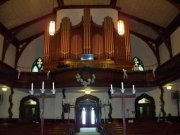
One of the biggest kicks I get being the pastor of such a church is showing people the church sanctuary. I don’t think it’s failed to happen yet, you hear them silently, reverently suck in a little air and say a quiet wow! You want a place that evinces true Christian spirituality? Look at the featured picture, and that really doesn’t do it justice. If you don’t know where you are, well you have problems that I can’t help you with.

I did find the point of bringing nature into a church an interesting one. . I’d like to see if we could do more of that. I will say Christmas the altar is covered with poinsettias and Easter with lillies. But it is an inner-city church and a place in the church that would be a place where we could have some plants and some kind of natural effects would have a huge benefit, so thanks for the suggestion. Let’s see some of these people who talk a good game show up and put it in motion, I’ll be right there with you.

Respite” “Millenials, perhaps more than any other generation, have a deep need for peace and quiet; they long for a sanctuary. ‘Our culture is fragmented and frenetic and there are few places to take a breather to gain much-needed perspective,’ says Kinnaman. ‘Ironically, most churches offer what they think people want: more to do, more to see. Yet that’s exactly the opposite of what many young adults crave: sacred space.,’ ”

“Our churches are places of action, not places of rest; spaces to do rather than spaces to be. The activities, of course, are designed to connect people with God and each other – and some Millennials hope for that, too – but many just want an opportunity to explore spiritual life on their own terms, free to decide when to sit quietly on the edges of a sacred space and when to enter in.”

My answer, you need sacred space at two in the morning, you call me up and I will come down and open up the church. But you better be serious, don’t be there whining, be there genuinely searching. I would love it! We have action, we are an inner-city church and we often have to deal with real issues, but our priority is always spiritual health. Dr Luther describes pastors as Seel Sorgers, ‘soul healers’ that’s what I am first and foremost, but I try to do the other things.

When we first got to First St Johns, we set up a “Prayer Room”, I also had a few, very few, people want to go into the sanctuary to pray. We have prayer groups right after worship, we have a prayer breakfast once per month, we have a “Healing Service” one per month, Matins worship Thursday mornings and Sunday morning. I’d happily do some of these much more often, but frankly, not exactly overwhelmed with response as it is now.

“Give them Jesus – building relationships and learning about Jesus are two central reasons why Millennials stay connected to church. Barna’s research shows that young adults who remain involved in a local church beyond their teen years are twice as likely as those who don’t to have a close personal friendship with an older adult in their faith community (59% vs 31%).”

For a small church, we do this pretty well, we could do better, but there has to be buy-in from everyone and again I would jump through hoops to facilitate it.

So to Marian and David, Taylor and Heather, here you go. This is it right here. Genuine worship, genuine doctrine, genuine space, genuine relationships and authenticity. Let’s sit and talk, let’s really deal with our relationship with Jesus and genuinely worship and honor Him. Does He need our worship? No, but we need to worship and we need to do it with authenticity, not sit back and fill me/entertain me. Don’t expect me to just pat you on the head, sure when it’s needed, but today, we need to get real and get back to the real church and not the happy/clappy God just wants me to be happy. No, it’s joy in Christ, won’t always be pleasant, but it is true relationship. Do you want that or not?

A Decree Went Out From the Father, His Son our Lord Jesus Luke 2 First St Johns December 24, 2014

A BABY CHANGES EVERYTHING

We make our beginning in the Name of God the Father and in the Name of God the Son and in the Name of God the Holy Spirit and all those who “have seen a great light”, our Savior Jesus, said … AMEN

Almost 700 years before He was born, some of the greatest words of Jesus were said by the prophet Isaiah: “The people who walked in darkness have seen a great light;…” Who are the people who have walked in darkness? … Yes, we are. Sure the sun in the sky may be out and shining, but so often we feel that we are in darkness. We all know what darkness is like, especially this time of year. When I worked in Boston, I would have to take the train and it would come pretty much around dawn this time of year, I would get into the city and the trip would mostly be in the dark and when I left at or later than 5pm, it would always be dark and get darker on my way home. The cold of walking to the train station through city streets, often walking through snow and wind, that would just take your breath away and cut you down. My only hope was to make it to the dim light and less cold of the train station to get on a train, that would at least, get me out of the weather and give me enough light to read a newspaper.

Even in the brightest summer day we really walk in darkness, especially if we don’t know Jesus as Lord. We all live in the same world, the world is dark and evil. I really hate winter weather, even when the weather is relatively mild, I never refer to it as “warm” just “less cold”. In the same way, yes we have light, but it’s really only “less dark”, the real light is in Jesus and that’s what He brought into the world in the dark night in Bethlehem. No one who was there would say that it was any “lighter”, whether it was at the beginning of winter or early spring, there really is never any light in a dark and evil world. A baby changes everything, in this case the Baby Jesus. The dark and the evil of the world is why Jesus came into it, He brings His eternal and more than sufficient light into the world, He brought it with Him to Bethlehem. But for all those people out there, right at this very moment, maybe even scurrying around for that one last Christmas item, present, decoration, card, food for the feast, they scurry in the dark.

No matter how hard they try to “understand” God, unless they are guided by the Holy Spirit, they cannot understand; God’s wisdom, His Will, His light, His Word and frankly they just don’t want to. It has to be about God and His way or it’s not at all. Only those who are in Jesus will understand God’s will for the world. For each one who has been baptized, hears the preached Word and takes the Body and Blood of our Lord. I hesitate to say “understand”, because I doubt that any of us would say we “understand” God even as His born again children, even though we do accept what He does and understand when He does it. Only to His children in Jesus, will God’s will, word, His Light, and Warmth be accepted. John 1:9 describes it as the “true light, which enlightens everyone”. But John 3:9 acknowledges that people really don’t love the light; “…the light has come into the world, and people loved the darkness rather than the light because their deeds were evil.”

Faith Hill’s song “A Baby changes everything”, she’s talking about Mary and how her life goes from being, probably, a teenage girl, getting ready to be married, a huge step for anyone, how anyone of us has a boatload of expectations for marriage and then Mary is told that she will be the mother of Messiah. Her life has now been changed extraordinarily, she knows that this is of God and that she has been honored above all women, but her life is taking a course that she could never have expected. This baby has certainly changed everything for her, a life beyond her expectations, she has only an inkling of how this Baby has changed everything for man. Before this Baby our sin separated us from a completely just, completely holy God we were in a state of hostility with God. Now this Baby has changed everything and we are at peace with God. Before we were brought to eternal death, now we are saved eternally because we are at peace with God, we are His children. When we are “born again” through our baptism in Jesus and our nature is changed from the world and flesh to a nature that is in Jesus, a divine nature. We are still sinful beings, but in Christ, in that “Baby” who has changed everything, we are saved as eternal beings, we will be resurrected in the flesh. But no longer will that flesh be corrupted, it will be perfect in a perfect, physical world, that we were always intended by God to live in.

Ceasar Augustus issued a decree and all the people of the Roman Empire picked up and moved in order to be counted by the Roman government. That was for a time, and those people who were counted soon died. God the Father, the Son Jesus Christ and the Holy Spirit, the Godhead, issued a decree, that there would be a great light that would come into a world of darkness. That decree was originally issued through Isaiah who promised that great light would shine on all men and it would result in great rejoicing.

A Baby changes everything, Caesar Augustus issued a decree for a time. God the Father, through His Son, born a Baby issued a decree for eternity and His Son was the messenger. St Augustine writes: “Christ was called the Angel [Greek for messenger] of Great Counsel because he brought the message of the kingdom of heaven and the will of the Father.”1 That because of His incarnation, His birth as a baby that everything would be changed between us and the Father, we would have peace with the Father and be saved because that Baby would grow to be a man who would be the sacrifice, the payment for our sins.

I like to use a story that Paul Harvey would tell on Christmas to illustrate how the Father came down to us so that we would understand who He is and His will for us:

The man to whom I’m going to introduce you was not a scrooge, he was a kind decent, mostly good man. Generous to his family, upright in his dealings with other men. But he just didn’t believe all that incarnation stuff which the churches proclaim at Christmas Time. It just didn’t make sense, and he was too honest to pretend otherwise. He just couldn’t swallow the Jesus Story, about God coming to Earth as a man.

I’m truly sorry to distress you,” he told his wife, “but I’m not going with you to church this Christmas Eve.” He said he’d feel like a hypocrite. That he’d just stay at home, but that he would wait up for them. And so he stayed and they went to the midnight service.

Shortly after the family drove away in the car, snow began to fall. He went to the window to watch the flurries getting heavier and heavier and then went back to his fireside chair and began to read his newspaper. Minutes later he was startled by a thudding sound…Then another, and then another. At first he thought someone must be throwing snowballs against his living room window. But when he went to the front door to investigate he found a flock of birds huddled miserably in the snow. They’d been caught in the storm and, in a desperate search for shelter, had tried to fly through his large landscape window. Well, he couldn’t let the poor creatures lie there and freeze, so he remembered the barn where his children stabled their pony. That would provide a warm shelter, if he could direct the birds to it.

He put on a coat, galoshes, tramped through the deepening snow to the barn. He opened the doors wide and turned on a light, but the birds did not come in. He figured food would entice them in. So he hurried back to the house, fetched bread crumbs, sprinkled them on the snow, making a trail to the yellow-lighted wide open doorway of the stable. But to his dismay, the birds ignored the bread crumbs, and continued to flap around helplessly in the snow. He tried catching them…He tried shooing them into the barn by walking around them waving his arms…Instead, they scattered in every direction, except into the warm, lighted barn.

And then, he realized that they were afraid of him. To them, he reasoned, I am a strange and terrifying creature. If only I could think of some way to let them know that they can trust me…That I am not trying to hurt them, but to help them. But how? Because any move he made tended to frighten them, confuse them. They just would not follow. They would not be led or shooed because they feared him.

If only I could be a bird,” he thought to himself, “and mingle with them and speak their language. Then I could tell them not to be afraid. Then I could show them the way to safety, warm…to the safe warm barn. But I would have to be one of them so they could see, and hear and understand.” At that moment the church bells began to ring. The sound reached his ears above the sounds of the wind. And he stood there listening to the bells – Adeste Fidelis – listening to the bells pealing the glad tidings of Christmas. And he sank to his knees in the snow.”2

Foil Satan and hell, sin and death—foil them with the joy only Christ Jesus gives. Let Him comfort and defend you. Let Him feed and strengthen you. For He who once was born of Mary, wrapped in swaddling clothes, and placed in a manger, is here for you in His Holy Word and soon will be wrapped in bread and wine and placed on a plate and in a cup for Your salvation!

Yes, we’re surrounded by troubles and heartbreaks, and Satan, sin and selfishness relentlessly attack, but don’t just sit there—sing for joy! Your Savior is born! There is peace on earth for you, come for all, to set us free.”3 A Baby does change everything.

The peace of God which passes all understanding keep your hearts and minds in Christ Jesus. Shalom and Amin.

1Augustine quoted by Steven McKinion Ancient Christian Commentary Old Testament X p 69

2[1]Keiki Hendrix, Everyday Christian, Christmas Classics: The Man And The Birds By Paul Harvey (December23,2012, http://www.everydaychristian.com/blogs/post/christmas_classics_the_man_and_the_birds_by_paul_harvey).

3God’s Love at Christmas CPH sermon

Good News to the Poor, All of us Isaiah 61: 1-11 First St Johns Dec 14, 2014

Please check out the audio version of this sermon, click on he above link or copy and paste into your browser.

We make our beginning in the Name of God the Father and in the Name of God the Son and in the Name of God the Holy Spirit and if you are anointed and if the Holy Spirit is on you, say … AMEN!

The reading in Isaiah is the theme of the sermon today, but I have to start with our epistle reading. Paul tells us to exhort, so I am going to exhort you: “Rejoice always!” We know what time of year it is, we are reminded that while Advent is a time of penance, of clearing the clutter of sin that has gathered in our heart we are prepared for the coming of the Christ child and just as significantly, His second coming at the end of time. So yes, rejoice, but still remember to pray without ceasing. Part of prayer should be repentance. Pray for forgiveness, but a special emphasis on praying for help to prepare for His return. For myself, Lord remind me of whose I am in You, that I am saved in You. Yes I need forgiveness, that I am sinful, that I need a Savior.

700 years before the fact, before it actually happens God is giving Isaiah the words that Jesus says in Luke 4: 18-19. These are the words that Jesus says at the beginning of His earthly ministry. He had just gone through the temptation by Satan, certainly Satan knew Jesus is God the Son and now Jesus has gone back to his hometown, Nazareth. He proclaimed the words of Isaiah to identify Himself as the one anointed by God. Jesus was born in Bethlehem, but His ministry started when He returned to Nazareth and in front of the synagogue on the Sabbath day He proclaimed, “The Spirit of the Lord is upon me, because He has anointed me to proclaim the good news to the poor.”

What, just the poor? Yea! Who are the poor? In terms of our relationship with God, we are all poor. Remember “Christmas Clubs”? I don’t think banks have them anymore, but all year long, you would go to the bank (yea, definitely before electronic banking), you would take part of your regular income and deposit it in your Christmas Club account? Back then it would actually earn some meaningful income and then just before Christmas, not Black Friday, that wasn’t around either. You would take everything you’ve saved, go and buy your presents and decorations and holiday food. When you emptied that account you might have felt like you had some money, but after a few days of Christmas shopping you felt even lighter in the pocket book then you had before. You may have been poor again, but celebrating the birth of Jesus makes us rich.

Yea, this time of year, like it or not, we are all kind of poor so that we can have that great holiday celebration. But that’s not what Jesus is really talking about.  He’s talking about the “Poor in Spirit”. Where does that phrase come from? … The Beatitudes, “The Sermon on the Mount”. What does He say about the “Poor in Spirit”? “Blessed are the poor in spirit, for theirs is the kingdom of heaven.” We want to be “Poor in Spirit” don’t we? As Christians, by definition we should be poor in spirit in order to have the Kingdom of Heaven. That Kingdom came when Jesus came into the world. We who are the poor in spirit have inherited that kingdom. We are living that kingdom today. While that kingdom has arrived in Jesus and we should live our lives as subjects of the kingdom, as loyal subjects of King Jesus, the kingdom that is to come, as we pray for it, has not yet been realized. You may not think you’re “poor” in anything, but you would be wrong, unless of course you don’t know Christ as your Savior.

It is Jesus who has been xv;m’ That is anointed, kings and priests would be “anointed”, this would be a special blessing to them to bear their duties, to faithfully serve, to be the ones who would do what Yahweh has designated them to do. We call Jesus, Messiah, that is the One who is anointed, who has been blessed and designated by God to bring us the Good News, to bind up, proclaim liberty, release those who are bound. All the things that sin imposes on us and Jesus is anointed to save us from.

While Yahweh is giving the words to Isaiah of the great promise of the Savior, He’s also reaffirming a previous promise. He’s reaffirming a promise made about 800 years earlier, to Abraham, not just that Abraham will have, what we know to be hundreds of millions of descendants, but that they will be blessed in Jesus who has been anointed, who has the Spirit of the Lord. We who are blessed to be eternally saved in Jesus, in the resurrection. In one of the verses not quoted, Yahweh promises “…you shall be called the priests of the Lord; they shall speak of you as the ministers of God;…” Peter re-emphasizes that when he writes 700 years later: “But you are a chosen race, a royal priesthood, a holy nation, a people for his own possession, that you may proclaim the excellencies of him who called you out of darkness into his marvelous light.” You may be poor in spirit, but Yahweh says that we are priests, minister of our God and speaks through Peter to re-affirm that promise 700 years later.

We end with God’s promises that will be confirmed and carried out by Jesus during His human lifetime and will be the gifts of all who are in Jesus, you and I, until He returns that second and last time. Isaiah writes: “I will greatly rejoice in the LORD; … He has clothed me with the garments of salvation…the robe of righteousness, the bridegroom will have a beautiful headdress and the bride will be adorned in jewels.” It may be difficult to picture or appreciate, but there is no doubt in my mind that we will understand how magnificent it will be when we see it accomplished in all of us who are in Jesus. We have a tiny little speck of it when we celebrate Christmas, the lights and decorations, for the Lord’s first coming. We can’t even begin to imagine how magnificent it will be, what we will see in the second coming of Jesus.

Paul’s words, two simple phrases, write them down in your journal, really think over them: “Rejoice always” “Pray without ceasing”. Rejoice because we have the promises. Pray to stay strong in God’s promises. Rejoice always means, always. It’s often tough to do, but always means always; not just when you’re in the mood. Not just when Christmas is coming, or maybe when it’s over. Rejoice even when someone bashes in your door, when you’re in the hospital, yes even when the time of year reminds you who won’t be at the Christmas feast this year. Rejoice not because they’re gone, but because we have the eternal promises to be with those we love and to enjoy the magnificence of eternity in God, Father, Son and Holy Spirit. So how do you rejoice this Advent, what are your prayers?

The peace of God which passes all understanding keep your hearts and minds in Christ Jesus. Shalom and Amin.

Science and Christian apologetics

It is important. I realize that too much focus on the “apologetics”, the issues that are based more in terms of history, science, social sciences, archaeology should never overshadow faith. They should never be the reason that we are Christians, that we know Christ as our Lord and Savior. Because I am giving this issue a lot of attention is not my way of saying Christianity is real, look at the documented facts. People may find the arguments compelling, they may even be convinced, but you are going to be saved by what the Holy Spirit is doing in your soul. Hey, who knows He may be using these arguments, but the cut to the chase is that coming to know Christ as your Lord will be because of Him, not because of what you do.

Now that I’m over the Gospel disclaimer, I move along to a book that I’ve been reading by Philip Yancey. I’ve written about those writers who, if they published their grocery list, I would read it. Yancey is one of those writers and much thanks to my brother in the Lord Rev Dr Mike Ramey for this gift.

The book, “Vanishing Grace”, seems to be sort of in the series of books, “What’s So Amazing About Grace”, for example, by Yancey. He discusses the fact that Christians and the church don’t seem to really practice grace and that there certainly isn’t any grace in contemporary society.

As part of the discussion he includes a section on the relation of science and Christianity. Most would say say that they are mutually exclusive, but when God is the One who has created all that science studies, clearly they aren’t. Yancey quotes Sir William Bragg, “…a pioneer in the field of X-ray crystallography, who was asked whether science and theology are opposed to one another: ‘They are: in the sense that the thumb and fingers on my hand are opposed to one another. It is an opposition by means of which anything can be grasped.’ For much of history the great scientists – Copernicus, Kepler, Galileo, Newton, Leibniz – believed their discoveries in ‘the ‘the book of nature’ comprised a form of revelation, teaching us clues about a creator God.” (p 177)

“I suggested to the panel that although science had contributed much to modern life, there are at least three important questions for which it has no answers since they lie beyond its bound. (1) Why is there something rather than nothing? (2) Why is that something so beautiful and orderly? (3) How ought we to conduct ourselves in such a world?…” (p 177)

Theology used to be considered the “Queen of the sciences”, that it was where all the sciences end up. There are those whose “faith” is in science, the evolutionists believes in Darwin’s writings even though it is not even a good hypothesis, no less ‘theory’. Their faith, compared to the reality of Jesus and His incarnational ministry, is most definitely “blind faith”. The historocity of Jesus is really beyond dispute, He is the most studied individual in history and despite fallacious attempts to discredit the original texts and writings down through the centuries the certainty of His life is more than any figure in antiquity.

Another discussion that’s been impressed on me is the impossibility of life here on earth. “Scientism” (my own creation for the ‘religion of science’) ‘science’ insists that there has to be life elsewhere. Hey maybe there is, God’s going to do His will regardless of the ‘impossibility’ involved, we’re here aren’t we? But to say that life can be blindly reproduced in other parts of the universe, despite the impossible odds of life on earth, is just not dealing with reality. “…In their heyday the Soviets swept the sky with huge antennas listening for messages. Some scientists estimated the universe the universe would reveal a hundred thousand, perhaps a million advanced civilizations. Enthusiasm cooled as, one by one the projects failed to turn up any evidence of intelligent life.” (p 178)

I would quickly note that the “SETI” program in the United States has been mostly discontinued except for sparse private funding.

Yancey elaborates on the discussion about the impossibility of blind creation of the universe. “Scientists themselves who calculate the odds of the universe coming into existence by accident suggest such boggling figures as one in 10 to the 60th power. [That’s one chance in 10 with 60 zeros]. Physicist Paul Davies explains, ‘To give some meaning to those numbers, suppose you wanted to fire a bullet at a one-inch target on the other side of the observable universe, twenty billion light years away. Your aim would have to be accurate to that same part in 10 to the 60th power.’ Stephen Hawking admits that if the rate of expansion one second after the big bang had varied by even one part in a hundred thousand million million, the universe would have recollapsed. That’s only the beginning: if the nuclear force in certain atoms varied by only a few percentage points then the sun and other stars would not exist. Life on earth depends on similarly delicate fine-tuning: a tiny change in gravity, a slight tilting of earth’s axis, or a small thickening in its crust would make conditions for life impossible.” (p 178)

Yancey goes on to describe the responses of the high-priests of evolution (my snide remark) and undirected creation which are to the effect, ‘hey don’t try to confuse me with the facts: “Confronted with the staggering odds against random existence, Richard Dawkins simply shrugs and says, ‘Well, we’re here, aren’t we?’ He, along with many others, sees no need to assume a Designer behind such apparent evidence of cosmic design (although in a conversation with Francis Collins, Dawkins admitted that the fine-tuning of the universe is the most troubling argument for nonbelievers to counter). Scientists in the U.S. are equally divided, with 51 percent believing in some form of deity.” (p 179)

“…it occurred to me, that if the odds were reversed we likely would not have had a discussion. If someone calculated the odds of God’s existence at one in 10 to the 60th power, I seriously doubt any scientists would waste their time discussing faith issues with people who believed in such an improbable God. Yet they happily accept those odds of a universe randomly coming into existence on its own.” (p 179)

Yancey goes on to write about the narrow mindedness, the denial of facts that’s often attributed to religious fundamentalists that scientists demonstrate. They are not just in denial, but they are pejorative in their attitudes towards people of faith. There is certainly antagonism by Christians towards the secular, but the antagonism of those of the faith of “scientism” is much more narrow minded and dismissive. “When I talked with the Nobel laureates later, I asked about their own belief or disbelief in God. All three spoke of a strict Jewish upbringing against which they later reacted. Martin Perl, discoverer of the Tau lepton particle, said candidly, ‘Ten percent of Americans claim to have been abducted by aliens, half are creationists, and half read horoscopes each day. Why should it surprise us if a majority believe in God? I oppose all such superstition, and in my experience religion is mostly harmful. I limit my beliefs to observation, not revelation.'” Wow, that’s pretty narrow and bigoted. I know Yancey would not appreciate my lack of graciousness, but come on, really I’m just pointing out the obvious.

This obvious narrow-minded bigotry is not, mercifully, universal among scientists. But you have to wonder, people who claim to be driven by “observation”, can sure pick and choose and live in such denial. “…Albert Einstein, was more receptive to faith: ‘The scientist must see all the fine and wise connections of the universe and appreciate that they are not of man’s invention. He must feel toward that which science has not yet realized like a child trying to understand the works and wisdom of a grown-up. As a consequence, every really deep scientist must necessarily have religious feeling.”‘

“Einstein marveled that our minds are able to assemble patterns of meaning. As he told a friend, ‘A priori, one should expect a chaotic world which cannot be grasped by the mind in any way.’ The fact that this isn’t the case, that the cosmos is comprehensible and follows laws gives evidence of a ‘God who reveals himself in the harmony of all that exists.’ Yet Einstein could not bring himself to believe in a personal God such as the Bible portrays…” (p 180)

“Other scientists share Einsteins’ childlike wonder. Alexander Tsiaras, a professor at the Yale Department of Medicine, entranced a sophisticated crown at a TED conference with a video of the fetal stages from conception to birth. he had written the soft ware to utilize an MRI technique that had earned its inventor a Nobel Prize. The video compresses nine months of growth and development into a nine-minute film…”

“The human body largely consists of collagen – hair, skin, nails, bones, tendon, gut, cartilage, blood vessels – Tsiaris explains in his introduction. A rope-like protein, collagen changes its structure in only one place, the cornea of the eye, where it spontaneously forms a transparent grid pattern. As the video of speeded-up fetal development plays, this mathematician drops his objectivity, awed by a system ‘so perfectly organized it’s hard not to attribute divinity to it… the magic of the mechanism inside each genetic structure saying exactly where that nerve cell should go.'”

“…the programmer Tsiaras remarks, ‘The complexity of the mathematical models of how these things are done is beyond human comprehension. Even though I am a mathematician, I look at this with marvel: How do these instruction sets not make mistakes as they build what is us? It’s a mystery, it’s magic, it’s divinity.'” (p 181)

Carl Sagan was, of course, the  high priest of “scientism” and was usually very antagonistic to Christianity. Despite his profound knowledge of the facts, he seemed to be much more motivated by self-promotion and enhancing the faith system he promoted. But Yancey writes:”…In an exchange of letters with Robert Seiple, then president of World Vision USA, Carl Sagan clarified that even he remained open to belief in God. He viewed with wonder the beauty and simplicity in the laws governing the cosmos. Summing up, he wrote, ‘As a scientist, I hold that belief should follow evidence and to my mind the evidence of the universe being created is far from compelling. I neither believe nor disbelieve. My mind is, I think, open, awaiting better data.'” (p 182)

I really hate it when someone plays me, and Sagan was playing. “Creationism” isn’t “proved” so I’m going to be a proponent of something that is statistically impossible, unless and until such time as there is proof of God. Huh? This is a person that is in denial. People like this love to talk about their objectivity, but they have none. Sorry, but these are narrow minded fanatics that insist that you agree with them in every detail or you’re the one with a problem. I’ve been watching a television show on people and their families who are out on the street abusing drugs. Frankly the attitude seems to be the same in “scientism”, don’t judge me, don’t try to confuse me with the facts, just enable me and leave me alone in my addiction, my denial, my own little abusive world. There are many scientists that are objective and have no problem trying to reconcile the reality of the created universe and the One who created it and His Son Jesus Christ who came to reveal the will of the One through whom all was created. I have always had an interest in various aspects of science long before I was a Christian. The astronauts of the 60s and 70s were my heros, I loved reading books dealing with astronomy and space travel. One of the earliest books I remembered reading was on Clyde Tombaugh, you know who he is? I have always been fascinated by astronomy, but seriously don’t get in my face trying to convince me that this massive, elaborate, amazing universe all spun into existence by accident. It didn’t and anyone who can understand probability understands that.

Holy Communion continued I

My Christian background is a little odd, although more and more it’s becoming common among younger generations and is not out of the question with in my “baby boomer” generation. I was dedicated as an American Baptist (“Baptists” don’t baptize infants. Parents “dedicate” their children, promising that they will raise their child as a Christian in the Baptist Church.) I was married by a “Congregational” minister (it’s now called United Church of Christ). I was baptized by a United Methodist Minister and ordained by a Lutheran minister. I cannot say I was “raised’ as a Christian, no less in any particular tradition. I’m not saying that based on my checkered past that I’m an expert on various traditions of the Lord’s Supper, but my experience might give me a little bit of a unique perspective.

To be clear, yea, I have a firm conviction about the Lord’s Supper, I’m very serious about the Lord’s Supper. Lutherans would agree with Roman Catholics that the Bread and Wine in the Lord’s Supper is the true Body and Blood of Jesus. There’s disagreement as how that’s arrived at and dealt with, but just to give you a place to start to understand what the church’s position is. Having been a Methodist, I’ve seen the Lord’s Supper treated more like a cookie and coco break during worship, I’ve seen it treated pretty cavalierly in other traditions too, it’s offensive, it’s really offensive, it’s the Holy Body of our Lord and Savior.

I know I’m kind of stacking the discussion, but Jesus told us: “Take, eat; this is my body.”, Not this is a symbol, this is something I’m doing to be chummy, this is some weird mystical thing. No this is My Body, this is My Blood. This is what has been sacrificed for you, this is what has been given to be a part of you, this is what was given in order to assure you I paid the price for you sin and you are now forgiven, there should be no doubt in your mind about this.

OK? Don’t think there’s a lot of room to maneuver. When we treat the Body and Blood less than that, then it’s hard to take seriously those who treat His Body so lightly. For those of you who are so easily offended, this is real offense, mistreating the true Body and Blood of your Savior, the One who died to pay for your sins.

Rev Dr Peter Kurowski has written a really great book “Close Communion Conversations”, discussing issues associated with the Lord’s Supper. Since different denominations have different perspectives on the Lord’s Supper, most denominations try to specifiy with whom it is appropriate to allow to share communion with outside the denomination. For most of Protestant Christianity all you have to do is profess some acceptance of Christ and be able to fog up a mirror. Lutheran Church Missouri Synod takes our most solemn sacrament very seriously and, I feel at least, that it should be treated seriously by everyone, regardless of church or lack of church.

Therefore I refer to Dr Kurowski’s book to discuss the concepts of “Open Communion”, “Closed Communion” which are the two contrasts, and “Close Communion” which Dr Kurowski labels the middle ground.

Open Communion in the extreme is the notion that the Lord’s Supper is administered to all people who come to the altar without any due diligence on the part of the administering pastor. This is not how Jesus wants His supper distributed. (1 Corinthians 4:1; Matthew 28: 18-20) Such a position is reckless and loveless. It creates Corinthian confusion. Church bodies that run this direction invariably will lose a true gospel centeredness lapsing into lawlessness. The person of Christ is diminished and “It is finished!” is rarely heard by the famished (John 19:30).”

Closed Communion” in the extreme is the notion that the Lord’s Supper is administered only to people who are communicant members of a denomination that has publicly declared altar fellowship. Though well meaning, this brittle approach is a reproach to many a saint who comes to the Lord’s Table hungering for righteousness but is met with a stone wall rather than a cup of compassion. The damage done when one’s position is too narrow is chilling, devastating and at times causes irreparable harm turning the Church – a hospital for sinners – into a kind of “Club Christ”, or a “Christ who clubs!”

Close Communion Conversations” seeks to pursue the good golden gospel middle of genuine evangelical theology on altar fellowship issues…The guideline in service of the gospel runs this way: Although we have as a general rule closed communion we have exceptions to the rule. Both the general rule and the exceptions to the rule are for the sake of the gospel. At the same time the exceptions ought not t become the rule.”

“Because of this evangelical guideline, I prefer the term close communion. It captures the theological tensions in which evangelical Christianity must live. It brings with it a paradoxical Lutheran edge.” (pp 9-10)

This sets the discussion and I want to emphasize that when in doubt, my preference is to have “closed’ communion. I’ve written about this before, but it is not to set some sort of “more worthy Christian”, but to assure that the recipient truly understands and accepts a correct understanding of what the Lord’s Supper truly is. I often tell those who are new to the Lutheran Church that we don’t want them to feel excluded, we want them to understand how seriously we take the Lord’s Supper, that it is for their spiritual health. As a member eligible to receive the Lord’s Supper a person stands before the church that, as a part of membership, they vow to accept the true understanding of what the Lord’s Supper truly is. I want to give people the Lord’s Supper, believe me it is one of the great parts of being a pastor. But I want to do it to the recipients spiritual health and nourishment and knowing that we both understand what we are doing.

Please feel free to discuss and I plan to have more discussion.

Serving those who’ve served

I have decided to label the following a continuing campaign to highlight what good many Christians do in contrast to the stereotype some non-Christians like to apply that Christians are somehow cheap or provincial. The fact of the matter in reality is quite contrary and if anything much is done that no one ever knows about. If you don’t read Forbes Magazine, which you should, you would not have seen an article on B. Wayne Hughes. Hughes is a billionaire from building a chain of self storage facilities named “Public Storage”. (Katia Savchuk Forbes Magazine, Dec 2014 p 36)

He cashed out of the business world to be a cattle rancher, but decided to take it a step further. He used his “sprawling ranch in central California” to run “‘Fight Club’ a faith-based program Hughes runs for veterans with PTSD,…”

During the day, for a week “…he and a handful of veterans went zip-lining, rode horses and raced ATVs.” They would have different classes on such things as character  He has hosted over 500 active duty and veterans since 2012 and expects to increase that number next year. This was prompted

Yea, I know, he can afford it and he has the time, probably. But he did it, after hearing a report that an “…an average of 22 veterans were committing suicide every day.” Unlike most everyone else who talks a good game but rarely does anything, he put up. God bless him.

Remembering our sin in preparation for the Child First St Johns November 30, 2014 Isaiah 64: 1-9

For the audio version of this sermon, click on the above link, or copy and paste it into your web browser. Thank you and God bless.

We make our beginning in the Name of God the Father and in the Name of God the Son and in the Name of God the Holy Spirit and all those who prepare for the coming of the Son in the new liturgical year said … AMEN!

Happy New Year, sounds a little weird, aren’t we supposed to have Christmas first and then have New Year? Today is the first Sunday of the church New Year, the time of Advent, the time where we wait in anticipation, our whole life is a time of waiting in anticipation of the coming of Jesus in the clouds of His power and glory. But for now we wait on the feast, the celebration of the coming of the Christ child. The Advent of His Kingdom in the world. We joined together in the Apostle’s Creed to remember that He will come again, to judge both the living and the dead. Those who have died in Christ will be raised to the resurrection the eternal Kingdom, the New Jerusalem.

Isaiah says “Be not so terribly angry, O LORD, and remember not iniquity forever. Behold please look, we are all your people.” (Is 64:8-9) Ya, Isaiah is addressing the Old Testament God. Remember Isaiah 6? Isaiah is raised into the presence of God: “Woe is me, I am a man of unclean lips… for my eyes have seen the King, the Lord of Hosts!’ (Is 6:5)? From the beginning of Isaiah to the end, our reading today, Isaiah is readily acknowledging the fact that we are sinful and unclean, we are simply not suitable to be in the presence of a pure, holy, God. Clearly God has revealed to Isaiah that we are sinful and there needs to be a solution to our condition. Yahweh makes it very clear to Isaiah that the sacrifices of Israel; rams, bulls, lambs, just doesn’t cut it. Read all through Isaiah 1: 10-15. But then what does God do? He promises that they will be made as white as snow… our sins will be like wool, nice and white, cleaned, made pure. He makes it very clear all through Isaiah’s book that we are sinful, and Isaiah is completely aware of his own condition. Imagine being brought straight into the presence of our completely holy God, just being overwhelmed by His holy presence, His Holy being and our being, the complete opposite, totally depraved and sinful. It must be an overpowering experience. Many people demand that God come into their presence, we couldn’t begin to cope with that, we would be consumed by our sinfulness in contrast to His holiness, we would be completely blown away and that’s why God won’t do it.

Until we completely internalize Paul’s words in our epistle reading: “I give thanks to my God always for you because of the grace of God that was given you in Christ Jesus… who will sustain you to the end, guiltless in the day of our Lord Jesus Christ.” ( 1 Cor 1: 4, 8) Only in Christ are we guiltless, that we can then be in the presence of the Father, totally righteous and holy, but only through our baptism-new life, we are made holy, we don’t have to be reduced to the fear and disgust that Isaiah felt. In Christ, in the Father’s presence we are lifted up to joy, we can rejoice. I have no doubt that it will be an overwhelming feeling of love and freedom in Christ, in the Father’s presence.

Isaiah is making a plea for restoration. He has been made completely aware of how unworthy he is, how unworthy we all are. Isaiah is no better or worse then we are, none of us is any better or any worse. Isaiah is making this plea that we can be restored. In what way are we restored? We can now be in the Father’s presence, we are no longer separated from Him, alienated from Him. We are alienated from Him because we are aliens in relation to Him. No we aren’t green or odd-shaped, we don’t have antenna’s in our head, but our nature, as Isaiah has been made profoundly aware of, is totally opposite to His. He is completely holy, completely perfect, we are imperfect and deeply sinful. Walter Roehrs in the Concordia Self-Study Commentary writes: “Isaiah devotes the remainder of his book to correct two misconceptions his hearers and readers are prone to harbor about the way God wants to lead them to glory.” I might add that this is the way we think today, probably more so, then what the people in Isaiah’s time thought. “It is a fatal mistake on the one hand, to … walk with God with one foot, and with the other to stalk through the sewer of sin.”1 That’s the way we think today, “I’m good enough, I haven’t killed anyone, there are others much worse than me.” So we continue to live our lives in this mind-set that I can give God what ever I decide and He has to take what I give Him and deal with it. God is not a half-way kind of guy, it’s His way or no way. How the world comes to another conclusion totally baffles me. Why should a perfect, holy God be happy with some scraps that we throw Him, bring us into His presence and just allow whatever phony, mooshy, sentimental whim we chose over His perfect being? Why would He let our lusts and greed overcome His Holiness. Through our sin, we’ve messed up what God created, away from Him, cutoff from Him. He drove Satan out of heaven when Satan presumed to be better than God, why would He let us in to do the same thing Satan did? He’s not and if you think otherwise, you’re only kidding yourself. Dr Roehrs writes: “Isaiah had to set Israel straight [and by extension us who are now Israel] on both counts. He [Isaiah] foretold certain disaster for a sinful nation, a people laden with iniquity’ and so depraved as to lift ‘hands … full of blood’ to the Lord in a pose of prayer.” (Is 1: 4, 15)2 That’s us, and that’s not going to work in the presence of God the Father, but in Christ we become cleansed and pure and suitable enough to be saved to eternity in God’s salvation in Jesus.

Isaiah is acutely aware of the human condition in relation to God: “We have all become like one who is unclean and all our righteous deeds are like a polluted garment. We all fade like a leaf and our iniquities, like the wind, take us away.”

So what now, what needs to happen. Can we do anything that is going to make us closer to God, to make us more desirable, more deserving of being in His presence? No… But earlier in his book, Isaiah knew that God was going to move, to do something. It was going to take about 700 years, for us that would be intolerable! We want the solution, we want it now and well, if you can’t make it happen on our time table, we’re just going to have to get ourselves a new “god”. But in God the Father’s time, it is perfect, complete, not a band-aid fix, an eternal, complete, perfect fix: “For to us a child is born, to us a son is given; and the government shall be upon his shoulder, and his name shall be called Wonderful Counselor, Mighty God, Everlasting Father, Prince of Peace.” (Is 9:6) I like what David Johnson says: “…Advent is not just anticipatory of a saccharin sweet nativity story, but bona fide bitter judgment against sin! Heaven and earth collide and are mingled in Jesus! God and man! Jesus is wrapped in human flesh; the world is wrapped in divine grace…”3 The seasonal color for Advent is usually blue, although purple is acceptable also. What other season is purple the seasonal color? Lent. The blue, and some say it’s bluish-purple, is a symbol of waiting, it represents Mary waiting with the rest of the church for her child. But the more traditional color is purple and like Lent means a time of repentance, in the sense of preparing for the coming of the Savior in repentance, being prepared for Him by repenting of our sins. That’s why we don’t normally sing Christmas carols, which are celebration, we are faithfully preparing and repenting so that in the Christ Child we are saved and we spend the Christmas season in joy and celebration. Spend the Advent season raising up your sins for forgiveness, clean out your heart, like you clean your house on Shrove Tuesday and you will be prepared to receive the child on Christmas Day as we receive the risen Christ on Easter.

The peace of God which passes all understanding keep your hearts and minds in Christ Jesus. Shalom and Amin.

1Roehrs, Franzman Concordia Self-Study Commentary p 490

2Ibid

3David A Johnson Concordia Journal Fall 2014 p 322

Sheep protected and led by the Great Shepherd First St Johns, York, Pa. Ezekiel 34: 11-16, 20-24 November 23, 2014

to listen to the audio of this sermon, please click on the above link or copy and paste into your browser

We make our beginning in the Name of God the Father and in the Name of God the Son and in the Name of God the Holy Spirit and all those who will be together in the glory and plenty of eternity in Christ shouted out … AMEN

Our readings today are about eschatology, these are eschatological studies, don’t try saying that at home, I’m a trained professional. I’m thinking in terms of the ultimate Thanksgiving. You think you need a big kitchen table at your house for Thanksgiving? Think about how big God’s table is going to be that He will need for His promised time of life in the Resurrection. “And I will bring them out from the peoples and gather them from the countries, and will bring them into their own land. And I will feed them on the mountains of Israel.” (Ezekiel 34:13)

If you’ve ever been to Quincy Market in Boston, there is a restaurant named Durgin Park. This restaurant goes back to the turn of the 20th century and if you’re in the right parts, well you can tell how old it is. They have great seafood, they have great prime rib, lots of other dishes, but here’s the deal, it’s served to you family style. You don’t have little tables all around, you have big long tables and you just grab your seat. There’s no maitre di, no pretense, you get a menu on the way, grab your seat, order your food and while you wait get to know the people all around you. It’s one reason you go there. It’s not for the service, the wait staff seems to make it their mission to see how uncomfortable they can get you, the food is great, like I said the atmosphere is early 20th century, but it’s great food, in an “interesting” facility. There are plenty of other people around you and you all know you’re there to meet people and you do, very little in terms of being bashful. Get a great dinner, stay for awhile, you have to because there’s so much to eat, and enjoy the impromptu goings on.

This is what it will be like at the dinner that God is promising Ezekiel. Being invited to the White House for dinner is a series of hoops and rolls, waiting, anticipating. How will the feast that God is talking about happen? “I myself will search for my sheep and will seek them out… I will rescue them from all places where they have been scattered on a day of clouds and thick darkness…” You won’t be expecting anything and then you will be in His presence and He is going to give you the ultimate offer you can’t refuse. Durgin Park’s food is good, but how much better, how much more, how much more fun will the feast, the banquet at the end of time be? The ultimate open menu; You want New England Lobster, here it is. Cheasapeake Bay crab cakes? The best you’ve ever tasted. Chicago prime rib? New York City pizza, … what, huh? Really pizza, at the marriage feast of the Lamb? OK, you got it.

He promises us that we will be with people scattered from all places. Places that for a day were cloudy and dark, that’s where we are right now. Life…, in terms of eternity? It’s a day, it’s over before you know it, life is not reality, the resurrection is reality, this is eternal reality. You may be in those dark, cloudy places where you know you don’t belong. Not because you’re good or too smart or even unworthy, you’re there because He took you up, the Father saw His Son in you. Jesus came to you and said “Come, you who are blessed by my Father, inherit the kingdom prepared for you from the foundation of the world.” (Matt 25: 34). You will be there for one reason and one reason only and it has nothing to do with anything you did, it’s all about how you were saved by Christ. You were saved in baptism, you became that new creation in baptism, you were faithfully led by the Holy Spirit to worship, to take the Body and Blood of Jesus. Those small bits of bread and wine, His Body and Blood, are only a reminder of the immensity of what you will inherit, of what the Father will bring you to “…the kingdom prepared for you from the foundation of the world.”

In our passages today God is showing you the ultimate Thanksgiving Day feast. You didn’t do a thing for it. Moms, you aren’t going to cook, you aren’t going to serve, you aren’t going to clean up, you will be there with Christians from around the world, rejoicing with each other that you are saved, that you are eternally going to enjoy all the great gifts of the resurrection, the new world, the world the way it was intended to be, life and life more abundant. Abundance you can never imagine in the here and now.

A friend of mine had relatives in Lithuania, his parents were from Lithuania. My friend took them to the grocery store and when they got inside and saw all the marvelous food just waiting to be taken off the shelf and put in the shopping cart they were so overwhelmed some of them actually started to cry. That will be us when we’ve been rescued from the clouds and darkness of the world and brought to the marriage-feast.

I know for many people this may not sound initially inviting, you will be sitting with people that you may have never met, Christian brothers and sister, and they will be from all the places that God scattered them in life. Many will probably have gone through difficult, even serious trials, some life or death trials because of their faith. But they won’t talk about the unpleasantness of those trials, they will talk about how thankful they are that even through difficult times God provided, God gave them the hope and promise of being provided for. They will be celebrating their deliverance, we all will be, we all will be celebrating how faithful God was to provide in life, even in those times of pain and loss. The pain and loss of earth will be a dim memory, even if it was only a few hours ago for some.

The idea of sitting with a bunch of what you might think of as strangers might seem a little uncomfortable to some of you, but if you’ve ever had to do a lot of traveling, which often involves being in an unfamiliar place, with unfamiliar people, meals are often a chore and often uncomfortable. That’s why Durgin Park is appealing to many who are traveling to Boston, they will be with a bunch of other people who want to be with a friendly group and I can assure you I’ve never had a bad dinner there. But in the resurrection we will be with people who are true brothers and sisters in a world that will dazzle even us who think that we’re hard to impress. We will be like the relatives from Lithuania, overwhelmed in delight at what God has provided for us and for those whose earthly life might have been in material poverty and need.

In his book “Heaven” Randy Alcorn writes: “We know that people in Heaven have lots of feelings – all good ones. We’re told of banquets, feasts and singing. People will laugh there (Luke 6:21) Feasting, singing and rejoicing involve feelings.”1

Alcorn quotes Seneca the Roman philosopher who said, “The day thou fearest as the last is the birthday of eternity.”2

I have no doubt that you will enjoy your Thanksgiving celebration with family and friends, it will be a time of pleasure and belonging. But it will be a snack compared to what you will be given when you are picked by the Lord and brought to that banquet, eternally in the presence of the crucified and Risen Savior, our Redeemer. It won’t be a feast of just food and companions, it will be a feast of life and life more abundant, a world that will be just waiting for you to enjoy it’s splendour, its activity and its vastness, a world where even in eternity you will not be able to experience everything it has to offer. God is an infinite God, He delights in the pleasure of His children. To be sure, the world is often not very delightful, if not downright troubling. But the world that God brings us to will be a continuous celebration of life, eternal life to His glory, forever and ever …

The peace of God which passes all understanding keep your hearts and minds in Christ Jesus. Shalom and Amin.

1Randy Alcorn Heaven p 284

2Ibid p xvii

Fear is so crippling, so limiting, such a waste to live.

FEAR!!! Fear of failure, of the future, of change, of growing older and either being injured, sick or disabled, or losing physical ability. Fear drives our desperate attempts to keep what we have and never trying to move and grow. If we attempt to move and grow we might risk what we have. Fear of trying church, of taking a chance to follow Jesus, not committing but at least trying, trusting a friend, family or pastor and just giving worship a chance.

Jesse Thomas in “Triathlete Magazine” (May 2014 pp 40-42) talks about the fear, as a professional triathlete of that day when he (or his wife Lauren, also a professional triathlete) will suffer a career ending injury or just realize that his abilities are not sufficient to remain an elite athlete. I participate (I hesitate to say compete, because while I wish I did, wouldn’t really be accurate) in triathlons. I certainly don’t make my living doing triathlons because I’d starve on a street corner. I’ve had all kinds of goofy “owwees”, left heel, plantar, both knees, serious cramps, right now sciatica, all eminently treatable, but when they happen the thought races through your brain, “oh no, this is it, I’ll never be able to …” Last season playing basketball in a church league, my left calf violently seized up. It was so severe that I was sure that I ruptured the achilles tendon, literally had to crawl off the basketball floor. Turned out to be a bad cramp, found a way to contend with cramps, haven’t had another and it’s going on a year now. But I remember thinking as I crawled off that floor, “this is it”, the fear was very compelling.

Thomas points out “”Ninety-five percent of the time our ailments and injuries evaporate within in a week.” And that’s been my experience, but approaching the big “60”, my physical abilities continue to decrease and the better chance that something will happen that will keep me from a high level of participation. Certainly with a professional like Jesse Thomas the fear has to be more profound. l’m a pastor my most visible function is to preach, if I somehow couldn’t speak properly anymore that would certainly put my future as a pastor in jeopardy. “…I’d be SUPER BUMMED”, writes Thomas, “in all caps for emphasis. And even though the risk is remote, I think the weight of that possibility is why my brain instantly goes to the darkest place in moments of doubt. It’s like trying to speed by a black hole without getting sucked in. According to Stephen Hawking, that’s impossible, no matter what your bike split is.”

We are all there, we all have that fear, it certainly does happen but it is rare. The possibility of such an occurrence is something that is supposed to be provided for by society, it’s certainly being abused in this day and age, but for those people with character, integrity, trust in God, and looking to live life they do not want to be “disabled”, they will fight tooth and nail against it.

There is an issue, those of us of want to keep going, are giving in to a different type of sin(s); fear, failure, relying on ourselves/idolatry, lack of faith. It also keeps us from living at the level we should be living: “So this ritualistic thinking about an athletic ending is just a way to acknowledge that fear, no matter how remote the chance that it actually materializes and to acknowledge that stupid trick that the mind can play on us. [I would interject, it’s more about our pride, more than us being victimized by our mind – Jim] And by acknowledging it [I’d say pride] we can stop our minds from dragging us into a fear cycle, make the conscious choice to disregard it and proceed in pursuit of the goal despite the possibility of failure. In that way, we CAN speed by the black hole. Where you at now, Stephen Hawking?” I would attribute Thomas’ claim not to my determination, but to the faith that God gives me to trust in Him and follow where He leads even when it might seem hopeless. He overcomes my fear, gives me the faith I need and then pushes me back to confront the world, but He is always with me.

Now the reality is that at some point I’m going to just be too old or disabled to toe up on a beach somewhere and jump in the water with a bunch of other people. (You have no idea how difficult that was to write), so then what? Could stay home, sit and bemoan my fate and just give up. I like Thomas’ perspective: “Acknowledging that worst-case-scenario, fear, also helps both Lauren and I realize that even if the ‘worst’ happened (our careers ended) in the grand scheme of things, it wouldn’t be that big of a deal… Lauren and I would have to find other professions, we’d be forced to not exercise all day, every day and not go to bed at 8 pm on Saturday night because we have a big session Sunday morning. As terrible as that sounds, nobody dies, we won’t starve… We will go on as a family and probably thoroughly enjoy the next phase of our lives. And after the sting of the disappointment wears off, we’d realize that the journey was all worth it anyway,” Absolutely, we’ve lived the life, we’ve gotten all we’re likely to get out of it, God has taught us what He wants us to learn from it and now it’s time to move on. For sure I won’t like it, yea my ego and dignity will take a hit. But then He moves me on. Thomas doesn’t address the ultimate time when it will really be over, our culture today is pretty sure that death happens to everyone else, not to us. For Christians death will mean the resurrection, put in our perfected bodies, that will never be sick, will never break down, will be perfect for ever. It won’t be over, it will just be starting. I have no doubt that I will actually be able to complete an Ironman Triathlon in the resurrection. Even in eternity I will never be able to do all that the new, very physical world offers, but I will never have that fear, even if I fail, I will have infinite opportunities to grow, develop and go back and start again.

But the thing I will never understand is this fear of ever even trying because you might fail. Bad news, you will!!! Deal with it, get over it and yourself, decide what you’re going to do about it and move on. Fear of trying, like ya worship, making excuses, keeping the mediocre and even destructive and passing on what truly gives life, what truly moves us in life, what is truly life and life more abundant, I just don’t understand. This world is not the answer, it’s only a stage, it will end, do you want it to end with you whining in fear and failure, hidden away some where, to ultimate destruction? Or do you want to live the life God has given us, to live to His glory and then move on to a life that, ya there will still be failure, but it’s OK, it’s perfect life and life with abundant opportunities to succeed and move on in life? Ya, seems rather obvious doesn’t it? So why are you still sitting there obsessing?