The evidence keeps rolling in, while people don’t seem to actively express the desire, more and more it seems that people want worship that is serious.
The common rap is that “liturgical” worship is “boring”, it’s not fun, it’s not entertaining. Who said that worship was suitable for any of this. No it isn’t entertainment. But when you actively participate, when you genuinely try to understand versus this odd idea that most come into worship with: “I’m an empty vessel fill me”. These same people have been going to worship for years, decades, yet two, maybe three times a month, they go to worship and say “fill me, I haven’t done anything, you need to do it for me.” OK, sure, I’m there “to do”, to lead in worship. But folks, this is the “Body of Christ”. If you come in with the attitude that it’s all about me and you need to do for me, it’s not going to work and I submit that is becoming more evident in all these “churches” that do everything but worship.
People are looking to be connected to God, we are connected to the Father, because of the Son, by the Holy Spirit. As I said, this is “the Body of Christ.” What does that mean? The head does all the work and everything else just hibernates. That’s not going to work in human biology, why would it work as a Christian. If the heart stops beating, the head isn’t going to be of much use. You can sit there with head and heart, but if nothing else works, you’re simply not going to get it. Christian worship is participatory, not passive taking in. The issue becomes who is worship for? Well yes, it is for you, it is for those around you, it is for those out in a dark, cold world. It’s not for God. He wants us to worship and through our worship He feeds us, He builds us up, but you need to genuinely be heart and soul in worship, passively sitting back doesn’t work for you, brothers and sisters in Jesus or God. The church is there to serve, to equip you in order to grow in Jesus, but my philosophy is that if there is 5, 50 or 500 it’s still the same. If 5 have shown up, I’m not going to get all bitter with the others who didn’t. Five people, plus me, showed up to worship. I have 5 faithful brothers and/or sisters (it’s only 5 it could be all guys…) Anyway, they are there for me, I am there for them, we’re all there before God, that’s all that matters.
In a Leadership Journal article Marian Liautaud likes to pat herself on the back as to how millenials have become so critical in their thinking. (Make Room for Me Fall 2014 pp 55-57)They haven’t found genuine worship in churches, so they don’t go to worship. I’d like to assure them genuine worship is very much alive, if you haven’t found it, you haven’t looked to hard. Now, I have to wonder, is this just an excuse to avoid worship or a lack of effort to truly look. My answer is “yes”. Everyone likes to pat themselves on the back as to their critical thinking and discernment, but they frankly still want to sit back and just be an empty vessel. Frankly, I don’t even get the title. I assure you Marian, 100%, you show up with a genuine willingness to be a part, I will do back flips for you to be a part. But frankly in that generation I get this sort of “arms-length” attitude, they really don’t want to make an effort, they want someone to read their mind and they then still continue to dissemble.
Heather Stevens, a junior in college, writes “If you are a church leader, this data should stop you in your tracks. It should make you think, ‘What the heck am I doing wrong?'”
Wow, isn’t that just precious, her go to position is someone else is doing something wrong. I would agree to an extent, there is a lot of “wrong” “worship” out there. Seems to me Heather is more concerned about changing the places she thinks are wrong to fit her profile, versus finding the places that will meet her questions. This is another indication that people today, and frankly it’s any age group, are not very critical in their thinking. ‘Something’s wrong, so it must be someone else’s fault.” Instead of, I need to keep an open mind to the other possibilities out there, that do offer genuine worship and are eager to share that, to disciple others. I would jump through flaming hoops to have such a group together, but they won’t, they’re not really looking for answers, they’re just about airing out their lungs, letting everyone else know what their uninformed opinion is.
However, and I’ve said this before, the church has messed itself up too, The church has tried, for at least, the last three generations, to cater to this attitude that Heather expresses. So it’s not just millenials, it goes back to at least to people in the Depression Era. The church hasn’t stood up and said “this is what’s important”, it’s kind of groveled and said “tell us what you want, just try to make it in a Christian context.”
Just expressing what any contemporary American could/would say Taylor Snodgrass says: “Our generation has been advertised at our whole life and even now on social media,’… Consequently, if a church isn’t giving you the whole story, if it’s sugarcoated or they’re onstage putting on an act 20s see through this. It causes us to leave. We’re good at seeing when people are lying.” Well bless your heart Taylor, you have part of it, but it’s still a copout, an excuse. Great, if you think that, but be as honest as you claim to be. You don’t really want the truth, I feel like Jack Nicholson here, “You can’t handle the truth.” You want to avoid and you’re using someone else’s failure to drop out. Believe me, if people were genuine in these assertions, the church I pastor would be heaving at the seams, instead it’s excuse after excuse.
Ya, maybe my candor, might be a little intimidating, but that’s what all these “get real” types want, isn’t it? No, they want nice, they want sugar coated, just their way, not their parents. I’m not saying beat people, pummel them with truth, that’s not my style either. But my style is to be upfront, to challenge, to deal with the real issues. Come on, let’s deal with them together, I’d love it!
To wit, let’s look at the rest of what millennials want and a church like First St Johns has. “Visual clarity: ‘Millennials want to be able to answer the questions ‘Where am I?’ and ‘What’s expected of me?” This is according to David Kinnaman, president of the Barna Group….”
“As part of Barna’s study on Millenials and church architecture, they brought two groups of 20-somethings to modern churches, and then to cathedral style churches. In the cathedrals, ‘they felt it was a space for serious activities such as prayer, coping with tragedy and communing with God. They sensed the spirituality of the place,’ says Kinnaman. ‘At the same time, they were concerned about how they would fit in – If I visit, do I need to wear dressy clothes? – and a few participants, especially unchurched people, felt intimidated by the spiritual intensity of the space.'”
Well! Welcome to First St Johns. First off, no, believe me “dressy clothes” are not a big priority. We have plenty of people who do the best they can, that’s all I can ask.
One of the biggest kicks I get being the pastor of such a church is showing people the church sanctuary. I don’t think it’s failed to happen yet, you hear them silently, reverently suck in a little air and say a quiet wow! You want a place that evinces true Christian spirituality? Look at the featured picture, and that really doesn’t do it justice. If you don’t know where you are, well you have problems that I can’t help you with.
I did find the point of bringing nature into a church an interesting one. . I’d like to see if we could do more of that. I will say Christmas the altar is covered with poinsettias and Easter with lillies. But it is an inner-city church and a place in the church that would be a place where we could have some plants and some kind of natural effects would have a huge benefit, so thanks for the suggestion. Let’s see some of these people who talk a good game show up and put it in motion, I’ll be right there with you.
“Respite” “Millenials, perhaps more than any other generation, have a deep need for peace and quiet; they long for a sanctuary. ‘Our culture is fragmented and frenetic and there are few places to take a breather to gain much-needed perspective,’ says Kinnaman. ‘Ironically, most churches offer what they think people want: more to do, more to see. Yet that’s exactly the opposite of what many young adults crave: sacred space.,’ ”
“Our churches are places of action, not places of rest; spaces to do rather than spaces to be. The activities, of course, are designed to connect people with God and each other – and some Millennials hope for that, too – but many just want an opportunity to explore spiritual life on their own terms, free to decide when to sit quietly on the edges of a sacred space and when to enter in.”
My answer, you need sacred space at two in the morning, you call me up and I will come down and open up the church. But you better be serious, don’t be there whining, be there genuinely searching. I would love it! We have action, we are an inner-city church and we often have to deal with real issues, but our priority is always spiritual health. Dr Luther describes pastors as Seel Sorgers, ‘soul healers’ that’s what I am first and foremost, but I try to do the other things.
When we first got to First St Johns, we set up a “Prayer Room”, I also had a few, very few, people want to go into the sanctuary to pray. We have prayer groups right after worship, we have a prayer breakfast once per month, we have a “Healing Service” one per month, Matins worship Thursday mornings and Sunday morning. I’d happily do some of these much more often, but frankly, not exactly overwhelmed with response as it is now.
“Give them Jesus – building relationships and learning about Jesus are two central reasons why Millennials stay connected to church. Barna’s research shows that young adults who remain involved in a local church beyond their teen years are twice as likely as those who don’t to have a close personal friendship with an older adult in their faith community (59% vs 31%).”
For a small church, we do this pretty well, we could do better, but there has to be buy-in from everyone and again I would jump through hoops to facilitate it.
So to Marian and David, Taylor and Heather, here you go. This is it right here. Genuine worship, genuine doctrine, genuine space, genuine relationships and authenticity. Let’s sit and talk, let’s really deal with our relationship with Jesus and genuinely worship and honor Him. Does He need our worship? No, but we need to worship and we need to do it with authenticity, not sit back and fill me/entertain me. Don’t expect me to just pat you on the head, sure when it’s needed, but today, we need to get real and get back to the real church and not the happy/clappy God just wants me to be happy. No, it’s joy in Christ, won’t always be pleasant, but it is true relationship. Do you want that or not?
We make our beginning in the Name of God the Father and in the Name of God the Son and in the Name of God the Holy Spirit and all those who “have seen a great light”, our Savior Jesus, said … AMEN
Almost 700 years before He was born, some of the greatest words of Jesus were said by the prophet Isaiah: “The people who walked in darkness have seen a great light;…” Who are the people who have walked in darkness? … Yes, we are. Sure the sun in the sky may be out and shining, but so often we feel that we are in darkness. We all know what darkness is like, especially this time of year. When I worked in Boston, I would have to take the train and it would come pretty much around dawn this time of year, I would get into the city and the trip would mostly be in the dark and when I left at or later than 5pm, it would always be dark and get darker on my way home. The cold of walking to the train station through city streets, often walking through snow and wind, that would just take your breath away and cut you down. My only hope was to make it to the dim light and less cold of the train station to get on a train, that would at least, get me out of the weather and give me enough light to read a newspaper.
Even in the brightest summer day we really walk in darkness, especially if we don’t know Jesus as Lord. We all live in the same world, the world is dark and evil. I really hate winter weather, even when the weather is relatively mild, I never refer to it as “warm” just “less cold”. In the same way, yes we have light, but it’s really only “less dark”, the real light is in Jesus and that’s what He brought into the world in the dark night in Bethlehem. No one who was there would say that it was any “lighter”, whether it was at the beginning of winter or early spring, there really is never any light in a dark and evil world. A baby changes everything, in this case the Baby Jesus. The dark and the evil of the world is why Jesus came into it, He brings His eternal and more than sufficient light into the world, He brought it with Him to Bethlehem. But for all those people out there, right at this very moment, maybe even scurrying around for that one last Christmas item, present, decoration, card, food for the feast, they scurry in the dark.
No matter how hard they try to “understand” God, unless they are guided by the Holy Spirit, they cannot understand; God’s wisdom, His Will, His light, His Word and frankly they just don’t want to. It has to be about God and His way or it’s not at all. Only those who are in Jesus will understand God’s will for the world. For each one who has been baptized, hears the preached Word and takes the Body and Blood of our Lord.I hesitate to say “understand”, because I doubt that any of us would say we “understand” God even as His born again children, even though we do accept what He does and understand when He does it. Only to His children in Jesus, will God’s will, word, His Light, and Warmth be accepted. John 1:9 describes it as the “true light, which enlightens everyone”. But John 3:9 acknowledges that people really don’t love the light; “…the light has come into the world, and people loved the darkness rather than the light because their deeds were evil.”
Faith Hill’s song “A Baby changes everything”, she’s talking about Mary and how her life goes from being, probably, a teenage girl, getting ready to be married, a huge step for anyone, how anyone of us has a boatload of expectations for marriage and then Mary is told that she will be the mother of Messiah. Her life has now been changed extraordinarily, she knows that this is of God and that she has been honored above all women, but her life is taking a course that she could never have expected. This baby has certainly changed everything for her, a life beyond her expectations, she has only an inkling of how this Baby has changed everything for man. Before this Baby our sin separated us from a completely just, completely holy God we were in a state of hostility with God. Now this Baby has changed everything and we are at peace with God. Before we were brought to eternal death, now we are saved eternally because we are at peace with God, we are His children. When we are “born again” through our baptism in Jesus and our nature is changed from the world and flesh to a nature that is in Jesus, a divine nature. We are still sinful beings, but in Christ, in that “Baby” who has changed everything, we are saved as eternal beings, we will be resurrected in the flesh. But no longer will that flesh be corrupted, it will be perfect in a perfect, physical world, that we were always intended by God to live in.
Ceasar Augustus issued a decree and all the people of the Roman Empire picked up and moved in order to be counted by the Roman government. That was for a time, and those people who were counted soon died. God the Father, the Son Jesus Christ and the Holy Spirit, the Godhead, issued a decree, that there would be a great light that would come into a world of darkness. That decree was originally issued through Isaiah who promised that great light would shine on all men and it would result in great rejoicing.
A Baby changes everything, Caesar Augustus issued a decree for a time. God the Father, through His Son, born a Baby issued a decree for eternity and His Son was the messenger. St Augustine writes: “Christ was called the Angel [Greek for messenger] of Great Counsel because he brought the message of the kingdom of heaven and the will of the Father.”1 That because of His incarnation, His birth as a baby that everything would be changed between us and the Father, we would have peace with the Father and be saved because that Baby would grow to be a man who would be the sacrifice, the payment for our sins.
I like to use a story that Paul Harvey would tell on Christmas to illustrate how the Father came down to us so that we would understand who He is and His will for us:
“The man to whom I’m going to introduce you was not a scrooge, he was a kind decent, mostly good man. Generous to his family, upright in his dealings with other men. But he just didn’t believe all that incarnation stuff which the churches proclaim at Christmas Time. It just didn’t make sense, and he was too honest to pretend otherwise. He just couldn’t swallow the Jesus Story, about God coming to Earth as a man.
“I’m truly sorry to distress you,” he told his wife, “but I’m not going with you to church this Christmas Eve.” He said he’d feel like a hypocrite. That he’d just stay at home, but that he would wait up for them. And so he stayed and they went to the midnight service.
Shortly after the family drove away in the car, snow began to fall. He went to the window to watch the flurries getting heavier and heavier and then went back to his fireside chair and began to read his newspaper. Minutes later he was startled by a thudding sound…Then another, and then another. At first he thought someone must be throwing snowballs against his living room window. But when he went to the front door to investigate he found a flock of birds huddled miserably in the snow. They’d been caught in the storm and, in a desperate search for shelter, had tried to fly through his large landscape window. Well, he couldn’t let the poor creatures lie there and freeze, so he remembered the barn where his children stabled their pony. That would provide a warm shelter, if he could direct the birds to it.
He put on a coat, galoshes, tramped through the deepening snow to the barn. He opened the doors wide and turned on a light, but the birds did not come in. He figured food would entice them in. So he hurried back to the house, fetched bread crumbs, sprinkled them on the snow, making a trail to the yellow-lighted wide open doorway of the stable. But to his dismay, the birds ignored the bread crumbs, and continued to flap around helplessly in the snow. He tried catching them…He tried shooing them into the barn by walking around them waving his arms…Instead, they scattered in every direction, except into the warm, lighted barn.
And then, he realized that they were afraid of him. To them, he reasoned, I am a strange and terrifying creature. If only I could think of some way to let them know that they can trust me…That I am not trying to hurt them, but to help them. But how? Because any move he made tended to frighten them, confuse them. They just would not follow. They would not be led or shooed because they feared him.
“If only I could be a bird,” he thought to himself, “and mingle with them and speak their language. Then I could tell them not to be afraid. Then I could show them the way to safety, warm…to the safe warm barn. But I would have to be one of them so they could see, and hear and understand.” At that moment the church bells began to ring. The sound reached his ears above the sounds of the wind. And he stood there listening to the bells – Adeste Fidelis – listening to the bells pealing the glad tidings of Christmas. And he sank to his knees in the snow.”2
“Foil Satan and hell, sin and death—foil them with the joy only Christ Jesus gives. Let Him comfort and defend you. Let Him feed and strengthen you. For He who once was born of Mary, wrapped in swaddling clothes, and placed in a manger, is here for you in His Holy Word and soon will be wrapped in bread and wine and placed on a plate and in a cup for Your salvation!
Yes, we’re surrounded by troubles and heartbreaks, and Satan, sin and selfishness relentlessly attack, but don’t just sit there—sing for joy! Your Savior is born! There is peace on earth for you, come for all, to set us free.”3 A Baby does change everything.
The peace of God which passes all understanding keep your hearts and minds in Christ Jesus. Shalom and Amin.
1Augustine quoted by Steven McKinion Ancient Christian Commentary Old Testament X p 69
It’s gotten to be almost trite, cliche in the world, “can’t burn the midnight oil, the candle at both ends”. Did God make us to work 50 plus hours, to some people that would be a short week, constantly on call, always in touch via computers, cell phones. Sure, once in awhile you have to stretch. Finished graduate school 4 years ago, oh yeah many a time when that paper had to be finished and it needed to be finished that night it was an all-nighter. 29 years in the Coast Guard Reserve. In the Coast Guard reserve you were expected to augment a unit where your training was applicable to. I was trained on boats doing search and rescue and law enforcement. Especially after I was activated, but even doing reserve duty, there were many times where you could be working all day and be out all night, getting bounced around in lousy weather, having to be alert to save lives and property or enforce laws. Often this would be miles off shore in frigid weather for most if not all the night. Even in my corporate life trips would start early in the morning, end late at night and require late hours to do what was necessary in order to resolve issues with the customer.
Things haven’t gotten easier, technology means we’re on call at all hours, text messages, e-mail can be worked on and even responded to until all hours. Downsizing is across the board, few sectors of the economy haven’t seen a reduction of people which requires the remaining souls to pick up the slack.
Pastors are certainly not immune to emergencies at all hours and each one requiring asap attention. In addition to the needs of my congregation I am a chaplain for the York Police. I’ve responded to, mostly deaths, late at night, also the parent of a sexual assault victim. Our jobs have worthy reasons to put in long hours, but what happens when it becomes routine instead of the exception.
An article in Inc Magazine by Jennifer Alsever (Feb 2014 p 54) cites the following research:
“Research shows that making your staff wok marathon hours does more ill than good…
67% increase risk of developing heart disease for workers who put in 11 hours a day vs eight.
3X increased likelihood that those who work 50-plus hours a week will develop an alcohol abuse problem. [I think I’m the exception, no interest whatsoever, but you can certainly see how it would happen – Jim]
50% of employees are less productive as a result of stress
20 hours without sleep is equal to a 0.1 blood alcohol level, which is the equivalent of five or six dirnks (for people 160 to 180 hours).”
As a pastor I would hasten to add the loss of family time (ya, just ask my wife), you betchum that causes some stress. I hasten to add that odd/long work hours keep people from worship, either because they’re working or recovering thereof. Not to mention the lack of participation in other church activities. In my experience this causes a separation from church and the nurturing of being in the presence of the Lord and with brothers and sisters in Jesus. I have definitely seen it result in further separation and eventually just completely dropping out. While many want that relationship, they feel awkward just showing up once in awhile. Heck imagine a relationship where you show up once in awhile, go through the motions and run out the door at the earliest opportunity. Too often it just becomes an excuse, work isn’t really that demanding, but they just don’t want to deal and it’s a great excuse to the pastor. I’m kind of amazed at the excuses, actual and created, I know people shouldn’t have to, I’d much rather they gave me the blunt truth, but wandering away is just easier.
I would hope that if people are in that situation that they let me know. Their physical, mental health is a vital consideration when work life overwhelms your time, but spiritual health is also going to take a serious hit. Separation from the church, from the Word, from the Sacraments, from the support and encouragement of fellow Christians is going to take away ones spiritual strength and just turn them into an asset, a working machine. Long amounts of time dedicated to work is dehumanizing and subtly separates us from the spiritual nourishment that is so necessary to His creation who are made in His image. God doesn’t need rest, but He took time to set an example for us who are in desperate need of rest, by requiring us to observe the Sabbath.
Talk to your pastor, help him to see that you’re in need and need his help to keep you spiritually strong. Help him to think out of the box for worship opportunities, maybe just a time of prayer for two or more of you. Time of study that you could share on line, but something that keeps you connected. Maybe the church could have prayer for those who are separated for various reasons. But simply fading out is not acceptable, it contributes to the deterioration of your fellowship and we are commanded to meet together in Christ’s church (Hebrews) and we are not doing ourselves any favor by missing the revival, restoration and refreshment of being in the presence of the Lord with Christian brothers and sisters.
So let’s discuss, Wednesday morning 10am at the Green Bean Coffee Shop the corner of W King and Beaver Sts in downtown York. Park right behind the church and walk east about 4 doors.
A lot is being written lately, about how younger generations have just stopped going to church. I’m not sure that means stopped being a Christian, but just stopped going to church. Yea I guess this is my favorite whipping boy, but it’s tough to take a lot of “Christian” churches seriously today. Which is why I think it’s not just an issue of younger people but also of men. Women are relationally oriented and will support things that are important even if they don’t seem to be a achieving their purpose. I think the young and immature are too critical in their assessment of anything, except their own shortcomings. I think with men there is too little in terms of cooperation and truly understanding the purpose of a strong Christian relationship, e.g. “I have all the answers don’t need no one else.” Again a maturity issue since it does seem when guys get older they realize that they really don’t have all the answers and it’s not a weakness to find someone who does.
I do find it bizarre how I’m often treated as if a clerical collar took away almost 30 years of corporate and military experience. That lack of respect and maturity seems to have something to do with this lack of respect lack of seriousness on the part of many, the young particularly in respect to the church. The church needs to get out of the entertainment business, it needs to challenge the “big box” churches who lower the credibility and seriousness of the church and clergy need to start being a lot more assertive and a lot less in terms of people-pleasing and a sort of “Sunday School” theology. The rest of society would be doing itself and everyone else to start holding the church, clergy responsible for a serious theology and not country club/Sunday School mentality.
The church should start holding people to high expectations instead of just being happy there are butts in the pews. As much as the world doesn’t treat the church and clergy with respect, perhaps it’s time to have higher expectations of others before they are treated seriously instead of seeming to be accommodating just to get them into church.
Why is there an exodus of men and young from the church is that they aren’t serious and they, rightly perceive the church is not serious.
It’s reached the point of obnoxious with the NFL “gotta get it right”, multiple “reviews” of every tricky-tack play. Frankly they’re not interested in getting it “right” as much as trying to get some cheesey edge. In terms of living our lives in Christ in integrity, seriously trying to get our lives right for ourselves, our wives and our children and all that in relation to the church, not really interested in getting it “right” especially when the happy-clappy, people pleasing churches make it easy to not be taken seriously.
We’ve been trying to pull together a “flesh & blood group”, versus an on-line group for awhile about living our lives as Christians in the workplace. We have an on-line group on LinkedIn, but can’t seem to get it past that. More and more it seems we are disconnecting our work life and our other “vocations” from the fact that we are Christian. Seems like church is an activity we check off the list, instead of a time we come into contact with the living God, look at our life and what it means to be a Christian and how we are going to go back into the world and apply our Christian life.
For the “once in awhile” that we have people at our Wednesday morning “Coffee Break Bible Study”, we been using a book by Dr Gene Veith “God at Work: Your Christian Vocation in All of Life”, which I think is, unfortunately, out of print, but I did manage to grab one off of Amazon.
Dr Veith is the Provost at Patrick Henry College in Virginia and also a very prominent Lutheran leader, writer and teacher. As a Lutheran teacher he is obviously highlighting Martin Luther’s teachings and as Dr Veith points out: “For Luther, vocation, as with everything else in his theology, is not so much a matter of what we do; rather, it is a matter of what God does in and through us.”
This is an important distinction. Lutheran theology is all about what God does, not what we do. The issue of faith, for example. Too many Christian teachers talk about how we need faith. No argument there, but the issue becomes how we get faith. Too often it will be imposed on the person to somehow generate “faith”, otherwise they are somehow not good enough or worthy enough to be Christians. Sorry, but we don’t generate our own faith, when we trust in God and what He’s doing, the Holy Spirit will provide us the faith that we need. We don’t “choose” God, he chooses us. We don’t do anything to earn our way to salvation or justification, it is God who does it and that’s a very good thing. Let’s face it if it’s up to us to have enough faith or somehow achieve justification, really, how’s that going to work out for us? Right! We aren’t going to make it. But when we trust in the Holy Spirit to do it, how’s that going to work out? Yea, we have what we need because He provides us with it.
Obviously when God gives us that kind of trust and understanding that impacts our entire life He is going to do it far better in our life than we will. We trust that He is moving us where we need to be and what we should be doing. That applies not just on Sunday morning, but our lives at work, our lives with our parents, spouses, siblings and children, our lives in the community, whatever we do. God guides us in our entire life. We don’t say that because we go to work God’s not there. Of course God is there guiding us in an important aspect of our life. When we go to school, despite what many in the world think, God doesn’t wait at the door as if public education is somehow some greater “god”. Really! What part of our life is Jesus not Lord of?
We will have group meet at the Green Bean Coffee Co 10 am Wednesday mornings, right at the corner of W King and Beaver Sts in downtown York, Pa. Parking is available right behind the church, 140 W King St, and it’s just a few yards to the coffee shop.
My Christian background is a little odd, although more and more it’s becoming common among younger generations and is not out of the question with in my “baby boomer” generation. I was dedicated as an American Baptist (“Baptists” don’t baptize infants. Parents “dedicate” their children, promising that they will raise their child as a Christian in the Baptist Church.) I was married by a “Congregational” minister (it’s now called United Church of Christ). I was baptized by a United Methodist Minister and ordained by a Lutheran minister. I cannot say I was “raised’ as a Christian, no less in any particular tradition. I’m not saying that based on my checkered past that I’m an expert on various traditions of the Lord’s Supper, but my experience might give me a little bit of a unique perspective.
To be clear, yea, I have a firm conviction about the Lord’s Supper, I’m very serious about the Lord’s Supper. Lutherans would agree with Roman Catholics that the Bread and Wine in the Lord’s Supper is the true Body and Blood of Jesus. There’s disagreement as how that’s arrived at and dealt with, but just to give you a place to start to understand what the church’s position is. Having been a Methodist, I’ve seen the Lord’s Supper treated more like a cookie and coco break during worship, I’ve seen it treated pretty cavalierly in other traditions too, it’s offensive, it’s really offensive, it’s the Holy Body of our Lord and Savior.
I know I’m kind of stacking the discussion, but Jesus told us: “Take, eat; this is my body.”, Not this is a symbol, this is something I’m doing to be chummy, this is some weird mystical thing. No this is My Body, this is My Blood. This is what has been sacrificed for you, this is what has been given to be a part of you, this is what was given in order to assure you I paid the price for you sin and you are now forgiven, there should be no doubt in your mind about this.
OK? Don’t think there’s a lot of room to maneuver. When we treat the Body and Blood less than that, then it’s hard to take seriously those who treat His Body so lightly. For those of you who are so easily offended, this is real offense, mistreating the true Body and Blood of your Savior, the One who died to pay for your sins.
Rev Dr Peter Kurowski has written a really great book “Close Communion Conversations”, discussing issues associated with the Lord’s Supper. Since different denominations have different perspectives on the Lord’s Supper, most denominations try to specifiy with whom it is appropriate to allow to share communion with outside the denomination. For most of Protestant Christianity all you have to do is profess some acceptance of Christ and be able to fog up a mirror. Lutheran Church Missouri Synod takes our most solemn sacrament very seriously and, I feel at least, that it should be treated seriously by everyone, regardless of church or lack of church.
Therefore I refer to Dr Kurowski’s book to discuss the concepts of “Open Communion”, “Closed Communion” which are the two contrasts, and “Close Communion” which Dr Kurowski labels the middle ground.
“Open Communion in the extreme is the notion that the Lord’s Supper is administered to all people who come to the altar without any due diligence on the part of the administering pastor. This is not how Jesus wants His supper distributed. (1 Corinthians 4:1; Matthew 28: 18-20) Such a position is reckless and loveless. It creates Corinthian confusion. Church bodies that run this direction invariably will lose a true gospel centeredness lapsing into lawlessness. The person of Christ is diminished and “It is finished!” is rarely heard by the famished (John 19:30).”
‘Closed Communion” in the extreme is the notion that the Lord’s Supper is administered only to people who are communicant members of a denomination that has publicly declared altar fellowship. Though well meaning, this brittle approach is a reproach to many a saint who comes to the Lord’s Table hungering for righteousness but is met with a stone wall rather than a cup of compassion. The damage done when one’s position is too narrow is chilling, devastating and at times causes irreparable harm turning the Church – a hospital for sinners – into a kind of “Club Christ”, or a “Christ who clubs!”
“Close Communion Conversations” seeks to pursue the good golden gospel middle of genuine evangelical theology on altar fellowship issues…The guideline in service of the gospel runs this way: Although we have as a general rule closed communion we have exceptions to the rule. Boththe general rule and the exceptions to the rule are for the sake of the gospel. At the same time the exceptions ought not t become the rule.”
“Because of this evangelical guideline, I prefer the term close communion. It captures the theological tensions in which evangelical Christianity must live. It brings with it a paradoxical Lutheran edge.” (pp 9-10)
This sets the discussion and I want to emphasize that when in doubt, my preference is to have “closed’ communion. I’ve written about this before, but it is not to set some sort of “more worthy Christian”, but to assure that the recipient truly understands and accepts a correct understanding of what the Lord’s Supper truly is. I often tell those who are new to the Lutheran Church that we don’t want them to feel excluded, we want them to understand how seriously we take the Lord’s Supper, that it is for their spiritual health. As a member eligible to receive the Lord’s Supper a person stands before the church that, as a part of membership, they vow to accept the true understanding of what the Lord’s Supper truly is. I want to give people the Lord’s Supper, believe me it is one of the great parts of being a pastor. But I want to do it to the recipients spiritual health and nourishment and knowing that we both understand what we are doing.
Please feel free to discuss and I plan to have more discussion.
I have decided to label the following a continuing campaign to highlight what good many Christians do in contrast to the stereotype some non-Christians like to apply that Christians are somehow cheap or provincial. The fact of the matter in reality is quite contrary and if anything much is done that no one ever knows about. If you don’t read Forbes Magazine, which you should, you would not have seen an article on B. Wayne Hughes. Hughes is a billionaire from building a chain of self storage facilities named “Public Storage”. (Katia Savchuk Forbes Magazine, Dec 2014 p 36)
He cashed out of the business world to be a cattle rancher, but decided to take it a step further. He used his “sprawling ranch in central California” to run “‘Fight Club’ a faith-based program Hughes runs for veterans with PTSD,…”
During the day, for a week “…he and a handful of veterans went zip-lining, rode horses and raced ATVs.” They would have different classes on such things as character He has hosted over 500 active duty and veterans since 2012 and expects to increase that number next year. This was prompted
Yea, I know, he can afford it and he has the time, probably. But he did it, after hearing a report that an “…an average of 22 veterans were committing suicide every day.” Unlike most everyone else who talks a good game but rarely does anything, he put up. God bless him.
For the audio version of this sermon, click on the above link, or copy and paste it into your web browser. Thank you and God bless.
We make our beginning in the Name of God the Father and in the Name of God the Son and in the Name of God the Holy Spirit and all those who prepare for the coming of the Son in the new liturgical year said … AMEN!
Happy New Year, sounds a little weird, aren’t we supposed to have Christmas first and then have New Year? Today is the first Sunday of the church New Year, the time of Advent, the time where we wait in anticipation, our whole life is a time of waiting in anticipation of the coming of Jesus in the clouds of His power and glory. But for now we wait on the feast, the celebration of the coming of the Christ child. The Advent of His Kingdom in the world. We joined together in the Apostle’s Creed to remember that He will come again, to judge both the living and the dead. Those who have died in Christ will be raised to the resurrection the eternal Kingdom, the New Jerusalem.
Isaiah says “Be not so terribly angry, O LORD, and remember not iniquity forever. Behold please look, we are all your people.” (Is 64:8-9) Ya, Isaiah is addressing the Old Testament God. Remember Isaiah 6? Isaiah is raised into the presence of God: “Woe is me, I am a man of unclean lips… for my eyes have seen the King, the Lord of Hosts!’ (Is 6:5)? From the beginning of Isaiah to the end, our reading today, Isaiah is readily acknowledging the fact that we are sinful and unclean, we are simply not suitable to be in the presence of a pure, holy, God. Clearly God has revealed to Isaiah that we are sinful and there needs to be a solution to our condition. Yahweh makes it very clear to Isaiah that the sacrifices of Israel; rams, bulls, lambs, just doesn’t cut it. Read all through Isaiah 1: 10-15. But then what does God do? He promises that they will be made as white as snow… our sins will be like wool, nice and white, cleaned, made pure. He makes it very clear all through Isaiah’s book that we are sinful, and Isaiah is completely aware of his own condition. Imagine being brought straight into the presence of our completely holy God, just being overwhelmed by His holy presence, His Holy being and our being, the complete opposite, totally depraved and sinful. It must be an overpowering experience. Many people demand that God come into their presence, we couldn’t begin to cope with that, we would be consumed by our sinfulness in contrast to His holiness, we would be completely blown away and that’s why God won’t do it.
Until we completely internalize Paul’s words in our epistle reading: “I give thanks to my God always for you because of the grace of God that was given you in Christ Jesus… who will sustain you to the end, guiltless in the day of our Lord Jesus Christ.” ( 1 Cor 1: 4, 8) Only in Christ are we guiltless, that we can then be in the presence of the Father, totally righteous and holy, but only through our baptism-new life, we are made holy, we don’t have to be reduced to the fear and disgust that Isaiah felt. In Christ, in the Father’s presence we are lifted up to joy, we can rejoice. I have no doubt that it will be an overwhelming feeling of love and freedom in Christ, in the Father’s presence.
Isaiah is making a plea for restoration. He has been made completely aware of how unworthy he is, how unworthy we all are. Isaiah is no better or worse then we are, none of us is any better or any worse. Isaiah is making this plea that we can be restored. In what way are we restored? We can now be in the Father’s presence, we are no longer separated from Him, alienated from Him. We are alienated from Him because we are aliens in relation to Him. No we aren’t green or odd-shaped, we don’t have antenna’s in our head, but our nature, as Isaiah has been made profoundly aware of, is totally opposite to His. He is completely holy, completely perfect, we are imperfect and deeply sinful. Walter Roehrs in the Concordia Self-Study Commentary writes: “Isaiah devotes the remainder of his book to correct two misconceptions his hearers and readers are prone to harbor about the way God wants to lead them to glory.” I might add that this is the way we think today, probably more so, then what the people in Isaiah’s time thought. “It is a fatal mistake on the one hand, to … walk with God with one foot, and with the other to stalk through the sewer of sin.”1 That’s the way we think today, “I’m good enough, I haven’t killed anyone, there are others much worse than me.” So we continue to live our lives in this mind-set that I can give God what ever I decide and He has to take what I give Him and deal with it. God is not a half-way kind of guy, it’s His way or no way. How the world comes to another conclusion totally baffles me. Why should a perfect, holy God be happy with some scraps that we throw Him, bring us into His presence and just allow whatever phony, mooshy, sentimental whim we chose over His perfect being? Why would He let our lusts and greed overcome His Holiness. Through our sin, we’ve messed up what God created, away from Him, cutoff from Him. He drove Satan out of heaven when Satan presumed to be better than God, why would He let us in to do the same thing Satan did? He’s not and if you think otherwise, you’re only kidding yourself. Dr Roehrs writes: “Isaiah had to set Israel straight [and by extension us who are now Israel] on both counts. He [Isaiah] foretold certain disaster for a sinful nation, a people laden with iniquity’ and so depraved as to lift ‘hands … full of blood’ to the Lord in a pose of prayer.” (Is 1: 4, 15)2 That’s us, and that’s not going to work in the presence of God the Father, but in Christ we become cleansed and pure and suitable enough to be saved to eternity in God’s salvation in Jesus.
Isaiah is acutely aware of the human condition in relation to God: “We have all become like one who is unclean and all our righteous deeds are like a polluted garment. We all fade like a leaf and our iniquities, like the wind, take us away.”
So what now, what needs to happen. Can we do anything that is going to make us closer to God, to make us more desirable, more deserving of being in His presence? No… But earlier in his book, Isaiah knew that God was going to move, to do something. It was going to take about 700 years, for us that would be intolerable! We want the solution, we want it now and well, if you can’t make it happen on our time table, we’re just going to have to get ourselves a new “god”. But in God the Father’s time, it is perfect, complete, not a band-aid fix, an eternal, complete, perfect fix: “For to us a child is born, to us a son is given; and the government shall be upon his shoulder, and his name shall be called Wonderful Counselor, Mighty God, Everlasting Father, Prince of Peace.” (Is 9:6) I like what David Johnson says: “…Advent is not just anticipatory of a saccharin sweet nativity story, but bona fide bitter judgment against sin! Heaven and earth collide and are mingled in Jesus! God and man! Jesus is wrapped in human flesh; the world is wrapped in divine grace…”3 The seasonal color for Advent is usually blue, although purple is acceptable also. What other season is purple the seasonal color? Lent. The blue, and some say it’s bluish-purple, is a symbol of waiting, it represents Mary waiting with the rest of the church for her child. But the more traditional color is purple and like Lent means a time of repentance, in the sense of preparing for the coming of the Savior in repentance, being prepared for Him by repenting of our sins. That’s why we don’t normally sing Christmas carols, which are celebration, we are faithfully preparing and repenting so that in the Christ Child we are saved and we spend the Christmas season in joy and celebration. Spend the Advent season raising up your sins for forgiveness, clean out your heart, like you clean your house on Shrove Tuesday and you will be prepared to receive the child on Christmas Day as we receive the risen Christ on Easter.
The peace of God which passes all understanding keep your hearts and minds in Christ Jesus. Shalom and Amin.
1Roehrs, Franzman Concordia Self-Study Commentary p 490
The following article is from the NY Times, Nov 16, 2014. The subject has been a regular one of mine, in that I’m continually taken by the fear people have of failure. As a Christian pastor seems I deal with failure, at least in a secular sense on a regular basis, a lot more than I did in the corporate world or the military. Failure seems to be kind of built in, and if you read the Bible, you will see much failure, at least in the secular sense. While we see failure as “bad”, I really think that God kind of sees it more in terms of our faith. We see this daunting challenge that God has set in front of us, and our instinct is to just turn around and go the other way. But we can feel the Holy Spirit pressing on us to keep going. Say I’m witnessing to someone about Jesus. The Holy Spirit is pushing me to witness and the other person to hear what I’m saying and be led to Christ by the Holy Spirit. That person can refuse. Did I fail? No. I was faithful, I did what I was led to do, hopefully not only to the best of my ability but also with the Holy Spirit using me to act and speak through. All good things, I didn’t fail, I was faithful, and the take away should always be, that as much as I want someone to be saved in Christ, you can’t dray someone into the kingdom either.
The take away as a Christian is this God isn’t going to see failure the way we do. He’s led me through a lot in the world, business, military, civic, education, family, when I look back on it as a pastor, I really don’t see failure as much as I see God preparing me. Instead of getting too caught up in the world’s ideas, let’s faithfully follow the leading of the Holy Spirit, trust what He is doing and leave the results up to Him and take away the lessons and experience for ourselves. I’ve taken the discussion a little different route then what the author, Adam Davidson, probably intended, but the world knows that failure is often the route to success, we as Christians should know that we aren’t necessarily called to be successful, but we are called to be faithful. I’ve reblogged the article in total because it is a good discussion on how we should see the world:
“When you pull off Highway 101 and head into Sunnyvale, Calif., the first thing you notice is how boring innovation looks up close. This small Silicon Valley city, which abuts both Cupertino, the home of Apple, and Mountain View, the site of the Googleplex, is where Lockheed built the Poseidon nuclear missile. It’s where the forebear of NASA did some of its most important research and where a prototype for Pong debuted at a neighborhood bar. Countless ambitious start-ups — with names like Qvivr, Schoolfy, eCloset.me and PeerPal — appear in Sunnyvale every year. Aesthetically, though, the city is one enormous glass-and-stucco office park after another. Its dominant architectural feature, the five-story headquarters of Yahoo, a few minutes from Innovation Way, looks about as futuristic as a suburban hospital.
As an industry becomes more dynamic, its architecture, by necessity, often becomes less inspiring. These squat buildings have thick outer walls that allow for a minimal number of internal support beams, creating versatile open-floor plans for any kind of company — one processing silicon into solar-power arrays, say, or a start-up monitoring weed elimination in industrial agriculture. In Sunnyvale, companies generally don’t stay the same size. They expand quickly or go out of business, and then the office has to be ready for the next tenant. These buildings need to be the business equivalent of dorms: spaces designed to house important and tumultuous periods of people’s lives before being cleaned out and prepped for the next occupant.
Photo
A staff office with a collection of reclaimed clocks.CreditMichael Vahrenwald for The New York Times
Perhaps the best place to behold the Valley’s success as a platform for innovation is a 27,000-square-foot facility just down the block from Yahoo. This is the warehouse of Weird Stuff, a 21-person company that buys the office detritus that start-ups no longer want. One section of the space teems with hundreds of laptops and desktops; another is overloaded with C.P.U.s and orphaned cubicle partitions. “If founders are in a building that’s costing $50,000 a month, and they’ve lost their funding and have to be out by next Friday, we respond very quickly,” said Chuck Schuetz, the founder of Weird Stuff.
Weird Stuff also acquires goods from the start-ups that succeed, when they are ready to upgrade offices and need to offload their old equipment. “We get truckloads every day,” Schuetz told me. He said that he receives a lot of calls from government offices and large corporate-network operators who desperately need, for example, a 1981 Seagate ST506 hard drive in order to keep a crucial piece of equipment running. But much of his stuff is bought by new waves of start-ups in search of inexpensive keyboards or cubicle partitions. What doesn’t move is sold to scrap dealers. “This,” he said, gesturing to the giant scrap bin out back, “is where everything ends up.”
For decades, entrepreneurs and digital gurus of various repute have referred to this era, in a breathlessness bordering on proselytizing, as the age of innovation. But Weird Stuff is a reminder of another, unexpected truth about innovation: It is, by necessity, inextricably linked with failure. The path to any success is lined with disasters. Most of the products that do make it out of the lab fail spectacularly once they hit the market. Even successful products will ultimately fail when a better idea comes along. (One of Schuetz’s most remarkable finds is a portable eight-track player.) And those lucky innovations that are truly triumphant, the ones that transform markets and industries, create widespread failure among their competition.
An age of constant invention naturally begets one of constant failure. The life span of an innovation, in fact, has never been shorter. An African hand ax from 285,000 years ago, for instance, was essentially identical to those made some 250,000 years later. The Sumerians believed that the hoe was invented by a godlike figure named Enlil a few thousand years before Jesus, but a similar tool was being used a thousand years after his death. During the Middle Ages, amid major advances in agriculture, warfare and building technology, the failure loop closed to less than a century. During the Enlightenment and early Industrial Revolution, it was reduced to about a lifetime. By the 20th century, it could be measured in decades. Today, it is best measured in years and, for some products, even less. (Schuetz receives tons of smartphones that are only a season or two old.)
The closure of the failure loop has sent uncomfortable ripples through the economy. When a product or company is no longer valued in the marketplace, there are typically thousands of workers whose own market value diminishes, too. Our breakneck pace of innovation can be seen in stock-market volatility and other boardroom metrics, but it can also be measured in unemployment checks, in divorces and involuntary moves and in promising careers turned stagnant. Every derelict product that makes its way into Weird Stuff exists as part of a massive ecosystem of human lives — of engineers and manufacturers; sales people and marketing departments; logistics planners and truck drivers — that has shared in this process of failure.
Photo
The founder of Weird Stuff, Chuck Schuetz.CreditMichael Vahrenwald for The New York Times
Innovation is, after all, terrifying. Right now we’re going through changes that rip away the core logic of our economy. Will there be enough jobs to go around? Will they pay a living wage? Terror, however, can also be helpful. The only way to harness this new age of failure is to learn how to bounce back from disaster and create the societal institutions that help us do so. The real question is whether we’re up for the challenge.
After a tour of Weird Stuff, Schuetz mentioned a purple chair that he kept among the office furniture piled haphazardly in the back of his facility. Unbeknown to him, that chair actually provides a great way to understand the acceleration of innovation and failure that began 150 years ago. In ancient times, purple chairs were virtually priceless. Back then, all cloth dyes were made from natural products, like flower petals or crushed rocks; they either bled or faded and needed constant repair. One particular purple dye, which was culled from the glandular mucus of shellfish, was among the rarest and most prized colors. It was generally reserved for royalty. Nobody had surplus purple chairs piled up for $20 a pop.
But that all changed in 1856, with a discovery by an 18-year-old English chemist named William Henry Perkin. Tinkering in his home laboratory, Perkin was trying to synthesize an artificial form of quinine, an antimalarial agent. Although he botched his experiments, he happened to notice that one substance maintained a bright and unexpected purple color that didn’t run or fade. Perkin, it turned out, had discovered a way of making arguably the world’s most coveted color from incredibly cheap coal tar. He patented his invention — the first synthetic dye — created a company and sold shares to raise capital for a factory. Eventually his dye, and generations of dye that followed, so thoroughly democratized the color purple that it became the emblematic color of cheesy English rock bands, Prince albums and office chairs for those willing to dare a hue slightly more bold than black.
Perkin’s fortuitous failure, it’s safe to say, would have never occurred even a hundred years earlier. In pre-modern times, when starvation was common and there was little social insurance outside your clan, every individual bore the risk of any new idea. As a result, risks simply weren’t worth taking. If a clever idea for a crop rotation failed or an enhanced plow was ineffective, a farmer’s family might not get enough to eat. Children might die. Even if the innovation worked, any peasant who found himself with an abundance of crops would most likely soon find a representative of the local lord coming along to claim it. A similar process, one in which success was stolen and failure could be lethal, also ensured that carpenters, cobblers, bakers and the other skilled artisans would only innovate slowly, if at all. So most people adjusted accordingly by living near arable land, having as many children as possible (a good insurance policy) and playing it safe.
Our relationship with innovation finally began to change, however, during the Industrial Revolution. While individual inventors like James Watt and Eli Whitney tend to receive most of the credit, perhaps the most significant changes were not technological but rather legal and financial. The rise of stocks and bonds, patents and agricultural futures allowed a large number of people to broadly share the risks of possible failure and the rewards of potential success. If it weren’t for these tools, a tinkerer like Perkin would never have been messing around with an attempt at artificial quinine in the first place. And he wouldn’t have had any way to capitalize on his idea. Anyway, he probably would have been too consumed by tilling land and raising children.
The secret of the corporation’s success was that it generally did not focus on truly transformative innovations.
Perkin’s invention may have brought cheap purple (and, later, green and red) dyes to the masses, but it helped upend whatever was left of the existing global supply chain, with its small cottage-size dye houses and its artisanal crafts people who were working with lichen and bugs. For millenniums, the economy had been built around subsistence farming, small-batch artisanal work and highly localized markets. Inventions like Perkin’s — and the steam engine, the spinning jenny, the telegraph, the Bessemer steel-production process — destroyed the last vestiges of this way of life.
The original age of innovation may have ushered in an era of unforeseen productivity, but it was, for millions of people, absolutely terrifying. Over a generation or two, however, our society responded by developing a new set of institutions to lessen the pain of this new volatility, including unions, Social Security and the single greatest risk-mitigating institution ever: the corporation. During the late 19th century, a series of experiments in organizational structure culminated, in the 1920s, with the birth of General Motors, the first modern corporation. Its basic characteristics soon became ubiquitous. Ownership, which was once a job passed from father to son, was now divided among countless shareholders. Management, too, was divided, among a large group of professionals who directed units, or “subdivisions,” within it. The corporation, in essence, acted as a giant risk-sharing machine, amassing millions of investors’ capital and spreading it among a large number of projects, then sharing the returns broadly too. The corporation managed the risk so well, in fact, that it created an innovation known as the steady job. For the first time in history, the risks of innovation were not borne by the poorest. This resulted in what economists call the Great Compression, when the gap between the income of the rich and poor rapidly fell to its lowest margin.
The secret of the corporation’s success, however, was that it generally did not focus on truly transformative innovations. Most firms found that the surest way to grow was to perfect the manufacturing of the same products, year after year. G.M., U.S. Steel, Procter & Gamble, Kellogg’s, Coca-Cola and other iconic companies achieved their breakthrough insights in the pre-corporate era and spent the next several decades refining them, perhaps introducing a new product every decade or so. During the period between 1870 and 1920, cars, planes, electricity, telephones and radios were introduced. But over the next 50 years, as cars and planes got bigger and electricity and phones became more ubiquitous, the core technologies stayed fundamentally the same. (Though some notable exceptions include the television, nuclear power and disposable diapers.)
Celebrated corporate-research departments at Bell Labs, DuPont and Xerox may have employed scores of white-coated scientists, but their impact was blunted by the thick shell of bureaucracy around them. Bell Labs conceived some radical inventions, like the transistor, the laser and many of the programming languages in use today, but its parent company, AT&T, ignored many of them to focus on its basic telephone monopoly. Xerox scientists came up with the mouse, the visual operating system, laser printers and Ethernet, but they couldn’t interest their bosses back East, who were focused on protecting the copier business.
Corporate leaders weren’t stupid. They were simply making so much money that they didn’t see any reason to risk it all on lots of new ideas. This conservatism extended through the ranks. Economic stability allowed millions more people to forgo many of the risk-mitigation strategies that had been in place for millenniums. Family size plummeted. Many people moved away from arable land (Arizona!). Many young people, most notably young women, saw new forms of economic freedom when they were no longer tied to the routine of frequent childbirth. Failure was no longer the expectation; most people could predict, with reasonable assurance, what their lives and careers would look like decades into the future. Our institutions — unions, schools, corporate career tracks, pensions and retirement accounts — were all predicated on a stable and rosy future.
Photo
Obsolete computer monitors mix with keyboards and other detritus throughout the 27,000-square-foot warehouse.CreditMichael Vahrenwald for The New York Times
We now know, of course, that this golden moment was really a benevolent blip. In reality, the failure loop was closing far faster than we ever could have realized. The American corporate era quietly began to unravel in the 1960s. David Hounshell, a scholar of the history of American innovation, told me about a key moment in 1968, when DuPont introduced Qiana, a kind of nylon with a silklike feel, whose name was selected through a computer-generated list of meaningless five-letter words. DuPont had helped to create the modern method of product development, in which managers would identify a market need and simply inform the research department that it had to produce a solution by a specific date. Over the course of decades, this process was responsible for successful materials like Freon, Lucite, Orlon, Dacron and Mylar. In Qiana, DuPont hoped that it had the next Lycra.
But not long after the company introduced Qiana to the market, it was met by a flood of cheap Japanese products made from polyester. Qiana, which only came close to breaking even during one year of sales, eventually sustained operating losses of more than $200 million. Similar shudders were felt in corporate suites across America, as new global competitors — first from Europe, then from Asia — shook up the stable order of the automotive and steel industries. Global trade narrowed the failure loop from generations to a decade or less, far shorter than most people’s careers.
For American workers, the greatest challenge would come from computers. By the 1970s, the impact of computers was greatest in lower-skilled, lower-paid jobs. Factory workers competed with computer-run machines; secretaries and bookkeepers saw their jobs eliminated by desktop software. Over the last two decades, the destabilizing forces of computers and the Internet has spread to even the highest-paid professions. Corporations “were created to coordinate and organize communication among lots of different people,” says Chris Dixon, a partner at the venture-capital firm Andreessen Horowitz. “A lot of those organizations are being replaced by computer networks.” Dixon says that start-ups like Uber and Kickstarter are harbingers of a much larger shift, in which loose groupings of individuals will perform functions that were once the domain of larger corporations. “If you had to know one thing that will explain the next 20 years, that’s the key idea: We are moving toward a period of decentralization,” Dixon says.
Were we simply enduring a one-time shift into an age of computers, the adjustment might just require us to retrain and move onward. Instead, in a time of constant change, it’s hard for us to predict the skills that we will need in the future. Whereas the corporate era created a virtuous cycle of growing companies, better-paid workers and richer consumers, we’re now suffering through a cycle of destabilization, whereby each new technology makes it ever easier and faster to create the next one, which, of course, leads to more and more failure. It’s enough to make us feel like mollusk-gland hunters.
Much as William Henry Perkin’s generation ripped apart an old way of life, the innovation era is sundering the stability of the corporate age. Industries that once seemed resistant to change are only now entering the early stages of major disruption. A large percentage of the health-care industry, for example, includes the rote work of recording, storing and accessing medical records. But many companies are currently devising ways to digitize our medical documents more efficiently. Many economists believe that peer-to-peer lending, Bitcoin and other financial innovations will soon strike at the core of banking by making it easier to receive loans or seed money outside a traditional institution. Education is facing the threat of computer-based learning posed by Khan Academy, Coursera and other upstart companies. Government is changing, too. India recently introduced a site that allows anybody to see which government workers are showing up for their jobs on time (or at all) and which are shirking. Similarly, Houston recently developed a complex database that helps managers put an end to runaway overtime costs. These changes are still new, in part because so many large businesses benefit from the old system and use their capital to impede innovation. But the changes will inevitably become greater, and the results will be drastic. Those four industries — health care, finance, education and government — represent well more than half of the U.S. economy. The lives of tens of millions of people will change.
Some professions, however, are already demonstrating ways to embrace failure. For example, there’s an uncharacteristic explosion of creativity among accountants. Yes, accountants: Groups like the Thriveal C.P.A. Network and the VeraSage Institute are leading that profession from its roots in near-total risk aversion to something approaching the opposite. Computing may have commoditized much of the industry’s everyday work, but some enterprising accountants are learning how to use some of their biggest assets — the trust of their clients and access to financial data — to provide deep insights into a company’s business. They’re identifying which activities are most profitable, which ones are wasteful and when the former become the latter. Accounting once was entirely backward-looking and, because no one would pay for an audit for fun, dependent on government regulation. It was a cost. Now real-time networked software can make it forward-looking and a source of profit. It’s worth remembering, though, that this process never ends: As soon as accountants discover a new sort of service to provide their customers, some software innovator will be seeking ways to automate it, which means those accountants will work to constantly come up with even newer ideas. The failure loop will continue to close.
Lawyers, too, are trying to transform computers from a threat into a value-adding tool. For centuries the legal profession has made a great deal of money from drawing up contracts or patent applications that inevitably sit in drawers, unexamined. Software can insert boilerplate language more cheaply now. But some computer-minded lawyers have found real value in those cabinets filled with old contracts and patent filings. They use data-sniffing programs and their own legal expertise to cull through millions of patent applications or contracts to build never-before-seen complex models of the business landscape and sell it to their clients.
The manufacturing industry is going through the early stages of its own change. Until quite recently, it cost tens of millions of dollars to build a manufacturing plant. Today, 3-D printing and cloud manufacturing, a process in which entrepreneurs pay relatively little to access other companies’ machines during downtime, have drastically lowered the barrier to entry for new companies. Many imagine this will revitalize the business of making things in America. Successful factories, like accounting firms, need to focus on special new products that no one in Asia has yet figured out how to mass produce. Something similar is happening in agriculture, where commodity grains are tended by computer-run tractors as farming entrepreneurs seek more value in heritage, organic, local and other specialty crops. This has been manifested in the stunning proliferation of apple varieties in our stores over the past couple of years.
Every other major shift in economic order has made an enormous impact on the nature of personal and family life, and this one probably will, too. Rather than undertake one career for our entire working lives, with minimal failure allowed, many of us will be forced to experiment with several careers, frequently changing course as the market demands — and not always succeeding in our new efforts. In the corporate era, most people borrowed their reputations from the large institutions they affiliated themselves with: their employers, perhaps, or their universities. Our own personal reputations will now matter more, and they will be far more self-made. As career trajectories and earnings become increasingly volatile, gender roles will fragment further, and many families will spend some time in which the mother is a primary breadwinner and the father is underemployed and at home with the children. It will be harder to explain what you do for a living to acquaintances. The advice of mentors, whose wisdom is ascribed to a passing age, will mean less and less.
To succeed in the innovation era, says Daron Acemoglu, a prominent M.I.T. economist, we will need, above all, to build a new set of institutions, something like the societal equivalent of those office parks in Sunnyvale, that help us stay flexible in the midst of turbulent lives. We’ll need modern insurance and financial products that encourage us to pursue entrepreneurial ideas or the education needed for a career change. And we’ll need incentives that encourage us to take these risks; we won’t take them if we fear paying the full cost of failure. Acemoglu says we will need a far stronger safety net, because a society that encourages risk will intrinsically be wealthier over all.
History is filled with examples of societal innovation, like the United States Constitution and the eight-hour workday, that have made many people better off. These beneficial changes tend to come, Acemoglu told me, when large swaths of the population rally together to demand them. He says it’s too early to fully understand exactly what sorts of governing innovations we need today, because the new economic system is still emerging and questions about it remain: How many people will be displaced by robots and mobile apps? How many new jobs will be created? We can’t build the right social institutions until we know the precise problem we’re solving. “I don’t think we are quite there yet,” he told me.
Generally, those with power and wealth resist any significant shift in the existing institutions. Robber barons fought many of the changes of the Progressive Era, and Wall Street fought the reforms of the 1930s. Today, the political system seems incapable of wholesale reinvention. But Acemoglu said that could change in an instant if enough people demand it. In 1900, after all, it was impossible to predict the rise of the modern corporation, labor unions, Social Security and other transformative institutions that shifted gains from the wealthy to workers.
We are a strange species, at once risk-averse and thrill-seeking, terrified of failure but eager for new adventure. If we discover ways to share those risks and those rewards, then we could conceivably arrive somewhere better. The pre-modern era was all risk and no reward. The corporate era had modest rewards and minimal risks. If we conquer our fear of failure, we can, just maybe, have both.
to listen to the audio of this sermon, please click on the above link or copy and paste into your browser
We make our beginning in the Name of God the Father and in the Name of God the Son and in the Name of God the Holy Spirit and all those who will be together in the glory and plenty of eternity in Christ shouted out … AMEN
Our readings today are about eschatology, these are eschatological studies, don’t try saying that at home, I’m a trained professional. I’m thinking in terms of the ultimate Thanksgiving. You think you need a big kitchen table at your house for Thanksgiving? Think about how big God’s table is going to be that He will need for His promised time of life in the Resurrection. “And I will bring them out from the peoples and gather them from the countries, and will bring them into their own land. And I will feed them on the mountains of Israel.” (Ezekiel 34:13)
If you’ve ever been to Quincy Market in Boston, there is a restaurant named Durgin Park. This restaurant goes back to the turn of the 20th century and if you’re in the right parts, well you can tell how old it is. They have great seafood, they have great prime rib, lots of other dishes, but here’s the deal, it’s served to you family style. You don’t have little tables all around, you have big long tables and you just grab your seat. There’s no maitre di, no pretense, you get a menu on the way, grab your seat, order your food and while you wait get to know the people all around you. It’s one reason you go there. It’s not for the service, the wait staff seems to make it their mission to see how uncomfortable they can get you, the food is great, like I said the atmosphere is early 20th century, but it’s great food, in an “interesting” facility. There are plenty of other people around you and you all know you’re there to meet people and you do, very little in terms of being bashful. Get a great dinner, stay for awhile, you have to because there’s so much to eat, and enjoy the impromptu goings on.
This is what it will be like at the dinner that God is promising Ezekiel. Being invited to the White House for dinner is a series of hoops and rolls, waiting, anticipating. How will the feast that God is talking about happen? “I myself will search for my sheep and will seek them out… I will rescue them from all places where they have been scattered on a day of clouds and thick darkness…” You won’t be expecting anything and then you will be in His presence and He is going to give you the ultimate offer you can’t refuse. Durgin Park’s food is good, but how much better, how much more, how much more fun will the feast, the banquet at the end of time be? The ultimate open menu; You want New England Lobster, here it is. Cheasapeake Bay crab cakes? The best you’ve ever tasted. Chicago prime rib? New York City pizza, … what, huh? Really pizza, at the marriage feast of the Lamb? OK, you got it.
He promises us that we will be with people scattered from all places. Places that for a day were cloudy and dark, that’s where we are right now. Life…, in terms of eternity? It’s a day, it’s over before you know it, life is not reality, the resurrection is reality, this is eternal reality. You may be in those dark, cloudy places where you know you don’t belong. Not because you’re good or too smart or even unworthy, you’re there because He took you up, the Father saw His Son in you. Jesus came to you and said “Come, you who are blessed by my Father, inherit the kingdom prepared for you from the foundation of the world.” (Matt 25: 34). You will be there for one reason and one reason only and it has nothing to do with anything you did, it’s all about how you were saved by Christ. You were saved in baptism, you became that new creation in baptism, you were faithfully led by the Holy Spirit to worship, to take the Body and Blood of Jesus. Those small bits of bread and wine, His Body and Blood, are only a reminder of the immensity of what you will inherit, of what the Father will bring you to “…the kingdom prepared for you from the foundation of the world.”
In our passages today God is showing you the ultimate Thanksgiving Day feast. You didn’t do a thing for it. Moms, you aren’t going to cook, you aren’t going to serve, you aren’t going to clean up, you will be there with Christians from around the world, rejoicing with each other that you are saved, that you are eternally going to enjoy all the great gifts of the resurrection, the new world, the world the way it was intended to be, life and life more abundant. Abundance you can never imagine in the here and now.
A friend of mine had relatives in Lithuania, his parents were from Lithuania. My friend took them to the grocery store and when they got inside and saw all the marvelous food just waiting to be taken off the shelf and put in the shopping cart they were so overwhelmed some of them actually started to cry. That will be us when we’ve been rescued from the clouds and darkness of the world and brought to the marriage-feast.
I know for many people this may not sound initially inviting, you will be sitting with people that you may have never met, Christian brothers and sister, and they will be from all the places that God scattered them in life. Many will probably have gone through difficult, even serious trials, some life or death trials because of their faith. But they won’t talk about the unpleasantness of those trials, they will talk about how thankful they are that even through difficult times God provided, God gave them the hope and promise of being provided for. They will be celebrating their deliverance, we all will be, we all will be celebrating how faithful God was to provide in life, even in those times of pain and loss. The pain and loss of earth will be a dim memory, even if it was only a few hours ago for some.
The idea of sitting with a bunch of what you might think of as strangers might seem a little uncomfortable to some of you, but if you’ve ever had to do a lot of traveling, which often involves being in an unfamiliar place, with unfamiliar people, meals are often a chore and often uncomfortable. That’s why Durgin Park is appealing to many who are traveling to Boston, they will be with a bunch of other people who want to be with a friendly group and I can assure you I’ve never had a bad dinner there. But in the resurrection we will be with people who are true brothers and sisters in a world that will dazzle even us who think that we’re hard to impress. We will be like the relatives from Lithuania, overwhelmed in delight at what God has provided for us and for those whose earthly life might have been in material poverty and need.
In his book “Heaven” Randy Alcorn writes: “We know that people in Heaven have lots of feelings – all good ones. We’re told of banquets, feasts and singing. People will laugh there (Luke 6:21) Feasting, singing and rejoicing involve feelings.”1
Alcorn quotes Seneca the Roman philosopher who said, “The day thou fearest as the last is the birthday of eternity.”2
I have no doubt that you will enjoy your Thanksgiving celebration with family and friends, it will be a time of pleasure and belonging. But it will be a snack compared to what you will be given when you are picked by the Lord and brought to that banquet, eternally in the presence of the crucified and Risen Savior, our Redeemer. It won’t be a feast of just food and companions, it will be a feast of life and life more abundant, a world that will be just waiting for you to enjoy it’s splendour, its activity and its vastness, a world where even in eternity you will not be able to experience everything it has to offer. God is an infinite God, He delights in the pleasure of His children. To be sure, the world is often not very delightful, if not downright troubling. But the world that God brings us to will be a continuous celebration of life, eternal life to His glory, forever and ever …
The peace of God which passes all understanding keep your hearts and minds in Christ Jesus. Shalom and Amin.





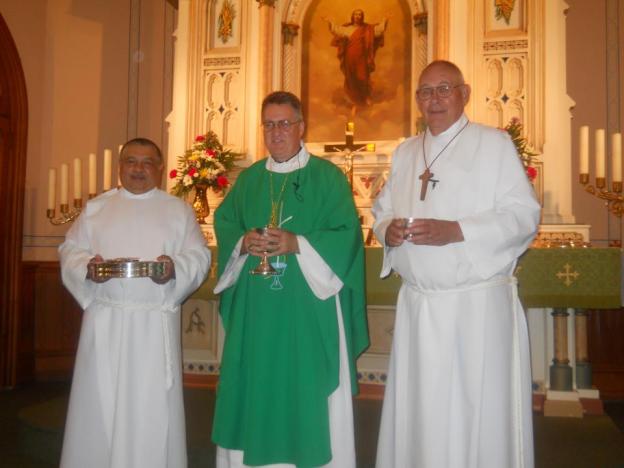


 Pastor Jim Driskell