Category Archives: Sermons

Service in to the Lord and His church LWML Sunday Jan 18, 2015 First St Johns

Click on the above picture for the audio version of this sermon.

This sermon isn’t mine, it was prepared by the Lutheran Women’s Mission League national office. It’s a really good sermon, and it honors a great group of ladies who serve their church and community so well and a group that is a terrific part of our church. We had a great dinner after worship. The Men’s Network is making gains!!!

Service in to the Lord and His church   LWML Sunday   Jan 18, 2015   First St Johns

Rich blessings and congratulations to the women of the LWML, our Lutheran Women in Mission, this morning as we celebrate and investigate how we all by faith in the sacrifice of our Lord Jesus Christ are enabled to be fragrant sacrifices and offerings before Him in both His Kingdom and in the earth.

The book of Ephesians, written by Saint Paul, to the saints of Ephesus in the decade of the 60’s is one of the letters that Paul wrote from a jail cell in Rome. He writes, despite his own dire situation, a word of encouragement to the saints. Paul understands this, that since His conversion on the Damascus Road his life has been one of great trial and tribulation. When Saul met the Lord Jesus whom he was persecuting, he was in his own words a premier Israelite circumcised on the eighth day, of the people of Israel, of the tribe of Benjamin, a Hebrew of Hebrews; as to the law, a Pharisee; as to zeal, a persecutor of the church; as to righteousness under the law blameless (Philippians 3:4b-6).

Paul had come to the realization what all the faithful in Christ have come to understand under the power of the Holy Spirit. We understand that none of our labor is acceptable to God. We understand that none of our carnal, fleshly work is acceptable in His sight. All our works are as filthy rags before God (Isaiah 64:6) although some men may be very pleased and impressed with our achievements. None of our carnal works rise to the Lord Jesus as fragrant offerings or are acceptable to our Father in heaven as pleasing sacrifices. Our God sees all our work as filthy rags, not one worthy of meriting any attention from Him.

In a sermon on this text proclaimed on the Third Sunday in Lent by Dr. Martin Luther these words were spoken, “This expression Paul takes from the Old Testament. There the temporal sacrifices are described as being ‘a sweet-smelling savour’ unto God: that is, they were acceptable and well-pleasing to him; but not, as the Jews imagined, because of the value of the work or of the sacrifices in themselves. For such thoughts they were chastised by the prophets often enough. They were acceptable on the ground of the true sacrifice which they foreshadowed and encircled.” Dr. Luther well understands that none of our works reach God as fragrant sacrifices and offerings. Those kinds of offerings never did reach the Lord even in the Old Testament.

Dr. Luther continues in saying, “They [Israel’s sacrifices] were acceptable on the ground of the true sacrifice which they foreshadowed and encircled. Paul’s thought is this: The sacrifices of the Old Testament have passed.

Now all sacrifices are powerless but that of Christ himself; he is the sweet-smelling savour. This sacrifice is pleasing to God. He gladly accepts it and would have us be confident it is an acceptable offering in our stead.”

Once again we are faced with the reality of our fallen condition. We are at once sinners and saints. We have the terrible stain of sin upon us and at the same time have the wonderful promise of resurrrection glory upon us through the sacrifice of Jesus on the cross. This wonderful fragrant and gracious sacrifice on our behalf is the one that God receives as a fragrant offering and sacrifice. This is the ultimate sacrificial offering but there are many others worked by our Lord Jesus in obedience to our Father. Remember? In the beginning the Holy Spirit comes to a virgin named Mary and a Son is born to her and Joseph who is named Jesus. Prophecy proclaims the birth of this Child and angels sing the birth of this Child. The shepherds and wise men rejoice at the birth of this Child and our Father receives this miraculous birth as a fragrant 2014 LWML Sunday Sermon

Theme: “Fragrant Sacrifices and Offerings”

Text: Ephesians 5:2sacrifice and offering. This Jesus at eight days old is dedicated back to His Father in the rite of circumcision, a fragrant offering to the Lord. There is a wedding that is running a bit short on wine. Jesus turns water into the

best wine and the Father catches that scent as a fragrant offering. And there is more!

Blind people see, deaf people hear, lame people have their limbs restored, sick people are healed, lepers are cleansed, seas are calmed, demons are cast out, mute people speak, the hungry are fed, demon possessed are delivered, captives are set free, severed ears restored, and if that were not enough, resurrection and life become the new normal. Our Father receives all these acts as fragrant sacrifices and offerings. They reach to His nostrils and the Lord rejoices, the angels dance, the Holy Spirit rejoices because our Father is well pleased, the incense has been lit, the fire is burning and the perfect sacrifice, the blood that speaks a better word than the blood of Abel (Hebrews 12:24) is set to be shed. The perfect offering is so sweet and fragrant a sacrifice to the Father that it has the power to cover and remove the sin of all humankind for all time.

That is the plan and design of God. That Jesus Christ, the perfect fragrant sacrifice and offering, the Lamb slain from before the foundation of the world in whose book the names of all who live and die and rise by faith in Christ Jesus have been written. (Revelation 13:8) And not only are their names written in the book of the Lamb and in the heart of the Father but their works of faith, good works prepared beforehand in which they walk, rise to the throne of our Father as fragrant sacrifices and offerings.

Understand that when you in obedience to Matthew 28, As you are going, make disciples-share the Gospel with some soul in need of encouragement-the Father receives that as a fragrant sacrifice and offering. When you, water-baptized, blood-covered, Holy Spirit-filled, consecrated, and anointed Daughters of Zion in the LWML, give your pennies, nickels, dimes, quarters, and dollars in the interest of missions, our Father receives every single sacrificial mite as a fragrant sacrifice and offering. When we all in faithful obedience, study the Word of God to show ourselves approved, when we dwell together in unity, when we faithfully hold the confession of the church in this perverse generation, when we speak faith, when we love one another, fragrant sacrifices and offerings rise up to the nostrils of our merciful, holy, and gracious God and Father.

I love the testimony of the Gospel of Saint Mark chapter sixteen verses sixteen through eighteen that say, Whoever believes and is baptized will be saved, but whoever does not believe will be condemned. Our baptismal faith rises up to our Father as a fragrant sacrifice. Saint Mark further testifies, These signs will accompany those who believe: in my name [the name above every name, the name of Jesus] they will cast out demons; [Hallelu-Jah!] they will speak in new tongues; they will pick up serpents with their hands; and if they drink any deadly poison, it

will not hurt them; they will lay their hands on the sick, and they will recover.

Every act of obedience, every work of the saints of God, every act of faith, every word spoken in faith rises up to the Father as a sweet-smelling savor and sacrificial offering. We have the awesome privilege of bringing joy to the heart of our Father by not simply performing deeds of which He would approve but also in the words of Saint Paul to the Romans in the twelfth chapter, I appeal to you therefore, brothers, by the mercies of God, to present your bodies as a living sacrifice, holy and acceptable to God, which is your spiritual worship. Do not be conformed to

this world, but be transformed by the renewal of your mind, that by testing you may discern what is the will of God, what is good and acceptable and perfect.

So, dear saints of God, let’s strive with all our Holy Ghost-inspired and Spirit-filled faith to infuse the heavens with fragrant sacrifices and offerings by not simply doing, but by being those sacrifices and offerings in the nostrils of our loving God and Father.

Now may the peace of Christ that passes all understanding rule and reign in our hearts as fragrant sacrifices and offerings to our gracious God and Father, in the name of our matchless Lord Jesus Christ we pray. Amen.

Sabiduría en un mundo de pragmatismo, la “sabiduría” del mundo 1 Reyes 3 Lucas 2: 47 First St Johns

Hacemos nuestro comienzo en el Nombre de Dios el Padre y en el nombre de Dios el Hijo y en el nombre de Dios el Espíritu Santo y todos los que que quieren ser fuertes en la sabiduría de Dios dijo … AMEN!

No sabemos mucho acerca de la infancia de Jesús, nuestra lectura de hoy es sobre el único registro que se tiene de su infancia en absoluto. Pero las lecturas de hoy son sin duda un contraste en la sabiduría. En nuestra lectura del Antiguo Testamento vemos, lo que, al menos, parece ser, una especie de acto altruista por parte de Salomón. El texto dice: “Salomón amó a Jehová, andando en los estatutos de su padre David; sólo, … “Pero también vemos Salomón poniendo un poco demasiado atrapados en los caminos de la política mundial. Se casó con una hija de Faraón. Ahora bien, esto es contrario a la Ley que Jehová dio vuelta en el Pentateuco, los primeros cinco libros de la Biblia. Eliezer Shemtov escribe: “La fuente primaria de la que la prohibición de que un Judio se case con un no-Judio se encuentra en (Deut. 7: 3):” No casarse con ellos (los gentiles), que no dará su hija a su hijo y no tomarás a su hija para tu hijo “.

La razón de esta prohibición está claramente en el siguiente versículo: “Porque él va a llevar a tu hijo descarriado de Mí y que servirá dioses extraños …” (“dioses ajenos” pueden también ser interpretados en el sentido de esos ideales y ‘ismos’ que no se ajustan a los dictados de la Torá, …) 1 vemos Salomón conseguir un poco atrapados en los caminos del mundo y olvidar lo que Jehová les había dicho que hiciera. La Biblia de Estudio cronológico escribe: “El matrimonio es un medio eficaz para la creación de alianzas entre las naciones antiguas. La esperanza era que uno podría tratar más amablemente con los familiares que con los extraños. No hay mayor evidencia de la importancia de Salomón entre los países vecinos sería que para registrar su matrimonio con una hija de un faraón egipcio. Como política, los faraones de Egipto no dieron sus hijas a los reyes extranjeros. “2 El pasaje de 1 Reyes 3: 1 nos dice:” Salomón hizo una alianza matrimonial con Faraón rey de Egipto. Él tomó la hija de Faraón, y la trajo a la ciudad de David … “(ESV) Además, el pasaje nos dice que” … el rey fue a Gabaón a sacrificar allí, porque ese era el lugar alto principal. Salomón usó para ofrecer mil holocaustos sobre ese altar “(1 Reyes 3: 4). Esa es una impresionante sacrificio! Pero ¿por qué Salomón hacer una ofrenda allí? El Arca de la Alianza, el tabernáculo estaba en Jerusalén. ¿Por qué no hacer sus sacrificios? La tradición de las religiones paganas era hacer sacrificios en “lugares altos”. Más tarde, en 2 Reyes, el escritor señala: “Y el pueblo de Israel hizo en secreto contra el Señor su Dios las cosas no rectas. Ellos construyeron para sí mismos lugares altos en todas sus ciudades, … “(2 Reyes 17: 9) Hay 75 versículos en el Antiguo Testamento acerca de” lugares altos “y todos ellos condenan el hecho de que Israel adoró en” lugares altos “. Ya en Levítico Jehová dice: “Y destruiré vuestros lugares altos, y derribaré vuestras imágenes, y pondré vuestros cuerpos muertos sobre los cuerpos muertos de vuestros ídolos, y mi alma se abominará.” (Lev 26:30) Doesn ‘t parece haber ninguna duda de que hay! Está claro que Israel no es el uso de “lugares altos” para la adoración de Yahvé. Sin embargo, es en Gabaón que Yahvé viene a Salomón en un sueño y le dice “Pide lo que te daré.” Salomón ciertamente dice las cosas correctas. Habla de cómo Jehová fielmente amado padre de Salomón David y David amaba a Yahvé. Salomón reconoce que Yahvé ahora lo ha hecho rey de Israel, y por lo que parece que Salomón realmente entiende por qué está donde está. Sus palabras están justo en el mensaje: “Dale a tu siervo un corazón con entendimiento para gobernar a tu pueblo, para discernir entre el bien y el mal, porque ¿quién podrá gobernar este tu pueblo tan grande” Salomón sabe que Israel es el pueblo de Yahweh, que sólo Dios hábilmente puede gobernar y Salomón parece entender que él ha sido puesto allí para gobernar con fidelidad como Jehová lo ha colocado allí.

Salomón fue sin duda brillante, Israel se elevó a la altura de su poder bajo Salomón. Se convirtió en el reino más poderoso de la región, era rico más allá de la imaginación. Se dice que Salomón no hizo uso de la plata para decorar cualquiera de sus edificios porque el oro era tan común. La Reina de Saba viajó desde su reino africano de tomar en la sabiduría de Salomón. Pero con toda la sabiduría, el poder y el material bendición del mundo, Salomón hizo demasiado enamorado de su poder mundano y lo hizo todo lo necesario para mantener su poder y riqueza. Él ya no confiaba en la sabiduría de Jehová a gobernar a Israel, pero confiaba en la sabiduría del mundo. Él construyó su poder mundano al casarse con mujeres de muchos reinos diferentes: “Pero el rey Salomón amó a muchas mujeres extranjeras, además de la hija de Faraón: moabita, amonita, edomita, de Sidón, y las mujeres hititas, … Él tenía 700 esposas, princesas y 300 concubinas. Y sus mujeres desviaron su corazón. “(1 Reyes 11: 1, 3) El escritor de Reyes señala:” Jehová había dicho a los hijos de Israel: “No contraer matrimonio con ellos, ni se ensayarán con usted , porque ciertamente harán inclinar vuestros corazones tras sus dioses “. Salomón se aferró a ellas en el amor “Más inquietante Isho’dad escribe:”. La razón de esa prohibición era no sea que [sus hijas] podría hacer que sus hijos también se prostituyen a sus dioses “3 Todas estas mujeres de diferentes partes del mundo,. éstos a Salomón un gran hombre en el barrio. Todas las naciones que lo rodean entienden su poder debido a todas sus esposas y alianzas. Vieron su poder como resultado de estas alianzas, y no como resultado de lo que el Señor había previsto para él y lo hicieron a través de él. Porque Salomón confió en el poder en el mundo, comenzó a ignorar Yahweh y confiar en los “dioses” de sus esposas. Eso resultaría en un desastre para Israel, que pasaría de ser el gorila de 800 libras, que dividida, pobre, constante lucha interna y, finalmente, sería invadida y su gente asesinados o deportados a países extranjeros. Sólo podemos imaginar lo que Israel habría sido como si Salomón y los reyes posteriores habían seguido fielmente Yahweh.

Mientras Salomón parecía venir aparte debido a su sabiduría, vemos que Jesús también comenzó como sabio. Salomón era joven cuando fue concedido gran sabiduría por Dios y, desde luego, ya que Jesús es Dios, Él tenía una gran sabiduría desde el principio. Demostró que la sabiduría desde el principio. Los maestros del templo, los hombres que han pasado toda su vida estudiando Torá “se admiraban de su inteligencia y de sus respuestas.” Esto sería como un niño de doce años de edad hoy en día ir a una reunión en la Escuela de Derecho de Harvard y “sorprendentes” todos los profesores ya está. Es sólo que no iba a pasar, los maestros del templo probablemente tenía un conocimiento más profundo de la Torá entonces los profesores de Harvard tienen de la ley.

La diferencia es la siguiente. Mientras que Salomón llegó a pedazos como escribió en el libro de Eclesiastés: “Vanidad de vanidades, dice el Predicador, vanidad de vanidades! Todo es vanidad. “Todo es inútil cuando seguimos la sabiduría del mundo, todo sólo se rompe. Pero con Jesús: “Y Jesús crecía en sabiduría, en estatura y en gracia ante Dios y los hombres.” (Lucas 2: 52 ESV)

Lo vemos a nuestro alrededor. La gente se llena de sí mismos debido a su poder o sabiduría o la riqueza. Ellos ya no confían en la dirección de Dios, confían en lo que está a su alrededor. Ellos confían en el mundo y su propia comprensión y al final, como Salomón, se encuentran con que todo era inútil, que no hace ningún bien a nadie, si algo causa daño y destrucción. Por otro lado, Jesús ciertamente no llegó a ser rico o poderoso, ni ninguno de sus discípulos. Sin embargo, lo que dejaron fue una iglesia que sigue sirviendo, edificar y animar a la gente de Jesús. La vida de Jesús terminó en la cruz y lo que podría parecer en la pérdida y la derrota, pero Él venció a la muerte. Jesús resucitó de entre los muertos para darnos la promesa de la vida eterna. No puede haber mayor contraste, la mundanidad y la derrota de Salomón, tan lleno de promesas. La santidad y la victoria de Jesús, que vino al mundo sin nada, vivían una vida que el mundo diría nada y, sin embargo, nos da la promesa y la esperanza de Su en este mundo y también en la eternidad.

Salomón falló, confiando en el mundo. Jesús triunfó confiando en la esperanza y la promesa de Dios. Ya que estamos en el comienzo de un nuevo año, vamos a tomar un giro diferente en nuestras resoluciones del Año Nuevo y realmente pensar en lo mucho que nos hemos alejado de el plan de Dios para nuestra vida y de confianza demasiado en las promesas del mundo.

¿Qué podemos hacer en nuestras vidas para volver a dedicarnos a Dios y su voluntad para con nosotros y comenzar a mirar las cosas en nuestra vida que son demasiado acerca de riqueza, el poder, la comodidad y muy poco acerca de la vida en Cristo, por nosotros y por todos los que nos guía el Espíritu Santo para testificar a.

La paz de Dios que sobrepasa todo entendimiento, guardará vuestros corazones y vuestros pensamientos en Cristo Jesús. Shalom y Amin.

Good News to the Poor, All of us Isaiah 61: 1-11 First St Johns Dec 14, 2014

Please check out the audio version of this sermon, click on he above link or copy and paste into your browser.

We make our beginning in the Name of God the Father and in the Name of God the Son and in the Name of God the Holy Spirit and if you are anointed and if the Holy Spirit is on you, say … AMEN!

The reading in Isaiah is the theme of the sermon today, but I have to start with our epistle reading. Paul tells us to exhort, so I am going to exhort you: “Rejoice always!” We know what time of year it is, we are reminded that while Advent is a time of penance, of clearing the clutter of sin that has gathered in our heart we are prepared for the coming of the Christ child and just as significantly, His second coming at the end of time. So yes, rejoice, but still remember to pray without ceasing. Part of prayer should be repentance. Pray for forgiveness, but a special emphasis on praying for help to prepare for His return. For myself, Lord remind me of whose I am in You, that I am saved in You. Yes I need forgiveness, that I am sinful, that I need a Savior.

700 years before the fact, before it actually happens God is giving Isaiah the words that Jesus says in Luke 4: 18-19. These are the words that Jesus says at the beginning of His earthly ministry. He had just gone through the temptation by Satan, certainly Satan knew Jesus is God the Son and now Jesus has gone back to his hometown, Nazareth. He proclaimed the words of Isaiah to identify Himself as the one anointed by God. Jesus was born in Bethlehem, but His ministry started when He returned to Nazareth and in front of the synagogue on the Sabbath day He proclaimed, “The Spirit of the Lord is upon me, because He has anointed me to proclaim the good news to the poor.”

What, just the poor? Yea! Who are the poor? In terms of our relationship with God, we are all poor. Remember “Christmas Clubs”? I don’t think banks have them anymore, but all year long, you would go to the bank (yea, definitely before electronic banking), you would take part of your regular income and deposit it in your Christmas Club account? Back then it would actually earn some meaningful income and then just before Christmas, not Black Friday, that wasn’t around either. You would take everything you’ve saved, go and buy your presents and decorations and holiday food. When you emptied that account you might have felt like you had some money, but after a few days of Christmas shopping you felt even lighter in the pocket book then you had before. You may have been poor again, but celebrating the birth of Jesus makes us rich.

Yea, this time of year, like it or not, we are all kind of poor so that we can have that great holiday celebration. But that’s not what Jesus is really talking about.  He’s talking about the “Poor in Spirit”. Where does that phrase come from? … The Beatitudes, “The Sermon on the Mount”. What does He say about the “Poor in Spirit”? “Blessed are the poor in spirit, for theirs is the kingdom of heaven.” We want to be “Poor in Spirit” don’t we? As Christians, by definition we should be poor in spirit in order to have the Kingdom of Heaven. That Kingdom came when Jesus came into the world. We who are the poor in spirit have inherited that kingdom. We are living that kingdom today. While that kingdom has arrived in Jesus and we should live our lives as subjects of the kingdom, as loyal subjects of King Jesus, the kingdom that is to come, as we pray for it, has not yet been realized. You may not think you’re “poor” in anything, but you would be wrong, unless of course you don’t know Christ as your Savior.

It is Jesus who has been xv;m’ That is anointed, kings and priests would be “anointed”, this would be a special blessing to them to bear their duties, to faithfully serve, to be the ones who would do what Yahweh has designated them to do. We call Jesus, Messiah, that is the One who is anointed, who has been blessed and designated by God to bring us the Good News, to bind up, proclaim liberty, release those who are bound. All the things that sin imposes on us and Jesus is anointed to save us from.

While Yahweh is giving the words to Isaiah of the great promise of the Savior, He’s also reaffirming a previous promise. He’s reaffirming a promise made about 800 years earlier, to Abraham, not just that Abraham will have, what we know to be hundreds of millions of descendants, but that they will be blessed in Jesus who has been anointed, who has the Spirit of the Lord. We who are blessed to be eternally saved in Jesus, in the resurrection. In one of the verses not quoted, Yahweh promises “…you shall be called the priests of the Lord; they shall speak of you as the ministers of God;…” Peter re-emphasizes that when he writes 700 years later: “But you are a chosen race, a royal priesthood, a holy nation, a people for his own possession, that you may proclaim the excellencies of him who called you out of darkness into his marvelous light.” You may be poor in spirit, but Yahweh says that we are priests, minister of our God and speaks through Peter to re-affirm that promise 700 years later.

We end with God’s promises that will be confirmed and carried out by Jesus during His human lifetime and will be the gifts of all who are in Jesus, you and I, until He returns that second and last time. Isaiah writes: “I will greatly rejoice in the LORD; … He has clothed me with the garments of salvation…the robe of righteousness, the bridegroom will have a beautiful headdress and the bride will be adorned in jewels.” It may be difficult to picture or appreciate, but there is no doubt in my mind that we will understand how magnificent it will be when we see it accomplished in all of us who are in Jesus. We have a tiny little speck of it when we celebrate Christmas, the lights and decorations, for the Lord’s first coming. We can’t even begin to imagine how magnificent it will be, what we will see in the second coming of Jesus.

Paul’s words, two simple phrases, write them down in your journal, really think over them: “Rejoice always” “Pray without ceasing”. Rejoice because we have the promises. Pray to stay strong in God’s promises. Rejoice always means, always. It’s often tough to do, but always means always; not just when you’re in the mood. Not just when Christmas is coming, or maybe when it’s over. Rejoice even when someone bashes in your door, when you’re in the hospital, yes even when the time of year reminds you who won’t be at the Christmas feast this year. Rejoice not because they’re gone, but because we have the eternal promises to be with those we love and to enjoy the magnificence of eternity in God, Father, Son and Holy Spirit. So how do you rejoice this Advent, what are your prayers?

The peace of God which passes all understanding keep your hearts and minds in Christ Jesus. Shalom and Amin.

Remembering our sin in preparation for the Child First St Johns November 30, 2014 Isaiah 64: 1-9

For the audio version of this sermon, click on the above link, or copy and paste it into your web browser. Thank you and God bless.

We make our beginning in the Name of God the Father and in the Name of God the Son and in the Name of God the Holy Spirit and all those who prepare for the coming of the Son in the new liturgical year said … AMEN!

Happy New Year, sounds a little weird, aren’t we supposed to have Christmas first and then have New Year? Today is the first Sunday of the church New Year, the time of Advent, the time where we wait in anticipation, our whole life is a time of waiting in anticipation of the coming of Jesus in the clouds of His power and glory. But for now we wait on the feast, the celebration of the coming of the Christ child. The Advent of His Kingdom in the world. We joined together in the Apostle’s Creed to remember that He will come again, to judge both the living and the dead. Those who have died in Christ will be raised to the resurrection the eternal Kingdom, the New Jerusalem.

Isaiah says “Be not so terribly angry, O LORD, and remember not iniquity forever. Behold please look, we are all your people.” (Is 64:8-9) Ya, Isaiah is addressing the Old Testament God. Remember Isaiah 6? Isaiah is raised into the presence of God: “Woe is me, I am a man of unclean lips… for my eyes have seen the King, the Lord of Hosts!’ (Is 6:5)? From the beginning of Isaiah to the end, our reading today, Isaiah is readily acknowledging the fact that we are sinful and unclean, we are simply not suitable to be in the presence of a pure, holy, God. Clearly God has revealed to Isaiah that we are sinful and there needs to be a solution to our condition. Yahweh makes it very clear to Isaiah that the sacrifices of Israel; rams, bulls, lambs, just doesn’t cut it. Read all through Isaiah 1: 10-15. But then what does God do? He promises that they will be made as white as snow… our sins will be like wool, nice and white, cleaned, made pure. He makes it very clear all through Isaiah’s book that we are sinful, and Isaiah is completely aware of his own condition. Imagine being brought straight into the presence of our completely holy God, just being overwhelmed by His holy presence, His Holy being and our being, the complete opposite, totally depraved and sinful. It must be an overpowering experience. Many people demand that God come into their presence, we couldn’t begin to cope with that, we would be consumed by our sinfulness in contrast to His holiness, we would be completely blown away and that’s why God won’t do it.

Until we completely internalize Paul’s words in our epistle reading: “I give thanks to my God always for you because of the grace of God that was given you in Christ Jesus… who will sustain you to the end, guiltless in the day of our Lord Jesus Christ.” ( 1 Cor 1: 4, 8) Only in Christ are we guiltless, that we can then be in the presence of the Father, totally righteous and holy, but only through our baptism-new life, we are made holy, we don’t have to be reduced to the fear and disgust that Isaiah felt. In Christ, in the Father’s presence we are lifted up to joy, we can rejoice. I have no doubt that it will be an overwhelming feeling of love and freedom in Christ, in the Father’s presence.

Isaiah is making a plea for restoration. He has been made completely aware of how unworthy he is, how unworthy we all are. Isaiah is no better or worse then we are, none of us is any better or any worse. Isaiah is making this plea that we can be restored. In what way are we restored? We can now be in the Father’s presence, we are no longer separated from Him, alienated from Him. We are alienated from Him because we are aliens in relation to Him. No we aren’t green or odd-shaped, we don’t have antenna’s in our head, but our nature, as Isaiah has been made profoundly aware of, is totally opposite to His. He is completely holy, completely perfect, we are imperfect and deeply sinful. Walter Roehrs in the Concordia Self-Study Commentary writes: “Isaiah devotes the remainder of his book to correct two misconceptions his hearers and readers are prone to harbor about the way God wants to lead them to glory.” I might add that this is the way we think today, probably more so, then what the people in Isaiah’s time thought. “It is a fatal mistake on the one hand, to … walk with God with one foot, and with the other to stalk through the sewer of sin.”1 That’s the way we think today, “I’m good enough, I haven’t killed anyone, there are others much worse than me.” So we continue to live our lives in this mind-set that I can give God what ever I decide and He has to take what I give Him and deal with it. God is not a half-way kind of guy, it’s His way or no way. How the world comes to another conclusion totally baffles me. Why should a perfect, holy God be happy with some scraps that we throw Him, bring us into His presence and just allow whatever phony, mooshy, sentimental whim we chose over His perfect being? Why would He let our lusts and greed overcome His Holiness. Through our sin, we’ve messed up what God created, away from Him, cutoff from Him. He drove Satan out of heaven when Satan presumed to be better than God, why would He let us in to do the same thing Satan did? He’s not and if you think otherwise, you’re only kidding yourself. Dr Roehrs writes: “Isaiah had to set Israel straight [and by extension us who are now Israel] on both counts. He [Isaiah] foretold certain disaster for a sinful nation, a people laden with iniquity’ and so depraved as to lift ‘hands … full of blood’ to the Lord in a pose of prayer.” (Is 1: 4, 15)2 That’s us, and that’s not going to work in the presence of God the Father, but in Christ we become cleansed and pure and suitable enough to be saved to eternity in God’s salvation in Jesus.

Isaiah is acutely aware of the human condition in relation to God: “We have all become like one who is unclean and all our righteous deeds are like a polluted garment. We all fade like a leaf and our iniquities, like the wind, take us away.”

So what now, what needs to happen. Can we do anything that is going to make us closer to God, to make us more desirable, more deserving of being in His presence? No… But earlier in his book, Isaiah knew that God was going to move, to do something. It was going to take about 700 years, for us that would be intolerable! We want the solution, we want it now and well, if you can’t make it happen on our time table, we’re just going to have to get ourselves a new “god”. But in God the Father’s time, it is perfect, complete, not a band-aid fix, an eternal, complete, perfect fix: “For to us a child is born, to us a son is given; and the government shall be upon his shoulder, and his name shall be called Wonderful Counselor, Mighty God, Everlasting Father, Prince of Peace.” (Is 9:6) I like what David Johnson says: “…Advent is not just anticipatory of a saccharin sweet nativity story, but bona fide bitter judgment against sin! Heaven and earth collide and are mingled in Jesus! God and man! Jesus is wrapped in human flesh; the world is wrapped in divine grace…”3 The seasonal color for Advent is usually blue, although purple is acceptable also. What other season is purple the seasonal color? Lent. The blue, and some say it’s bluish-purple, is a symbol of waiting, it represents Mary waiting with the rest of the church for her child. But the more traditional color is purple and like Lent means a time of repentance, in the sense of preparing for the coming of the Savior in repentance, being prepared for Him by repenting of our sins. That’s why we don’t normally sing Christmas carols, which are celebration, we are faithfully preparing and repenting so that in the Christ Child we are saved and we spend the Christmas season in joy and celebration. Spend the Advent season raising up your sins for forgiveness, clean out your heart, like you clean your house on Shrove Tuesday and you will be prepared to receive the child on Christmas Day as we receive the risen Christ on Easter.

The peace of God which passes all understanding keep your hearts and minds in Christ Jesus. Shalom and Amin.

1Roehrs, Franzman Concordia Self-Study Commentary p 490

2Ibid

3David A Johnson Concordia Journal Fall 2014 p 322

Los santos de Jesús, los que viven con autenticidad Primera Saint Johns, 02 de noviembre 2014

Hacemos nuestro comienzo en el nombre de Dios Padre y en el nombre de Dios el Hijo y en el Nombre de Dios el Espíritu Santo. Yo voy a decir buenas santos de la mañana de York y vas a dar los buenos días en Saint Jim, buenos santos de la mañana de York …
Y todo el pueblo de Dios dijo AMEN! Celebramos hoy el Día de Todos los Santos, que es también el mismo día como Día de la Reforma que observaremos en el culto de esta tarde, el día en que Martín Lutero clavó sus 95 tesis.
Halloween, que se observó el viernes, tiene sus raíces en un día de fiesta pagano gaélico llamado Samhain [Sawin pronunciado], que es cuando se pensaba que los espíritus y hadas podían moverse con mayor facilidad en el mundo físico. Las almas de los muertos visitaban los lugares donde vivían. Halloween es la segunda fiesta más observado después de la Navidad. Para aquellos en el mundo secular que les gusta pensar en cómo pragmático y la realidad que son impulsados​​, un escritor señaló que “Halloween es él último día de fiesta de fingir … nos vestimos y ‘pretender’ ser alguien o algo distinto de nosotros mismos. .. “En otras palabras, simplemente pone de relieve la falsedad del mundo en que vivimos. un mundo que niega la realidad de un cariño, Dios Creador y trata de hacer en algo mucho mejor que no lo es. El mundo ama a preocuparse de su auto con el aspecto falso de “espiritualidad” que muchas personas hoy en día comprar fácilmente en y negar la verdadera espiritualidad que es Jesucristo. Sigo buscando, pero no encuentro donde explica que lo que la gente realmente piensa que tipo de espiritualidad va a hacer, excepto que les da la sensación de estar en control, pero nunca realmente cómo se realiza ese control. ¿Cómo funciona en términos de la eternidad? Nadie parece ser el más mínimo interés. El mundo habla un buen juego de ser “auténtico”, de autenticidad, pero que rara vez se ve, es sólo en términos de su percepción ilusoria de un mundo sin Dios y luego se preguntan por qué siempre se siente perdida, asustada y sola. Sólo hay una fuente de autenticidad y que está en Jesús. Cuando estamos a un santo en Jesús son verdaderamente auténtico, parte de la cual está siendo humilde, que es cuando confiamos en el Señor para vivir la vida que Él nos ha salvado para. Para estar seguro de ser cristiano es mucho más que las Bienaventuranzas, nuestra lectura de hoy, pero sin duda modelar autenticidad cuando hacemos nuestro mejor esfuerzo para vivir esa vida a través del poder del Espíritu Santo. Las Bienaventuranzas no son nuestras obras, que son el fruto del Espíritu Santo que está trabajando a través de nosotros. Todavía el pecado, el mundo piensa que debemos vivir en la perfección. No, los santos siempre serán personas falibles, el anciano vive en cada uno de los santos, pero el Espíritu Santo nos mueve una y otra vez a la altura de las Bienaventuranzas. El mundo trata de vivir sus propias virtudes, pero es muy claro que esas virtudes son sólo para mejorar su propia vida y el fruto de su propio espíritu, el espíritu del mundo y no del Espíritu Santo. Roy Lloyd dice lo siguiente: “… un hombre que llegó en 1953 en la estación de ferrocarril de Chicago para recibir el Premio Nobel de la Paz. Como él bajó del tren … como las cámaras destellaron y funcionarios de la ciudad se acercaron … él les dio las gracias cortésmente. Entonces él pidió ser excusado por un momento. Caminó a través de la multitud hacia el lado de una mujer de negro anciano que lucha con dos grandes maletas. Él los recogió, sonrió y la escoltó hasta el autobús, la ayudó a subir y le deseó un buen viaje. Luego Albert Schweitzer se volvió hacia la multitud y se disculpó por mantenerlos esperando. Se ha informado de que un miembro del comité de recepción le dijo a un reportero, “Esa es la primera vez que vi un pie sermón. ‘” Schweitzer fue un teólogo alemán, luterano, un organista que estudió Bach, un médico, un médico misionero a África. Fue galardonado con el Premio Nobel de la Paz por su filosofía de “Reverencia por la Vida”, se evidencia en su fundación de un hospital en Gabón alrededor de la vuelta del siglo XX. Es interesante cómo un santo de Cristo, que produce tanta fruta como un discípulo cristiano, por lo realizado y aún en una gran multitud, era el único que se dio cuenta de una anciana que necesitaba ayuda, entonces y allí, para hacer su próxima conexión para su viaje. Un simple acto de un hombre que sirvió a nuestro Señor de una manera tan magníficas, un gran santo de Cristo.
David Kinneman fue el orador en la conferencia en Carolina del Norte que asistí. Una cosa que él regresó a una y otra vez en su presentación fue que las generaciones más jóvenes de hoy en día y, a mi juicio la mayoría de la gente en el mundo, están buscando, es authenticty, genuinness. Ellos saben y nosotros, los que están en Cristo saben que el mundo no es genuino. Todas las instituciones del mundo fallan en repetidas ocasiones y, sin embargo tratar de convencer de su autoridad y autenticidad, incluso mientras ellos imponen en nuestra sociedad y en repetidas ocasiones fallan. Todos nosotros podemos relacionar con la forma en que podemos ver a través del fino velo de la hipocresía que nos rodea. La iglesia es a menudo acusado de hipocresía y, a menudo por una buena razón. Tratamos de convencer al mundo de que somos santos perfectos en Jesús y sin embargo nuestro intento se hizo añicos cuando nos fijamos en los santos verdaderos. Pablo llamó a sí mismo el jefe de todos los pecadores. Él no dijo que en un intento de que parecen ser piadoso, él sabía de los pecados que había cometido en contra de Jesús y su iglesia y él los reconoció y continuó a producir el fruto del Espíritu Santo. No es como una especie de forma de expiar sus pecados. ¿Por qué? Sus pecados han sido pagados a la Cruz, Pablo sabía que no había nada que pudiera añadir a sacrificio de Jesús por nosotros. Jesús pagó por nuestros pecados a través de Su sufrimiento y sacrificio. Nosotros, como sus santos, somos salvos en Su sacrificio, sino como sus santos que fielmente seguimos el liderazgo, ánimo, esperanza y promesa del Espíritu Santo, que es la única manera en que podemos vivir las Bienaventuranzas. Reconocemos nuestras faltas, nuestros pecados. Cuando tratamos de convencer al mundo de que somos perfectos, y sobre todo el mal del mundo, el mundo puede ver a través de nosotros. Pero cuando reconocemos que la única manera de que somos perfectos es a través de Jesús y sólo a través de su gracia y el perdón, que todavía luchamos y todavía fallamos en el pecado, entonces el mundo conozca la salvación a través de Jesús.
Estamos valioso, nosotros somos su creación y somos salvos por Él a través de Cristo. Tenemos que recordar lo valioso que somos para Dios. Juan escribe: “ver qué tipo de amor [que es el amor ágape} el Padre nos ha dado: que seamos llamados hijos de Dios; y así estamos. La razón por la cual el mundo no sabe de nosotros es que no lo conocía … pero sabemos que cuando él se manifieste, seremos semejantes a él, .. “Vamos a ser sus santos y vamos a ser perfecto, no en nosotros mismos, sino en Aquel que murió por nosotros, y debido a que somos valiosos para el Padre y Él ama a sus hijos con la expresión más alta del amor.
Dr. Lutero escribió: “Mañana tengo que dar una conferencia sobre la embriaguez de Noé [Génesis 9: 20-27]; así que deben beber suficiente esta noche para poder hablar de que la maldad como alguien que sabe por experiencia. “Lutero era auténtica, no te estoy diciendo que imitar autenticidad a ese grado, pero es reconocer que somos tentados y ocasionalmente fallar.
Dado que los ancianos, los santos en Cristo se reunieron alrededor del trono de Dios en el cielo, como leemos en Apocalipsis 07:12, los santos alabando a Dios y lo adoran, vamos a tirar hacia fuera las letras insertadas en su boletín y Alabemosle aquí y ahora: Te amo Señor, letra de Petra …
La paz de Dios que sobrepasa todo entendimiento, guardará vuestros corazones y vuestros pensamientos en Cristo Jesús. Shalom y Amin.

God uses all creation, because He made all creation. Isaiah 45: 1-7 First St Johns October 19, 2014

Please click on the above link to hear the audio sermon:

We make our beginning in the Name of God the Father and in the Name of God the Son and in the Name of God the Holy Spirit and all those who know that in all things God works for the good of those who love him said … Amen!
“Thus says the LORD to his anointed Cyrus…” That’s rather odd, who is Cyrus?… Why is God telling Isaiah that Cyrus is His anointed? … Isn’t anointing reserved for those who are God’s? Cyrus is a pagan from Persia. Quoting from the Chronological Study Bible; “In 559 BC Cyrus the Great became the ruler and founder of [a dynasty] of Persia which expanded quickly in all directions to become a world empire. … Cyrus ultimately conquered the Neo-Babylonian Empire …”1 The writer goes on to point out that those in the ancient world would ask “What God has empowered this Persian king, Cyrus?” Well ancient people had it right in the sense that God does empower us. They had it wrong in the sense of trying to figure out “what ‘god’”. Why … Ya, there’s only one God. Cyrus would have worshiped Marduk, Bel and/or Nebo. Did any of them give Cyrus what it took to conquer most of the known world? No! Why? It says right here in our reading in Isaiah; “Thus says the LORD to His anointed, To Cyrus, whose right hand I have held – to subdue nations before him … For Jacob [when we see that, we know Yahweh is talking about … Israel] My servant’s sake, and Israel My elect, I have called you by your name; I have named you, though you have not known Me. I am the LORD, and there is no other; There is no God besides Me… I form the light and create darkness, I make peace and create calamity; I, the LORD, do all these things.” (Isaiah 45: 1, 4-5, 7 NKJV) So for all those in the world who like to say; “Well my ‘god’”. Well that’s all it is, their ‘god’. Even in writing that’s twenty-five centuries old, I don’t hear any mumbling here, do you? Yahweh is clearly saying … I am the LORD, and there is no other and in the Hebrew I am, there is are all forms of the name that God told Moses what His Name is, what Jesus told the Jews who questioned Him, God’s Name is the great I AM and there is no other.
Sure we can make it up, we can live a life that is deluded and full of lies. We can make these little idols in our lives and call them “god”, rely on them, but as Yahweh speaks to Cyrus, He is telling us; “I am the LORD, and there is no other”. Scripture is God’s word to us and when He tells us who He is and what He does, that’s the way it is and we need to get over anything else we think or do about Him.
There is a cylinder, which is the form of writing that the people in the Middle East used at the time, dated 538 BC that announces that Marduk chose Cyrus to conquer the world.2 Well … NO! Have you seen that cylinder? I haven’t. It is one archaeological artifact that’s certainly interesting, but what writing from that period has survived from then until now that the entire world knows? The Bible, Holy Scripture, which says very clearly, “I am the LORD, and there is no other.” We know that from 2500 years ago until now, I’m pretty sure that what Marduk “says” today, doesn’t matter to anyone.
The Babylonians had originally conquered Israel and Judah. They deported the best and the brightest of Israel to Babylon and they abused the Israelites and had shown them no mercy. Israel may have been conquered by Babylon as a judgment on the Jewish people, but contrary to the thinking of the time, that did not give Babylon the right to abuse God’s chosen people, they were still God’s elect. It’s like with my little brother, I can pick on him, but no one else better try to pick on him. In Isaiah 47 God makes it very clear to the Babylonians what happens when they picked on Yahweh’s people: “I was angry with my people [Yahweh says in chap 47] I have profaned my inheritance, And given them into your hand. You showed them no mercy: For you have trusted in your wickedness; You have said, ‘No one sees me’; Your wisdom and your knowledge have warped you; And you have said in your heart, I am, and there is no one else besides me.’ Therefore evil shall come upon you; You shall not know from where it arises. And trouble shall fall upon you; You will not be able to put it off. And desolation shall come upon you suddenly,”…(Isaiah 47: 6, 10-11 NKJV) God is now going to use Cyrus to bring judgment on the Babylonians who have abused His people. Remember when God says: “Vengeance is mine, I will repay, says the Lord.” (Rom 12:19) He’s making it very clear to the Babylonians that is the case and His vengeance, through Cyrus on behalf of His people, Israel, will not be pretty.
God tells us He’s a jealous God, well this is partly what it means, He can take us out behind the woodshed and let us have what-for, but He’s not going to stand by while we are being abused by the world. We are His, and He expects us to trust in Him, to put our faith in Him, the faith that He give us. When we fail to do that, when we sin, when we make ourselves, our own idol, He is going to discipline us. That’s a good thing, do you really want God to just stand by and watch you sink into sin, to fall away from Him and be swallowed up by the world? Would a Holy, faithful, loving father do that? No! So He will resort to discipline to get our attention, to get our focus back on Him and away from a violent and cursed world. He may use people like Nebuchadnezzar and Cyrus to impose that discipline, does that mean He loves us less? No, it means He loves us enough to do what it takes to keep us in His will and not lost in the world’s.
God uses many trials and enemies to focus on Him. In the movie God’s Not Dead there is a twenty-something young lady who is right on the top of her game. She has built a big-media following, she is on the go, interviewing the movers and shakers of entertainment, her boyfriend is a wealthy and powerful financier, the sky’s the limit and then one day she goes in for a medical exam. “You have cancer, the doctor tells her and you may not live.” Her response: “I don’t have time for cancer.” I’m not going to tell you how that plays out, you have to come and see the movie, but she was her own idol, it was all about her and how she had created her own world. God forces His way into that world and tells her, that it’s all about Him, not about her. She may have done all these things in her life, but at some point there will be a day of reckoning and she will have to surrender to the fact that it is all about God. We will all have that time of reckoning. For her that time was when she was told she had cancer. You can be in denial of these things, you can run your own game. But in the end God makes it very clear to all of us, that we will have to turn to Him. We may still resist, but it will be a done deal and God will have His way, just as He did with a king, Cyrus, who did not know Him and a people, Israel, who rejected Him.
Rev Dr Dale Meyer in his “Meyer Minute” for October 17 talks about how God can use the result of our sin to bless and benefit many generations. We certainly watch with concern the events surrounding the Ebola virus. We forget that there have been many serious diseases that have spread through our country. Only about 60 years ago, polio spread through the United States. Dr Meyer writes about a cholera epidemic that swept through St Louis in 1849. “The epidemic was devastating to Johann Friedrich Buenger, an immigrant and Lutheran pastor.” His first wife died in the epidemic and their three sons had died in infancy before the epidemic. He remarried and had four daughters with his second wife, two who died in infancy. He was led by God to establish the Lutheran Hospital in 1853, from which the Lutheran Foundation of St Louis, Lutheran Senior Services and Lutheran Family and Children’s services now serve thousands.3
Ebola is not of God, war and abuse are not of God, cholera is not of God and a king in the Middle East 2,500 years ago may not know God. All the evil in the world is the result of man’s sin, yours, mine, the whole world’s. We certainly don’t like it, we are certainly going to have fear about it, but as those who are saved in Christ, we trust that our fear is rapidly turned into faith. Not because of what we do, but because through the sacrifice of Jesus, we are saved, we know how the story ends, for the world, and for us individually. Remember our reading from a few weeks ago: “And we know that for those who love God all things work together for good, for those who are called according to his purpose.” (Rom 8:28 ESV) God will unleash evil on those, like the Babylonians, who were evil, we who are saved in Jesus, who are made holy in His sacrifice, we will also deal with evil, but out of that God will use it according to His purpose. As Dr Meyer notes: “the love of Christ motivates God’s people to meet human need and God multiplies the blessings.” How is that agape love that we have from Jesus motivating you? You trust that God is just and will repay those, like the Babylonians, who abuse His people. Since we are freed from the hate and bitterness of the world, we go on to the things of God. He guides His Israel, us, back to our promised land and by doing so enables us to serve Him and all of His creation. How can you trust that God is protecting you? You don’t have to fuss about the evil that’s going on around you, and because you are free from that, what do you do in order to serve those in the world to the glory of our God, Father, Son and Holy Spirit.
The peace of God which passes all understanding keep your hearts and minds in Christ Jesus. Shalom and Amin.

Learn to forgive like Joseph forgave,

Please click on the above link to listen to the audio version, or copy this link and paste it into your browser.

We make our beginning in the Name of God the Father and of God the Son and of God the Holy Spirit and all those who forgive because they know how much they’ve been forgiven said … AMEN!
Matthew, quoting Jesus, has really camped on a theme for our last few sermons, that being forgiveness. Specifically we’ve talked about holding grudges, being offended. “To err is human; to forgive, divine.” Many people out in the world will tell you that’s in the Bible, “No! You are the weakest link! Goodbye.” It is from English poet Alexander Pope. Sort of presupposes that God forgives, but people, well… we just can’t rise up to that level. Yet, we do see forgiveness. Remember the story of Joseph?
He kind of flaunted the gift from his father, Israel. His father was originally named Jacob, but after wrestling with God all night, God renamed him Israel. He became the father of the 12 patriarchs, the men/brothers who would be the roots of the twelve tribes of Israel. Jacob/Israel had two wives, that is a whole other story, except to say that Rachel was his favorite. Now the wrinkle there was that while Rachel was the favorite, she was having a great deal of difficulty in conceiving. As we’ve said, not having children was a huge humiliation to the man and wife, but particularly to the wife. Jacob’s other wife, Leah, had 6 sons, that arrived soon and fast, while Rachel ached in embarrassment. Rachel finally had a son, Joseph and he became Jacob’s favorite, the son of his favorite wife. Rachel had another son, Benjamin, Rachel died giving birth to him. No doubt that probably caused problems being the son who caused his beloved wife’s death. It would seem that Jacob doted on Joseph and the rest of his sons resented that. Genesis 37:3 tells us that Jacob “made a richly ornamented robe for him.” for Joseph. Remember these people are nomads, they don’t run to the mall to buy their clothes, clothes are hard to come by and especially fancy clothes. The fact that he made this for Joseph and it was very lavish, made this an extraordinary gift and was certainly the talk of the tribe and no doubt made Joseph everyone else’s target. Now add to that Genesis 37:5-7 “Joseph had a dream, and when he told it to his brothers they hated him even more. He said to them, “Hear this dream that I have dreamed: Behold, we were binding sheaves in the field, and behold, my sheaf arose and stood upright. And behold, your sheaves gathered around it and bowed down to my sheaf.” His brothers said to him, “Are you indeed to reign over us? Or are you indeed to rule over us?” So they hated him even more for his dreams and for his words.” And then he had another dream that even the sun, moon and stars would bow down to him. Hey he was a kid, he really didn’t know, but to everyone else he is over the top obnoxious. The coat, the bowing down, all makes Joseph the spoiled rotten, snott nosed kid that everyone hates. I don’t really believe that Joseph intended to be so obnoxious, but that’s how he came across. Can’t you see his brothers? “What you little punk, who do you think you’re talking to? You may be daddy’s favorite, but you’re just a kid and daddy’s not going to be around forever, and hmmmm, who knows, can never tell out there in the desert, ahhh, you just might have an “accident”. Jacob sends Joseph out to his brothers, really to check up on them out in the pastures tending sheep. That turns out to be a stupid move. His brothers saw him in the distance and decided, “great this is our chance, we are going to take care of this little punk once and for all.”
They decided they were going to leave him to die, then they decided, ahh, we should make a shekel out of this for ourselves and sold Joseph as a slave. He was a slave for awhile, then he was falsely accused, thrown into an Egyptian prison where he would have probably just died, but God decided He had bigger plans for Joseph and that’s where we see Joseph now. He has been made the second most powerful man in Egypt. He could have just let his family starve back in Israel or at least with his brothers now bowing down in front of him, just like in his dreams, he could have just done away with his brothers. He didn’t do that, he saw God’s hand in what happened: “…you meant evil against me, but God meant it for good, to bring it about that many people should be kept alive.” (Ge 50:20) He didn’t let his anger, hurt and bitterness keep him from seeing the big picture.
I can’t tell you to put all your anger and hurt into a kit bag and smile, smile, smile. I can’t look you in the face and tell you I’d do that, it’s not a question of stuffing it down or denying that you’re hurt. But it is a question of whether it will just drag you down, get you to obsess. Hey that’s just fine with Satan, if we are going to obsess about our anger and ignore Christ, then Satan has accomplished his mission, whatever it takes to get your eyes off Christ is the goal. If you are going to let your anger eat you up and devour you, then mission accomplished. We are called to move on. From the cross Jesus said, “forgive them Father they know not what they do.” What if He decided, “heck with this, I’m getting off this cross and I’m just going to show all these people who’ve tormented me what for. Then what about forgiveness for our sins? Three days later Jesus rose from the grave, that was the victory! We are sunk in our sins, no other way to escape except through His sacrifice. He died to give us the promise and assurance of forgiveness, and so we are. But if He had not died, He would not have rose again. We would not have forgiveness and we would not have the promise of eternal life through our resurrection in Him. He has shown us what the real effect of forgiveness is, so we can get bitter and consumed in our hurt and anger, or we can move on as Jesus did. When He moved on, He gave us victory over death and the grave, He gave us eternal life. He didn’t waste His time and effort fighting over the cross, He faithfully followed His Father’s plan. Through that He became Lord of our life, since He paid the price for our life. Most people would have thought Joseph would have been perfectly justified in just wiping out his brothers. “You guys, made my life as a kid miserable, you left me for dead, decided to sell me as a slave, I ended up in an Egyptian prison until God took me and put me where He wanted me.” Joseph knew his place, “Do not fear, for am I in the place of God?” He was not going to take revenge, he knew God would be faithful, remember last week’s sermon? “Vengeance is mine says the Lord”? I think we all agreed that God is going to work it out better than me. Joseph followed God’s lead, God had certainly provided for Joseph and now Joseph would provide for his brothers. Israel would grow, the tribes would increase and God would lead them back to the promised land to be a great nation.
How can you take your issues, your anger and bitterness, and instead of using it to return evil for evil, what can you do to glorify God through that. People watch you, you say you are a Christian and then the slightest little hurt, you react with anger and bitterness and you look for a way to hurt the other person. The world sees that and says “yea, big talk from Christians, but when it comes right down to it, they do the same thing we do, if they get slapped, they slap back. So there’s really nothing to this Jesus stuff.” Our witness is very much in what we do in our actions, it’s not easy, it wasn’t easy for Jesus, but to be a Christian is not the easy way. You can just slap back, or you can lift it up to God, let Him deal with it and then let Him guide you to use your hurt and bitterness for good. You can put the best face on what hurt you and forgive. Revenge, anger, payback, frankly I find that a lot of work. I’ve found it’s easier to get past the hurt, find a way to make-up, to put the best face on the issue or other person and get on with what and who is really important, that is Jesus Christ and His church. So how are you going to deal with your hurt feelings? Stay angry and drag everyone down, or find a way to use it to the glory of God?
The peace of God which passes all understanding keep your hearts and minds in Christ Jesus. Shalom and Amin.

Make church and worship a little challenging for yourself.

Yea, “Leadership Magazine” is out (Summer 2014 p 92) and Skye Jethani has written an editorial to challenge our idea of what a sermon should be like. I will take his column a little further. Lutheran worship has always espoused a sermon that is “Law and Gospel”, remind people why they are in worship. We are sinners, we need to be reminded that we violate God’s Law on a regular basis, so we are reminded of what His Law is. But God doesn’t stop there, because we also have the Gospel, the Good News, that Jesus came to be the sacrifice, the payment, the propitiation for our sin. The Law and our regular violation of the Law separates us from God. God is holy, just, righteous. If there is a violation of His Law then His justice requires that there be payment for that violation. Jesus made that payment for us on the cross, through His death and sacrifice. Jesus restored our relationship with God the Father through that sacrifice, when God sees us, He sees His Son. Jesus is perfect, sinless, God the Son and the only One who could make a sacrifice sufficient to pay for the sins of the world. When the Father sees you or me who are in Jesus, He sees His Son and we are restored in the relationship with the Father.
But in this day and age, too often, pastors downplay our sin and give us a more “rose-colored” view of the world and ourselves. We continue to sin, but that gets soft pedaled. Skye writes “…we only grow when we are uncomfortable, and too much comfort can be downright dangerous.” For me it’s dangerous in a couple of ways, it makes us complacent towards the content of the sermon and to the seriousness of the sin that separates us from God the Father and leaves many condemned because we don’t take our Christian discipleship seriously enough for those who don’t know Jesus.
Skye writes: “…With the best intentions, we have tried to make worship a comfortable place for both believers and seekers to learn about God.” And I might add, to learn about our relationship with Him and how we separate ourselves from Him.
Skye points out that our brain functions on two levels. One is when we kind of coast, take it in, but don’t think about it too critically. Our other level is when we are “…required to rethink assumptions, challenge ideas, and construct new behaviors and beliefs. System two must be active to learn. Research shows that the brain shifts from system one to system two when forced to work; when challenged and uncomfortable.” So he asks the question, “…should we be seeking engagement that requires more work on the part of our listeners rather than less?” Shouldn’t my sermons be more challenging, more critical, uplifting, but in terms of remembering what we have to be thankful for and why. We should be able to take what we get from a sermon, examine our own life, our family’s and to be able to articulate that to a person who does not know Christ as Lord of their life? In order to do that I have to push you in my sermons and not make them easy or comfortable.
Skye writes about how: “…Jesus was a brilliant communicator, … it is obvious that the comfort of his audience was not a significant consideration. In fact, Jesus taught in a manner that challenged (sometimes baffled) his listeners. He expected them to work in order to understand his teaching. He asked them questions wrapped his teaching in opaque parables, and often taught in distracting settings.”
Speaking for myself, I want people to be even a little baffled when they leave worship. I would love it if they came up to me and said “hey pastor, what did that mean when you said … and how does that apply to me?”
There’s an old pastoral saying, that we are “to comfort the afflicted and afflict the comfortable.” When you sit in those pews in front of me, I want you to feel challenged, convicted, not beat up on, but in a way that makes you want to fight to that next level. When you really confront what the Law is, what Jesus did for you and how that applies to you and those around you, it should raise a host of questions. When you leave on Sunday morning I will feel I have achieved my goal as a “seel sorger” a soul healer if you leave feeling a little challenged. Not because I’m so smart or so good, believe me, that sermon should reach both of us and remind us that only by God’s grace, by the life, death and resurrection are we saved in Christ. And when we remember that, we should also feel that we’ve been pushed and prodded to grow in the faith.

The Gates of Hell

We make our beginning in the Name of God the Father and in the Name of God the Son and in the Name of God the Holy Spirit. And all those who say “You are the Christ, the Son of the Living God” said … AMEN.
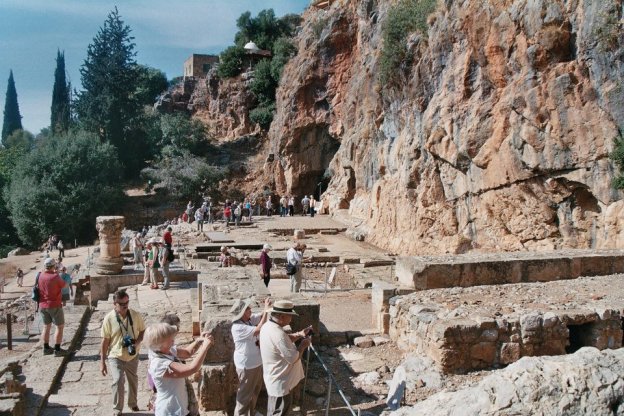
Jesus and His disciples are in the district of Caesarea Philippi. which is north of Capernaum, in the north of Israel, near the Syrian/Lebanon borders. Look at the cover of your bulletin, this is a temple of Zeus and Bacchus that was built by Philip the Tetrarch of this district. Philip was the son of Herod the Great, one of the few surviving sons. Since both he and his father owed heir titles to the Romans, they were careful to flatter the Romans to keep them happy and Philip built this temple to Roman Gods. Philip wasn’t exactly Jewish, he used his quasi Jewish status when it suited him and likewise switched to Roman “gods” when it suited his purpose. Philip married Salome, you might remember that Salome was the daughter of Herod and Herodias and after she danced for Herod asked for John the Baptist’s head. Yea, these people were more than a little messed up. Philip had enlarged the city and named it after Caesar and himself, which seems a little presumptuous. You can imagine, the Jews in this area hated Philip for his various offenses and saw this temple as a blasphemy, a sacrilege against their Jewish religion and they referred to this temple as the “Gates of Hell”. According to legend, this is where Jesus and the twelve disciples were camping when today’s reading took place. You can kind of picture them sitting around the campfire. Things are starting to come to a head, in the very next chapter the same Peter, with John and James are going to climb a mountain with Jesus and see Him transfigured and God the Father declaring Jesus to be His Son. For those who like to deny that Jesus is God the Son, seems pretty hard to dispute Peter’s confession, Jesus’ confirmation and then the Father confirming His Son. If Jesus isn’t God the Son, seems a big fuss is being made.
There are a few things going on in this passage and they might seem a little random.
Peter has his failures, and they’re pretty huge and he also has his high points, no question this is a high point. No doubt Peter is sure that this Jesus is someone pretty special. But when Jesus says “…who do you say I am”, Peter didn’t seem to hesitate. ‘Thou art the Christ, the Son of the living God.” Peter’s saying a few things here and this temple is the effective backdrop of this exchange. You are the promised one. Christ isn’t a name, it’s a title. The Hebrew word Mesi,an is the equivalent word of Christ or cristo,j which means anointed one. According to John MacArthur Mesian in the Hebrew: “refers in the Old Testament to prophets (1 Kings 19:16), priests (Lev 4:5, 16) and kings (1 Sam 24: 6, 10). In the sense that all of them were anointed with oil. This anointing symbolized a consecration for ministry by God. Jesus Christ, as the Anointed One, would be the ultimate Prophet, Priest and King (Is 61:1, John 3:34) … Peter declares his faith in Jesus as the promised Messiah.”1
Peter really stepped up and Jesus proclaims, “Blessed are you Simon Barjona, because flesh and blood did not reveal this to you, but My Father who is in heaven.” Jesus is saying that you are special Peter, God has chosen you to proclaim this, you know who I AM to the depths of your soul. Not because you had some great insight but because the Father chose you to declare that I AM the promised Messiah, the one who is the promised Savior of mankind.
Jesus builds on this, since you know this, I can also declare that I will build my church on your proclamation and the gates of Hell shall not prevail against My church. Church in the Greek refers to those who are called out, the Christian community of saints. Not just this building, or the Lutheran Church, all the saints, all those who are hagios, holy, separated people of Jesus, you.
If you look at this picture again, you might be able to tell that this temple has been carved out of stone, this whole thing is one big rock. So when Jesus says on this rock, on top of this pagan temple is where my church, my people will be. When I was there, hearing the tradition, I could almost see Jesus pointing over His shoulder. You see that big rock, that people here call the gates of Hell, my church is going to be built on this temple to false “god’s” and it will never prevail against My church, My church will always be on top.
I also took from this, that Jesus is making a direct reference to the idea that all false “gods” are of Satan. That all false “gods” are actually demons, evil spirits who have corrupted people to believe that they are “gods”. Jesus is saying that these false “gods” and we know that Satan is referred to as the “god of this world” John 12:31, 14:30, 16:11 will never overcome the Kingdom of Heaven.
In four more chapters Jesus will make His triumphant entry into Jerusalem to establish His victory over the world. He will be sacrificed then, He will die as payment for all of our sins and then will rise again in triumphant victory over sin and death. Sin and death are the very essence of Satan and His demons. They may rule the world now, but Jesus’ promise to His disciples and we are His … disciples, that in the end when it really matters He will defeat Satan and reestablish the world the way that God had created it.
In establishing His church, Jesus begins to empower His church. His church will possess the keys to heaven on earth. This means He has given His church the authority to declare what is sin and bind that sin. No other institution has that authority, only the church of Jesus, which the Lutheran Church certainly is. Our authority is based on Scripture and we bind or loose based on God’s Word. Because of God’s Word, we know what God has already bound, who He has locked heaven against. We are simply declaring what has been bound, and in a sense, enforcing that binding from what God has declared.
The world may try to deny the authority and even the legitimacy of the church, but Jesus has certainly declared the church’s authority in this passage. The church, made up of those who are separated, declared holy, will be those who have not just authority, but also responsibility to be the instrument of God’s will.
To those who ignore the church, deny the church has any real meaning, Jesus is clearly establishing His church. The disciples, represented by Peter, have recognized who Jesus is and that He is the promised One of God. He is the anointed One, anointed Prophet, Priest and King and now Jesus has established His church and declared that His disciples make up that church and they have the authority to represent Jesus. As His apostles, His sent ones they, and us, will do the things that the church is responsible to do, to declare the will of Jesus in the world. For those who think that “worship” is on the golf course or the beach, Jesus is saying these people are my church, they will lead in worship, do the work of the church. Anything else will only be personal preference and idolatry.
Take some time this week to think about how that looks, what does that mean to the world? Certainly it is proclaiming the Gospel, He who died to pay for our sins and who rose to give us the only way to eternal life. It is also going to those who are living a life that rejects Jesus and chooses to only be concerned with their own desires. The church is the institution that Jesus empowered to baptize, to be His instrument to bring people into the Kingdom of heaven. His church has been given the responsibility to offer the life saving Blood and Body of Christ. His church is responsible for preaching His proclaimed Word so that all will be able to hear the Good News of forgiveness and salvation in Jesus. Take some time to think of how that should look to the world as we exercise that authority here at First St Johns.
The peace of God which passes all understanding keep your hearts and minds in Christ Jesus. Shalom and Amin.

Awesome God First St Johns Lutheran Church August 10, 2014


We make our beginning in the Name of God the Father, and in the Name of God the Son and in the Name of God the Holy Spirit and all those who know that we trust and obey God and never rely on our own understanding said … AMEN
Pastor Cory Burma refers to the Rich Mullins song “Awesome God”, Burma says that Mullins was surprised that people were taking “awesome” in a contemporary sense, like amazing, or really cool. “awesome” means that God is “to be feared and loved, one who has done things our mind cannot fully comprehend.” 1
If we go back to chapter 1 in the Book of Job starts by saying “There was a man in the land of Uz, whose name was Job and that man was blameless, upright, fearing God and turning away from all evil.” Quick note, Uz was also where Moses lived for forty years.2 Satan reports into God, and seems a little random, but God pops up with: ‘Have you considered My servant Job? For there is no one like him on the earth, a blameless and upright man, fearing God and turning away from evil.” The Hebrew word translated “turning away”, means not just avoiding but even actively turning away evil influences. So what we see here is God not just commending Job for being so great, but actively pushing away the influence of evil. WOW! Wouldn’t that be great, if God was talking about you that way? Ya that Jim he’s such a great guy, not only does he live his life right, but he actively does things in order to rip out evil in his part of the world. I’d certainly love it if God talked about me that way. But Satan kind of challenges God on Job; sure Job’s great, everyone would be great if you set them up the way You’ve set up Job.
You might hear in Christian circles people praying that God will set a hedge about them. In other words that God will protect them and this is where the expression comes from because Satan says; “Hast Thou not made a hedge about him and his house?” (Job 1:10) Satan is saying; “of course Job is all righteous, he’s your fair-haired boy, you’ve set his life up to be perfect. Job knows where his blessings are coming from and so of course he’s going to be faithful and upright with you. But if you rip everything away from him then “he will surely curse Thee to Thy Face.”’ I couldn’t find anyone who would take a shot to say why God would allow Satan to go and stomp on Job, but there can be no doubt that God, in His sovereignty, has already set this whole thing up. I have no doubt that God wants us to know that He doesn’t have favorites, that He will subject us to trials, that no one is so “good”, that they are immune to the trials and tribulations of life.
Job is immensely wealthy and he has a lot to lose and almost immediately Satan swoops in and arranges for the Sabeans to attack and they took off with all Job’s livestock, and killed all his servants. Then a great wind comes and knocks the house that his children are in and kills all his children. What was Job’s response to what would seem to be this unfair treatment? Those words we have heard so often: “The Lord gave and the Lord has taken away. Blessed be the name of the Lord.” (Job 1:21). Wow! Job is a righteous man. Then God allows Satan to take Job’s health. At this point the advice starts pouring into Job. His wife says, the Driskell translation; “really, you’re still faithful to God? Just curse Him and die!” Advice Job rejects. Then his three friends come along; Eliphaz, Bildad, Zophar. What’s their answer to all of this? … Come on Job, you’ve obviously committed a really huge sin, fess up, ask for forgiveness and then trust God. Longman and Dillard point out that “The Three friends represent the age-old wisdom of retribution theology… God blesses the righteous; he curses the wicked. If so, then if Job suffers, he must be a sinner in need of repentance.”3 Now is that the case? Is Job being punished for some really humongo sin?… No! We just read at the beginning of Job what God Himself has said about Job: “…there is no one like him on the earth, a blameless and upright man, fearing God and turning away from evil.” Eliphaz, Bildad and Zophar are all wet, they don’t know what they’re talking about, yet they presume to make judgments for God. Not smart! Job even responds after Zophar’s speech to say: “Behold, the ‘fear’ of the Lord, that is wisdom; And to depart from evil is understanding.”(Job 28: 28) Job goes on through chapter 30 praising and extolling God and then, well, the cheese kinda slips off the cracker. “Hey it’s not because of my sin, come on, look at all these great things I’ve done to serve God,” really saying “hey I don’t deserve to be kicked around by God and I’ll tell Him all these great things to His face, ‘Behold, here is my signature; Let the Almighty answer me!… I would declare to Him the number of my steps”’.(Job 31: 35, 37) OK, now Job’s kind of stepped off the deep end, now he’s getting a little self righteous and ya, “maybe God does owe me an explanation, because I did all these great things and I don’t deserved to be kicked around.”
Elihu has stepped into the conversation now and he takes offense and finally someone is the voice of reason. He tells Job, woe now, just wait a minute here: “The Spirit of God has made me, And the breath of the Almighty gives me life.” (Job 33: 4) Let’s get a little perspective here Job and remember who created us and what He does for us. You have no right to demand an explanation. Elihu goes on four more chapters praising God and all that He is. Then finally what happens? … Ya, our reading today. God Himself steps in and says, woe, wait just a minute all of you and speaks to Job. “Hey, where were you when I created all things, where are you when I sustain all things. You have no clue the vastness of all these things. Who are you to get up into My grill and demand answers.” God goes on three chapters pushing Job and questioning him. Obviously Job is just overwhelmed, he has no answer to God’s questions and finally says: “But now my eye sees Thee; Therefore I retract, and I repent in dust and ashes.” (Job 42:5-6). God gave Job a four chapter beatdown, which applies to us also. Especially in this day and age when we think that science and technology have all the answers and we don’t need to rely on God. Read chapters 38-41, do you think you or any of our brilliant scientists have any answers to the questions God raises? No! Sure, we can still keep learning and searching, but keep in mind that there will always be questions that we will never know the answers to.
Take some time this week to first read chapters 28-30 in Job. See how Job glorifies God, even though Job has just been beaten down and maybe we might think unfairly, but in His sovereignty. “…we know, that God causes all things to work together for good to those who love God, to those who are called according to His purpose.” (Rom 8:28)
as Paul told us in our readings from a couple of weeks ago. From ancient Scripture God is using Job’s experience to teach us today that it’s not our understanding that matters, it is God’s will that matters and yes sometimes His will is really tough to accept. But in the end, it is God’s will who saved us through Jesus, His will, which we don’t understand, that caused Jesus’ suffering but for our deliverance. When we are Job, we don’t understand the need for suffering. When we are sinners in need of a Savior, then we do accept God’s wisdom, that wisdom that put His own Son on a Cross to die for our sins.
So yes, “Our God is an awesome God, He does reign from heaven above with wisdom, power and love, our God is an awesome God.”
The peace of God which passes all understanding keep your hearts and minds in Christ Jesus. Shalom and Amin.