Tag Archives: Jesus is Lord

We serve our neighbors in service to God

We’ve been talking about vocation in many ways at our Wednesday Coffee Break Bible study. Certainly our vocation in terms of our job, profession, position. Position can mean many different things in terms of our spouse, children, parents, siblings. Our position in the community. Any responsibility we hold in the church, on and on. Positions God puts us in, in His service, but to serve others. I’m sure we recognize that God doesn’t need our service per se. Jesus has done all that is necessary, and God sustains us in every way. We are in His service for what we do for ourselves and for others.

I serve by working to better myself in every possible way nutrition, exercise, study things that are edifying. We are in His service when we serve our neighbors. Surely God puts us into situations where our service to a neighbor would be pleasing to Him. In fact I would hope that we would do works to glorify Him, that others may know that what I did was a result of what God does to me and through me. So anything I do for another is only a result of the Holy Spirit in me.

Henry and Richard Blackaby “Experiencing God Today”, p 122: “God deserves our love and He demands that we love others in the same way He does.” And yes, I will say it again God’s love is of genuine concern for what is best for another, not this phoney, empty enabling love we think of today. What is in that person’s best interests and not ours. Believe me that is hard to do but that is the goal we need to strive for. Heck, in today’s world, anyone who even approaches that is doing more than anyone expects.

The Blackabys spell this out: “We are to love our spouses, not as they deserve, but as God commands (Eph 5: 22-33). We are to treat our friends, not as they treat us, but as Christ loves us (John 13:14). We are to labor at our jobs, not in proportion to the way our employer treats us, but according to the way God treats us. God is the One we serve (Eph 6:5).”

“Mediocrity and laziness have no place in the Christian’s life. Christians must maintain integrity at home and in the workplace… Our toil then becomes an offering to God. We not only worship God at church on Sunday, but our labor throughout the week is an offering of worship and thanksgiving to the One who has given us everything we have.”

How many times have you seen someone decide that they’re just not treated fairly and they do what amounts to be stupid things to strike back? And we all know how that works out. It bites them, it brings them a bad reputation and if people know they are a Christian, it always puts Christians in a bad light. “Our” work is “our” work. We may be getting what we think is a bad deal, but doing work that doesn’t serve our neighbor and reflects poorly on Christ and Christian brothers and sisters really ends up only hurting the people who you’ve professed to be in fellowship with and the Father. Do we really want people to think we are all about shoddy, half baked service? Sure we aren’t always going to be great, but we should make our best effort to be as good as possible and never be perceived as “tanking the ball”. Someone will call us on it and we’re the one who looks bad in the end. That certainly should be our perspective in our work and no less in our family and our church.

Our efforts should even be thought of as an offering to God, not in the sense of earning anything or buying anything, but certainly in the sense of Thanksgiving.

Even when others fail us, refuse us, treat us poorly, we continue to serve because our service is always given in thanks to God. Take a break during the week, Wednesday mornings, the coffee shop at the corner of W King and Beaver Sts in downtown York, Pa.  10am, park behind the church. I will even buy you your first cup of coffee. No charge, no obligation.

For God so loved all peoples, all heritages John 3: 14-21 First St Johns Mar 15, 2015

[For the audio version of this sermon please click on the above link]

We make our beginning in the Name of God the Father and in the Name of God the Son and in the Name of God the Holy Spirit, and all those who are brothers and sisters in Jesus said … AMEN!!

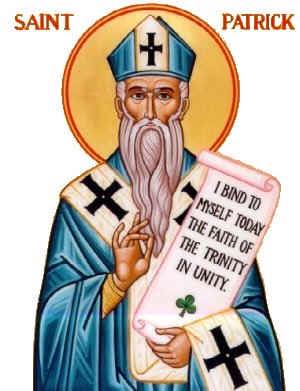
You may have heard me refer to St Patricks as the “high holy day”, if you grew up where I grew up, it would be easy to come to that conclusion. I went to the St Patrick’s Day mass in Boston, once. It was conducted, by then, Cardinal Law. You wanna talk “high holy day”, that was it. The worship service, for what was during the week, was very ornate and well attended. This was at the Cardinal’s seat at Holy Cross Church in Boston. Say what you will about the Roman Catholic Church, but I left there very much feeling as if I had been in worship.

The story is told of Mayor James Michael Curley of Boston. Mayor Curley was quite the character, sort of a Robin Hood figure at the time, which was pretty much during the depression. He couldn’t make March 17 a holiday for a Christian Saint, he tried to find an historical event to commemorate. He hit upon the fact that March 17 is when the British evacuated Boston during the Revolutionary War. Well the fact that our Boston ancestors drove the mighty British out of Boston wasn’t something that not only the old Boston Yankees would happily commemorate, but also the Irish-American population would also buy into. Call it what you would, there was a holiday on March 17 and we all know what it’s really about. Evacuation Day is still a recognized holiday in Middlesex and Suffolk counties where Boston is located in. And it is duly celebrated.

Heritage is an important thing, it should be shared and celebrated. Right here we have at least four different groups in First St Johns Lutheran Church that are very serious in the living and celebrating of their heritage and there is nothing wrong with that. In a society that has become so splintered and so alienated, I submit that those people who remember their heritage, share that heritage with others of the same group, make sure that their children, grandchildren and other relatives remember that and don’t surrender to what has become an increasingly homogenized society. As much as diversity is promoted in today’s society, it really is putting away ethnic and religious heritages, to be bound together under an increasingly secular and humanist heritage. Many talk a good game about heritage, the lack of knowledge of American and ethnic history is getting to be scandalous. Too many young people can’t even think in historical terms, as if what came before them doesn’t matter and yet has very much made them what they are. This lack of anchoring in our society, to our Christian heritage and our family heritage has left us with a society that is increasingly detached and alienated.

When you were baptized, you became a new person. In Baptism you are “born again”, you are given real life, in Jesus Christ, you are that new man or woman. Because of that you are born into a new heritage. You may be of German ethnicity or Irish or Spanish, African-American, Italian, but as the song says “…in Christ alone…” We share a heritage that goes back to the beginning in Jesus. As Paul wrote to the Galatian brothers: “There is neither Jew nor Greek, there is neither slave nor free, there is neither male nor female, for you are all one in Christ Jesus.” (Galatians 3:28)

Because it is the “high holy day”, I bring this up because I do try to make St Patricks a little special. I know it’s the middle of Lent and should be somber. Sundays, though, even in Lent, are still festival days on the church calendar. It’s odd how it works out and if you would like me to explain it, I will, but I see St Patricks as a way to kind of stay in touch with the culture that I was brought up in and even as a Lutheran was included in. I have to admit, being of Irish/Yankee ethnicity, makes me an oddball in the Lutheran Church. Although it’s not the only thing that does, but I see St Patricks as a way to remember not just our ethnic identity, but so much more importantly our identity in Jesus.

One reason that I have felt it was so important to recite the Apostle’s and Nicene Creeds with the word “catholic” is to emphasize that the Lutheran Church is very much a universal church. We should not concede that to any other church. We are universal and the Lutheran Church has members and churches in almost every country in the world. There are countries where Christianity is seriously repressed, so we really don’t know what church is or isn’t represented. The fastest growing Lutheran population in the world is not in the United States or Europe, it’s in …. Africa, by far. “…there are over 16 million Lutherans in Africa?  To put that in perspective, that’s more Lutherans than in all of North America. Unlike the Church in Europe and North America, Africa as well as Asia is seeing phenomenal growth in membership.” Put in perspective, from Dr Luther grew the churches of modern Protestantism. [1] Anglicans, Baptists, Methodists, genuine Protestant Christian, excluding Anabaptist churches, churches are the result of what Martin Luther did 500 years ago. We are all truly brothers and sisters in Christ. Often more brothers and sisters than the people that we share physical parents with.

I may use St Patricks Day to add a little twist into worship, I try to do it better, but it never seems to come about. But we have a shared heritage that far transcends what countries our ancestors were born in, we have a heritage that matters for eternity. Jesus died for all of us equally, we are all equally saved in Jesus, whether you were baptized last week, or seventy years ago. I am no more saved because I’m of Irish descent than you are of German descent, or Spanish, African American. In the eternal resurrection our heritage is solely in He who died so that we could be saved. He who is the Lord of our life, in this life and in the life eternal. “For God so loved the world that He gave His only Son…” World, ko,smoj in Greek means “…the inhabitants of the earth, men, the human race”[2] We are all brothers and sisters in the Holy Catholic, universal Lutheran church of Jesus Christ.

The peace of God which passes all understanding keep your hearts and minds in Christ Jesus. Shalom and Amin.

[1] See more at: http://www.messiahlacrescent.org/2010/09/lutherans-in-africa/#sthash.x7ApeFjD.dpuf

[2] BibleWorks

True disciples in Jesus, not phoney expectations

This is from Henry and Richard Blackaby’s Experiencing God Day by Day p 142: “James and John sought to outmaneuver their fellow disciples in order to gain the places of greater honor next to Jesus (Mark 10:37). Over and over the disciples’ actions showed that they did not truly understand who Jesus was (John 6:7-9; Mark 6:49). Even after three years with Jesus, Peter was afraid to confess Christ before a young servant girl (Matt 26:69-75).

Yea these guy’s definitely failed, but I respectfully disagree being in Jesus does not mean that we all of a sudden become lions for Jesus. As a Lutheran we certainly know that we become a new creation in Jesus. Baptism makes us a new man or woman, we have been born again in the Spirit a new creature. We absolutely do. But Martin Luther always cautioned that the old/worldly person would always be lurking waiting for the chance to jump in and assert itself.

When it’s not about Jesus it’s about me. I have no doubt that the ratio is well over fifty percent weighted to me. Sure they became new men on the day of Pentecost and we praise God for that. We do become spiritual beings in Jesus and the Holy Spirit does keep working on us.  I pray that we do respond to Him when we are called on, that we are raised up far more than we fail.  But the beef I have with Reformed theology falls in to works righteousness theology, that we have to become virtually perfect. This side of heaven we aren’t going to be perfect or even too close. I’ve talked to too many people who have given up, have despaired because some uneducated, self-proclaimed “evangelist”, who doesn’t know what he/she is talking about and makes it up. Who genuinely thinks he/she has reached some state of perfection and thinks everyone else should be. They just don’t know what they’re talking about. The Blackabys certainly are much better educated than me, but all Reformed theology still breaks down in this works righteousness and creates an environment where too many give up because they can’t reach an impossible goal of perfection.

I’m not saying give up and don’t strive. Christians should always be striving for Jesus. But don’t get sucked into this idea that you’re going to be perfect and have it all together. Too many have been spit out the “big box” church because of faulty teaching and faulty people. These are the kinds of Jim Jones/cult kind of thinking that causes serious spiritual dysfunction. The fastest way to truly die is to let your spiritual life be undermined.

Look at ISIS, all the places where Christians are truly persecuted and truly living for Christ. They don’t have the time and resources for big box Christianity, the Joel Osteen, Mark Driscoll, nonsense. We have brothers and sisters in Africa, Asia who have and continue to suffer persecution. While people sit in their non-denominational big boxes being amused and convinced they’re perfect just by virtue of being them, the denominational churches, the ones who live the life and put it on the line are out there truly serving. I wonder when non-denominational churches are going to be sending military chaplains who are right on the front line. Who are going to do the work of Lutheran World Missions, for those who sit in pretty sanctuaries, world pleasing sanctuaries.

The big box phoney churches can try to sell that you need to be perfect, but for those who are living the life by actually serving, who are suffering, who know the real world of Christianity, we aren’t perfect. Dr Luther knew the old man, and I certainly have never known a Christian more real than Martin Luther. We need to quit creating phoney expectations that are not Biblical and are only in the head of some self-important big box player to the crowd. Let’s stand up as true brothers and sisters in Jesus accept that we and those around us are fallible and go out and really live the life in Jesus. Let’s not set people up for failure which the big box churches are doing.

It’s about God and brothers and sisters in Jesus, it’s not about you

I was listening to J Vernon McGee while I was reading this devotional by Henry Blackaby and I noticed how the common thread was “it’s not about you” or me, it’s about God!

Dr McGee was answering the tire old nonsense “a loving God wouldn’t send anyone to hell.” I really wish people would think a little more and quit with the simple little cliches. People love to say how much smarter they are than everyone before or now. It’s not true. Dr McGee points out that God is loving. He is also righteous, just and holy.  He has given us a way to be saved unlike any other belief system, but it has to be on the basis of salvation in His Son. But in our day and age when we think it’s all about us, we think God is supposed to take whatever we offer Him. No! It’s not your way it’s God’s way.

We are holy in Jesus.  In Jesus we are in the presence of the Lord, God is holy. That means set apart, sanctified. He will not accept anything less, His nature abhors anything less. The “ONLY” way we can be holy is through God the Son. There is no other way. Jesus said “no one comes to the Father except through Me.”

Dr Blackabys devotional was on how what we do and don’t do affects other Christians. We should act only after we consider how our actions will affect other Christians. When we sin “Sin promotes independence. It isolates you from others… God designed you for interdepenence.”

We do have responsibility to our brothers and sisters in Jesus. But that does raise the question in terms of those who aren’t in Jesus. The Acts church was solely focused on only supporting fellow Christians. The church I pastor does reach out to help, but frankly there’s only so much we can do and we have a responsibility to help brothers and sisters. I think we should be very discerning in who we help because we just do not have the resources. The church at all levels does so much with so little for so many and yet the average secularist (who statistically) does very little for anyone else still likes to wag their finger at the church. Yes those same people who love to say how non-judgmental they are.

The take away is this.  It’s just not about you. If you really don’t understand what God is about, you better not go around making statements about what God will or won’t do. I mean come on that’s just stupid. God gave His Son for our salvation we are saved in Him or we condemn ourselves.

We need to remember when we sin, it’s not just about us. Our sin reflects on and affects countless numbers of other Christians. And we should be in service, but primarily to brothers and sisters in Jesus. We are guided by the Holy Spirit to help others but we are focused on serving those who are in Jesus.

Dr J Vernon McGee weekly question and answer podcast for March 14, 2015

“experiencing God Day by Day Henry and Richard Blackaby  p 130

Death Cafes Mark 8: 27 – 38 First St Johns, York, Pa March 1, 2015

For the audio version please click on the link above.

We make our beginning in the Name of God the Father and in the Name of God the Son and in the Name of God the Holy Spirit and all those who know that death in this world is only the beginning of life in the Resurrection said … AMEN!!

I’ve got news for youse, in case you didn’t know it, the world just keeps getting weirder. Shawn Kumm writes about nice little dinner parties that are becoming popular. There’s all the trappings china, linen, small sandwiches, pastries, comfortable coffee house setting, these are known as “Death Cafes”. These started in 2011 by an Englishman named Jon Underwood. “The stated objective is ‘to increase awareness of death to help people make the most of their (finite) lives”. I’d say to check it out, they of course have a website deathcafe.com. “Groups gather together to discuss death over refreshing drinks and nourishing food – and cake -.” Hey we’re all going to die, we might as well eat cake. Pastor Kumm goes on to say “but, ‘with no intention of leading people to any conclusion … or course of action.”[1] Well of course, because heavens, it’s the post-modern age, whatever we say goes, and we’re just going to have our nice little designer eternity, fit to our specifications. Folks, people really live these kind of deluded lives. We have a world that really is out of control. We can’t even stop the radicals in the Middle East who continue to burn alive, decapitate, bury alive, brother and sister Christians. Yet we have those who live deluded, self-obsessed, degenerate lives, sitting around and having little coffee parties, talking about death and coming to no conclusion, but being sure that things after death will be just fine.

In today’s reading Jesus tells His disciples, for the third time: “…the Son of Man must suffer many things and be rejected by the elders and the chief priests and the scribes and be killed…” It’s as if the disciples, like those in their delusional little coffee klatches, simply remain in denial. To the extent that Peter, and yes I really do love that guy, he is a stand up guy and then drops the ball again. A few lines earlier, Peter is confessing exactly who Jesus is, “You are the Christ.” In Matthew’s Gospel Peter goes on to say: “…the Son of the Living God.” Everyone of those disciples that heard Peter’s confession, knew exactly what he was saying. This is Messiah, Mesheach, this is He who has been promised since the beginning of God’s revelation. He’s not another prophet, who were all men. This is God the Son, the Son of the Living God, David’s Son, David’s Lord, He who is the salvation of the world. Jesus has told them twice already, that He would die. Granted, He didn’t exactly fill in the blanks of what His death and resurrection meant to them, but regardless, their reaction was a sort of, … yea OK, but is it possible you might be overreacting just a little.

There’s Peter and he has stepped right up, inspired by the Holy Spirit, but let’s face it, many people have been inspired by the Holy Spirit and have fumbled the ball. Not Peter! I’d like to think that he knew where the inspiration came from and was not going to be denied. Jesus tells Peter in Matthew, “yup you got it, you have been blessed to know exactly who I AM.” But then Jesus, the Son of God, the Messiah, adds, for the third time, having said that and being recognized as the promised Messiah, men are going to take me, beat me, torture me and then kill me. Well Peter likes the Messiah idea, but ya … no, the killing thing, well that just doesn’t fit into his, still, worldly paradigm. The Messiah is going to physically lead all his followers, as His father David would, and drive out the hated Romans and establish God’s kingdom here on earth. Peter is just not at the point where he can understand anything but that Israel needs to be delivered in the here and now. He cannot grasp Jesus’ eternal perspective. Oh yes, the Kingdom of God is here, Jesus is saying I AM here, but the plan is that the Kingdom of God is not yet recognized.

While Peter gets who Jesus is, that He is the Son of God, Peter takes it upon himself to let Jesus know the being killed part just doesn’t work for him. That Jesus is going to stay alive and be the conqueror king. Jesus certainly will conquer. But not according to Peter’s agenda and drive out the Romans. Jesus will conquer death! He will overcome the true enemy of man, He will be the agent of God’s plan to reconcile man to Himself. He will be the propitiation, the payment, the Redeemer of all our sins. Those who are in Jesus will still be in the world, but now we will be saved from the world. We will now be delivered from the world of death, disease, suffering, evil and in our baptism in the Triune God, be adopted into the family of God, reborn into the Spirit. Still in this world, but now new creations in relationship with God the Father, redeemed by God the Son and guided in this world by God the Holy Spirit.

Jesus has to drive these things home. According to Mark’s Gospel, in chapter 10, they were on the road going up to Jerusalem. In just a few days will be the triumphant entry. Jesus will enter into Jerusalem riding on a donkey. This is no small thing, he will be hailed by the crowd, cheered welcoming the Messiah, but not in the sense that Peter expects. They are welcoming Him who will deliver them from the Romans. In today’s reading Peter takes Jesus aside to set Him straight; He’s not going to be killed, Peter doesn’t say it, but when Peter criticizes Jesus, it’s to tell Him, “no, you’ve got it wrong, this is going to be the Kingdom where we all rule with you.” The Concordia Self-study Bible’s reads: “Peter’s attempt to dissuade Jesus from going to the cross held the same temptation Satan gave at the outset of Jesus’ ministry (Matt 4: 8-10).”[2] Jesus’ 40 days in the desert, being tempted by Satan: “All this I will give you, he [Satan] said, ‘if you will bow down to me.’” Peter is saying as much as Satan said: “Forget all that dying stuff Jesus, we can do what’s really important, rule the whole world. Don’t worry about salvation for all those people. What’s dying going to do? What’s important is ruling and running Your own agenda.” Of course what would that mean to them, to us, to people all down through history? Jesus didn’t die for us, He didn’t redeem us, He didn’t pay for our sins? The only thing affected is this part of the world and we are not saved in Jesus’ death. Jesus came to redeem us from death, from all the evil of the world, to redeem our sins and give us the promise of eternal salvation. He made that very clear to Satan in the beginning of His ministry and now as that ministry comes to an end Jesus makes it very clear to Peter and by extension us. Certainly Satan was not happy being stripped of his authority and surely Peter wasn’t happy that his vision of Jesus’ ministry wasn’t going to occur. Of course Peter, all the disciples, would be filled with the Holy Spirit and they would come to know how they were saved and they, like us, would know the promise and hope of Jesus in eternal salvation in the resurrection.

Sad, isn’t it? Those people at the coffee houses, who subscribe to deathcafe.com. They don’t have that hope and promise. They think they can talk death to death and they will have their very own designer eternity, probably sitting around a coffee house in their superficial, phoney, non-existent, little eternity.

Sorry to say, they will be lost and condemned. They refuse to be guided by the Holy Spirit to true life in the resurrection and think it’s all about them. So take out that journal this week. Really pray over what Jesus has said, remember that He is summing up His earthly ministry and preparing for His death. He doesn’t want to endure this, but through His love for us, that agape, sacrificial love He has for us, that His Body and Blood will suffer and be spilled as the sacrifice that will conquer all and give us the hope and promise of eternal life in the resurrected world. Write about what that hope means to you and how you can give hope to those you know through Jesus Christ.

The peace of God which passes all understanding keep your hearts and minds in Christ Jesus. Shalom and Amin.

[1] Shawn L. Kumm  “Concordia Pulpit Resources” Vol 25, Part 2, Series B, p 6

[2] Concordia Self Study Bible p 1518

Temptation Eyes James 1: 12-18 First St Johns Feb 22, 2015

We make our beginning in the Name of God the Father and in the Name of God the Son and in the Name of God the Holy Spirit and all those who have remained steadfast under trial said … AMEN!

In the early 1970’s, one of the first songs that I remember as a teen, ironically, was by a group called the Grass Roots, titled “Temptation Eyes”. It was a hard driving rock song, which, really characterizes temptation. For me, temptation is sort of this hard driving, almost drilling into you this desire, you just have to have it. The lyrics, for a secular song, really do give you a sense of temptation. “She’s got something that moves my soul…”[1] A secular song talking about something that reaches right down into the soul. This temptation that is so compelling is moving this singer with a hard rock rhythm.

Have no doubt that when Jesus was being tempted by Satan, Jesus was feeling temptation that was drilling down into Him. The desert is not a welcoming place, it’s hot, it’s dry (unless of course it’s snowing and freezing rain in York, then it’s almost inviting.) temptation for shelter from the sun, for cool, refreshing water, for food, is compelling in the desert. But as the writer of Hebrews tells us: “For because he himself has suffered when tempted, he is able to help those who are being tempted. This passage assures us that Jesus did suffer. He felt temptation deep down. He knows that we are tempted and He knows that temptation can steer us to things that aren’t good for us, that take our eyes off of Him who is our hope and promise. But also because of this we know that we can trust Him.

Too often we deal with things in our lives that reach down into our soul. Others will try to give us comfort and assurance, “oh it’s nothing”, we can stay strong and cope. It’s a big difference between men and women. There are things women contend with, that they are tempted by, that as men we just don’t get. We just cannot empathize with the compulsion they feel. And certainly vice versa. We can tell each other nice things, and think that we are helping, but too often we really aren’t and may be aggravating the situation. However, with Jesus, based on James’ words and of the writer of Hebrews, we are assured that Jesus understands. Too often we get an image of God as angry and vengeful, just waiting to strike us down when we are even so much as tempted. That is God to many, to those who are not saved in Jesus. But we, who are saved in Jesus, who are born again as new men and women, saved in Christ, we have a Savior who understands, who wants to help us push back against temptation before we are overwhelmed and give in. Temptation is not a sin, Mark tells us that Jesus was tempted (Mark 1:13), we certainly know that Jesus did not sin. But for us, who are weak in ourselves, it is much too easy for that temptation to push us into something that is sin. James writes: “…each person is tempted when he is lured and enticed by his own desire. Then desire when it has conceived gives birth to sin and sin when it is fully grown brings forth death.” (Jas 1:14-15) Temptation is all around us, the Ben and Jerry’s you know is in the freezer, anger, vengeance, doing things that hurt you and someone else. Turn on the television, computer, books, magazines, its everywhere. When we give in to sin, we come up with excuses and rationalizations that push Jesus away and make that sin an idol, and then we cross the line and commit sin.

Our Savior understands that, He’s not standing over us just waiting for us to make that wrong move, that gotcha. He has been there, in this time of Lent we remember His time in the desert. From that Jesus can relate to those who are His, because, as the writer of Hebrews pens: “For we do not have a high priest who is unable to sympathize with our weaknesses, but one who in every respect has been tempted as we are,…” (Heb 4:15), but then goes on to say, “yet without sin.”

Jesus knows what confronts us, He does relate to us. Even more, if we let Him, the Holy Spirit will reach down and strengthen us. We often think of that sin as a treat, we pooh-pooh things like over indulging in food. It’s not healthy for us, it’s weakening our body, it makes us less able to serve Jesus and our brothers and sisters in Jesus. Sure in moderation, but in this day and age? We are not a moderate people. Have you seen Ben and Jerry’s concoction, formulated by Jimmy Fallon, it puts me into a diabetic coma just looking at it.

It does make you wonder, why Satan would even try with Jesus. Satan knows as well as anyone how this is going to end up. But he wants us to fail. He wants us to quit. Clearly Jesus had come into the world to mess up Satan’s plans and schemes. You can’t expect Satan to just twiddle his thumbs while Jesus undoes all the evil and sin of the world. You can’t expect him to give up, he wants to unravel the world, he’s condemned, he wants everyone condemned. So he had to push back against Jesus. But Satan isn’t normally over the top, he’s not usually in your face. He is usually subtle, continually trying to undermine us. He’s putting temptation in front of you so that you will quit and give in. You will stop caring about what Jesus wants and only focus on the object of your desire.

Writing about our vocations in life; work, family, church, community; “Wingren says that ‘Temptation in vocation is the devil’s attempt to get man out of his vocation” (121) Dr Gene Veith goes on to write: The devil wants you to quit. He wants you to quit your job. He wants you to get a divorce. He wants you to stop doing things for that ungrateful bunch at church. He wants you to tell your kids to ‘Do whatever you want to do. I give up.’ He wants you to leave that congregation because it’s nothing but trouble.”[2] Is that not the world we see today? Left and right we see this giving into temptation. Not just the obvious temptations, lust, gluttony, greed, anger etc. The more subtle temptation of giving up. Why try? The government will provide for you, some relative will provide for you, the church, should, provide for you. Why try at work? People are just mean to you there. Why try in your marriage? If someone doesn’t make you happy, dump ‘em. Why try with your kids, they’re just going to do what they want. Why try with your church? The pastor is hopeless, nothing good is happening and of course, we know that the church is just full of hypocrites anyway.

Yea, the quitter mentality we see in the world today. You can give into the world, you can let Satan lead you away and give into the temptation that he waves in front of you to quit, to give up. Jesus could have quit out in the desert, just packed it in, “hey, not my problem, they’re going to have to deal with this temptation stuff themselves.” He didn’t! He was faithful to you, to make sure you had that hope and promise that you have a Savior who will not quit on you. He gives us the faith to continue to trust in Him, but we just go ahead and chuck it? Then what? Revelation chapters 2 and 3, Jesus is telling the readers that they will face terrible tribulation. Jesus promises the one who overcomes: “The one who conquers and keeps my works until the end, to him I will give authority over the nations… He will be clothed in white garments and I will never blot out his name out of the book of life. I will confess his name before my Father and before his angels…Hold fast so that no one will seize your crown… I will make him a pillar in the temple of my God…” Read chapters 2 and 3 in the Book of Revelation. He warns us, but the promises He makes to those who are faithful, are eternal and overwhelming.

The great thing is, Jesus doesn’t leave us to our own strength to overcome temptation and sin. We know we have His promise to defend us, to protect us, to give us the faith we need. But how sad is it, when He is standing there protecting us and we just run away, concerned only about ourself? Mandisa is a great Christian rock singer, these lyrics are from a recent song:

“Everybody’s been down Hit the bottom, hit the ground, Ooh, you’re not alone
Just take a breath, don’t forget, Hang on to His promises, He wants You to know

You’re an overcomer, Stay in the fight ‘til the final round, You’re not going under
‘Cause God is holding you right now[3]

Be an overcomer, don’t give into temptation. The lyrics of the Grass Roots song are instructive: “But she lets me down everytime, can’t make her mind she’s no one’s lover…” Temptation will always let you down, will fail you. But Christ will always strengthen you and save you. You can continue to deal with temptation or be an overcomer.

The peace of God which passes all understanding keep your hearts and minds in Christ Jesus. Shalom and Amin.

[1] Grass Roots  “Temptation Eyes”

[2] Gene Veith “God at Work” quoting Wingren “Luther on Vocation”

[3] Mandisa “Overcomer”

Is the Gap Between Pulpit and Pew Narrowing? Latest Research from LeTourneau University

Is the Gap Between Pulpit & Pew Narrowing? Read about the Latest Research

Dallas TX: New research conducted by the Barna Group for the Center for Faith & Work at​ LeTourneau University shows a substantial uptick in the number of pastors who say they preach on work. However, most church-goers still doubt the significance of their work to God.

“While American church-goers hear more sermons on work these days, there’s still a gap between what’s preached from the pulpit and what’s grasped by those in the pew,” says Bill Peel, Executive Director.

The research revealed that 70 percent of Christians do not see how their work serves God’s purposes, and 78 percent see their work as less important than the work of a pastor or priest.

Jim Mullins is a pastor who’s been pondering this breakdown of communication between the pulpit and the pew. In an insightful article, Mullins tells how one of his parishioners—a biomedical engineer who developed devices to help doctors detect early-stage cancer—was considering a career change to become a pastor or missionary. He told Mullins, “I don’t want to waste my life. I want to do something that has real significance, where I can glorify God and actually love people.”

Mullins says this faulty perspective was not for lack of hearing sermons on God’s view of work. He writes,

At our church, we preach the lordship of Christ over all aspects of life, offer classes about the theology of work, and repeat our favorite phrase every Sunday: “All of life is all for Jesus.”

After mulling why the message about the broad scope of the gospel and its implications for work wasn’t getting through to the engineer, Mullins had a revelation.

I realized that the issue wasn’t with what he heard, but with what he saw. He frequently heard teaching about the importance of vocation and all-of-life discipleship, but he never saw anyone’s work—apart from pastoral, missionary, and nonprofit work—publicly celebrated.

Pastors are awakening to the importance of helping people integrate faith and work. But it’s going to take more than sermons and classes to inculcate a biblical theology of work. Like the engineer, most of us need not only to hear that our work is important to God, we need to see it honored and celebrated as well.

Over the past four years, Barna Group research commissioned by LeTourneau University’s Center for Faith & Work has uncovered some important trends.

In 2011 our research …

  • Nearly all (93 percent) of pastors said that helping people integrate faith into daily work is “very important.”
  • Two-thirds (68 percent) of those pastors questioned their understanding of workplace issues.
  • Only half (49 percent) of churchgoing, employed Christians “strongly agreed” that their church provided information, guidance, and support to live out faith at work.
  • One in four (26 percent) of pastors said their sermons addressed faith at work.
  • Fewer than one in ten (8 percent) of pastors said they provided prayer support for workplace issues.
  • Only a fraction (3 percent) of pastors reported visiting their members at work.

Fast forward three years and note increases our new research reveals.

In 2014 …

  • Over one-third (36 percent) of senior Protestant pastors say they preached a sermon on what the Bible says about God’s view of work within the past month.
  • An additional 36 percent say they have preached on work in the past six months.
  • In all, 86 percent of pastors have preached a sermon within the last year that focused on what the Bible says about God’s view of work, and specifically on how one’s faith should impact one’s work.

According to Peel, “These findings indicate a significant surge in the attention pastors are giving to the importance of faith and work—an encouraging trend indeed! However, there’s a still a gap between what parishioners are hearing about the importance of their work to God, and they are seeing.”

The new research shows that, apart from pastoral and missionary work, little attention has been paid to publicly celebrating the work most parishioners do between Sundays.

  • During the last year, fewer than one in five (18 percent) of churches publicly dedicated or commissioned their members to serve God in the places where they work.

“I believe that this gap between what is preached and what is celebrated continues to cloud how people assess the value of their work to God,” says Peel.

  • Over two-thirds (70 percent) of Christians still cannot envision how the work they do serves God.
  • Almost four out of five church-goers (78 percent) doubt that the work they do is equal in importance to the work of a pastor or priest.

“Clearly, increased preaching and teaching about faith and work is a positive, praiseworthy step, but much more is needed. Churches must become fully engaged in shaping people spiritually for the workplace. A powerful next step is to schedule time in worship services to publicly celebrate all kinds of work that advance God’s creation,” advises Peel. “This simple action can help people connect God’s truth with their work in life-changing ways.”

Find ideas for conducting a commissioning service by clicking here.

ABOUT THE RESEARCH

The 2014 data about pastors originated through research conducted by Barna Group of Ventura, California. The questions were commissioned by the Center for Faith & Work at LeTourneau University. The PastorPollSM included 602 telephone interviews conducted among a representative sample of senior pastors of Protestant churches from within the continental U.S. The telephone interviews were conducted from June 3 through June 13, 2014. The sampling error for PastorPollSM is +/-4 percentage points, at the 95% confidence level. The cooperation rate in the PastorPollSM was 96%.

The 2014 data about church-goers originated through research conducted by Barna Group of Ventura, California. The questions were commissioned by the Center for Faith & Work at LeTourneau University. The OmniPollSM included 1,036 online surveys conducted among a representative, nationwide sample of adults ages 18 and older.  The online interviews were conducted from September 2 through September 10, 2014. The sampling error for OmniPollSM is +/-3.1 percentage points at the 95% confidence level. The participation rate in the Fall 2014 OmniPollSM was 95%.

The 2011 data about pastors originated through research conducted by Barna Group of Ventura, California. The questions were commissioned by the Center for Faith & Work at LeTourneau University. The PastorPollSM included 646 telephone interviews conducted among a representative sample of senior pastors of Protestant and Catholic churches from within the 48 continental United States. The survey was conducted from May 26, 2011 through June 20, 2011. The sampling error for this PastorPollSM is +/-4% at the 95% confidence level.

The 2011 data about church-goers originated through research conducted by Barna Group of Ventura, California. The questions were commissioned by the Center for Faith & Work at LeTourneau University. The OmniPollSM included 1,007 telephone interviews conducted among a representative sample of adults over the age of 18 within the 48 continental states. The survey was conducted from August 1, 2011 through August 14, 2011. Only those adults who self-identified as Christian or Catholic, who attended church in the past six months, and who were employed full-time or part-time qualified to participate in the module of questions for LeTourneau University. In this study, a total of 350 adults qualified to participate. The sampling error for a sample of this size (n=350) is plus or minus 5.2 percentage points, at the 95% confidence level.

– See more at: http://www.centerforfaithandwork.com/node/804#sthash.ndE6cXFa.dpuf

Christian creeds, what we really vow to truly believe before God

I did a post yesterday based on an article in Leadership Magazine about “Evangelcial Christian” churches who just dispense with Christian worship. They call it worship but is it? When you don’t even do the basics of Christian worship? Please feel free to check it out and let’s talk.

In the meantime, in my other reading I’m reading a book titled “The Catholicity of the Reformation”. That Dr Martin Luther really had no issue with Roman Catholic worship the liturgy, for the most part. What he had a problem with was the doctrine and traditions that had grown up in the church.

The book by Carl E Braaten and Robert W. Jenson discusses how much even liturgical churches have slid into American Evanglical Chritianity, as it were. It’s a regular issue in the Lutheran Church that some pastor is making worship too Catholic. I know what that means, but I don’t think the person(s) saying it really knows what it means. If worship is getting liturgical, that’s not a problem in the Lutheran church. Luther never proscribed the liturgy, he frankly encouraged it. But the American Lutheran Church has become so affected by American evangelicalism that it really has lost its identity. The liturgy in the Lutheran Church faithfully lifts up Scripture and true worship. It is what we should be doing and not getting into what was frontier/camp meeting “worship” led by, often, self- appointed “preachers”. Generally there were too many preachers that were uneducated, didn’t really understand the Bible, doctrine and the purpose of actual worship. They made a bunch of nice-sounding noises and played to the crowd, but did little real teaching and no one really knew to keep them accountable. Hence, today, we have all sorts of nice sounding stuff, that has little with actual Christian worship. Oh, I can hear it now,  “yada, yada, that’s your opinion, we can do what we want, yada, yada” which only illuminates the speakers lack of understanding of Christian worship.

One thing that particularly caused me agita (although I don’t think I can ever get over the idea that a “Christian” church doesn’t included the Lord’s prayer in worship!!!), was the lack of a creed, confession. In this day and age when all sorts of organizations, from Fortune 500 companies, huge government agencies, down to the smallest organizations, are told to develop mission statements and mottoes, to think that the Christian church shouldn’t be likewise focused is just stunning!

Braaten and Jensen write: ” The function of the creeds and confessions is to provide standards by which the church can judge and condemn false teaching contrary to the gospel.” (p 59) Would any knowledgeable Christian disagree with that? Really, how could you disagree? They go on to point out: ” …heresy has become virtually outmoded in the modern church…” Would any of the same people disagree with that? No! Yea, guess I’m going to be a little catty here, but when we join together as the Body of Christ and recite a creed (Apostles, Nicene, Athanasian) we are making a vow, before God, in terms of what we genuinely believe. So my catty comment is; Why don’t so many churches (many flat-line, uhmmm, I mean main-line) say the creeds? Because they know their teachings are false, and they’re at least smart enough to not offend God any further, by making false promises. Do I give them credit for at least a little integrity?

The writers go on to say: “…the enlightenment brought the age of tolerance in which the rules that set limits to heresy were overthrown. Orthodoxy was put on the defensive. Heresy become a matter of religious freedom and human rights. The threat of heresy to personal salvation that prevailed in the ancient church was annulled…Dissent was permitted so long as it did not break the unity of the church. Not heresy but schism became the more serious concern. To prevent heresy from leading to schism, the churches today, maintaining their organization unity at almost all costs, have taken to promoting inclusivity and diversity at the expense of revealed truth and biblical morality, pushing back the limits to heresy, to the point where people are ‘tossed to and fro and blown by every wind of doctrine’ (Eph 4:14)

I know, maybe another cheap shot, but certainly Mark Driscoll and Mars Hill comes to mind. But certainly so many other “Christian churches” who become much more  about other things. The Mormon Church is much more about big business. Churches that are all about their pastor, their building, their… You name it. But are just not about real Christian doctrine. Why don’t they want to get into creeds, because genuine Christian worship is just not what they’re about.

Yea, I’ve singled some out, but this is so widespread that the actual orthodox Christian churches are the ones that are perceived as odd-ball and the rest of the churches are seen as “real” Christian churches. The result of that is a cynical perception of the church by the general population. If the big churches really don’t teach Christianity, and they must be representative because they have all the money and people. Well then the church is actually just a feel-good-rah-rah operation. To most people that translates into phoney and I’m certainly not going to disagree. But for those churches that are genuinely Christian, who do lift up the creeds, who do the things in worship that do turn us to God, who do lift up Jesus as the atonement of our sins and the Lord of our salvation, solely because of His works, they are lumped in with the phoney. That is not a desirable result for any church, or believer.

Maybe those “churches” and all who claim to be true Christian churches might start getting on track and we might be able to all make a true witness to the rest of the world of genuine Christianity, to our Savior Jesus Christ, by making it regular practice to profess a genuine/historical creed (Apostles, Nicaean, Athanasian) Come on, really impress everyone and take time once per month to do the Athanasian Creed. Look it up.

Do you go to Nineveh or blow off God? Really? Jonah First Saint Johns January 25, 2015

We make our beginning in the Name of God the Father and in the Name of God the Son and in the Name of God the Holy Spirit and all those who follow God’s lead, even to their own Nineveh said … AMEN!

The Ninevites were bad people, to quote Charles Dickens you must remember that or nothing good will come from what I tell you, they were very bad people. Jonah had every reason in the world to avoid going to Nineveh. Side note, up until the 1800’s scholars chocked the entire Jonah story up to fable, one reason being that they felt that Nineveh was a myth, that it had never existed. Well surprise, archeologists found it and it does exist. In fact it was a very important city, to deny it existed, as many skeptics today try to deny many aspects of the Bible, would be to deny a great deal of antiquity.

Nineveh was a great city for it’s time. The writer of Jonah says: “Now Nineveh was an exceedingly great city, three days’ journey in breadth.” It’s estimated that it had a population of 120,000 people. By today’s standards, that’s really a small city, York has a population of about 50,000, Boston has about 600,000, New York City over 8 million. But for a time when most people farmed or raised livestock, most people didn’t live in a city, it was pretty huge. We have to remember that cities really didn’t become so massive until the industrial revolution and even then not until the early 1900s, when people went to cities to work in factories. Are there difficulties with the Jonah account? Yes. There are really no whales in the Mediterranean and it’s hard to reconcile what kind of “fish” would have swallowed Jonah. There are accounts of men, in the whaling ship days, who were swallowed by a whale and recovered, but can’t really make that case with Jonah. But when we are talking about God, who made all and sustains all of creation, I think it’s a small thing that He created a fish to turn Jonah around.

Nineveh was the capital of the Assyrian Empire and as I said, they were, straight out, bad people. A Wikipedia article quoting King Sennacherib about a recent military victory: “ “Its inhabitants, young and old, I did not spare, and with their corpses I filled the streets of the city.” The Wikipedia article also refers to stone carvings of “many battle scenes, impalings and scenes showing Sennacherib’s men parading the spoils of war before him.”1 These were not nice people. Jonah had every reason in the world not to go there, chief among those reasons was, that he may not come out alive. That was a very real concern. But, as the Chronological Study Bible points out; “Two features stand out in the book’s theology. One is the universal love and compassion of God for all nations. Another is the sovereignty of God.”2

A case could be made that Jonah was written about 700 BC. As I said the Assyrians were widely hated. The Chronological Study Bible states: “Few armies were as hated as the Assyrian army. Even in a time and culture that was not known for respecting human life, Assyrian tactics and policies toward their enemies were notoriously brutal.”3

So when we wonder what the point of this story is about, it certainly has to do with faithfulness and obedience. When God calls us to do something, many times He sets up the circumstances to make sure that His something gets done. If it takes an extraordinary story of a man being thrown into the ocean, swallowed by a big fish, delivered up to the destination that He wants Jonah delivered to, to drive home the point that God’s will is to be done and He can put us where He wants us, then so be it. Even if it’s to a people who are widely hated. You also have to remember that at this point in history, the people of Israel saw God as the universal God, as the creator of all, but still, somehow, thought of Yahweh as their God, exclusively in favor of Israel. Nineveh was the center of worship for the goddess Ishtar, who the Ninevites worshiped. Odd contrast, the Ninevites considered her the goddess of fertility, love, war and sex. I suppose you could reconcile some of those together, but for pagan “gods”, that seems to be a rather wide portfolio. Obviously war, among other things was a priority for the Ninevites/Assyrians. Going to a pagan people to tell them about the real God must have struck Jonah as plain crazy.

Rev Stephen Gaulke writes in Concordia Pulpit: A Sunday school teacher asked her class, ‘What can we learn from Jonah?’ One girl blurted out, ‘When whales swallow people, they get real sick?’”

I was with a group of pastors when I heard that silly Sunday School story. One pastor told the punch line, ‘People make whales really sick.’ Another pastor joked, ‘That’s funny, I always thought the point of Jonah’s story is you can’t keep a good man down!’

Jonah went to Nineveh not because he thought, ‘I’m a good guy.’ He painfully knew, ‘ I was the bad guy, running from God?’ And Jonah joyfully believed, ‘God loves me anyway. The Lord forgives me, gives me new life. He’s the God of second chances!’

What do you think? ‘I’m better than the person God wants me to help? No. The only difference between us and them is that we know who gives life, who forgives!’”4 And I might add that in gratitude, if the Father wants to use me or you, anyone, to see God’s forgiveness and salvation, can I really in good conscience refuse to do what God is guiding me to do? No!

Jonah by his actions said to God; “Forget it, I’m not going to Nineveh. Those people are evil! Go ahead and destroy them! They deserve it! They don’t deserve grace, they deserve to be nuked and I’m not going!” I really can’t say that Jonah was wrong. I can’t say that if God put me on a boat to North Korea or some place in the Middle East, I would certainly have mixed emotions, if not outright rejection of the idea. But God does push on us, if we are a disciple of Christ, if we have received grace and forgiveness from our baptism and from Jesus’ sacrifice on the cross, if God sustains us and His Son saves us, shouldn’t we follow where He leads us?

Our Gospel reading today is Jesus calling Simon, Andrew, James and John saying: “Follow me and I will make you become fishers of men.” Certainly Jonah’s story is a graphic illustration. As it says in your call to worship: “We hear of God’s call to Jonah in the Old Testament and how, after trying to run away, he was given a second chance. Before he became a ‘fisher of men’, he literally became fish bait! God calls us both to salvation for ourselves and to be fellow [fishermen and women] speaking God’s grace to others.” Those ‘others’ may be people who are different, they may be people we think could be violent or hurt us, they could be people that we just don’t personally like. But all people are God’s creation and in His sovereignty He chooses those who will be saved. He may use you or me, in order to save those people. Jesus was tortured and crucified in order to be the sacrifice for all the sins of the world. Jesus’ sacrifice restored our relationship with God, this gives us hope and the promise of eternal, resurrected life. So the question is, if Jesus did all that for us, if we are His, if we are His disciples, do we really have the right to blow Him off and refuse to go to our Nineveh? Jonah did go to Nineveh, he preached what God told him to preach, the Ninevites did repent of their sin and God did not destroy them. Jonah was faithful and used by God to save many people.

For this week’s assignment, read the whole book of Jonah. Get a real feel for how Jonah felt about his calling. Are there things that God calls you to do that you think are unreasonable? They may be unreasonable to you, but if this is in God’s will, the only unreasonable thing is your refusal to follow God’s leading. He will supply you with what you need to follow Him. He will give you the faith to trust that what He’s asking is according to His will. Are you really going to run off to Tarshish and refuse Him?

The peace of God which passes all understanding keep your hearts and minds in Christ Jesus. Shalom and Amin.

2Chronological Study Bible pp 576-577

3Ibid p 576

4Stephen E Gaulke Concordia Pulpit Volume 25 Part 1 pp 14-15

Stupid behavior of others does affect other people

I will qualify this by saying that in terms of substance abuse that I have frankly just never got it. Don’t understand why anyone would, so yea I’m lacking in empathy.
Having said that, for someone to use that as an excuse is for that person to continue to live in their own little world of denial, just another excuse which some many abusers are so good at. So grow up and get a grip.
The usual abusers excuse is “what I do doesn’t hurt anyone else”. Wow! If you believe that I have a bridge you might like to buy.
There has been a reality series on television that has really driven this home for me. One particular episode is a father with three sons where the oldest son is abusing OxyContin and he is enabling that son with money and excuses and the father has his own gambling addiction. He has two younger sons and they are victims of all this. They are living in a hotel and will probably be on the street shortly and they often don’t get anywhere near enough to eat. They are early adolescence. Lack of food at this stage of development will affect them through their whole life, because of someone else’s abuse and neglect.
The father had a good job but was finally fired for embezzling. He probably should be in jail for that which would impact his sons.
To say that the bad habits of the two older ones doesn’t affect others is to live in your own little world of denial and we’re not even talking about how it affects extended family members.
The answer? Legalizing marijuana? So now we condone bad behavior and create even more problems? We see that legalized gambling has created a whole set of social problems. People going into debt, health issues, living on the street because of wasting money on government gambling. Both government regulated gambling and drugs are more expensive than what’s on the street. Those who don’t have money are just wasting more?
The family who usually gets sucked into giving them money and just enabling the problem. Who suffer financial loss, anxiety and often abuse for enabling?
I submit that putting any kind of abuser in jail helps everyone. Get treatments? Sure but make it legal? That’s just dumb. The public is safer by putting abusers away. Family doesn’t have to suffer by losing money, not being taken care of, going through all the drama and violence that abusers put families through. They’re in jail they’re relatively safe. They’re being treated, fed, sheltered and others can get on with their lives without having to spend the time and energy on substance abusers.
Legalizing drugs, gambling is not an answers it exacerbates the problem for everyone. Government has a stake in it and won’t give it up because it’s getting revenue from this and in the meantime everyone else suffers.
Anyone who believes in “victimless” crimes is ridiculously naive. The amount of damage caused by “victimless” crimes rips through our society.
Do we extend compassion to people who suffer like this? Sure but once they are in a place where they have to confront their issue, stop living in their denial. As Christians we should do what we can to get those on the street to deal with those problems. But as a pastor I have people who need attention for real issues and not just problems they created themselves or government enabled them to do. Do I focus on the person who has wrecked their life through their ignorance and selfishness? Or the person who is trying and is in need of strengthening? Yet government, society keeps enabling people and then dumping the problems that enabling causes on someone else, often the church. The church barely has enough resources to deal with what it’s supposed to do in Jesus. As a pastor I’m not really in a position to undo the problems government has created.
We pray we encourage, but at some point we need to help those who are dealing with reality and have to cut the cord with those who want to drag me down, their family down and anyone else who gets dragged in. Just so they can have another drink, another joint, place another bet?