Tag Archives: Gospel

Original sin

Part of my responsibility in preaching is to preach about Law and Gospel. A good Lutheran sermon always contains discussion that we are condemned under the Law, we all break the Law, we all offend God, when I say all, I mean ALL. That therefore means all those who are human and are alive and have ever been alive (except of course Jesus). No one is exempt and so the pushback I always get is that there must be some, yup like babies, that aren’t sinful. Some Christians will even assert that there is an “age of accountability” and for those who fall below that age they are not sinful. I mean how could cute, sweet infants be sinful? I have to wonder if the person that brings this point has ever had to deal with a baby. Does a baby mean to be selfish, angry, demanding? Of course not they will respond, that’s just their nature. Uhm yea, and that’s the point. We are all naturally sinners, King David writes: “ESV Psalm 51:5 Behold, I was brought forth in iniquity, and in sin did my mother conceive me.” This is Scriptural, there is no reference in Scripture about an “age of accountability”. This is just a way for man to overcome an uncomfortable truth, from birth to death we are immersed in sin and death in this life, that is our condition. You don’t slowly develop into being a sinner, you are one right out of the gate.

And of course you always have the “…well I’m a good person…” Really? In general I’m sure you love your momma and don’t kill people, I’m really not trying to offend, but for every person who thinks they’re a “good” person, I bet I could ultimately turn up five people who would not think they’re so good, would have some problem with them. That’s the human condition, not so much that any of us are “bad”, we are and we do sin, we do things that offend a pure, holy, just God. We sin because we are born of two sinners, into a sinful world, a world of death and defect. None of us can be anything else. So you oh so sensitive souls who take offense at every little slight, first off, get over your sensitive little self. Second, deal with it, you are in this world, with us people and you are as sinful as anyone else. This state of sin cannot but separate us from God whose nature is completely opposite to ours, completely holy.

Having said this, there is a qualification. While we all remain sinners until the day someone’s throwing dirt on our face, some of us have been brought back into relationship with God. There is only one way we can be brought into relationship with God, and that is through the righteousness of God the Son, the Lord Jesus Christ. We are still sinners, but because Jesus paid for our sins through His sacrifice on the Cross and in His perfect righteousness we are saved and restored into right relationship with God.

Martin Chemnitz was the next generation of Lutheran theologians after Martin Luther. Chemnitz picked up Luther’s mantle and wrote and taught extensively on Lutheran belief, or as he and Luther would have taught what was original, genuine Christian teaching. In the following Chemnitz writes about what “original sin” is, that which we are all under and is only healed through baptism in Jesus. Also why sin separates us from God and why that separation needs to be closed in order for us to be in God’s will and not condemned to the sin, death and lostness of the world. We can reject God, but that leaves us in the human condition of sin and death, and that only results in condemnation. If we reject God, there is only one option, we are all condemned by sin and if we stay in that condition and reject Christ we are condemned to Hell. By our rejection of God, because Hell is the final end for all who want their way and not God’s.

To rewind, this is from Chemnitz, in “The Doctrine of Man” (p 196), giving a description of our spiritual condition from birth to death unless it is remedied by baptism, the faith that God gives us and maintained through confession, absolution, taking the true Body and Blood of Jesus and hearing the preached Word of Law and Gospel.

Chemnitz writes about the condition of those who are not in Jesus: ” Original sin is darkness of the mind, aversion to the will of God and stubbornness of the heart against the Law of God. These evils are not called actions, but out of them arise the actual sins, both inner and outer. In the mind come persistent doubts and blasphemies. In the will arise false security, neglect and mistrust of God, admiration of self and the placing of our life and wishes before the command of God. Then come great confusions and a flood of vile affections. Let us not imagine that original sin is an inactive thing. For though indeed a few men are held in check by honest discipline, nevertheless there are great doubts in the minds of men and many inner drives pulling them away from God and running contrary to His Law. It is as Jeremiah says: The heart of man is wicked, brazen and inscrutable (Jer 17:9)”

“Thus with the original depravity there are always actual sins, which in the unregenerate are all mortal. And the total person is damned with his fruits, as John says: ‘He that believeth not the Son … the wrath of God abideth on him’ (John 3:36)…”

Of course we have those who will just reject God’s say. “Who’s to say what is good or bad? I didn’t vote for God!” They will ask up to the point when someone does something to them, then of course it requires a federal investigation. If it happens to you, eh, too bad for you. get over it. If it happens to me? Well of course that’s wrong, I demand justice! This is of course the immature, selfish, sinful nature of the world. The dog eat dog, survival of the fittest, if I can take from you to bad for you and good for me. That’s why there is God, He is a God of justice, completely holy and wrathful against those who sin and offend. He is there to assure that ultimately those who offend, who reject Him, who make themselves their idol, their ultimate end, that they will not be allowed to offend again. That His people will be saved to eternal life. They will no longer be subjected to the evil, sinful lusts of those in the world who truly believe that it is all about them. In Christ we have the promise of eternal life the way it was meant to be, the new world of the resurrection. Yes there is a God, who does love us, who did give His Son to save us. Who also is not going to tolerate anyone else presuming to be God, to set the rules, to determine what is “fair” and “unfair”. It always amuses me to hear someone say something to the effect that they don’t need God, they can operate their own life, it’s not fair, I didn’t vote for this. There really are presumptuous, arrogant people like that. But if we’re all honest, we’re like that to some degree. The world and all who are in it are sinful by nature and man is just fine with that, we want it our way. We are all condemned by original sin which is our nature, God will not tolerate that. He did give us a way to be in relationship with Him even in this lost world and that is through Jesus. So you can live in your fantasy world that denies the sinful world around us and that you don’t need to be saved. Or you can really decide to follow where the Holy Spirit is leading you and to start living true life in Jesus. You are a sinner and you need to be saved in Jesus.
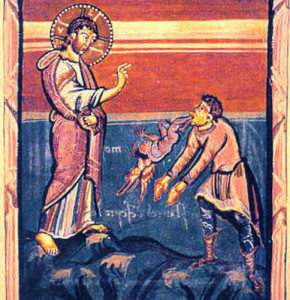
If you can! Really? Bring it! Mark 9 First Saint Johns September 13, 2015

[To hear the audio version of this sermon click on the above link]

We make our beginning in the Name of God the Father and in the Name of God the Son and in the Name of God the Holy Spirit and all those who know that Jesus can said … AMEN!

We often read Scripture in sort of bland/vanilla terms. In today’s Gospel reading we have a father whose son has been tormented, tortured, used, abused, just completely beaten down. No doubt the father is absolutely beside himself with fear and, complete hopelessness. My mother has had issues with epilepsy. The symptoms have been under control for many years, but I remember as a child that she had severe seizures. You can imagine as a child these episodes were very distressing for me and certainly very upsetting experience for my mother. There was only so much I could do as a child. But in this pericope I’m sure the father felt severe dejection. Dads are supposed to take control, fix things and you can imagine how helpless and hopeless the father felt. My mother’s symptoms were serious, but the description that we see of the son’s symptoms were even more serious. Some were classical symptoms of seizures, but there were far more serious issues with the son. He was being literally picked up and thrown down, I played football in my youth, tight end, basketball, basic military training and a little martial arts, I know full well how it feels for someone to put me to the ground. But we were usually fairly equal and I often had padding and was conditioned for it, it hurt, but it wasn’t continuous, or someone trying to seriously injure or kill me. I don’t think they were. The Greek word used to describe the son is paidi,on which means not just a child, but a young child. We’d probably guess no more than ten/eleven years old. So this probably physically small child is literally getting bounced off the walls and the demon even tries to throw him into the fire to burn him or into the water to drown him. In addition to being mute. This little boy was being treated hellaciously and dad was constantly a witness to this, no doubt trying to wrestle his son away from this supernatural power, do doubt failing most of the time and probably being hurt himself in the process. We can imagine the pain the child is going through, quite possibly to the extent of broken bones, stitches, maybe even more serious and the parents trying to protect and restore to health.

We should certainly empathize with the father, he was in a very difficult situation, which he says had been going on since the boy was a child, the Greek isn’t specific here, but perhaps since he was a toddler. Either way we would have to suppose that it had been going on for probably years. So we can certainly understand that the father is at his wits end. Jesus has just come down from the Transfiguration, this momentous event that we celebrate every year. It is coming down to the end of Jesus’ incarnational ministry, He is focused on the Cross, so perhaps in a way He is a little distracted, but also affirmed and glorified by God the Father. The boy’s father seems to know who Jesus is, He tells Jesus straight out that he has brought his son to Him for healing. So certainly the father is aware of what Jesus has done. According to Mark, Jesus has taught new teachings, that only God could introduce. Jesus and God the Father have made it clear who Jesus is. Mark has recounted how Jesus has freed others from Satan and his demons. Jesus has calmed the storm, He has raised the dead, healed many, fed over 5,000, walked on the water, healed the lepers, given faith to many, forgiven the sins of many, healed blind and deaf men, Peter has confessed who Jesus is and now this father brings his son and says: “But if you can do anything and have compassion on us and help us.” Jesus must have been a little put out and his response seems to indicate a little irritation: “If you can!” Jesus’ isn’t asking a question, He’s making what seems to be an incredulous declaration. In the Driskell translation I’m seeing Jesus saying: “Really? If I can! I know that you are weary and desperate and have gone through a terrible situation, but obviously you’ve heard all the other things. You couldn’t come to me and say; ‘I know you can heal my son who has gone through so much affliction, You have given me the faith I need to bring my son to You and I am trusting that according to Your will do what is necessary relating to my son.” And certainly the father does respond, that he does have faith, he did bring his son, “but please help me to have and keep faith in You and in Your will.” But let’s face it, too often we do put limits on what God can do in our lives. We need to remember that it is always according to His will.

Does faith mean that God is always going to act according to our will, that He is always going to heal, or that He is going to provide for us according to our agenda? Faith is trusting in His will, faith is looking for what His plan is according to what is happening. A Wisconsin fishing guide points out: “The only thing that casts doubt on the miracles of Jesus is that they were all witnessed by fishermen.”[1] That’s not true. We have God’s inspired Word in the Gospel, He inspired men to write about the miracles that Jesus did and we know through our faith that Jesus continues to heal, not always the body, but for those He leads He heals the soul and gives us the faith we need to trust and be led by Him, to have the hope and promise that only He gives us. Sure our human weakness gets in the way. When that happens let’s look back at the beleaguered father’s example and pray: “I do believe; help me overcome my unbelief.” St Augustine observes: “If one can pray so that one may cast out another demon, how much more should one pray that one’s own demons be cast out.”[2] Jesus told His disciples they needed to pray to cast out the demon afflicting this boy, certainly He is telling us, His disciples, to pray, in faith, that He will cast out the demons that afflict ourselves and always to pray for healing for others. Jesus can! He died to save us to everlasting salvation, He died to save us who are sinners and sin in our own will and who are led to sin by evil beings. He can and does save us and heal us, through His grace, His people who He does give faith to believe and to trust in His will.

The peace of God which surpasses all understanding keep your hearts and minds through Christ Jesus. Amin and Shalom.

[1] Rowell and Steffen   “Humor for Preaching and Teaching” p 57

[2] Simonetti, Manlio  quoting St Augustine “Ancient Christian Commentary NT 1b” p 59

Church is important Douglas Morton of Institute of Lutheran Theology

This is a big issue to me, I hear so much nonsense, to the effect “I’m too smart for church”. Yet when someone needs it, they expect the church, the people, the worship etc, to be AJ perfect, even though they haven’t done anything to contribute to it. It is important to be a part of the Christian community and that culminates every Sunday morning in worship. For too many people in our society today, it’s the only time when (at least Lutheran worship), it’s about God and not about them.

There  is so much to be done, and there is nothing more important than witnessing to the love, strength, comfort, power of Jesus Christ and the eternal life of the resurrection that He promises. But to be in communion with Christ, you have to be in communion with His Body which is the church. We are His for eternity beginning with being part of His Body in worship and service. The following is from Douglas Morton, take some time to consider what it is to be part of the Body of Christ in worship, service and the prelude to life and life eternal and abundant in Jesus.

Institute of Lutheran Theology, Douglas Morton
Yesterday at 11:06am ·
“You don’t have to go to church to be a Christian?”
True. Nor do you have to breathe to be human. However, we know what happens when we don’t breathe.
The Gospel is the message of sins freely forgiven in Christ. This Gospel gives us life. It’s also what we are to find and breathe in when we “go to church.” Below are four ways this Gospel comes (or should come) to us with its fresh air in the church service.
First, in “church” we come in contact with the word of God. If this doesn’t happen in your congregation, then find another. I’m not saying the church service is the only place we come in contact with God’s word. What I am saying is that the church service is the important place for this to happen. Here we listen to the Scriptures. God’s word often permeates the hymns. The pastor proclaims this word to us in the sermon. We hear both law and Gospel; the law to show us our sins and the Gospel to show us our Savior, who freely takes away our sins. We can get the law in many places. God has even written it on our hearts. However, the Gospel is foreign to us. It must come to us from the outside, in a word from God. Thus, “church” is a great place to hear this Gospel.
Second, in “church” we come in contact with two visible ways (often called “the visible word”) God proclaims his forgiveness for us. In Baptism, we meet the God who puts his name on us – “the name of the Father, the Son, and the Holy Spirit” – and marks us as his own. In the Lord’s Supper, we meet the whole Christ in his body and blood broken and shed for the forgiveness of our sins.
Third, in “church” we hear God’s audible word of pardon for our sins. This voice comes not in an “immediate voice from heaven,” but in the voice of another, our pastor. Certainly we can hear this absolution elsewhere, from other people. However, many church services begin with a confession of sins. Here we admit before God that we have sinned and need his forgiveness. Then comes absolution, where God speaks his word of pardon to us through the voice of our pastor.

Finally, in “church” we gather with our fellow brothers and sisters in Christ. We share with each other God’s love and forgiveness in the Savior. This sharing is called the “mutual conversation and consolation of brethren.” There is something wonderful and refreshing about being around others who share with each other the Gospel of sins forgiven in Christ.
The Gospel word is the only word that gives us breath, and thus spiritual life. We live in a world that often suffocates our faith in Christ. In “church” we gather around the fresh air of the life-giving Gospel. The Holy Spirit uses this Gospel to create and sustain our spiritual breathing, thus sustaining our spiritual life.
By the way, “I’d much rather use the words “Worship Service,” or better yet, “Divine Service,” than “church” or “church service.” The “Church” is God’s people. These people come together in the service. Here God serves each with the Gospel that creates and sustains faith. And in faith, we respond with thanksgiving and a life of service.
The Gospel of sins freely and totally forgiven in Christ is the most important air we will ever breathe. Find a Christian congregation that proclaims this Gospel in all of its wonders. Gather regularly with others to breathe in this life-giving word of forgiveness in Christ. You’ve got nothing to lose and a lot of fresh air to inhale.
Douglas V. Morton, the writer of the above article, is the Director of Certificate Programs and Director of Communications at the Institute of Lutheran Theology, an Independent Lutheran Seminary, in Brookings, South Dakota (http://www.ilt.org). He is also Senior Editor of the school’s magazine, The Word at Work and on the Faculty in the Certificate Programs. He is coauthor of From “Vesper Chimes” to ‘The Way International” and The Integrity and Accuracy of The Way Word. He has also written for the Journal of Pastoral Practice, The Quarterly Journal of Personal Freedom Outreach, and for The Word at Work. You may contact him at dmorton@ilt.org.

Dealing with trials so that God can use you to witness to others to Jesus

The Blackabys point out how Paul used his circumstances to continually witness to Jesus (Experiencing God p 177)  When someone gives me the “prosperity Gospel” nonsense, Paul is the first person I refer them to. If Paul isn’t the greatest Christian in history he’s in the top five. Yet Paul suffered a lot during his ministry. He was regularly jailed, beaten. He often went without food and water. He was shipwrecked and just generally subjected to harassment and abuse. But he didn’t lash back about those circumstances but used them to demonstrate his faith in Jesus and what Jesus did through Paul. He witnessed to mobs who wanted to abuse him, he witnessed to others jailed with him, to those who were judging him. Paul really never tried to defend himself when Festus was judging him, only witnessing to Jesus to the point where Festus says that Paul almost had Festus convinced of Jesus.

Certainly our witness is much more effective when people see us living our life in Jesus. Sometimes they’re not always seeing the best, but maybe they need to see that side also. Maybe they need to be assured that to be a Christian does not mean that you have to be perfect. Let people see Jesus in you and what that means in real life, wether that is as Paul points out in prosperity or in need. How is God going to use the circumstances that you are dealing with in order to bring someone to salvation in His Son Jesus Christ? What better service could you do then be God’s instrument to bring someone else to salvation?

Should the church cater to the consumer mentality?

This is from Leadership Journal,      http://www.christianitytoday.com/parse/2015/april/dangers-of-consumer-church.html?paging=off

Dangers of Consumer Church

Can self-centeredness be leveraged for the gospel?

“We are unapologetically attractional. In our search for common ground with unchurched people, we’ve discovered that, like us, they are consumers. So we leverage their consumer instincts.”—Andy Stanley in Deep and Wide

“In order to help people follow Christ more fully, we would have to work against the very methods we were using to attract people to our church…we slowly began to realize that, to be faithful to the gospel of Jesus, consumerism was not a force to be harnessed but rather an anti-biblical value system that had to be prophetically challenged.”—Kent Carlson and Michael Lueken in Renovation of the Church

So which is it?

Are “consumer instincts” morally neutral (or at least morally inevitable) and thus fair game for being leveraged toward spiritual ends, or are they something the gospel intends to crucify?

Can a person’s innate self-orientation be used to introduce him to Jesus and to becoming less self-oriented and more God-oriented? Or is a person’s self-centered orientation the very problem that the gospel seeks to cure?

Wasn’t Jesus “attractional”?

Most of us want to believe the church’s relationship to consumerism is a both/and. I want to believe consumerism is simply an inevitable (and perhaps a bit less than ideal) reality that might as well be leveraged in the name of Jesus.

That seems to be Andy Stanley’s point and the conviction that shapes the way North Point practices church. There is something refreshing about Andy’s candor and you can sense the freedom this approach has afforded North Point—freedom from neurotic analysis and endless introspection; freedom that becomes energy to go and do church in a winsome way.

While Andy deserves kudos for even taking the time to defend the church’s relationship with consumerism in a culture where many pastors don’t think to bother, sometimes his rationale is problematic:

“When you read the Gospels, it’s hard to overlook the fact that Jesus attracted large crowds everywhere he went. He was constantly playing to the consumer instincts of his crowds. Let’s face it: It wasn’t the content of his messages that appealed to the masses. Most of the time they didn’t even understand what he was talking about … People flocked to Jesus because he fed them, healed them, comforted them, and promised them things.”

Was Jesus’ goal to attract a large crowd? We cannot ignore the fact that in John’s gospel, Jesus reprimands the large crowd that flocks to him for food and miracles (6:26-40), which sets in motion a chain of events that prompt Jesus to say some rather abrasive things about eating his flesh and drinking his blood, which causes the crowd to thin out considerably, leaving only the twelve and perhaps a few more (6:52-68). I don’t think this is Jesus appealing to the consumer instincts of his crowds.

Or there is the stark solemnity of Mark’s gospel, where Jesus hangs all alone, forsaken by every male disciple and glimpsed only by a few female disciples from a safe distance. Yes, at times there were large crowds, but Jesus’ ultimate goal seemed to be something else. In other words, in the Gospels a large crowd is not the unreservedly positive thing we often assume a large crowd to be. Indeed, large crowds are especially prone to miss the point.

I’m not sure the Gospels anywhere imply that Jesus desired to attract a large crowd. It seems Jesus desired to show and tell the truth about the kingdom of God while being absurdly hospitable to all manner of sinners and nobodies because that is what the kingdom is like. Nowhere do I find some sort of calculated exploitation of consumer instincts (“how attractive are we to our target audience?”).

If a large crowd showed up to hear and see the truth about the kingdom, great. If it didn’t, great. I don’t think it moved the needle for Jesus either way—certainly he didn’t feel obligated to get the crowd to return, or to grow the crowd even larger. Nor did his stomach sink at the sight of a small one. None of this is because he didn’t care about how many people entered the kingdom (Jesus certainly wants a full house at the wedding feast!), but because Jesus knew it mattered how you entered the kingdom.

Kent Carlson and Mike Lueken pastored a church that also believed we could and should exploit consumerism. But through a long and arduous process of examination, they changed their mind. They came to believe that the way we practice church forms us in ways that rival, and at times, preempt the things we say. We can tell people to practice self-denial, but when everything we do caters to their felt needs as consumers (from their placement in small groups, to their participation, or lack thereof, in worship), our practice contradicts the teaching. It’s no wonder so many well-meaning church goers find the call to a cruciform life utterly incoherent.

What do I mean by consumerism? I believe it’s best understood as an ideology that sees personal freedom as the highest human good, and that freedom is realized in a person’s ability to take and throw away, whatever, however, and whenever he/she wants (be it spouses, babies, genders, goods, ideas). In our culture, this is freedom, the highest good: “the perfect, unconstrained spontaneity of individual will is its own justification, its own highest standard, its own unquestioned truth.”

Mixed Messages

When we talk about leveraging “consumer instincts” in the way we practice church, we are taking the ideology of the market and the narrative of acquisitive freedom as the highest good and baptizing them. We are telling our people that their wants and felt needs need no further justification and need not be questioned. What is most important is not that they become like Jesus (unless of course they feel like it), but that they are free (and comfortable) to become whatever they want to become.

Of course we will do all of this while saying the exact opposite, encouraging people to follow Jesus, to be transformed into Christ’s likeness, to die to sin and walk in newness of life.

The unspoken assumption is that this is a no-obligation relationship. You can have a relationship with Jesus as long as you feel like it … and if not, that’s totally okay. Come and go as you wish.

Few of us consciously propagate the ideology of the free market to the detriment of the gospel. Our motives for exploiting consumerism are benign if not pious. We want as many people as possible at our churches because that means more people get a chance to meet Jesus and that is justification enough for leveraging consumerism. I can go down that road, so long as I don’t think about it too much.

So what does this mean for the way we do church? I have formed a core conviction as I sort through all of this: The primary goal of a church is to be a faithful expression of God’s kingdom.

I think the Anabaptist tradition is on to something here. The church’s deepest calling is to be the kingdom of God in the world; not to change the world, not to save the world, but to be a glimpse and partial embodiment of a different world: God’s world.

It seems to me the primary goal of many churches is to grow as large as possible while still being a faithful expression of church. I think the goal must be to be as faithful an expression of church as possible, while also seeking to grow as big as being a faithful expression of church allows. We do this by practicing radical hospitality, love, and forgiveness..

I think Jesus wants a full house, but I don’t think we have permission to make growing as big as possible our primary goal. If we aim at growing as big as possible—while still seeking, when possible, to be a faithful-ish expression of church—we inevitably lose our way.

Some may see this as splitting hairs, and perhaps it is. Consumerism obviously exists on a continuum. A church like North Point is, clearly, a beautiful expression of the kingdom. But a split hair can change trajectory, and trajectory, over time, can make all the difference in the world.

So which is it? Should the church make a habit of leveraging consumer instincts, or not?

I think “consumer instincts” can be a euphemism for the modern ideal of acquisitive freedom—an ideal the gospel has every intention of crucifying. I think consumerism, at its core, is rooted in taking, getting something for ourselves, while the gospel, at its core, is rooted in God’s grace to us in Christ, and our response of faith and hope and love. These are not always easy bedfellows.

So what am I suggesting? Go out of your way to make your church smaller (surely many churches don’t need any help with that)? Frustrate people with petty inconveniences (surely the standard truths of the gospel are inconvenient enough)? Reenact the early church’s policy of asking unbelievers to leave before serving the Eucharist? Stop serving good coffee? Use incompetent musicians?

No. What I’m am suggesting is that many of us have become far too obsessed with making people comfortable, far too fluent with the grammar of the market, far too timid in our practice of the most revolutionary phenomenon the world has ever seen: The Church.

Austin Fischer is the teaching pastor at Vista Community Church in Temple, Texas.

It’s all about God Exodus 20 First St Johns March 8, 2015

For the audio version of this sermon click on the above link

We make our beginning in the Name of God the Father and in the Name of God the Son and in the Name of God the Holy Spirit and all those who know it’s all about God; Father, Son and Holy Spirit said … AMEN!

Caesarius of Arles said: We should also know that the ten commandments of the law are also fulfilled by the two gospel precepts, love of God and love of neighbor. For the three commandments which were written on the first table pertain to the love of God, while on the second tablet … are recognized as pertaining to love of neighbor. The Lord said in the Gospel: ‘On these two commandments depend the whole Law and the Prophets.”[1]

The commandments, which are also called the Decalogue in Greek, are to you, they’re about loving God and loving others. When we do that, is there any doubt that we are loved back? Again, I want to emphasize, that we’re not talking about the sentimental, mushey love that we Americans have understood love to mean, or this sort of enabling “love” that doesn’t judge or rebuke. It’s love that wants what is best for us, that helps us to grow and to become people who are led to live lives that God had intended.

An article about a man Noel Biderman who started an on-line website that helps married people meet other married people to have an affair. This was published in Forbes Magazine, in the next issue of Forbes, the “letters to the editor”, were mostly appalled, but sure enough there were the “well if that’s what they want…” and “if he can make money…” There are people in today’s world who would try to convince you that for a variety of reasons it is loving to help people to sin. Let’s be very clear here, it is in no way shape or manner “loving” to help people do things that are clearly destructive. There is no such thing as a victimless crime, and it is not loving to think that there is.

To be truly loving, we do the things that benefit and enhance our spouses, our children, our parents, siblings, all those we encounter. Someone may hit me up for money for a “burger”, which means booze, when I refuse they accuse me of being unloving/unChristian, a bad pastor. Really? Am I really doing anyone any good by expediting their death? When we remember the Decalogue, we are remembering, yea, the things that we’re not supposed to do, but we also remember the why and not only the “don’t”, but also the “should”. Walter Roehrs writes: “…they are a basic epitome of the response that God expects of the participants in His covenant of grace…” He goes on to say: “..They lay claim to man’s total being from the hidden stirrings and intentions of the heart to their overt expression in word and deed. It eliminates all assertions of man’s self – determination. The new covenant doesn’t minimize but rather sharpens the demands of an uncompromised surrender of self to the Redeemer and the Fulfiller of the Law.”[2]

Remember the “Small Catechism”? Those basics of our faith that get shoved into the back of an out of the way bookcase, or, worse, a box in the basement, assuming you took your copy with you from your parents home, decades ago.

Let’s take a quick pass through, not just the don’t do this, don’t do that, but one thing that is unique about Lutheranism it also helps us to see what we should do.

“You shall have no other gods.” What does this mean? We should fear, love and trust in God above all things.”

“You shall not misuse the name of the Lord your God.” What does this mean? We should fear and love God so that we do not curse, swear, use satanic arts, lie or deceive by His name, but call upon it in every trouble, pray, praise and give thanks.”

“Remember the Sabbath Day by keeping it holy.” “What does this mean? We should fear and love God so that we do not despise preaching and His Word, but hold it sacred and gladly hear and learn it.”

“Honor your father and your mother.” “What does this mean? We should fear and love God so that we do not despise or anger our parents and other authorities, but honor them, serve and obey them, love and cherish them.”

“You shall not murder” “What does this mean? We should fear and love God so that we do not hurt or harm our neighbor in his body, but help and support him in every physical need.”

“You shall not commit adultery.” “What does this mean? We should fear and love God so that we lead a sexually pure and decent life in what we say and do, and husband and wife love and honor each other.”

“You shall not steal.” “What does this mean? We should fear and love God so that we do not take our neighbor’s money or possessions, or get them in any dishonest way, but help him to improve and protect his possessions and income.”

“You shall not give false testimony against your neighbor.” “What does this mean? We should fear and love God so that we do not tell lies about our neighbor, betray him, slander him, or hurt his reputation, but defend him, speak well of him, and explain everything in the kindest way.”

“You shall not covet your neighbor’s house.” “What does this mean? We should fear and love God so that we do not scheme to get out neighbor’s inheritance or house, or get it in a way which only appears right, but help and be of service to him in keeping it.”

“You shall not covet your neighbor’s wife, or his manservant or maidservant, his ox or donkey, or anything that belongs to your neighbor.” “What does this mean? We should fear and love God so that we do not entice or force away our neighbor’s wife, workers or animals or turn them against him, but urge them to stay and do their duty.”[3]

We should keep Dr Luther’s commentary in a contemporary context, can you imagine if we all lived that way? For God and each other and not ourselves? We should also remember that Christ certainly lived these commandments. He not only obeyed, but He also lived for what is best for us. The example He lived in the Incarnation was not just about not doing something, but pro-actively living so that others might come to know how to truly live the Decalogue. He also died so that we who were powerless to save ourselves, He served us who did nothing to earn His service and who don’t deserve to be served, but to be lost. He died to save us and to serve us.

The peace of God which passes all understanding keep your hearts and minds in Christ Jesus. Shalom and Amin.

[1] Joseph Lienhard editor, quoting Caesarius of Arles “Ancient Christian Commentary on Scripture OT III” p 102-101

[2] Walter Roehrs “Concordia Self Study Commentary” p 75

[3] Lutheran Service Book pp 321-322

Discipling means to confront and challenge, not to shrug you shoulders and say “whatever”.

On a personal note, I reached 5,000 views. I know that to many of you that’s kind of chump change, but I jumped that hurdle and want to mark it in this blog.

Now that I’m over that, I really want to do this blog, but I need to do a disclaimer, this is almost verbatim from a podcast (Insight for Living Feb 11, 2015), but it’s so good, and frankly something I’ve been wrestling with and that we really need to apply in all our lives. So you should buy Swindoll books, listen to the broadcasts, but in the meantime, I’m going to put it out there and I pray that you take it to heart.

“…there is  no where in the Bible that says “live and let live'” [or let die for that matter] or “whatever” or “you leave me alone, I’ll leave you alone”. Jesus never promoted that message. No one ever loved like His love, he never just shrugged his shoulders when one of His disciples was moving in the wrong direction. He confronted it. Why would he confront it? Why would confrontation be that essential? It proves that we love someone. Because we love someone we care for them, about them. We care about their welfare. Because we care there are times when we must say how much we care and occasionally it’s a confrontation.”

[Samuel confronts David about Bathsheba. A lot of people were affected by this, so please don’t give me that lame “victimless crimes, or actions”, that’s the biggest copout ever. There is just no such thing. There are always other people who suffer as the result of sexual misconduct, drug abuse, divorce, and just because it’s not a crime, does not mean that misconduct doesn’t hurt/affect others. In David’s case his children and wives were profoundly affected, at the time and later. The baby conceived by David and Bathsheba died. Certainly Uriah was affected. There were many people, David’s subjects, who were directly affected by the events of just this one occurrence of sexual misconduct and were caught up in the consequences – mine]

“Good physicians confront their patients when they’re involved in unhealthy habits, we expect them to. Good coaches confront sloppiness, laziness. Parents confront misbehaving kids [well they should-mine]. Bad attitudes need to be confronted.

Our best friends, in the best way, confronting us over our bad ways.

It’s not about control or trying to be smarter, it’s about seeing someone you care about harming themselves and, usually, causing harm to others. Confrontation ought to be with tears, never with pride, never with joy. Your heart is broken and because it’s broken you have to say something, especially because you care about that individual. Confrontation is love in action, caring about another’s welfare, helping someone realize they’re headed for trouble or danger if nothing changes and the proof of your love is that you will not look the other way. It’s not for control.”

[I have no interest in controlling, or unless necessary, knowing. I really don’t. That is just not what I’m about or most pastors are. We are about the Gospel and helping people to move on from their issues. We all have issues. But a big part of the job and expectations of others is that we have to help people confront and overcome. Like it or not, it will be through the power of the Holy Spirit, but there are times that are just so profoundly difficult that we need help to overcome them in order to refocus on Jesus. That’s what pastors are for. As a Lutheran pastor, anything you discuss with me is under the “seal of the confessional”, I cannot even discuss that I talked to you. Whatever anyone tells me, they have full confidence that it will not be discussed in any other context. Once that discussion is over, I do not treat you or act any differently to you. This is confrontation also, you are bringing me your issues and trusting me that I’m there to confide in, to confess and repent and to be absolved. I don’t really want to get into it, but I do want to serve you and help you to deal with it. But wow, what would the world look like if we were all trying to reach our greatest potential in Jesus, instead of “gimme, gimme, I want”? Let’s deal with the issue of confronting and not just sitting back and letting others suffer in sin or as a consequence of sin. And we can certainly tell when someone is confronting us in love versus when they’re trying to control us- mine]

“The difference in confronting someone because they need to hear it and trying to control someone to become like you, should be a gentle experience, not shameful. Some day you might fall to the same sin. Proverbs 27:6 “Wounds from a friend can be trusted, but an enemy multiplies kisses.” The Hebrew says faithful are the bruises. Proverbs 20:30 “Blows and wounds scrub away evil, and beatings purge the inmost being.'” 

“…God loves too much to let them get away with doing such things [or how about the one who says “heck with you”, goes off does what they want, gets in trouble and come back expecting you to help. Not asking or looking for forgiveness.Their attitude usually being that somehow it was your fault, I might have gone out and done something stupid, but you have to fix it. But we do need to remember that our goal for them and us, is that we become more like Christ, not to squeeze them into our mold. But yes there will be consequences, and maybe I don’t want to suffer actual or vicarious consequences with you? -mine]

“What is necessary is lots of prayer, waiting for the right time and speaking the truth in love. Ephesians 4:15: “ Instead, speaking the truth in love, we will grow to become in every respect the mature body of him who is the head, that is, Christ.'”

If you can do it without tears then you probably ought not to do it. If it’s painful for you realizing the wrong that’s going on and others are being or will soon be harmed. Sometimes a pastor who needs to be confronted, whose conduct would damage the Body of Christ. Love must often do the unpleasant. Remember a moment of confrontation, how painful it was. The goal of confrontation is restoration, not condemnation [as is ex-communication, the keys Jesus gave the church.-mine] It is help to get the person back on track so their lives will count for Christ.”

“We don’t go into confrontation to ‘set somebody straight”. You go in with fear and trembling and you’re going to use God’s words on a delicate, but sinful issue. King David as the example; leader, warrior, poet, musician, [He wrote most of the Psalms]. He had a way of winning your heart. But he also understood that he had to be confronted over his sin.

In the Fullness of Time Galatians 4: 4-7 First St Johns December 28, 2014

We make our beginning in the Name of God the Father and in the Name of God the Son and in the Name of God the Holy Spirit and all those who know the perfect timing of God said … AMEN

Under the heading: “There is no such thing as “coincidences” where God is concerned, for that matter anything, since God is concerned with everything about our lives, we read Paul’s letter to the Galatians. Galatian’s four short verses are loaded with teaching. Paul’s quote in Galatians 4 is particularly interesting: “But when the fullness of time had come, God sent forth his Son … to redeem those who were under the law, so that we might receive adoption as sons … you are no longer a slave, but a son,…”(Gal 4: 4-7)

The part that of find of interest right here is “…the fullness of time…” Some think that had something to do with Mary coming to term in her pregnancy, or something that was dictated by Joseph and Mary’s situation. But most see Paul’s short expression as an appreciation and understanding of how God does things in His time and dictates the course of events and history according to His will. The Father didn’t turn to the Son one day and for just any old reason say, “yeah, think it’s about time we do the incarnation thing.” This had been the plan since the beginning, He chooses to reveal that plan to us, first, in Genesis 3:15, at the very beginning and then just before He throws the switch to make it happen, the Father reaffirms His plan, in an even plainer way in Isaiah 9:6. The Genesis passage, the proto-Evangelium, where God promises Satan that there would be a Savior, that the Messiah, anointed One of God, would come into the world to crush Satan’s head. God the Son would crush Satan’s head and by doing so, would save us from the curse of Hell. That sounds harsh, necessary, but in your face. However the Father’s promise to Isaiah is the one that is His majestic promise that He made when Judah is about to be crushed by Assyria and to disappear as a nation, most of her people killed or enslaved. Certainly a great crisis where Yahweh promises them; “A Child is born, A Son is given, Wonderful, Counselor, Mighty God, Everlasting Father, Prince of Peace.” The Israelites knew that they were about to take a harsh and long-lasting beating and they needed this promise. Isaiah could have said the same thing Paul writes: “But when the fullness of time had come…”, because Israel had pushed too far for Yahweh and He was now about to let His people know what happens when they ignore Him and get too caught up in their own plans and expectations. The fullness of time had come and Israel, at least for a few generations, would cease to exist.

Paul on the other hand tells us that the “…fullness of time…” had just occurred for the Father to fulfill His promises to Adam and Eve, and to the people of Israel by Isaiah and it happened at this intersection of time. Although Paul didn’t know it, although Jesus prophesied it, this was the perfect time for God. While they were strolling away from the temple and the disciples were admiring the view of the buildings of the temple, Jesus took them to task and said “You see all these, do you not? Truly, I say to you, there will not be left here one stone upon another that will not be thrown down.” Don’t become to fascinated by the things man, in this case King Herod, build, because there is going to be another turning point in Israel’s history and this temple that you find so fascinating will be completely destroyed in just a few years. In about 40 years Israel, as you know it now, will cease to exist along with the temple. The Judaism of Israel would no longer be focused on the temple and would be scattered again. A new world would begin and the Christians in Israel would be forced to leave and take Christianity into the world.

This time, that Jesus had been born into, was the perfect time for Him to come into the world and conduct His incarnational ministry. It was a time of peace in Israel, Jesus did not have to contend with wars or any kind of famine or drought. He could get everyone’s full attention on His ministry and drive it deep into their awareness so that they could readily understand their new relationship with the Father. They had time to absorb the Gospel and begin to live it before they had to go into the world to spread the Gospel. They had to unlearn the legalism of Judaism and the debauchery of paganism and to come to understand that they were saved solely and completely by grace. They couldn’t earn their way to Christ in this world or to eternity, they could only be brought to salvation in Him and through His actions, what Jesus does to save us.

The conditions were exactly right for the disciples to absorb Jesus’ teaching and take those teachings into the world. Not only was there peace, the conditions surrounding them enabled them to bring Jesus to the world. As Lee Strobel points out: “The time period when Jesus lived was ideally suited for the spread of Christianity. The vast reach of the Roman Empire primed the known world for the gospel. Roman roads allowed relative ease of travel and greatly increased the area to which the gospel spread. Roman authority also helped protect travelers from robbers and attackers. Throughout the Roman Empire, Greek was the common language, and allowed communication of the gospel between groups who lived hundreds or thousands of miles from each other.”1

The Pax Romana, that is the peace of Rome, which united the entire world, enabled Jesus’ disciples to teach and preach without the distraction of wars or other disruptions to those they preached to. Jesus’ disciples could travel and teach without being abused because the Roman Empire tolerated many belief systems. Any earlier or later, and the disciples would be persecuted before Christianity could take root. At this time Christians could worship and evangelize unmolested. God created the conditions through man, mostly the Romans, so that He could send His Son into the world to preach God’s Word and Will and so that His church would grow. The church of Jesus Christ might otherwise have been steamrolled or isolated to small parts of the world. Jesus’ appearance met other promises of prophecy. Strobel writes: “God fulfilled his prophesied time frame. Daniel predicted that the Anointed One would come and would be ‘cut off’ (killed) before the destruction of Jerusalem and the second temple (Daniel 9: 24-26).”

From Paul’s writing we can see the sovereignty of God, that is God controls and is Lord of all that He has created. He planned and controlled human history so that at just the perfect time in that history His Son would appear and become the focus of the entire world. The world had never been brought together as it had under the Roman Empire and in a couple of hundred years it would be shattered and different peoples would be separated from each other, unable even to communicate. God controls the events of the world, which He does, although He permits man, because of His sin, to spread war and sickness and famine throughout the world. Then clearly God controls those who He has chosen to be Lord of their lives. For myself there is no doubt that God chose the perfect time for me to know Jesus as my Savior. Because you are here, baptized, listening to His Word, about to take His Body and Blood, He has chosen you at just the right time to be saved in Jesus.

Strobel writes: “ God had an appointed day when he would intersect human history with the promised redemption. The moment in history when Jesus arrived was tailored for the rapid spread of the Gospel. All human history is balanced on the fulcrum of Jesus’ life, death and resurrection.”2 God gives us the understanding we need in order to know Him as our Father and Jesus as our Savior, and when we see it in human history, we can better understand how He works in our own personal lives. Take some time over the next week and think about how “..in the fullness of time…” God the Father, Abba, has made us His own sons and daughters that Paul writes about in this passage.

The peace of God which passes all understanding keep your hearts and minds in Christ Jesus. Shalom and Amin.

1Lee Strobel The Case for Christ Study Bible p 1634

2Ibid p 1634

Sheep protected and led by the Great Shepherd First St Johns, York, Pa. Ezekiel 34: 11-16, 20-24 November 23, 2014

to listen to the audio of this sermon, please click on the above link or copy and paste into your browser

We make our beginning in the Name of God the Father and in the Name of God the Son and in the Name of God the Holy Spirit and all those who will be together in the glory and plenty of eternity in Christ shouted out … AMEN

Our readings today are about eschatology, these are eschatological studies, don’t try saying that at home, I’m a trained professional. I’m thinking in terms of the ultimate Thanksgiving. You think you need a big kitchen table at your house for Thanksgiving? Think about how big God’s table is going to be that He will need for His promised time of life in the Resurrection. “And I will bring them out from the peoples and gather them from the countries, and will bring them into their own land. And I will feed them on the mountains of Israel.” (Ezekiel 34:13)

If you’ve ever been to Quincy Market in Boston, there is a restaurant named Durgin Park. This restaurant goes back to the turn of the 20th century and if you’re in the right parts, well you can tell how old it is. They have great seafood, they have great prime rib, lots of other dishes, but here’s the deal, it’s served to you family style. You don’t have little tables all around, you have big long tables and you just grab your seat. There’s no maitre di, no pretense, you get a menu on the way, grab your seat, order your food and while you wait get to know the people all around you. It’s one reason you go there. It’s not for the service, the wait staff seems to make it their mission to see how uncomfortable they can get you, the food is great, like I said the atmosphere is early 20th century, but it’s great food, in an “interesting” facility. There are plenty of other people around you and you all know you’re there to meet people and you do, very little in terms of being bashful. Get a great dinner, stay for awhile, you have to because there’s so much to eat, and enjoy the impromptu goings on.

This is what it will be like at the dinner that God is promising Ezekiel. Being invited to the White House for dinner is a series of hoops and rolls, waiting, anticipating. How will the feast that God is talking about happen? “I myself will search for my sheep and will seek them out… I will rescue them from all places where they have been scattered on a day of clouds and thick darkness…” You won’t be expecting anything and then you will be in His presence and He is going to give you the ultimate offer you can’t refuse. Durgin Park’s food is good, but how much better, how much more, how much more fun will the feast, the banquet at the end of time be? The ultimate open menu; You want New England Lobster, here it is. Cheasapeake Bay crab cakes? The best you’ve ever tasted. Chicago prime rib? New York City pizza, … what, huh? Really pizza, at the marriage feast of the Lamb? OK, you got it.

He promises us that we will be with people scattered from all places. Places that for a day were cloudy and dark, that’s where we are right now. Life…, in terms of eternity? It’s a day, it’s over before you know it, life is not reality, the resurrection is reality, this is eternal reality. You may be in those dark, cloudy places where you know you don’t belong. Not because you’re good or too smart or even unworthy, you’re there because He took you up, the Father saw His Son in you. Jesus came to you and said “Come, you who are blessed by my Father, inherit the kingdom prepared for you from the foundation of the world.” (Matt 25: 34). You will be there for one reason and one reason only and it has nothing to do with anything you did, it’s all about how you were saved by Christ. You were saved in baptism, you became that new creation in baptism, you were faithfully led by the Holy Spirit to worship, to take the Body and Blood of Jesus. Those small bits of bread and wine, His Body and Blood, are only a reminder of the immensity of what you will inherit, of what the Father will bring you to “…the kingdom prepared for you from the foundation of the world.”

In our passages today God is showing you the ultimate Thanksgiving Day feast. You didn’t do a thing for it. Moms, you aren’t going to cook, you aren’t going to serve, you aren’t going to clean up, you will be there with Christians from around the world, rejoicing with each other that you are saved, that you are eternally going to enjoy all the great gifts of the resurrection, the new world, the world the way it was intended to be, life and life more abundant. Abundance you can never imagine in the here and now.

A friend of mine had relatives in Lithuania, his parents were from Lithuania. My friend took them to the grocery store and when they got inside and saw all the marvelous food just waiting to be taken off the shelf and put in the shopping cart they were so overwhelmed some of them actually started to cry. That will be us when we’ve been rescued from the clouds and darkness of the world and brought to the marriage-feast.

I know for many people this may not sound initially inviting, you will be sitting with people that you may have never met, Christian brothers and sister, and they will be from all the places that God scattered them in life. Many will probably have gone through difficult, even serious trials, some life or death trials because of their faith. But they won’t talk about the unpleasantness of those trials, they will talk about how thankful they are that even through difficult times God provided, God gave them the hope and promise of being provided for. They will be celebrating their deliverance, we all will be, we all will be celebrating how faithful God was to provide in life, even in those times of pain and loss. The pain and loss of earth will be a dim memory, even if it was only a few hours ago for some.

The idea of sitting with a bunch of what you might think of as strangers might seem a little uncomfortable to some of you, but if you’ve ever had to do a lot of traveling, which often involves being in an unfamiliar place, with unfamiliar people, meals are often a chore and often uncomfortable. That’s why Durgin Park is appealing to many who are traveling to Boston, they will be with a bunch of other people who want to be with a friendly group and I can assure you I’ve never had a bad dinner there. But in the resurrection we will be with people who are true brothers and sisters in a world that will dazzle even us who think that we’re hard to impress. We will be like the relatives from Lithuania, overwhelmed in delight at what God has provided for us and for those whose earthly life might have been in material poverty and need.

In his book “Heaven” Randy Alcorn writes: “We know that people in Heaven have lots of feelings – all good ones. We’re told of banquets, feasts and singing. People will laugh there (Luke 6:21) Feasting, singing and rejoicing involve feelings.”1

Alcorn quotes Seneca the Roman philosopher who said, “The day thou fearest as the last is the birthday of eternity.”2

I have no doubt that you will enjoy your Thanksgiving celebration with family and friends, it will be a time of pleasure and belonging. But it will be a snack compared to what you will be given when you are picked by the Lord and brought to that banquet, eternally in the presence of the crucified and Risen Savior, our Redeemer. It won’t be a feast of just food and companions, it will be a feast of life and life more abundant, a world that will be just waiting for you to enjoy it’s splendour, its activity and its vastness, a world where even in eternity you will not be able to experience everything it has to offer. God is an infinite God, He delights in the pleasure of His children. To be sure, the world is often not very delightful, if not downright troubling. But the world that God brings us to will be a continuous celebration of life, eternal life to His glory, forever and ever …

The peace of God which passes all understanding keep your hearts and minds in Christ Jesus. Shalom and Amin.

1Randy Alcorn Heaven p 284

2Ibid p xvii