Tag Archives: Christian Family

Christianity may be making a comeback? It was never gone.

In 2015, Christianity May Be Making a Comeback

Posted: 01/05/2015 6:42 pm EST Updated: 01/05/2015 6:59 pm EST
JESUS CHRIST

Just when everyone thought God was dead, The Creator seems to be making a serious comeback. Although non-believing cultural elites in media, academia, and entertainment may be the loudest voices in the room, a new Pew Research Studyindicates they’re becoming the smallest group in the room. Among it’s findings:

  • 73 percent of U.S. adults believe Jesus was born to a virgin.
  • 81 percent, the baby Jesus was actually laid in a manger.
  • 75 percent, wise men guided by a star brought gifts of gold, frankincense and myrrh.
  • 74 percent, an angel announced the birth of Jesus to shepherds nearby.

The study indicates that 65 percent of Americans believe all four of these elements of the Christmas story, and a mere 14 percent believe none. And just when you thought these numbers reflected the Bible Belt, it turns out that 54 percent of liberals believe in the virgin birth, and for adults with postgraduate degrees, 53 percent affirm the virgin birth of Jesus.

Hollywood apparently saw it coming. For decades producers and studios have bent over backwards to reach out to special interest groups like feminists, the gay community, environmentalists, and others. But simply looking at the numbers, they finally discovered the Christian community is the largest special interest group of all. So while they’ve had some Bible movies hit and miss, they understand the Christian audience isn’t going away soon. In fact, if they’ve learned anything after the productions of Noah and Gods and Kings, they’ve hopefully learned they need to get it right. The more a movie sticks to the Biblical account, the bigger the box office.

So the question becomes, where has Christianity been? Early in the 20th century, the Church embraced motion pictures, radio, then television and now the Internet and social media. But in the vast majority of cases today, they’re not using those platforms to engage the greater culture, but instead living inside a bubble. After all, why tweet, when you can join a Christian alternative to Twitter? And don’t go to eHarmony or Match.com if you’re looking for a mate, use Christian Mingle. From the web, to publishing, to record labels, TV networks, universities and more, the last 50 years have seen a remarkable withdrawal from mainstream culture and a move back to a cloistered, protective bubble.

In all honesty, the Church hasn’t been losing it’s voice, it’s been giving it away. As a result, they’ve lost remarkable influence in the culture. It’s a tragedy, because since the founding of this country, Christianity has been a powerful engine behind social service outreaches, educational institutions, hospitals and more.

So while the majority of the population still professes religious belief, will Christianity ever regain it’s influence in the culture? I believe it can, and there are plenty of signposts:

  • Vibrant churches are growing in major urban centers around the United States. From New York City to Chicago, to Los Angeles and Seattle, young pastors who have a passion for their cities find it difficult to locate facilities large enough for the crowds.
  • A new generation of talented writers, filmmakers, musicians, and other artists are unapologetic about their faith. As a result, they’re breaking out of traditional “Christian”-branded record labels, film distributors, and publishers, and are finding success with mainstream audiences.
  • Episodic television programs like Mark Burnett and Roma Downey’sThe Bible series broke audience records in the United States. Their new series “A.D.” based on the New Testament book of Acts debuts this spring, and a remake of the epic film Ben Hur is in the works.
  • The first Ebola cases to be treated on American soil were Dr. Kent Brantly and his assistant Nancy Writebol. Both were fighting the disease in Liberia with the Christian group “Serving in Mission.” Today, massive relief operations like “Mercy Ships,” “The Salvation Army,” and “Medical Ministry International” are all driven by Christian convictions and are making a dramatic difference in the most desperate places on the planet.

Honestly, it shouldn’t be a surprise. When the Iron Curtain fell, we discovered that Communism couldn’t silence the Church, and despite horrific torture and executions by ISIS militants, Christians in that region refuse to recant. So it shouldn’t be shocking that here in the West, for all the criticism and clatter from nonbelievers, or advertising campaigns from atheists, Christianity is actually growing.

In 2015, it will be obvious that Christianity is back. But truthfully, it never left.

Faithful discipleship and not going through the motions

It’s one of those cliches that Christians fall into, “God gave us the best in Jesus, we should give Him our best.” OK, you can’t argue with that, but it’s that sort of platitude that gets “ya-ya’d” and then pretty much left as a platitude. To be sure God has given us His best, He continues to do so and not only that is looking for our faithfulness, our growth, our trust in Him and our honest attempts to serve Him. I get it, that is not always going to be our “best”. No doubt, when we are doing things that are new, things that God is pushing us into, that are intimidating, that make us challenge our boundaries we are going to shrink back a little. To be sure, we’re not always going to produce our best, but what God wants is for us to rely on the faith that He’s given us in order to push us to do the things that He wants us to grow in. Anytime, there’s something new, something that is kind of towering over you, it does kind of freeze you up. So that’s the point, that’s what God is doing with so many in the Bible, making them go beyond what they thought they were capable of.

God gave us His best, Jesus picked up from the glory of Heaven, His place in the Godhead next to God the Father. He became a man in order to live the perfect life and therefore the spotless sacrifice, payment for all of our sins and restore the relationship in salvation with God the Father. As the Blackabys point out: “…He reliinquished the glory of His heavenly existence in order to become a man. He was born n a cattle shed; he slept in a feeding trough. His life was spent preparing for the day when He would suffer an excruciating execution…” (Henry Blackaby and Richard Blackaby Experiencing God Day by Day p 362) Jesus was He who all creation came into being and yet He is in a shed, in a humble place in Israel, which is itself a humble backwater to the rest of the world.

So having said all that, and realizing that we aren’t going to be “all that and a bag of chips”, but it seems that when we are pushed, we don’t even think about excellence, we think that we throw some crumbs, go through the motions and then we should be good with God. We need God to be great, perfect, Holy, almighty, sovereign Lord, we will never come close to being even a speck to the God who has created all and that’s good, we have a God that is Lord of all. Having said that and understanding that He does understand that we can never be anywhere near enough, that we have human limitations, we still expect that He’s supposed to lower His standards to ours. I get that a lot as a pastor, talk to me on my level, heck the church has been doing that since you and I were in Sunday school. It’s really not an attempt to help people to grow, to push themselves to new levels of Christian maturity, it’s the same old story. Pat us on the head, make everything nice and easy and everyone will be happy. We want God to come down to our level, but we still want Him to do all the great, magnificent things when we want them.

OK, God comes down to our level, but what does that even mean? Whose level of mediocrity should He lower Himself to, mine? Yours? The take-away is this. God sets the standard that we should all strive for and we should strive for God’s best. That’s not what saves us, we are saved simply and solely through Jesus who died as the perfect sacrifice for the sins of the world. We cannot earn our way into salvation, nothing we will ever do will ever be enough to save us in our sin. Jesus is the only One who could save us and is all there is, nothing we could ever come close to.

But instead of always offering our mediocre efforts, our gifts of crumbs and indifference, expecting that it should be “our way”, as if God is going to do billions of people individual ways. Instead let’s really trust in God’s leading, if He’s pushing you to trust more, to do something that seems out of your reach, to learn and to lead beyond what you think you can, then trust His leading. We have to get out of our mediocre, hum-drum ruts that’s so typical of the world and really strive for what the Holy Spirit is pushing us to. Are there new groups at church to help you learn and apply what you learn and are led to do? Are there ministries that are crying out to be established? Are there people, maybe even just one who could use attention, guidance, mentoring?

Our church service is not in terms of some pompous, “ya, always the best rah-rah”. It’s I’m here to be led to where the Holy Spirit is moving me, it’s not always going to be the best, the most successful, the most effective. It’s going to be in terms of the faithfulness that He gives us and lose the attitude of just going through the motions, throwing some crumbs and then moving on to “fun”. Ya, which is usually being a slug, that it’s all about you and don’t make me really make an effort. God gives us the faith, the talent, the ability, and when needed lifts us up past our ability and helps us to achieve to His glory. Let’s glorify God, focus on His will and not our weaknesses, get out of our mediocre ruts and really know His will and what He can do through us and then do it as well as we can.

Get real! You want real worship? It’s right there, churches like First St Johns

The evidence keeps rolling in, while people don’t seem to actively express the desire, more and more it seems that people want worship that is serious.

The common rap is that “liturgical” worship is “boring”, it’s not fun, it’s not entertaining. Who said that worship was suitable for any of this. No it isn’t entertainment. But when you actively participate, when you genuinely try to understand versus this odd idea that most come into worship with: “I’m an empty vessel fill me”. These same people have been going to worship for years, decades, yet two, maybe three times a month, they go to worship and say “fill me, I haven’t done anything, you need to do it for me.” OK, sure, I’m there “to do”, to lead in worship. But folks, this is the “Body of Christ”. If you come in with the attitude that it’s all about me and you need to do for me, it’s not going to work and I submit that is becoming more evident in all these “churches” that do everything but worship.

People are looking to be connected to God, we are connected to the Father, because of the Son, by the Holy Spirit. As I said, this is “the Body of Christ.” What does that mean? The head does all the work and everything else just hibernates. That’s not going to work in human biology, why would it work as a Christian. If the heart stops beating, the head isn’t going to be of much use. You can sit there with head and heart, but if nothing else works, you’re simply not going to get it. Christian worship is participatory, not passive taking in. The issue becomes who is worship for? Well yes, it is for you, it is for those around you, it is for those out in a dark, cold world. It’s not for God. He wants us to worship and through our worship He feeds us, He builds us up, but you need to genuinely be heart and soul in worship, passively sitting back doesn’t work for you, brothers and sisters in Jesus or God. The church is there to serve, to equip you in order to grow in Jesus, but my philosophy is that if there is 5, 50 or 500 it’s still the same. If 5 have shown up, I’m not going to get all bitter with the others who didn’t. Five people, plus me, showed up to worship. I have 5 faithful brothers and/or sisters (it’s only 5 it could be all guys…) Anyway, they are there for me, I am there for them, we’re all there before God, that’s all that matters.

In a Leadership Journal article Marian Liautaud likes to pat herself on the back as to how millenials have become so critical in their thinking. (Make Room for Me Fall 2014 pp 55-57)They haven’t found genuine worship in churches, so they don’t go to worship. I’d like to assure them genuine worship is very much alive, if you haven’t found it, you haven’t looked to hard. Now, I have to wonder, is this just an excuse to avoid worship or a lack of effort to truly look. My answer is “yes”. Everyone likes to pat themselves on the back as to their critical thinking and discernment, but they frankly still want to sit back and just be an empty vessel. Frankly, I don’t even get the title. I assure you Marian, 100%, you show up with a genuine willingness to be a part, I will do back flips for you to be a part. But frankly in that generation I get this sort of “arms-length” attitude, they really don’t want to make an effort, they want someone to read their mind and they then still continue to dissemble.

Heather Stevens, a junior in college, writes “If you are a church leader, this data should stop you in your tracks. It should make you think, ‘What the heck am I doing wrong?'”

Wow, isn’t that just precious, her go to position is someone else is doing something wrong. I would agree to an extent, there is a lot of “wrong” “worship” out there. Seems to me Heather is more concerned about changing the places she thinks are wrong to fit her profile, versus finding the places that will meet her questions. This is another indication that people today, and frankly it’s any age group, are not very critical in their thinking. ‘Something’s wrong, so it must be someone else’s fault.” Instead of, I need to keep an open mind to the other possibilities out there, that do offer genuine worship and are eager to share that, to disciple others. I would jump through flaming hoops to have such a group together, but they won’t, they’re not really looking for answers, they’re just about airing out their lungs, letting everyone else know what their uninformed opinion is.

However, and I’ve said this before, the church has messed itself up too, The church has tried, for at least, the last three generations, to cater to this attitude that Heather expresses. So it’s not just millenials, it goes back to at least to people in the Depression Era. The church hasn’t stood up and said “this is what’s important”, it’s kind of groveled and said “tell us what you want, just try to make it in a Christian context.”

Just expressing what any contemporary American could/would say Taylor Snodgrass says: “Our generation has been advertised at our whole life and even now on social media,’… Consequently, if a church isn’t giving you the whole story, if it’s sugarcoated or they’re onstage putting on an act 20s see through this. It causes us to leave. We’re good at seeing when people are lying.” Well bless your heart Taylor, you have part of it, but it’s still a copout, an excuse. Great, if you think that, but be as honest as you claim to be. You don’t really want the truth, I feel like Jack Nicholson here, “You can’t handle the truth.” You want to avoid and you’re using someone else’s failure to drop out. Believe me, if people were genuine in these assertions, the church I pastor would be heaving at the seams, instead it’s excuse after excuse.

Ya, maybe my candor, might be a little intimidating, but that’s what all these “get real” types want, isn’t it? No, they want nice, they want sugar coated, just their way, not their parents. I’m not saying beat people, pummel them with truth, that’s not my style either. But my style is to be upfront, to challenge, to deal with the real issues. Come on, let’s deal with them together, I’d love it!

To wit, let’s look at the rest of what millennials want and a church like First St Johns has. “Visual clarity: ‘Millennials want to be able to answer the questions ‘Where am I?’ and ‘What’s expected of me?” This is according to David Kinnaman, president of the Barna Group….”

“As part of Barna’s study on Millenials and church architecture, they brought two groups of 20-somethings to modern churches, and then to cathedral style churches. In the cathedrals, ‘they felt it was a space for serious activities such as prayer, coping with tragedy and communing with God. They sensed the spirituality of the place,’ says Kinnaman. ‘At the same time, they were concerned about how they would fit in – If I visit, do I need to wear dressy clothes? – and a few participants, especially unchurched people, felt intimidated by the spiritual intensity of the space.'”

Well! Welcome to First St Johns. First off, no, believe me “dressy clothes” are not a big priority. We have plenty of people who do the best they can, that’s all I can ask.

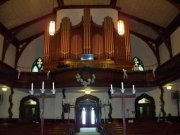
One of the biggest kicks I get being the pastor of such a church is showing people the church sanctuary. I don’t think it’s failed to happen yet, you hear them silently, reverently suck in a little air and say a quiet wow! You want a place that evinces true Christian spirituality? Look at the featured picture, and that really doesn’t do it justice. If you don’t know where you are, well you have problems that I can’t help you with.

I did find the point of bringing nature into a church an interesting one. . I’d like to see if we could do more of that. I will say Christmas the altar is covered with poinsettias and Easter with lillies. But it is an inner-city church and a place in the church that would be a place where we could have some plants and some kind of natural effects would have a huge benefit, so thanks for the suggestion. Let’s see some of these people who talk a good game show up and put it in motion, I’ll be right there with you.

Respite” “Millenials, perhaps more than any other generation, have a deep need for peace and quiet; they long for a sanctuary. ‘Our culture is fragmented and frenetic and there are few places to take a breather to gain much-needed perspective,’ says Kinnaman. ‘Ironically, most churches offer what they think people want: more to do, more to see. Yet that’s exactly the opposite of what many young adults crave: sacred space.,’ ”

“Our churches are places of action, not places of rest; spaces to do rather than spaces to be. The activities, of course, are designed to connect people with God and each other – and some Millennials hope for that, too – but many just want an opportunity to explore spiritual life on their own terms, free to decide when to sit quietly on the edges of a sacred space and when to enter in.”

My answer, you need sacred space at two in the morning, you call me up and I will come down and open up the church. But you better be serious, don’t be there whining, be there genuinely searching. I would love it! We have action, we are an inner-city church and we often have to deal with real issues, but our priority is always spiritual health. Dr Luther describes pastors as Seel Sorgers, ‘soul healers’ that’s what I am first and foremost, but I try to do the other things.

When we first got to First St Johns, we set up a “Prayer Room”, I also had a few, very few, people want to go into the sanctuary to pray. We have prayer groups right after worship, we have a prayer breakfast once per month, we have a “Healing Service” one per month, Matins worship Thursday mornings and Sunday morning. I’d happily do some of these much more often, but frankly, not exactly overwhelmed with response as it is now.

“Give them Jesus – building relationships and learning about Jesus are two central reasons why Millennials stay connected to church. Barna’s research shows that young adults who remain involved in a local church beyond their teen years are twice as likely as those who don’t to have a close personal friendship with an older adult in their faith community (59% vs 31%).”

For a small church, we do this pretty well, we could do better, but there has to be buy-in from everyone and again I would jump through hoops to facilitate it.

So to Marian and David, Taylor and Heather, here you go. This is it right here. Genuine worship, genuine doctrine, genuine space, genuine relationships and authenticity. Let’s sit and talk, let’s really deal with our relationship with Jesus and genuinely worship and honor Him. Does He need our worship? No, but we need to worship and we need to do it with authenticity, not sit back and fill me/entertain me. Don’t expect me to just pat you on the head, sure when it’s needed, but today, we need to get real and get back to the real church and not the happy/clappy God just wants me to be happy. No, it’s joy in Christ, won’t always be pleasant, but it is true relationship. Do you want that or not?

Where the Christ child is said to have laid His first night on earth

The featured image is where, according to legend, the Baby Jesus was laid after He was born, His first day as a human, as one of us. . 11_12

The featured image is where Mary is said to have laid when she gave birth to Jesus.

Needless to say, what is now an incredible church (if maybe a little over the top) is vastly different then what it was on the first night. A stable, actually almost a cave, with animals, no doubt dirtier than we would even keep  a stable today. A very humble place, where Jesus was born. He who gave up the glory of heaven to live life as a human.

Best wishes for a Blessed Christmas, remembering that it really is about God being with us in our lives on earth. That is certainly something to celebrate, and we should, but while we have so much and we celebrate amid all the lights and warmth of modern life, the Baby was born in the dark and the cold. “…the light has come into the world, and people loved the darkness rather than the light because their deeds were evil. For everyone who does wicked things hates the light and does not come to the light, lest his deeds should be exposed. But whoever does what is true comes to the light, so that it may be clearly seen that his deeds have been carried out in God…” (John 3: 19-21 ESV). We have all done evil, but Jesus came into the world, that new Baby so that we may come into the Light and it started here in Bethlehem, so that we could come into the Light and know peace with God, Father, Son and Holy Spirit.

Good News to the Poor, All of us Isaiah 61: 1-11 First St Johns Dec 14, 2014

Please check out the audio version of this sermon, click on he above link or copy and paste into your browser.

We make our beginning in the Name of God the Father and in the Name of God the Son and in the Name of God the Holy Spirit and if you are anointed and if the Holy Spirit is on you, say … AMEN!

The reading in Isaiah is the theme of the sermon today, but I have to start with our epistle reading. Paul tells us to exhort, so I am going to exhort you: “Rejoice always!” We know what time of year it is, we are reminded that while Advent is a time of penance, of clearing the clutter of sin that has gathered in our heart we are prepared for the coming of the Christ child and just as significantly, His second coming at the end of time. So yes, rejoice, but still remember to pray without ceasing. Part of prayer should be repentance. Pray for forgiveness, but a special emphasis on praying for help to prepare for His return. For myself, Lord remind me of whose I am in You, that I am saved in You. Yes I need forgiveness, that I am sinful, that I need a Savior.

700 years before the fact, before it actually happens God is giving Isaiah the words that Jesus says in Luke 4: 18-19. These are the words that Jesus says at the beginning of His earthly ministry. He had just gone through the temptation by Satan, certainly Satan knew Jesus is God the Son and now Jesus has gone back to his hometown, Nazareth. He proclaimed the words of Isaiah to identify Himself as the one anointed by God. Jesus was born in Bethlehem, but His ministry started when He returned to Nazareth and in front of the synagogue on the Sabbath day He proclaimed, “The Spirit of the Lord is upon me, because He has anointed me to proclaim the good news to the poor.”

What, just the poor? Yea! Who are the poor? In terms of our relationship with God, we are all poor. Remember “Christmas Clubs”? I don’t think banks have them anymore, but all year long, you would go to the bank (yea, definitely before electronic banking), you would take part of your regular income and deposit it in your Christmas Club account? Back then it would actually earn some meaningful income and then just before Christmas, not Black Friday, that wasn’t around either. You would take everything you’ve saved, go and buy your presents and decorations and holiday food. When you emptied that account you might have felt like you had some money, but after a few days of Christmas shopping you felt even lighter in the pocket book then you had before. You may have been poor again, but celebrating the birth of Jesus makes us rich.

Yea, this time of year, like it or not, we are all kind of poor so that we can have that great holiday celebration. But that’s not what Jesus is really talking about.  He’s talking about the “Poor in Spirit”. Where does that phrase come from? … The Beatitudes, “The Sermon on the Mount”. What does He say about the “Poor in Spirit”? “Blessed are the poor in spirit, for theirs is the kingdom of heaven.” We want to be “Poor in Spirit” don’t we? As Christians, by definition we should be poor in spirit in order to have the Kingdom of Heaven. That Kingdom came when Jesus came into the world. We who are the poor in spirit have inherited that kingdom. We are living that kingdom today. While that kingdom has arrived in Jesus and we should live our lives as subjects of the kingdom, as loyal subjects of King Jesus, the kingdom that is to come, as we pray for it, has not yet been realized. You may not think you’re “poor” in anything, but you would be wrong, unless of course you don’t know Christ as your Savior.

It is Jesus who has been xv;m’ That is anointed, kings and priests would be “anointed”, this would be a special blessing to them to bear their duties, to faithfully serve, to be the ones who would do what Yahweh has designated them to do. We call Jesus, Messiah, that is the One who is anointed, who has been blessed and designated by God to bring us the Good News, to bind up, proclaim liberty, release those who are bound. All the things that sin imposes on us and Jesus is anointed to save us from.

While Yahweh is giving the words to Isaiah of the great promise of the Savior, He’s also reaffirming a previous promise. He’s reaffirming a promise made about 800 years earlier, to Abraham, not just that Abraham will have, what we know to be hundreds of millions of descendants, but that they will be blessed in Jesus who has been anointed, who has the Spirit of the Lord. We who are blessed to be eternally saved in Jesus, in the resurrection. In one of the verses not quoted, Yahweh promises “…you shall be called the priests of the Lord; they shall speak of you as the ministers of God;…” Peter re-emphasizes that when he writes 700 years later: “But you are a chosen race, a royal priesthood, a holy nation, a people for his own possession, that you may proclaim the excellencies of him who called you out of darkness into his marvelous light.” You may be poor in spirit, but Yahweh says that we are priests, minister of our God and speaks through Peter to re-affirm that promise 700 years later.

We end with God’s promises that will be confirmed and carried out by Jesus during His human lifetime and will be the gifts of all who are in Jesus, you and I, until He returns that second and last time. Isaiah writes: “I will greatly rejoice in the LORD; … He has clothed me with the garments of salvation…the robe of righteousness, the bridegroom will have a beautiful headdress and the bride will be adorned in jewels.” It may be difficult to picture or appreciate, but there is no doubt in my mind that we will understand how magnificent it will be when we see it accomplished in all of us who are in Jesus. We have a tiny little speck of it when we celebrate Christmas, the lights and decorations, for the Lord’s first coming. We can’t even begin to imagine how magnificent it will be, what we will see in the second coming of Jesus.

Paul’s words, two simple phrases, write them down in your journal, really think over them: “Rejoice always” “Pray without ceasing”. Rejoice because we have the promises. Pray to stay strong in God’s promises. Rejoice always means, always. It’s often tough to do, but always means always; not just when you’re in the mood. Not just when Christmas is coming, or maybe when it’s over. Rejoice even when someone bashes in your door, when you’re in the hospital, yes even when the time of year reminds you who won’t be at the Christmas feast this year. Rejoice not because they’re gone, but because we have the eternal promises to be with those we love and to enjoy the magnificence of eternity in God, Father, Son and Holy Spirit. So how do you rejoice this Advent, what are your prayers?

The peace of God which passes all understanding keep your hearts and minds in Christ Jesus. Shalom and Amin.

Angels came to shepherds? Why?

I took the “featured image” of the place that according to tradition is where the shepherds were when they saw the angels who directed them to the new born baby Jesus.

Ya, I know, not much to look at. When I took the picture I wasn’t sure what I was trying to do, or get. But now I realize that is the point. Everything in Israel having to do with important sites particularly dealing with Christianity are all kind of over the top. They are kind of a little too much. Not disrespectful too much, but more in the sense of “all and anything we can do” in order to properly commemorate a site of meaning and importance to a Christian. Yea, ok, but….

The crucifixion site is probably the most “over the top”, just all kinds of stuff. Sure, it’s important, it’s as important as it gets and surely it’s tough to decide how much or how little you really want to mark a site.

Here and Capernaum are still essentially the same, and no question the Sea of Galilee was my favorite site in Israel. Both very much as Jesus would have seen them, or the shepherds. Bethlehem was important in that time, but only in terms of King David being born there and Micah’s prophecy that the Messiah would be born there, Micah 5:2. In Jesus’ time, 1,000 years after David, Bethlehem was a backwater, at best a notable cross roads. Why would the King of all Creation, the Lord of all, Savior of all, Messiah, why would the Son of God, King of Kings be born in this otherwise unremarkable place? And what happened to those shepherds in that unremarkable place?

They’re probably lying on the rocky soil in Israel, just trying to get some sleep. Shepherds were the lowest caste in Israel, just one small rung up from those who were criminals. They were ceremonially unclean so they couldn’t go to temple and worship. They were also not allowed to testify in courts, participate in any civic activity. They spent all their time in the fields with sheep, so you know they didn’t get a lot of invitations to visit for dinner.

But there these unremarkable people are, in this unremarkable place and the very remarkable happens! The sky lights up like nothing they could imagine. Legions of angels are standing over them. the “host of heaven”, that is the army of heaven. Angels aren’t the fluffy nice lady figures we imagine, angels in the Bible were very much portrayed as military, host means “army”. These shepherds must have been scared out of their minds by this. But the angel leader says “fear not”, we’re not here to overwhelm you. We’re here to tell you this amazing news, to you who aren’t amazing! This child is born, the Messiah, the promised One and you are invited to be His first visitors.

These bedraggled men, get up from their sleep from this unremarkable place, schlep through the darkness (there weren’t many roads and no street lights in Bethlehem in 1 AD), they find their way to this barn. They might have heard a baby cry from the barn. A baby in a barn, this time of night? And there they found the Savior of mankind, His mother Mary, no doubt still recovering. And the man God chose to give earthly guardianship to, Joseph, watching over the mother and child.

It really does stagger the imagination that God chose for His Son to be born in a remarkable way and yet to unremarkable people in an unremarkable place. He does not regard man, you could be king of the world, but God, having created that world, would not be impressed. With all that, yet His Son is born in such an ordinary place and the first people outside of His family to see Him are shepherds.

Jesus was born to save all people, He was born so that all could know Him as Savior. Not some all- powerful being, but the very close and knowable Son of God.

Does it honor God to abuse our bodies with overwork?

It’s gotten to be almost trite, cliche in the world, “can’t burn the midnight oil, the candle at both ends”. Did God make us to work 50 plus hours, to some people that would be a short week, constantly on call, always in touch via computers, cell phones. Sure, once in awhile you have to stretch. Finished graduate school 4 years ago, oh yeah many a time when that paper had to be finished and it needed to be finished that night it was an all-nighter. 29 years in the Coast Guard Reserve. In the Coast Guard reserve you were expected to augment a unit where your training was applicable to. I was trained on boats doing search and rescue and law enforcement. Especially after I was activated, but even doing reserve duty, there were many times where you could be working all day and be out all night, getting bounced around in lousy weather, having to be alert to save lives and property or enforce laws. Often this would be miles off shore in frigid weather for most if not all the night. Even in my corporate life trips would start early in the morning, end late at night and require late hours to do what was necessary in order to resolve issues with the customer.

Things haven’t gotten easier, technology means we’re on call at all hours, text messages, e-mail can be worked on and even responded to until all hours. Downsizing is across the board, few sectors of the economy haven’t seen a reduction of people which requires the remaining souls to pick up the slack.

Pastors are certainly not immune to emergencies at all hours and each one requiring asap attention. In addition to the needs of my congregation I am a chaplain for the York Police. I’ve responded to, mostly deaths, late at night, also the parent of a sexual assault victim. Our jobs have worthy reasons  to put in long hours, but what happens when it becomes routine instead of the exception.

An article in Inc Magazine by Jennifer Alsever (Feb 2014 p 54) cites the following research:

“Research shows that making your staff wok marathon hours does more ill than good…

67% increase risk of developing heart disease for workers who put in 11 hours a day vs eight.

3X increased likelihood that those who work 50-plus hours a week will develop an alcohol abuse problem. [I think I’m the exception, no interest whatsoever, but you can certainly see how it would happen – Jim]

50% of employees are less productive as a result of stress

20 hours without sleep is equal to a 0.1 blood alcohol level, which is the equivalent of five or six dirnks (for people 160 to 180 hours).”

As a pastor I would hasten to add the loss of family time (ya, just ask my wife), you betchum that causes some stress. I hasten to add that odd/long work hours keep people from worship, either because they’re working or recovering thereof. Not to mention the lack of participation in other church activities. In my experience this causes a separation from church and the nurturing of being in the presence of the Lord and with brothers and sisters in Jesus. I have definitely seen it result in further separation and eventually just completely dropping out. While many want that relationship, they feel awkward just showing up once in awhile. Heck imagine a relationship where you show up once in awhile, go through the motions and run out the door at the earliest opportunity. Too often it just becomes an excuse, work isn’t really that demanding, but they just don’t want to deal and it’s a great excuse to the pastor. I’m kind of amazed at the excuses, actual and created, I know people shouldn’t have to, I’d much rather they gave me the blunt truth, but wandering away is just easier.

I would hope that if people are in that situation that they let me know. Their physical, mental health is a vital consideration when work life overwhelms your time, but spiritual health is also going to take a serious hit. Separation from the church, from the Word, from the Sacraments, from the support and encouragement of fellow Christians is going to take away ones spiritual strength and just turn them into an asset, a working machine. Long amounts of time dedicated to work is dehumanizing and subtly separates us from the spiritual nourishment that is so necessary to His creation who are made in His image. God doesn’t need rest, but He took time to set an example for us who are in desperate need of rest, by requiring us to observe the Sabbath.

Talk to your pastor, help him to see that you’re in need and need his help to keep you spiritually strong. Help him to think out of the box for worship opportunities, maybe just a time of prayer for two or more of you. Time of study that you could share on line, but something that keeps you connected. Maybe the church could have prayer for those who are separated for various reasons. But simply fading out is not acceptable, it contributes to the deterioration of your fellowship and we are commanded to meet together in Christ’s church (Hebrews) and we are not doing ourselves any favor by missing the revival, restoration and refreshment of being in the presence of the Lord with Christian brothers and sisters.

So let’s discuss, Wednesday morning 10am at the Green Bean Coffee Shop the corner of W King and Beaver Sts in downtown York. Park right behind the church and walk east about 4 doors.

Yea, get it right! Let’s take Jesus and ourselves seriously

A lot is being written lately, about how younger generations have just stopped going to church. I’m not sure that means stopped being a Christian, but just stopped going to church. Yea I guess this is my favorite whipping boy, but it’s tough to take a lot of “Christian” churches seriously today. Which is why I think it’s not just an issue of younger people but also of men. Women are relationally oriented and will support things that are important even if they don’t seem to be a achieving their purpose. I think the young and immature are too critical in their assessment of anything, except their own shortcomings. I think with men there is too little in terms of cooperation and truly understanding the purpose of a strong Christian relationship, e.g. “I have all the answers don’t need no one else.” Again a maturity issue since it does seem when guys get older they realize that they really don’t have all the answers and it’s not a weakness to find someone who does.
I do find it bizarre how I’m often treated as if a clerical collar took away almost 30 years of corporate and military experience. That lack of respect and maturity seems to have something to do with this lack of respect lack of seriousness on the part of many, the young particularly in respect to the church. The church needs to get out of the entertainment business, it needs to challenge the “big box” churches who lower the credibility and seriousness of the church and clergy need to start being a lot more assertive and a lot less in terms of people-pleasing and a sort of “Sunday School” theology. The rest of society would be doing itself and everyone else to start holding the church, clergy responsible for a serious theology and not country club/Sunday School mentality.
The church should start holding people to high expectations instead of just being happy there are butts in the pews. As much as the world doesn’t treat the church and clergy with respect, perhaps it’s time to have higher expectations of others before they are treated seriously instead of seeming to be accommodating just to get them into church.
Why is there an exodus of men and young from the church is that they aren’t serious and they, rightly perceive the church is not serious.
It’s reached the point of obnoxious with the NFL “gotta get it right”, multiple “reviews” of every tricky-tack play. Frankly they’re not interested in getting it “right” as much as trying to get some cheesey edge. In terms of living our lives in Christ in integrity, seriously trying to get our lives right for ourselves, our wives and our children and all that in relation to the church, not really interested in getting it “right” especially when the happy-clappy, people pleasing churches make it easy to not be taken seriously.

God’s moving our life in our work and in all parts of our life.

We’ve been trying to pull together a “flesh & blood group”, versus an on-line group for awhile about living our lives as Christians in the workplace. We have an on-line group on LinkedIn, but can’t seem to get it past that. More and more it seems we are disconnecting our work life and our other “vocations” from the fact that we are Christian. Seems like church is an activity we check off the list, instead of a time we come into contact with the living God, look at our life and what it means to be a Christian and how we are going to go back into the world and apply our Christian life.

For the “once in awhile” that we have people at our Wednesday morning “Coffee Break Bible Study”, we been using a book by Dr Gene Veith “God at Work: Your Christian Vocation in All of Life”, which I think is, unfortunately, out of print, but I did manage to grab one off of Amazon.

Dr Veith is the Provost at Patrick Henry College in Virginia and also a very prominent Lutheran leader, writer and teacher. As a Lutheran teacher he is obviously highlighting Martin Luther’s teachings and as Dr Veith points out: “For Luther, vocation, as with everything else in his theology, is not so much a matter of what we do; rather, it is a matter of what God does in and through us.”

This is an important distinction. Lutheran theology is all about what God does, not what we do. The issue of faith, for example. Too many Christian teachers talk about how we need faith. No argument there, but the issue becomes how we get faith. Too often it will be imposed on the person to somehow generate “faith”, otherwise they are somehow not good enough or worthy enough to be Christians. Sorry, but we don’t generate our own faith, when we trust in God and what He’s doing, the Holy Spirit will provide us the faith that we need. We don’t “choose” God, he chooses us. We don’t do anything to earn our way to salvation or justification, it is God who does it and that’s a very good thing. Let’s face it if it’s up to us to have enough faith or somehow achieve justification, really, how’s that going to work out for us? Right! We aren’t going to make it. But when we trust in the Holy Spirit to do it, how’s that going to work out? Yea, we have what we need because He provides us with it.

Obviously when God gives us that kind of trust and understanding that impacts our entire life He is going to do it far better in our life than we will. We trust that He is moving us where we need to be and what we should be doing. That applies not just on Sunday morning, but our lives at work, our lives with our parents, spouses, siblings and children, our lives in the community, whatever we do. God guides us in our entire life. We don’t say that because we go to work God’s not there. Of course God is there guiding us in an important aspect of our life. When we go to school, despite what many in the world think, God doesn’t wait at the door as if public education is somehow some greater “god”. Really! What part of our life is Jesus not Lord of?

We will have group meet at the Green Bean Coffee Co 10 am Wednesday mornings, right at the corner of W King and Beaver Sts in downtown York, Pa. Parking is available right behind the church, 140 W King St, and it’s just a few yards to the coffee shop.

Holy Communion continued I

My Christian background is a little odd, although more and more it’s becoming common among younger generations and is not out of the question with in my “baby boomer” generation. I was dedicated as an American Baptist (“Baptists” don’t baptize infants. Parents “dedicate” their children, promising that they will raise their child as a Christian in the Baptist Church.) I was married by a “Congregational” minister (it’s now called United Church of Christ). I was baptized by a United Methodist Minister and ordained by a Lutheran minister. I cannot say I was “raised’ as a Christian, no less in any particular tradition. I’m not saying that based on my checkered past that I’m an expert on various traditions of the Lord’s Supper, but my experience might give me a little bit of a unique perspective.

To be clear, yea, I have a firm conviction about the Lord’s Supper, I’m very serious about the Lord’s Supper. Lutherans would agree with Roman Catholics that the Bread and Wine in the Lord’s Supper is the true Body and Blood of Jesus. There’s disagreement as how that’s arrived at and dealt with, but just to give you a place to start to understand what the church’s position is. Having been a Methodist, I’ve seen the Lord’s Supper treated more like a cookie and coco break during worship, I’ve seen it treated pretty cavalierly in other traditions too, it’s offensive, it’s really offensive, it’s the Holy Body of our Lord and Savior.

I know I’m kind of stacking the discussion, but Jesus told us: “Take, eat; this is my body.”, Not this is a symbol, this is something I’m doing to be chummy, this is some weird mystical thing. No this is My Body, this is My Blood. This is what has been sacrificed for you, this is what has been given to be a part of you, this is what was given in order to assure you I paid the price for you sin and you are now forgiven, there should be no doubt in your mind about this.

OK? Don’t think there’s a lot of room to maneuver. When we treat the Body and Blood less than that, then it’s hard to take seriously those who treat His Body so lightly. For those of you who are so easily offended, this is real offense, mistreating the true Body and Blood of your Savior, the One who died to pay for your sins.

Rev Dr Peter Kurowski has written a really great book “Close Communion Conversations”, discussing issues associated with the Lord’s Supper. Since different denominations have different perspectives on the Lord’s Supper, most denominations try to specifiy with whom it is appropriate to allow to share communion with outside the denomination. For most of Protestant Christianity all you have to do is profess some acceptance of Christ and be able to fog up a mirror. Lutheran Church Missouri Synod takes our most solemn sacrament very seriously and, I feel at least, that it should be treated seriously by everyone, regardless of church or lack of church.

Therefore I refer to Dr Kurowski’s book to discuss the concepts of “Open Communion”, “Closed Communion” which are the two contrasts, and “Close Communion” which Dr Kurowski labels the middle ground.

Open Communion in the extreme is the notion that the Lord’s Supper is administered to all people who come to the altar without any due diligence on the part of the administering pastor. This is not how Jesus wants His supper distributed. (1 Corinthians 4:1; Matthew 28: 18-20) Such a position is reckless and loveless. It creates Corinthian confusion. Church bodies that run this direction invariably will lose a true gospel centeredness lapsing into lawlessness. The person of Christ is diminished and “It is finished!” is rarely heard by the famished (John 19:30).”

Closed Communion” in the extreme is the notion that the Lord’s Supper is administered only to people who are communicant members of a denomination that has publicly declared altar fellowship. Though well meaning, this brittle approach is a reproach to many a saint who comes to the Lord’s Table hungering for righteousness but is met with a stone wall rather than a cup of compassion. The damage done when one’s position is too narrow is chilling, devastating and at times causes irreparable harm turning the Church – a hospital for sinners – into a kind of “Club Christ”, or a “Christ who clubs!”

Close Communion Conversations” seeks to pursue the good golden gospel middle of genuine evangelical theology on altar fellowship issues…The guideline in service of the gospel runs this way: Although we have as a general rule closed communion we have exceptions to the rule. Both the general rule and the exceptions to the rule are for the sake of the gospel. At the same time the exceptions ought not t become the rule.”

“Because of this evangelical guideline, I prefer the term close communion. It captures the theological tensions in which evangelical Christianity must live. It brings with it a paradoxical Lutheran edge.” (pp 9-10)

This sets the discussion and I want to emphasize that when in doubt, my preference is to have “closed’ communion. I’ve written about this before, but it is not to set some sort of “more worthy Christian”, but to assure that the recipient truly understands and accepts a correct understanding of what the Lord’s Supper truly is. I often tell those who are new to the Lutheran Church that we don’t want them to feel excluded, we want them to understand how seriously we take the Lord’s Supper, that it is for their spiritual health. As a member eligible to receive the Lord’s Supper a person stands before the church that, as a part of membership, they vow to accept the true understanding of what the Lord’s Supper truly is. I want to give people the Lord’s Supper, believe me it is one of the great parts of being a pastor. But I want to do it to the recipients spiritual health and nourishment and knowing that we both understand what we are doing.

Please feel free to discuss and I plan to have more discussion.