Category Archives: Lutheran Christianity

We serve our God who serves us in His will Mark 10: 32-45 First St Johns Mar 22, 2015

We make our beginning in the Name of God the Father and in the Name of God the Son and in the Name of God the Holy Spirit and all those who know they are  sons and daughters of the Father said … AMEN!!!

Dear Ma & Pa,
Am well. Hope you are. Tell brother Walt & brother Elmer the Marine Corps beats working for old man Minch by a mile. Tell them to join up quick before maybe all of the places are filled.
I was restless at first because you got to stay in bed till nearly 6 a.m., but am getting so I like to sleep late. Tell Walt & Elmer all you do before breakfast is smooth your cot and shine some things. No hogs to slop, feed to pitch, mash to mix, wood to split, fire to lay. Practically nothing.
Men got to shave but it is not so bad, they git warm water. Breakfast is strong on trimmings. Like fruit juice, cereal, eggs, bacon, etc…, but kind of weak on chops, potatoes, ham, steak, fried eggplant, pie, and other regular food. But tell Walt & Elmer you can always sit between two city boys that live on coffee.
Their food, plus yours, holds you till noon, when you get fed again. It’s no wonder these city boys can’t walk much. We go on “route” marches, which the Platoon Sergeant says are long walks to harden us. If he thinks so, it is not my place to tell him different. A “route march” is about as far as to our mailbox at home. Then the city guys gets sore feet and we all ride back in trucks. The country is nice, but awful flat.
They don’t bother you none. This next will kill Walt & Elmer with laughing. I keep getting medals for shooting. I don’t know why. The bulls-eye is near as big as a chipmunk and don’t move. And it ain’t shooting at you, like the Higgett boys. All you got to do is lie there all comfortable and hit it. You don’t even load your own cartridges.
Be sure to tell Walt & Elmer to hurry & join before other fellers get into this setup & come stampeding in.

Your loving daughter, Gail[1]

It is kind of a matter of perspective, here you have John and James, they have been in the presence of the Lord for three years now, they really don’t appreciate what they have, they seem to think that it’s just straight up ok to go to God the Son: “Teacher, we want you to do for us whatever we ask of you.” I mean wow, right up front pretty obnoxious!? It’s as if they weren’t even listening. Didn’t Jesus just tell them what would happen to Him? I’m going to be turned over to be killed, that’s bad, but then I will rise, that’s great! What’s their response? Hey we want you to do this for us Jesus. Gail appreciates where she’s been, even in Marine Corps boot camp. She thinks her new life is just terrific. James and John, they seem to forget where they’ve been, they seem to think they’re entitled to an upgrade in life. Yea, I know we’ve all been there, we all want better. But too often it’s our idea of “better” and we just ignore God’s idea.

John and James, like the rest of the disciples, frankly, like too many of us, still have not gotten the idea, it’s not about them and what they get, it’s about what God has for our lives. As it says in your bulletin: “Our old, sinful selves still sometimes want Jesus to be like a genie in a bottle who will give us three wishes rather than a Lord and Savior who has forgiven our sins.” It really comes down to this; as Christians who are in charge of our lives, who do we serve? Is it all about me? Or is it all about our brothers and sisters in Jesus and ultimately/most importantly about Jesus? About Him who sacrificed and suffered everything in order to serve us? He really does serve us, He gave us our relationship with the Father, He fulfills our hope of life – life eternal, we know all those in the world who are without hope, we have the promise, we know we don’t have to jump through hoops to have what we hope for. “For by grace you have been saved through faith. And this is not your own doing; it is the gift of God,” (Eph 2:8). Sola Gratia, grace alone that is given to us because of what Jesus did for us. We couldn’t do anything to earn that if we wanted to. What could we possibly add to what Jesus did for us? We are baptized in the Name of the Triune God. Jesus saved us and He gives us the grace, the faith to know that we’ve been saved. All this is done for us, through nothing that we’ve done. Paul goes on in Eph 2:9 “not a result of works, so that no one may boast.”

The motto of my first undergraduate college was “…not to be served, but to serve..”, This is an old public college, in liberal Massachusetts, I didn’t know what that motto was about when I went there and I’d bet pretty much no one else, student, teacher, staff knew where it was from. Jesus promised to serve us, He did and He continues to.

Private Gail, she’s serving, she’s in the Marines, while she serves, she appreciates how much that she has, how good life is. In the world we serve Satan/old man Minch. We may not see it, but he is cruel, merciless and at some point he will drop the hammer on those who are not in Jesus. This might be a little weird, but the Marines, being kind of like Jesus? May seem hard, but to us who have lived in the world and know the harshness of the world, Jesus tells us: “For my yoke is easy, and my burden is light.” (Matt 11:30) Let’s appreciate what Jesus has done, let’s hear what He has to say and not just push through with our agenda. The world/old man Minch, will only serve us at a price and it’s a pay me now and pay me later. With Jesus He lived, died, served, for John and James, all for we who are His and for all eternity.

The peace of God which surpasses all understanding keep your hearts and minds through Christ Jesus. Amin and Shalom

We serve our neighbors in service to God

We’ve been talking about vocation in many ways at our Wednesday Coffee Break Bible study. Certainly our vocation in terms of our job, profession, position. Position can mean many different things in terms of our spouse, children, parents, siblings. Our position in the community. Any responsibility we hold in the church, on and on. Positions God puts us in, in His service, but to serve others. I’m sure we recognize that God doesn’t need our service per se. Jesus has done all that is necessary, and God sustains us in every way. We are in His service for what we do for ourselves and for others.

I serve by working to better myself in every possible way nutrition, exercise, study things that are edifying. We are in His service when we serve our neighbors. Surely God puts us into situations where our service to a neighbor would be pleasing to Him. In fact I would hope that we would do works to glorify Him, that others may know that what I did was a result of what God does to me and through me. So anything I do for another is only a result of the Holy Spirit in me.

Henry and Richard Blackaby “Experiencing God Today”, p 122: “God deserves our love and He demands that we love others in the same way He does.” And yes, I will say it again God’s love is of genuine concern for what is best for another, not this phoney, empty enabling love we think of today. What is in that person’s best interests and not ours. Believe me that is hard to do but that is the goal we need to strive for. Heck, in today’s world, anyone who even approaches that is doing more than anyone expects.

The Blackabys spell this out: “We are to love our spouses, not as they deserve, but as God commands (Eph 5: 22-33). We are to treat our friends, not as they treat us, but as Christ loves us (John 13:14). We are to labor at our jobs, not in proportion to the way our employer treats us, but according to the way God treats us. God is the One we serve (Eph 6:5).”

“Mediocrity and laziness have no place in the Christian’s life. Christians must maintain integrity at home and in the workplace… Our toil then becomes an offering to God. We not only worship God at church on Sunday, but our labor throughout the week is an offering of worship and thanksgiving to the One who has given us everything we have.”

How many times have you seen someone decide that they’re just not treated fairly and they do what amounts to be stupid things to strike back? And we all know how that works out. It bites them, it brings them a bad reputation and if people know they are a Christian, it always puts Christians in a bad light. “Our” work is “our” work. We may be getting what we think is a bad deal, but doing work that doesn’t serve our neighbor and reflects poorly on Christ and Christian brothers and sisters really ends up only hurting the people who you’ve professed to be in fellowship with and the Father. Do we really want people to think we are all about shoddy, half baked service? Sure we aren’t always going to be great, but we should make our best effort to be as good as possible and never be perceived as “tanking the ball”. Someone will call us on it and we’re the one who looks bad in the end. That certainly should be our perspective in our work and no less in our family and our church.

Our efforts should even be thought of as an offering to God, not in the sense of earning anything or buying anything, but certainly in the sense of Thanksgiving.

Even when others fail us, refuse us, treat us poorly, we continue to serve because our service is always given in thanks to God. Take a break during the week, Wednesday mornings, the coffee shop at the corner of W King and Beaver Sts in downtown York, Pa.  10am, park behind the church. I will even buy you your first cup of coffee. No charge, no obligation.

Porque tanto amó Dios a todos los pueblos, todas las herencias … “Juan 3: 14-21 First St Johns 15 de marzo 2015

translation from Google Translate

Hacemos nuestro comienzo en el Nombre de Dios el Padre y en el nombre de Dios el Hijo y en el nombre de Dios el Espíritu Santo, y todos los que son hermanos y hermanas de Jesús dijo … AMEN !!

Usted puede haber oído me refiero a St Patricks como el “gran día santo”, si usted creció en el que crecí, sería fácil llegar a esa conclusión. Me fui a la misa del Día de San Patricio en Boston, una vez. Se llevó a cabo, por entonces, el cardenal Law. ¿Quieres hablar de “alto día santo”, eso fue todo. El servicio de adoración, por lo que fue durante la semana, fue muy vistoso y bien atendido. Esto fue en el asiento del cardenal en la Iglesia de la Santa Cruz, en Boston. Di lo que quieras acerca de la Iglesia Católica Romana, pero me fui de allí mucho sentimiento como si yo hubiera estado en la adoración.

Se cuenta la historia de alcalde James Michael Curley de Boston. Alcalde Curley era bastante el carácter, una especie de figura de Robin Hood en el momento, que era más o menos durante la depresión. No podía hacer 17 de marzo un día de fiesta para un santo cristiano, trató de encontrar un evento histórico para conmemorar. Golpeó en el hecho de que el 17 de marzo es cuando los británicos evacuaron Boston durante la guerra revolucionaria. Bueno, el hecho de que nuestros antepasados ​​Boston condujeron a los poderosos británicos de Boston no era algo que no sólo los viejos Yankees Boston nos encantaría conmemorar, sino también a la población estadounidense de origen irlandés también compraría en. Llámelo como lo haría, había una fiesta el 17 de marzo y todos sabemos lo que es realmente. Día de evacuación sigue siendo una fiesta reconocida en Middlesex y Suffolk, donde se encuentra en Boston. Y está debidamente celebrado.

El patrimonio es una cosa importante, que debe ser compartida y celebrada. Aquí tenemos al menos cuatro grupos diferentes en First St Johns Iglesia Luterana que son muy serios en la vida y que celebran su herencia y no hay nada malo en ello. En una sociedad que se ha vuelto tan astillada y tan alienados, considero que esas personas que recuerdan su patrimonio, comparten ese patrimonio con otros del mismo grupo, asegúrese de que sus hijos, nietos y otros parientes y recuerde que no se rinden a lo que se ha convertido en una sociedad cada vez más homogeneizado. Por mucho que se promueve la diversidad en la sociedad actual, lo que realmente está poniendo distancia herencias étnicas y religiosas, que quedará vinculado juntos bajo un patrimonio cada vez más secular y humanista. Muchos hablan de un buen juego sobre el patrimonio, la falta de conocimiento de la historia de América y étnica es llegar a ser escandalosa. Son demasiados los jóvenes ni siquiera pueden pensar en términos históricos, como si lo que vino antes que ellos no importa y sin embargo les ha hecho mucho de lo que son. Esta falta de anclaje en nuestra sociedad, a nuestra herencia cristiana y nuestra herencia familiar nos ha dejado con una sociedad que se separa cada vez más y alienada.

Cuando se bautizaron, que se convirtió en una persona nueva. En el bautismo usted ha “nacido de nuevo”, se le da la vida real, en Jesucristo, tú eres ese nuevo hombre o mujer. Debido a que usted ha nacido en un nuevo patrimonio. Usted puede ser de origen étnico alemán o irlandés o español, afroamericano, italiano, pero como dice la canción “… sólo en Cristo …” Compartimos una herencia que se remonta al comienzo en Jesús. Como Pablo escribió a los hermanos de Galacia: “No hay ni Judio ni griego, no hay esclavo ni libre; no hay varón ni mujer, porque todos vosotros sois uno en Cristo Jesús.” (Gálatas 3:28)

Debido a que es el “alto día santo”, menciono esto porque yo trato de hacer de San Patricio un poco especial. Sé que es la mitad de la Cuaresma y debe ser sombrío. Domingos, sin embargo, incluso en la Cuaresma, son aún los días de fiesta en el calendario de la iglesia. Es curioso cómo funciona y si te gustaría que te lo explique, lo haré, pero veo St Patricks como una manera de mantenerse un poco en contacto con la cultura que me crié en e incluso como un luterano fue incluido en . Tengo que admitir que, por ser de etnia / Yankee irlandés, me hace un bicho raro en la Iglesia Luterana. Aunque no es la única cosa que hace, pero no veo St Patricks como una manera de recordar no sólo nuestra identidad étnica, pero mucho más importante es que nuestra identidad en Jesús.

Una de las razones que me he sentido que era tan importante para recitar el Credo Niceno del Apóstol y con la palabra “católico” es poner de relieve que la Iglesia Luterana es en gran medida una iglesia universal. No debemos conceder que a cualquier otra iglesia. Lo universal y la Iglesia Luterana tiene miembros e iglesias en casi todos los países del mundo. Hay países donde el cristianismo es reprimida en serio, así que realmente no saben lo que es la iglesia o no está representado. La población de más rápido crecimiento Luterana en el mundo no está en los Estados Unidos o en Europa, está en …. África, de lejos. “… Hay más de 16 millones de luteranos en África? Para poner esto en perspectiva, eso es más luteranos que en toda América del Norte. A diferencia de la Iglesia en Europa y América del Norte, África, así como de Asia está experimentando un crecimiento fenomenal en la membresía. “Puesto en perspectiva, del Dr. Luther creció las iglesias del protestantismo moderno. Anglicanos, bautistas, metodistas, cristiano genuino protestante, con exclusión de las iglesias anabautistas, las iglesias son el resultado de lo que Martin Luther hizo hace 500 años. Todos somos verdaderamente hermanos y hermanas en Cristo. A menudo, más hermanos y hermanas que las personas que compartimos con los padres físicos.

Puedo usar el día del St Patricks de añadir un pequeño giro en la adoración, trato de hacerlo mejor, pero nunca parece venir alrededor. Pero tenemos un patrimonio compartido que va mucho más allá de lo países nuestros antepasados ​​nacieron en, tenemos un patrimonio que importa para la eternidad. Jesús murió por todos por igual, todos estamos igualmente salvos en Jesús, si usted fue bautizado la semana pasada o hace setenta años. Yo no más soy salvo porque soy de ascendencia irlandesa que usted es de ascendencia alemana o española, afroamericanos. En la resurrección eterna nuestro patrimonio es el único en el que murió para que nosotros pudiéramos ser salvos. Aquel que es el Señor de nuestra vida, en esta vida y en la vida eterna. “Porque tanto amó Dios al mundo que dio a su Hijo unigénito …” Mundo, ko, smoj en griego significa “… los habitantes de la tierra, los hombres, la raza humana” Todos somos hermanos y hermanas en la Católica, Luterana universales iglesia de Jesucristo.

La paz de Dios que sobrepasa todo entendimiento, guardará vuestros corazones y vuestros pensamientos en Cristo Jesús. Shalom y Amin.

For God so loved all peoples, all heritages John 3: 14-21 First St Johns Mar 15, 2015

[For the audio version of this sermon please click on the above link]

We make our beginning in the Name of God the Father and in the Name of God the Son and in the Name of God the Holy Spirit, and all those who are brothers and sisters in Jesus said … AMEN!!

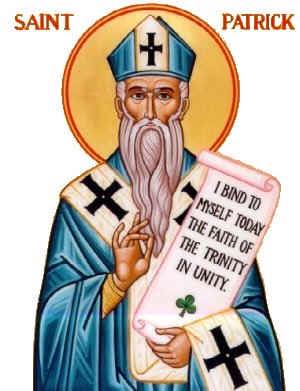
You may have heard me refer to St Patricks as the “high holy day”, if you grew up where I grew up, it would be easy to come to that conclusion. I went to the St Patrick’s Day mass in Boston, once. It was conducted, by then, Cardinal Law. You wanna talk “high holy day”, that was it. The worship service, for what was during the week, was very ornate and well attended. This was at the Cardinal’s seat at Holy Cross Church in Boston. Say what you will about the Roman Catholic Church, but I left there very much feeling as if I had been in worship.

The story is told of Mayor James Michael Curley of Boston. Mayor Curley was quite the character, sort of a Robin Hood figure at the time, which was pretty much during the depression. He couldn’t make March 17 a holiday for a Christian Saint, he tried to find an historical event to commemorate. He hit upon the fact that March 17 is when the British evacuated Boston during the Revolutionary War. Well the fact that our Boston ancestors drove the mighty British out of Boston wasn’t something that not only the old Boston Yankees would happily commemorate, but also the Irish-American population would also buy into. Call it what you would, there was a holiday on March 17 and we all know what it’s really about. Evacuation Day is still a recognized holiday in Middlesex and Suffolk counties where Boston is located in. And it is duly celebrated.

Heritage is an important thing, it should be shared and celebrated. Right here we have at least four different groups in First St Johns Lutheran Church that are very serious in the living and celebrating of their heritage and there is nothing wrong with that. In a society that has become so splintered and so alienated, I submit that those people who remember their heritage, share that heritage with others of the same group, make sure that their children, grandchildren and other relatives remember that and don’t surrender to what has become an increasingly homogenized society. As much as diversity is promoted in today’s society, it really is putting away ethnic and religious heritages, to be bound together under an increasingly secular and humanist heritage. Many talk a good game about heritage, the lack of knowledge of American and ethnic history is getting to be scandalous. Too many young people can’t even think in historical terms, as if what came before them doesn’t matter and yet has very much made them what they are. This lack of anchoring in our society, to our Christian heritage and our family heritage has left us with a society that is increasingly detached and alienated.

When you were baptized, you became a new person. In Baptism you are “born again”, you are given real life, in Jesus Christ, you are that new man or woman. Because of that you are born into a new heritage. You may be of German ethnicity or Irish or Spanish, African-American, Italian, but as the song says “…in Christ alone…” We share a heritage that goes back to the beginning in Jesus. As Paul wrote to the Galatian brothers: “There is neither Jew nor Greek, there is neither slave nor free, there is neither male nor female, for you are all one in Christ Jesus.” (Galatians 3:28)

Because it is the “high holy day”, I bring this up because I do try to make St Patricks a little special. I know it’s the middle of Lent and should be somber. Sundays, though, even in Lent, are still festival days on the church calendar. It’s odd how it works out and if you would like me to explain it, I will, but I see St Patricks as a way to kind of stay in touch with the culture that I was brought up in and even as a Lutheran was included in. I have to admit, being of Irish/Yankee ethnicity, makes me an oddball in the Lutheran Church. Although it’s not the only thing that does, but I see St Patricks as a way to remember not just our ethnic identity, but so much more importantly our identity in Jesus.

One reason that I have felt it was so important to recite the Apostle’s and Nicene Creeds with the word “catholic” is to emphasize that the Lutheran Church is very much a universal church. We should not concede that to any other church. We are universal and the Lutheran Church has members and churches in almost every country in the world. There are countries where Christianity is seriously repressed, so we really don’t know what church is or isn’t represented. The fastest growing Lutheran population in the world is not in the United States or Europe, it’s in …. Africa, by far. “…there are over 16 million Lutherans in Africa?  To put that in perspective, that’s more Lutherans than in all of North America. Unlike the Church in Europe and North America, Africa as well as Asia is seeing phenomenal growth in membership.” Put in perspective, from Dr Luther grew the churches of modern Protestantism. [1] Anglicans, Baptists, Methodists, genuine Protestant Christian, excluding Anabaptist churches, churches are the result of what Martin Luther did 500 years ago. We are all truly brothers and sisters in Christ. Often more brothers and sisters than the people that we share physical parents with.

I may use St Patricks Day to add a little twist into worship, I try to do it better, but it never seems to come about. But we have a shared heritage that far transcends what countries our ancestors were born in, we have a heritage that matters for eternity. Jesus died for all of us equally, we are all equally saved in Jesus, whether you were baptized last week, or seventy years ago. I am no more saved because I’m of Irish descent than you are of German descent, or Spanish, African American. In the eternal resurrection our heritage is solely in He who died so that we could be saved. He who is the Lord of our life, in this life and in the life eternal. “For God so loved the world that He gave His only Son…” World, ko,smoj in Greek means “…the inhabitants of the earth, men, the human race”[2] We are all brothers and sisters in the Holy Catholic, universal Lutheran church of Jesus Christ.

The peace of God which passes all understanding keep your hearts and minds in Christ Jesus. Shalom and Amin.

[1] See more at: http://www.messiahlacrescent.org/2010/09/lutherans-in-africa/#sthash.x7ApeFjD.dpuf

[2] BibleWorks

True disciples in Jesus, not phoney expectations

This is from Henry and Richard Blackaby’s Experiencing God Day by Day p 142: “James and John sought to outmaneuver their fellow disciples in order to gain the places of greater honor next to Jesus (Mark 10:37). Over and over the disciples’ actions showed that they did not truly understand who Jesus was (John 6:7-9; Mark 6:49). Even after three years with Jesus, Peter was afraid to confess Christ before a young servant girl (Matt 26:69-75).

Yea these guy’s definitely failed, but I respectfully disagree being in Jesus does not mean that we all of a sudden become lions for Jesus. As a Lutheran we certainly know that we become a new creation in Jesus. Baptism makes us a new man or woman, we have been born again in the Spirit a new creature. We absolutely do. But Martin Luther always cautioned that the old/worldly person would always be lurking waiting for the chance to jump in and assert itself.

When it’s not about Jesus it’s about me. I have no doubt that the ratio is well over fifty percent weighted to me. Sure they became new men on the day of Pentecost and we praise God for that. We do become spiritual beings in Jesus and the Holy Spirit does keep working on us.  I pray that we do respond to Him when we are called on, that we are raised up far more than we fail.  But the beef I have with Reformed theology falls in to works righteousness theology, that we have to become virtually perfect. This side of heaven we aren’t going to be perfect or even too close. I’ve talked to too many people who have given up, have despaired because some uneducated, self-proclaimed “evangelist”, who doesn’t know what he/she is talking about and makes it up. Who genuinely thinks he/she has reached some state of perfection and thinks everyone else should be. They just don’t know what they’re talking about. The Blackabys certainly are much better educated than me, but all Reformed theology still breaks down in this works righteousness and creates an environment where too many give up because they can’t reach an impossible goal of perfection.

I’m not saying give up and don’t strive. Christians should always be striving for Jesus. But don’t get sucked into this idea that you’re going to be perfect and have it all together. Too many have been spit out the “big box” church because of faulty teaching and faulty people. These are the kinds of Jim Jones/cult kind of thinking that causes serious spiritual dysfunction. The fastest way to truly die is to let your spiritual life be undermined.

Look at ISIS, all the places where Christians are truly persecuted and truly living for Christ. They don’t have the time and resources for big box Christianity, the Joel Osteen, Mark Driscoll, nonsense. We have brothers and sisters in Africa, Asia who have and continue to suffer persecution. While people sit in their non-denominational big boxes being amused and convinced they’re perfect just by virtue of being them, the denominational churches, the ones who live the life and put it on the line are out there truly serving. I wonder when non-denominational churches are going to be sending military chaplains who are right on the front line. Who are going to do the work of Lutheran World Missions, for those who sit in pretty sanctuaries, world pleasing sanctuaries.

The big box phoney churches can try to sell that you need to be perfect, but for those who are living the life by actually serving, who are suffering, who know the real world of Christianity, we aren’t perfect. Dr Luther knew the old man, and I certainly have never known a Christian more real than Martin Luther. We need to quit creating phoney expectations that are not Biblical and are only in the head of some self-important big box player to the crowd. Let’s stand up as true brothers and sisters in Jesus accept that we and those around us are fallible and go out and really live the life in Jesus. Let’s not set people up for failure which the big box churches are doing.

It’s all about God Exodus 20 First St Johns March 8, 2015

For the audio version of this sermon click on the above link

We make our beginning in the Name of God the Father and in the Name of God the Son and in the Name of God the Holy Spirit and all those who know it’s all about God; Father, Son and Holy Spirit said … AMEN!

Caesarius of Arles said: We should also know that the ten commandments of the law are also fulfilled by the two gospel precepts, love of God and love of neighbor. For the three commandments which were written on the first table pertain to the love of God, while on the second tablet … are recognized as pertaining to love of neighbor. The Lord said in the Gospel: ‘On these two commandments depend the whole Law and the Prophets.”[1]

The commandments, which are also called the Decalogue in Greek, are to you, they’re about loving God and loving others. When we do that, is there any doubt that we are loved back? Again, I want to emphasize, that we’re not talking about the sentimental, mushey love that we Americans have understood love to mean, or this sort of enabling “love” that doesn’t judge or rebuke. It’s love that wants what is best for us, that helps us to grow and to become people who are led to live lives that God had intended.

An article about a man Noel Biderman who started an on-line website that helps married people meet other married people to have an affair. This was published in Forbes Magazine, in the next issue of Forbes, the “letters to the editor”, were mostly appalled, but sure enough there were the “well if that’s what they want…” and “if he can make money…” There are people in today’s world who would try to convince you that for a variety of reasons it is loving to help people to sin. Let’s be very clear here, it is in no way shape or manner “loving” to help people do things that are clearly destructive. There is no such thing as a victimless crime, and it is not loving to think that there is.

To be truly loving, we do the things that benefit and enhance our spouses, our children, our parents, siblings, all those we encounter. Someone may hit me up for money for a “burger”, which means booze, when I refuse they accuse me of being unloving/unChristian, a bad pastor. Really? Am I really doing anyone any good by expediting their death? When we remember the Decalogue, we are remembering, yea, the things that we’re not supposed to do, but we also remember the why and not only the “don’t”, but also the “should”. Walter Roehrs writes: “…they are a basic epitome of the response that God expects of the participants in His covenant of grace…” He goes on to say: “..They lay claim to man’s total being from the hidden stirrings and intentions of the heart to their overt expression in word and deed. It eliminates all assertions of man’s self – determination. The new covenant doesn’t minimize but rather sharpens the demands of an uncompromised surrender of self to the Redeemer and the Fulfiller of the Law.”[2]

Remember the “Small Catechism”? Those basics of our faith that get shoved into the back of an out of the way bookcase, or, worse, a box in the basement, assuming you took your copy with you from your parents home, decades ago.

Let’s take a quick pass through, not just the don’t do this, don’t do that, but one thing that is unique about Lutheranism it also helps us to see what we should do.

“You shall have no other gods.” What does this mean? We should fear, love and trust in God above all things.”

“You shall not misuse the name of the Lord your God.” What does this mean? We should fear and love God so that we do not curse, swear, use satanic arts, lie or deceive by His name, but call upon it in every trouble, pray, praise and give thanks.”

“Remember the Sabbath Day by keeping it holy.” “What does this mean? We should fear and love God so that we do not despise preaching and His Word, but hold it sacred and gladly hear and learn it.”

“Honor your father and your mother.” “What does this mean? We should fear and love God so that we do not despise or anger our parents and other authorities, but honor them, serve and obey them, love and cherish them.”

“You shall not murder” “What does this mean? We should fear and love God so that we do not hurt or harm our neighbor in his body, but help and support him in every physical need.”

“You shall not commit adultery.” “What does this mean? We should fear and love God so that we lead a sexually pure and decent life in what we say and do, and husband and wife love and honor each other.”

“You shall not steal.” “What does this mean? We should fear and love God so that we do not take our neighbor’s money or possessions, or get them in any dishonest way, but help him to improve and protect his possessions and income.”

“You shall not give false testimony against your neighbor.” “What does this mean? We should fear and love God so that we do not tell lies about our neighbor, betray him, slander him, or hurt his reputation, but defend him, speak well of him, and explain everything in the kindest way.”

“You shall not covet your neighbor’s house.” “What does this mean? We should fear and love God so that we do not scheme to get out neighbor’s inheritance or house, or get it in a way which only appears right, but help and be of service to him in keeping it.”

“You shall not covet your neighbor’s wife, or his manservant or maidservant, his ox or donkey, or anything that belongs to your neighbor.” “What does this mean? We should fear and love God so that we do not entice or force away our neighbor’s wife, workers or animals or turn them against him, but urge them to stay and do their duty.”[3]

We should keep Dr Luther’s commentary in a contemporary context, can you imagine if we all lived that way? For God and each other and not ourselves? We should also remember that Christ certainly lived these commandments. He not only obeyed, but He also lived for what is best for us. The example He lived in the Incarnation was not just about not doing something, but pro-actively living so that others might come to know how to truly live the Decalogue. He also died so that we who were powerless to save ourselves, He served us who did nothing to earn His service and who don’t deserve to be served, but to be lost. He died to save us and to serve us.

The peace of God which passes all understanding keep your hearts and minds in Christ Jesus. Shalom and Amin.

[1] Joseph Lienhard editor, quoting Caesarius of Arles “Ancient Christian Commentary on Scripture OT III” p 102-101

[2] Walter Roehrs “Concordia Self Study Commentary” p 75

[3] Lutheran Service Book pp 321-322

It’s about God and brothers and sisters in Jesus, it’s not about you

I was listening to J Vernon McGee while I was reading this devotional by Henry Blackaby and I noticed how the common thread was “it’s not about you” or me, it’s about God!

Dr McGee was answering the tire old nonsense “a loving God wouldn’t send anyone to hell.” I really wish people would think a little more and quit with the simple little cliches. People love to say how much smarter they are than everyone before or now. It’s not true. Dr McGee points out that God is loving. He is also righteous, just and holy.  He has given us a way to be saved unlike any other belief system, but it has to be on the basis of salvation in His Son. But in our day and age when we think it’s all about us, we think God is supposed to take whatever we offer Him. No! It’s not your way it’s God’s way.

We are holy in Jesus.  In Jesus we are in the presence of the Lord, God is holy. That means set apart, sanctified. He will not accept anything less, His nature abhors anything less. The “ONLY” way we can be holy is through God the Son. There is no other way. Jesus said “no one comes to the Father except through Me.”

Dr Blackabys devotional was on how what we do and don’t do affects other Christians. We should act only after we consider how our actions will affect other Christians. When we sin “Sin promotes independence. It isolates you from others… God designed you for interdepenence.”

We do have responsibility to our brothers and sisters in Jesus. But that does raise the question in terms of those who aren’t in Jesus. The Acts church was solely focused on only supporting fellow Christians. The church I pastor does reach out to help, but frankly there’s only so much we can do and we have a responsibility to help brothers and sisters. I think we should be very discerning in who we help because we just do not have the resources. The church at all levels does so much with so little for so many and yet the average secularist (who statistically) does very little for anyone else still likes to wag their finger at the church. Yes those same people who love to say how non-judgmental they are.

The take away is this.  It’s just not about you. If you really don’t understand what God is about, you better not go around making statements about what God will or won’t do. I mean come on that’s just stupid. God gave His Son for our salvation we are saved in Him or we condemn ourselves.

We need to remember when we sin, it’s not just about us. Our sin reflects on and affects countless numbers of other Christians. And we should be in service, but primarily to brothers and sisters in Jesus. We are guided by the Holy Spirit to help others but we are focused on serving those who are in Jesus.

Dr J Vernon McGee weekly question and answer podcast for March 14, 2015

“experiencing God Day by Day Henry and Richard Blackaby  p 130

Prayer, prayer, prayer da, de, da

Da, de, da, love, love, love, the Beatles tune. How about Prayer, Prayer, prayer da,de, da?

Is there a greater way to show love then through prayer? No… Yet we in the church, given the opportunity to prayer for others often just pass, or make a perfunctory attempt. I’m not saying you have to wax eloquence, not at all, simple sincere prayer is much more effective. Just make it sincere.

That prayer is the the greatest weapon of the church is quite plain and I can speak to that from personal experience, as well as from what is taught, what we know from the Bible, and learned others who have written profoundly about prayer.

I’ve seen some crazy answers to prayer and often did not know how to deal with those answers. Often it took prayer to understand what I was dealing with.

Why do we as a church and faithful individuals give such short shrift, a nod to prayer? “Sure prayer is important, but then we have to do something “real”, afterwards!” Yea, there’s some genuine faith for you. The important part is done, the next important part, God’s answer and action, usually requires that you wait, for the real important part.

There is corporate prayer, the whole church body, a small group, two or three, more than one person raising their prayer concerns and the concerns of each other. Their is individual prayer, what we do in our prayer closets. Often the time we struggle over the deepest concerns in our souls.

I had really been pouring over a problem that I just did not know how to deal with. My inaction could have been perceived as procrastination. But while being in personal prayer, it was as if the Holy Spirit just knocked me across the head and said: ‘OK, pay attention this is what you’re going to do, bang, bang, bang, bullet point, bullet point. As things resulted, I have no doubt it was in His time and in His way.

I do wonder if some of the people who just like to carry on, how they really quench another’s spirit. I get it, sometimes there are issues where someone really does need some space and to let it out. I’m not criticizing that, I have a problem with the person that often just carries on and doesn’t realize how much another person’s spirit is being doused.

Those kind of people usually don’t offer any kind of encouragement, nothing uplifting, mostly just pointless, not creative, but often heartlessly critical. They always find the negative, never the upside.

It’s as if they are saying: “I know this is important to you, but I really don’t care. All I care is that I carry on about it and everyone knows where I am at. I am going to discourage you, not do anything constructive and actually feel like I’ve done something and that it’s really you who are clueless.”

Hmmmm, how about, “you know what? We really need to hit our knees and pray together and you’re going to do it without thoughtless comments, or just trying to indulge me. We are going to pray in genuine faith, put all the negative blah-blah behind us and trust God’s will.” How do you think prayer would help the person who needs encouragement? How would it help the person whose critical spirit maybe needs to be quenched?

Prayer is powerful in so many ways. Jesus told us to pray to the Father “…Our Father who art in heaven…” He wants us to lift our prayers to Him, He wants us to help and encourage others. Let’s pray a lot, let’s spend meaningful time in our own prayer closet, time with others and time in worship for real prayer. Prayer! Got it?!

Thoughts on Predestination from the Church Fathers to Martin Luther May 14, 2010

When I started this study on predestination, I assumed that this was simply to discuss that God must foresee the destiny of each person. Through this study though various writers have pointed to the need for God’s foreknowledge in all things. Certainly if God knows the destiny of Jim Driskell this has to include His foreknowledge of the entire environment, the history and the future in order to fit my life into my environment. In his commentary on Romans, Leon Morris explains the process that Paul describes in his letter, that it is indeed not just knowing who is saved but it is a process: “Those he predestined God also called (again the call is an effectual call, for it is preceded by predestination). Those he called God also justified … This is an important concept for Paul and receives special emphasis in this epistle. It leads on to glorification, for those whom God justified he also glorified. The aorist tense here is unexpected… it is more likely that it is used of set purpose to bring out the truth that our glorification is certain. So certain is it that it can be spoken of as already accomplished.”[1] So certainly Paul clearly intended for us to understand that the predestination he was talking about was not something that was just being worked out, it was, but the end had already been determined. The focus of much of the discussion on predestination is on Romans 8:28 – 9:24, specifically 8: 29 – 8:30.

Needless to say to take on such a study is staggering in its immensity and yet what is known with certainty is miniscule, what we know is rather speculative except for a few Bible passages that refer to God’s foreknowledge but not necessarily what that entails. That being the case we should work under the assumption that God knows everything. Of course this raises questions as to how man’s “free will” plays out in this. If I have free will can I act in a way that undermines God’s foreknowledge, or His plan as it were? If this means that God foreknew what I would do then does that preclude free will? Could there a middle ground? In situations like Judas does God predestine some things, maybe just the “important” things and then lets us kind of live our otherwise ordinary lives out according to our personal preferences and prejudices, does God really map out everything or just the “big” events that require divine intervention. Of course that then raises the question as to what is “important” and what is otherwise ordinary, something that really doesn’t require God’s attention?

The Book of Concord, which writing was led by Dr. Martin Luther, gives us a good explanation as to why we should examine the question of predestination, but Dr Luther writes, a great deal, in other places that while we discuss the question, we don’t become consumed by it, or try to presume to know God’s intentions and think that we can somehow understand what God’s intent really is. Clearly the Bible writes about it and we are aware of it, but it is through our faith in God that He is going to act according to His great holiness, grace, compassion and knowledge. We should trust in that and to quote Dr. Luther: “God doesn’t want you to know the future. So stick with your calling, remain within the limits of God’s Word, and use whatever resources and wisdom God has given you. For instance, I can’t foresee what my preaching will produce – who will be converted and who won’t. What if I were to say, ‘Those who are meant to be converted will be converted even without my efforts, and what’s the use of trying to convert those who aren’t meant to be saved?’ Saying that would be foolish and irreverent. Who are we to ask such questions? Take care of your responsibilities and leave the outcome to God.”

The writers of the Book of Concord wanted to clarify why it was necessary to discuss this issue: “Therefore, in order by God’s grace to prevent, as far as we can, disunity and schism in this article among our posterity, we have determined to set forth our explanation of this article in this document so that all men may know what we teach, believe, and confess in this article. 2 If the teaching of this article is set forth out of the divine Word and according to the example it provides, it neither can nor should be considered useless and unnecessary, still less offensive and detrimental, because the Holy Scriptures mention this article not only once, and as it were in passing, but discuss and present it in detail in many places. 3 In the same way, one must not by-pass or reject a teaching of the divine Word because some people misuse and misunderstand it; on the contrary, precisely in order to avert such misuse and misunderstanding, we must set forth the correct meaning on the basis of Scripture.”[2]

Fr William Most did a survey of the Church Fathers regarding predestination and he concludes that they all agree to some extent that merit figures in some way to God’s determination as to who will be saved. He starts by giving his understanding of how the Thomists, that is those who adhere to the school of Thomas Aquinas see predestination:

““The older Thomists, in general, explain it thus:

  1. In the order of intention: God first decides on the end, i.e., eternal glory for the predestined man. Then He decrees the merits needed for this end. Finally He decrees the graces needed for those merits.
  2. In the order of execution: God, in eternity, decrees the execution in time of the decrees He has already made/ First He decrees the graces needed for merits, then He decrees the merits, finally He decrees glory for the predestined man. For a reprobate however, he first decrees only sufficient graces (or, at least He does not decree efficacious graces t such an extent that the man would be saved), then He decrees the absence of merit after sufficient graces. Because it is metaphysically inconceivable for a man to perform a good work with such graces, sins infallibly follow, or rather, God moves the man to these. (Cf. 132.5) Because of the sins, He decrees eternal punishment.”[3]


The following is Fr Most’s summation of the Fathers’ view of predestination:

St Justin Martyr: “But I have already shown that it is not by the fault of God that those angels and men do become wicked who are foreseen as going to be unjust, but [rather that] by his own fault each one is such as he will appear [then].”[4]

St Irenaeus: “If therefore even now God since He foreknows all things, has handed over to their infidelity as many as He know will not believe, and has turned His face away from such ones, leaving them in the darkness which they chose for themselves: How is it strange if then He handed over to their own infidelity Pharaoh, who never would believe, and those who were with him?”

Fr Most’s comments on St Irenaeus’ view indicates that it is not a consideration of merit that God predestines some men, but because they chose sin: “…St Irenaus does not say that they lack the faith because God deserted them, but rather, that God handed them over to infidelity because they chose darkness for themselves… It is clear also that St Irenaeus by no means says that men can merit predestination. He does not, actually, speak at all about the positive side, but only about reprobation.”[5]

This seems to refute Fr Most’s argument. We are all condemned as a result of original sin, “”None is righteous, no, not one;” (Romans 3:10) So if we come into the world under sin and continue in our sin and God has foreseen that “He knows will not believe…” then they are left in their sin and surely God has determined that they will be left in their sin. There is no assertion that they can “earn” their salvation, it must be assumed that Irenaeus acknowledged this and therefore did not make a case that they could “earn” their salvation.

Clement of Alexandria: ‘For the coming of the Saviour did not make [men] foolish and hard of heart and faithless, but prudent, amenable to persuasion, and faithful. But they who were unwilling to obey, departing from the voluntary adherence of those who obeyed, were show to be imprudent and unfaithful and foolish. ‘But to those who are called, both Jews and Greeks, Christ the power of God and the wisdom of God.’ Should we not, then consider as negative (as is better) the statement ‘God has not made foolish the wisdom of the world’ (1 Cor 1:20)  …lest the cause of their hardheartedness seem to have come to them from God ‘who made foolish the wisdom [of the world]’? For altogether, since they were wise, they were more at fault in not believing the preaching. For the preference and choice of the truth is voluntary. But also the statement: ‘I will destroy the wisdom of the wise’ (1 Cor 1:19) means that He sent forth light, in contrast to the despised and condemned barbarian philosophy; just as also a lamp that is shone on by the sun is said to have perished, since it does not exert equal power [in comparison to the light of the sun]. Although, then, all men are called, those who willed to obey are named ‘called’. For there is no unrighteousness with God. So those out of each people who believed are the ‘chosen people’. And n the Acts of the Apostles you would find ‘So those who received His word were baptized’ but those who were unwilling to obey, obviously separated themselves. To them the prophecy says: ‘And if you wish and hear me, you will eat the good things of the land, showing that it lies in us to accept and to turn aside.’”[6] It again seems to me that the person Fr Most is quoting agrees that men can resist God, that God has left them in their sin and no doubt foresaw that they would. There is no indication that Clement claims, in any way, that man can somehow earn their salvation and that God foresaw that they would earn their salvation and thereby predestine them to salvation on that basis.

Fr Most states that ”…But he is anxious to show that the reason why some rejected the faith and others did not is found in men, not in God: ‘For there is no unrighteousness with God.’ And he finds the explanation implicitly contained in a line of the Acts of the Apostles: ‘So those who received His word were baptized.’ From this he concludes: ‘those who were unwilling to obey, obviously separated themselves.’ For : ‘It lies in us to accept and to turn aside.’[7] This last quote is from Isaiah 1:19. I do not understand how either Clement or Fr Most can understand this quote to mean that we can chose or refuse salvation. The context of the passage seems obvious to me, it seems to be a left hand/ right hand kingdom argument more then a way to merit salvation. That is if you obey then that can lead to a better life where you are. If you continue to sin, as Israel did, then they will not only not eat the good things of the land, they will not be on the land anymore. This certainly doesn’t apply to whether they will be saved or not.

The next discussion is based on St Gregory of Nazianzus comments on Matthew 19:12. “…When you hear ‘to whom it has been given,’ add: It is given to those who are called, and to those who are so disposed. For when you hear those words: ‘There is question not of him who wills nor of him who runs, but of God showing mercy,’ I judge you should think the same thing. For since there are some who to such an extent are proud of their good deeds that they attribute all to themselves and noting to the one who made them and made them wise and led them to good, this text [of St Paul] teaches them that even to will good needs help from God. Or rather, that the very choosing of the things that should be chosen is something divine, and a gift from God’s love of man. For it is necessary that salvation depends both on us and on God. Hence he [St Paul] says: ‘There is question not of him who wills,’ that is, not only of him who wills, ‘nor of him who runs’ only, ‘but’ also ‘of God showing mercy.’ So, since even the act of will is from God, he properly attributed all to God.’ And after a bit St Gregory continues, explaining the words of Christ to the mother of the sons of Zebedee, from Mt 20:23: ‘You will drink my cup, but to sit at my righthand and at my left is not mine to grant, but it is for those for whom it has been prepared by my Father.’ He comments: ‘Does then our mind that guides [count for] nothing? … Does fasting [count for] nothing? … Shall none of these profit a man anything but [instead] by a sort of capricious choice, is Jeremia sanctified, while others are rejected from the very womb? … There too, to the words ‘for whom it has been prepared’ add this: who are worthy, and who have not only received from the Father that they may be such, but also have give [it] to themselves.’”[8]

As far as his last questions goes I would take them as rhetorical and suggest that while the answer may be no, what is the reason we may do good works or fast? I would submit that it is because the Holy Spirit is working through us. If the Holy Spirit is working through us it would stand to reason that we are part of the Body of Christ. If we are part of the Body of Christ it is because we have been predestined to salvation. Furthermore why would someone use Matthew 20:23 to say that we are saved by our works? Clearly Jesus indicates that the choice is the Father’s, if James’ and John’s works don’t get them on the left and the right, I’m pretty sure that mine won’t get me there either.

St Gregory of Nyssa: “’The Father raises the dead and gives them life, and the Son give life to whom he will.’ We do not conclude from this that some are cast out from the lifegiving will; but since we have heard and we believe that all things of the Father belong to the Son, we obviously also see the will of the Father, as one of all these, in the Son. If then the Father’s will [attitude]is in the Son, and that Father, as the Apostle says, ‘will all men to be saved and to come to the knowledge of the truth’ it is plain that He who has everything that is the Father’s, and has the whole Father in Him along with the other good things of the Father, has fully also the salvific will…For not because of the Lord’s will are some saved but others are lost: for then the cause of their ruin would come from that will. But by the choice of those who receive the word, it happens that some are saved or lost.”[9]

There is no one questioning that the Father’s will is in the Son, but it should not be an issue at this point as to whether it is the Father’s will for a person to be condemned. It is not, God wills that all be saved, “And we should not regard this call of God which takes place through the preaching of the Word as a deception, but should know certainly that God reveals his will in this way, and that in those whom he thus calls he will be efficaciously active through the Word so that they may be illuminated, converted, and saved. For the Word through which we are called is a ministry of the Spirit — “which gives the Spirit” (2 Cor. 3:8) and a “power of God” to save (Rom. 1:16). And because the Holy Spirit wills to be efficacious through the Word, to strengthen us, and to give us power and ability, it is God’s will that we should accept the Word, believe and obey it. 30 The elect are therefore described as follows: “My sheep hear my voice, and I know them, and they follow me; and I give them eternal life” (John 10:27, 28), and they who are decreed “according to God’s purpose” to “the inheritance” hear the Gospel, believe on Christ, pray and give thanks, are sanctified in love, have hope, patience, and comfort in afflictions (Eph. 1:11, 13; Rom. 8:25).”[10] It is man’s evil that condemns him from the beginning. He can resist God’s will to save Him, but He can’t do anything to otherwise earn his salvation. God is not willing them to evil, He is just not choosing them for salvation.

It seems to me that Jerome was never a favorite of Luther and I can certainly see why from this quote: “If … the patience of God hardened Pharao, and for a long time put off the punishment of Israel, so that He more justly condemned those whom He had endured so long a time, God’s patience and infinite clemency is not to be blamed, but the hardness of those who abused the goodness of God to their own destruction. Moreover, the heat of the sun is one and according to the kind of thing that lies beneath it, it liquefies some, hardens others, loosens some, constricts others. For wax is melted, but mud is hardened: and yet, the nature of the heat [that each receives] is the same. So it is with the goodness and clemency of God: it hardens the vessels of wrath, that are fit for destruction; but it does not save the vessels of mercy in a blind way, and without a true judgment, but in accordance with preceding causes; for some did not accept the Son of God; but others of their own accord willed to receive Him.”[11] The Bible plainly states that God hardened Pharaoh’s heart, but it was a heart that was already evil, who rejected Yahweh in favor of the “gods” of Egypt. Pharaoh’s heart was made of stone and got a bit harder. So what makes him different that his heart is of stone (or mud as it were) and those who are saved are made of wax. God can melt or harden stone, but the heart is stone either way, that is evil, it is God’s prerogative to predestine “and those whom he called he also justified, and those whom he justified he also glorified.” (Rom 8:30) For the rest they were sunk in their evil, God did inflict it on them.

It appears that there is no hard and fast basis in the Fathers for a concept of predestination in any respect. But it would appear that they would not disagree with Augustine and his concept, despite what a typical Roman Catholic perspective would be, that being predestination based on some kind of merit, that all except for Jerome would agree that it is solely God’s decision. That they evil man does is clearly his own, if God hardens his heart, it is not to say that his heart wasn’t already hard enough for condemnation and if God lifts another man up for salvation, that is certainly his prerogative.

Although the Roman Catholic church drifted from the Augustinian view of predestination, toward a view that as we’ve seen is an attempt to try to rationalize the need for works, it is clear that Augustine was the demarcation between the tenuous concepts of the Fathers and the much more defined concepts of the medieval age. Albeit Roman Catholic dogma took it and twisted it to a works belief, that is represented by the bias shown to “Thomist’s” explanation of predestination by Fr Most.

Augustine took predestination and took the small foundation given to him by the Fathers and built a fortress on the foundation. In addition Augustine realized that predestination required more from God for man then just an assurance that he was saved. Certainly God can save whomever He wants, but Augustine felt that in order for man to demonstrate that God was guiding His chosen to salvation, God equipped man with perseverance and faith. Augustine describes at length God’s gifts of perseverance and faith to those whom He predestined. “Augustine’s intention in writing these works was to establish in the preaching of predestination an impenetrable bulwark for the defense of God’s grace against the teaching on meritorious deeds proposed by Pelagius’s followers (persev. 21.54). Predestination was understood, broadly speaking, as the preparation of grace by God, while grace itself was defined as a gift.”[12]

A lot of the argument, as we have seen, has been that either God foreknew what someone would do and elected that person based on his deed or decision. Fitgerald points out: “Predestination was not based upon God’s foreknowledge of human deeds, but was to be situated in God’s eternal decree and was therefore unfailing. This also meant that human beings had no right to claim God’s grace. Predestination, moreover, was for some and not all. The grace of perseverance in faith was no longer set aside for all the baptized, but only for those faithful people chosen by God from the massa damnata (or the massa perditionis or massa peccati), God’s electi.”[13]

Free choice is one of the basic arguments of the concept of predestination. In this letter of Bishop Evodious to Abbot Valentine: “…Adam, had the full reality of free choice, but he made bad use of the divine gift. Now man has free choice, but an injured choice … For from the moment free choice was damaged, it is for us sufficient only for perdition,…”[14] As Luther will point out, man really has no free choice, he is either called to the Kingdom by Christ or if man resists he is condemned to stay and die in the world, unsaved. Adam had the clear choice between keeping what he had, salvation in the Garden, or choosing to defy God and as a result was sent into the world. There is no salvation in the world, it is up to Jesus to predestine whom He will, therefore the choice was taken out of man’s hands.

Saint Fulgentius of Ruspe was bishop of the city of Ruspe, North Africa in the 5th and 6th century. He was from a wealthy family and probably received an excellent education. He stood up against the Arians in Ruspe and was exiled for a short period of time. He was called back to Ruspe to lead the people there back to the orthodox Catholic faith.[15]

Fulgentius was strongly in agreement with Augustine, but he seems to extend               Augustine’s position by saying that the will is prepared from the beginning of time in the individual to be worthy and therefore predestined to salvation. Much of his position on predestination is a strong echo of the Augustinian position, in that nothing we do justifies being predestined to salvation, that in fact we are predestined before we are ever born: “Let us enquire whether God must be believed to have predestined the works of the wicked for which he condemns them just as he is said to have predestined what he crowns in the saints? When we enquire about the cause of the condemnation of the wicked and of the glorification of the saints, we do not deny that the former are predestined to punishment or the latter to glory. But whether, just as the good works for which the just will be glorified are believed to be divinely predestined, must the evil works for which the unjust will be punished forever, be believed to be divinely predestined? For it is said in the book of psalms: ‘The unjust will be punished and the seed of the impious will perish, but the salvation of the just is from the Lord.’ Concerning both, our Savior also says, ‘And those will go off to eternal punishment but the righteous to eternal life.”

“In both, therefore, i.e., in the just and the unjust, I think that there are three things which must be considered: the beginning, the will; the unfolding, the work; the end, reward or punishment. That we may attribute to the just and good; we know that those things in which we find neither goodness nor justice are unworthy of God. And having considered the quality of works, we believe those things which are found to be worthy of and befitting the divine mercy or justice are predestined by God, ‘the gracious, merciful and righteous Lord.”

“And first we confess that the beginning of the whole of a good will is predestined and given by that eternal Trinity which is the one, sole, and true God. With a free justification, he has given this prepared to humankind, that which he had prepared to be given in eternal predestination. I shave shown this preparation of the will above, by the testimony of Holy Scripture, where it is said: ‘The will is prepared by the Lord.’”

“Therefore, the will is prepared by him who mercifully accomplishes in us both the willing and the completion. For the Apostle says, ‘For God is the one who, for his good purpose, works in you both to desire and to work.’ God, speaking through the prophet, confirms that it is he who empowers the faithful to do what they do, according to that oracle which has been cited by us above, where he says, ‘[I will] make you follow my statutes and be careful to observe my ordinances.’ [Ex 36:27] But what is ‘I will make you follow …’ except; all the good you will do is my doing. So he does that we may do. With him at work in us, every good thing we do comes about. Concerning this it is said in Hebrews: ‘[May he] furnish you with all that is good … May he carry out in you what is pleasing to him.’” [Heb 13:21]

“…We are in no way permitted, indeed, in a salutary way, we are forbidden, as much in our faith as in our works, to claim anything for ourselves as if it were our own. For the vessel of election says, ‘What do you possess that you have not received? But if you have received it, why are you boasting as if you did not receive it?’ [1 Cor 4:7] And in the holy Gospel, the word of the Lord’s precursor is ‘No one can receive anything except what has been given him from heaven.’ James the Apostle testifies, ‘All good giving and every perfect gift is from above, coming down from the Father of lights…’” [Jas 1:17][16] Clearly Fulgentius was an advocate of predestination and understood it to be a work solely of God and that man contributed nothing toward his predestination.

Gregory of Rimini (1300 – 1358) Was an adherent of Augustine, but seems to take the predestination discussion to the concept of “double predestination”, that is that God elects people to both salvation and damnation as an act of deliberate will. It could be argued that Augustine also condoned the idea of double predestination at some point in his writings. In The Predestination of the Saints he writes: “What the chosen have obtained, therefore, they have obtained gratuitously. The did not already have something of their own which they might first give to him order that they might be repaid. He saved them in return for nothing. But the rest who were, as the apostle did not fail to mention there, received this blindness as a repayment…Unsearchable then are both the mercy by which he gratuitously sets some free and the judgment by which he justly judges others.”[17] Later, however Augustine seems to acknowledge that this is a gift to some. All men are condemned, so if God decides to chose some, it is not that He has decided others are elected to condemnation, He is simply leaving them in the state they were in, choosing to make a gift to some others: “…this gift is given to some and not given to others. But why it is not given t all ought not to disturb a believer who believes that because of the one all have entered into condemnation, which is undoubtedly most just, and that there would be no just grounds for blaming God, even if no one were set free from it.”[18]

Gregory would be in agreement that God predestines us to both “glory and reprobation”: “In the first place God’s will becomes the sole agent whether in election to final glory or in condemnation to final reprobation. In the second place, His decision is free and unconditional, motivated by nothing but His willing. It is form obedience to these assumptions that his extremeism springs: for he [Gregory] refuses to go beyond the almost literal interpretation of God as the cause of both glory and reprobation (the so-called double predestination) with the result that, whereas his contemporaries and forerunners sought to mitigate the latter in attributing some part at least of the sinner’s penalty to his own sins, Gregory in effect denies him any such role. No less than he is who is saved, the man I reprobation owes his disability entirely to God. Consequently, as we shall see, Gregory’s outlook is distinguished not so much in the effects of predestination as in its cause, for it is with God that its most striking features lie.”

“Gregory, in accordance with common usage, defines predestination as election to eternal life and reprobation as the refusal of eternal life. They are eternally willed by God, and, as St Paul has said, it rests with God’s mercy whether a man is saved or not. Predestination is therefore God’s preparation and justification of the saved for eternal life while reprobation has no such end.”[19] He goes on to qualify this further by saying: “…on the other, it helped to point to reprobation as in some way having its case in the deficiency of those damned, as opposed to being directly willed by God.”[20] It is not clear if there is an “indirect” connection, other then sin on the part of the reprobate. So Gregory seems to be trying to remove blame from God, but somehow still trying to accommodate God’s foresight of all men, those saved and those condemned.

Thomas Bradwareine brings the debate up to the fourteenth century and also the British. He was a chancellor of Oxford as well as a professor of divinity and for a short period Archbishop of Canterbury.[21] “Bradwardine’s contribution to this process was no less far reaching. By removing faith from reason’s sphere, he was making it independent of everything but authority and dogma. Faith was the sole motive force once reason was withdrawn; belief had no use for reason’s aid or the knowledge which was from practical experience, for it proceeded independently upon an entirely different plane.” “Bradwardine having established that merit de congruo cannot be separated from merit de condigno, hasleft himself the comparatively straightforward task of showing that this cannot come from man. By rejecting the distinction between de congruo and de condign, he is able to confront its supporters as complete Pelagians: either they withdraw and accept that merit must come from grace and so have a supernatural value, or they expose themselves to denying merit as a supernatural quality and thus set up men’s natural powers on an equal footing with God’s… merit de congou as potential merit, does not really exist, merit de condigno, as a supernatural virtue, comes from God alone.”

“Bradwardine’s position, in fact, amounts to a complete rejection of merit as a human achievement. There can be no good act by a man which is not incited and aided by God’s grace.” [22]

The bookends of the predestination issue were Augustine of Hippo and Martin Luther. It seems in some ways as those who lived in the years between these two men were trying to rehash what had already been decided or were trying to somehow make man more complicit in their destiny. Generally that man would somehow merit his final disposition, either through his sin leading to condemnation or his works leading to his glorification. Quick referral to Augustine shows that he felt the issue settled: “But this whole argument by which we are maintaining that the grace of God through Jesus Christ our Lord is truly grace, that is, that it is not given in accord with our merits, is stated with the greatest clarity by the testimonies of the words of God.”[23]

It was Augustine who also went a few steps further to link predestination to a process. First that the saint would have to persevere: “But in the eyes of human beings it seems that all who are seen to be good believers ought to have received perseverance up to the end. God, however, has judged that it is better that some who will not persevere be mingled with the certain number of his saints in order that those people for whom it is not useful to be assured of their salvation amid the temptation of this life cannot be assured of their salvation.”[24] Faith obviously plays a part in our salvation, therefore faith had to be either a product of man’s will or a gift of God. Clearly the process had to include this being a work or God: “…both the beginning of faith and perseverance n it up to the end are gifts of God…But if each of them is a gift of God and if God foreknew that he would give these gifts of his – and who would deny this? – predestination must be preached in order that the genuine grace of God, that is, grace which is not given according to our merits, can be defended by an insurmountable bulwark.”[25] Thus all the gifts of God are accounted for in order for someone to be predestined; faith, perseverance and grace all result in the predestination of one to salvation.

In the interim between the men who had denied human merit and purely the will of God, the church had decided that it was indeed human merit that earned salvation for man. Martin Luther burst on the scene and went back millennium and rediscovered Augustine’s writings on predestination and Luther reestablished this teaching in the Reformation. While the Roman Catholic church had been empowering itself and seeming to reduce God in the equation, Luther asserts: ”He would be a ludicrous Deity – idol, rather – if His foreknowledge of the future were unreliable and could be falsified by events; for even the Gentiles ascribed to their gods ‘fate inevitable’! He would be equally ludicrous if He could not and did not do all things, or if anything were done without Him. But if the foreknowledge and omnipotence of God are conceded, it naturally follows by irrefutable logic that we were not made by ourselves, nor live by ourselves, nor do anything by ourselves, but by His omnipotence. Seeing that he foreknew that we should be what we are, and now makes us such, and moves and governs us as such, how, pray, can it be pretended that it is open to us to become something other than that which He foreknew and is now bringing about?”[26]

Clearly Dr Luther was not inclined to accept that man could do anything to effect God’s judgment: “Suppose we imagine that God ought to be a God who regards merit in those that are to be damned. Must we not equally maintain and allow that He should also regard merit in those that are to be save? If we want to follow Reason, it is as unjust to reward the undeserving as to punish the undeserving. So let us conclude that God ought to justify on the grounds of merit preceding; or else we shall be declaring Him to be unjust. One who delights in evil and wicked men, and who invites and crowns their impiety with rewards! But then woe to us poor wretches with such a God! But who shall be saved?”[27]

Clearly God does not save us by our merits. In the mystery of His plan He decided at the beginning of time who would be saved, that the rest of humanity already being in a state of depravity would be condemned. But God in His infinite wisdom chose to save some, when He could have let all die in their sins. So Luther teaches that we should we should proceed in faith: “Yes, it’s true that what is predestined will happen. However, we aren’t commanded to know what is predestined. In fact, we are forbidden to know it. We test God when we delve into unknowable matters. God has given Scripture to us so that we can know what we should and shouldn’t do. He expects us to act on this knowledge. What we cannot know, we should leave to God. We should stick to our responsibilities, vocation, and position in life. God and God alone knows what is predestined.”[28] God has given us the marks of the church, we have been baptized in His name. We then have His promises to rely on and it would not accomplish anything for us to become engrossed as to whether we are saved or not: “This doctrine must be preached and expounded to Christendom in general, but it must also be impressed so that each individual Christian can practice and apply it in his own particular trials. When the devil hits the heart with his darts (Eph. 6:16), labeled eternal predestination or God’s wrath and judgment, then I must be steeled against these with the Word of Christ and say: “Away with you, you vile spirit of lies! Go devour your own stench, and do not distract me with such thoughts! For I have learned from Christ and from God Himself that if I want to know how God is disposed toward me and what His plans are for me, I must listen to none other than my Lord’s voice. There I see and hear nothing else than His gift of Baptism, His Sacrament; there I see that He absolves me from sin and acquits me. There is no threat at all that He wants to hurl me into hell. He does not want to drown me in Baptism; He wants to wash, cleanse, and quicken me.” [29]

There can be no doubt that God is in complete control. That it is His will that determines what will transpire in history, the present and the future. Would an omniscient God simply disregard His people? He has given us His promises that He is with us always. “For those whom he foreknew he also predestined to be conformed to the image of his Son, in order that he might be the firstborn among many brothers.

And those whom he predestined he also called, and those whom he called he also justified, and those whom he justified he also glorified.” (Rom 8: 29-30 ESV) To those He has predestined to salvation He has given them what they need; faith, perseverance and grace. Need we look farther? We should live the life that He has granted us, secure in the blessing of our salvation, praise and glorify the Father, Son and Holy Spirit. Give thanks to the Son who died in order that His Father would chose us for salvation.

BIBLIOGRAPHY

Fulgentius of Ruspe The Fathers of the Church Fulgentius Selected Works translated by Robert Eno (Washington, Catholic University of America Press) 1997

Luther, M. 1999, c1961. Vol. 24: Luther’s works, vol. 24 : Sermons on the Gospel of St. John: Chapters 14-16 (J. J. Pelikan, H. C. Oswald & H. T. Lehmann, Ed.). Luther’s Works. Concordia Publishing House: Saint Louis

Luther, Martin The Bondage of the Will Translated by J. I. Packer and O. R. Johnston (Grand Rapids, Fleming H. Revell) 2006

Tappert, T. G. 2000, c1959. The book of concord : The confessions of the evangelical Lutheran church. Fortress Press: Philadelphia

Teske, Roland Translator The Works of Saint Augustine volume IV (New York, New City Press) 1999

Fitzgerald, Allan Augustine Through the Ages (Grand Rapids, Eerdmans Publishing Co) 1999

Galvin, James E. Martin Luther Through Faith Alone (Saint Louis, Concordia Publishing House) 1999

Leff, Gordon Bradwardine and the Pelagians (Cambridge, Cambridge at the University Press) 1957

Leff, Gordon Gregory of Rimini (Manchester, Manchester University Press) 1961

Morris, Leon The Pillar New Testament Commentary The Epistle to the Romans (Grand Rapids, Eerdmans Publishing Co) 1988

Most, Fr William G  Grace, Predestination and the Salvific Will of God (Front Royal, Va, Christendom Press) 1997

[1] Morris, Leon The Pillar New Testament Commentary The Epistle to the Romans pp 333-334

[2] [2]Tappert, T. G. 2000, c1959. The book of concord : The confessions of the evangelical Lutheran church. Fortress Press: Philadelphia

[3] Most, Fr William G  Grace, Predestination and the Salvific Will of God p 250

[4] Ibid p 259

[5] Ibid p 261

[6] Ibid pp 261-262

[7] Ibid p 263

[8] Ibid pp 265-266

[9] Ibid pp 267-268

[10] Tappert, T. G. 2000, c1959. The book of concord : The confessions of the evangelical Lutheran church. Fortress Press: Philadelphia

[11] Most, Fr William G  Grace, Predestination and the Salvific Will of God pp 274-275

[12] Fitzergeral, Allan Augustine Through the Ages p 678

[13] Ibid p 678

[14] Teske, Roland translator The Works of Saint Augustine volume IV  p 42

[15] Background information from Wikipedia

[16] Fulgentius of Ruspe The Fathers of the Church Fulgentius Selected Works translated by Robert Eno pp 205-208

[17] Teske, Roland translator “The Predestionation of the Saints” The Works of Saint Augustine volume IV  p 158

[18] Ibid p 163

[19] Leff, Gordon Gregory of Rimini pp 196-197

[20] Ibid p 199

[21] Background information from Wikipedia

[22] Leff, Gordon Bradwardine and the Pelagians p 263

[23] Teske, Roland translator “The Predestionation of the Saints” The Works of Saint Augustine volume IV  p 168

[24] Ibid p 201

[25] Ibid p 228

[26] Luther, Martin The Bondage of the Will pp 216-217

[27] Ibid pp 233-234

[28] Galvin, James E. Martin Luther Through Faith Alone

[29]Luther, M. 1999, c1961. Vol. 24: Luther’s works, vol. 24 : Sermons on the Gospel of St. John: Chapters 14-16 (J. J. Pelikan, H. C. Oswald & H. T. Lehmann, Ed.). Luther’s Works. Concordia Publishing House: Saint Louis