Prayer together
Leave a reply


Gallup research conducts and maintains a “Well-Being Index” on various aspects of Americans well being. Well, well, what do you think they found? “In U.S. Churchgoers Boast Better Mood, especially on Sundays.” (Gallup – Healthways Well-Being Index in 2011) The study was done by Chaeyoon Lim who sub-titled the study “Those who don’t attend religious services often see their mood decline.”
I am not saying that church should always be a “feel-good” experience, frankly if folks left worship from First St Johns and they didn’t feel a little, oh I don’t know, disturbed? If they didn’t feel a little challenged, a little pushed, I’d probably be disappointed. Sure I want people to be pumped up, encouraged, thankful to God and renewed in their relationship with Jesus. Frankly I’m not surprised that they are in a better mood. Even if they’ve been challenged, pushed, they still know whose they are, our Father’s. They know that they are part of the Body of Christ, surrounded by brothers and sisters in Jesus and ready to start a new week in the Lord standing for the Lord in the world. So yes they should leave worship in a “Better Mood”.
“…regular churchgoers seem to do better than non-churchgoers… in terms of their daily positive wellbeing experiences. This underscores previous Gallup research that finds very religious Americans do better across numerous dimensions of well being than do those who are less religious or not at all religious.”
And look, don’t give me any of this “Moonie effect” or other non-sense, there is no doubt in my mind that the general “well-being” of Americans has been directly related to the decrease of community and especially being a part of a church community. This goofy idea that you will be happier sitting at home watching television by yourself, thinking that you are genuinely getting community on your computer, the stories go on and on and you know them as well as I do. The solution, get off your quista and get out among real human beings. As we as a culture continue to cut ourselves off from each other, the worse our life attitude will be. Sit home by ourselves, isolated and vulnerable, Satan picks us off one by one. The Bible tells us two are better than one, we all need others to “have our back”, where better than brothers and sisters in Jesus?
The study goes on to report: “Not only do Americans who attend a church, synagogue or mosque frequently report having higher wellbeing in general, but they also get an extra boost to their emotional state on Sundays – while the rest of Americans see a decline in their mood. The average number of positive emotions frequent churchgoers report experiencing rises up to a high of 3..49 for the week on Sundays, whereas for those who attend church monthly or less often, the average number peaks on Saturdays and declines to a range of 3.14 to 3.29 on Sundays.” Yea, you read that right, on the day before we have to go back to the old salt mine, people who attend worship actually get a bump in their wellbeing. There is a sense of being secure in something bigger, knowing you are with like-minded brothers and sisters in Jesus and the research confirms this: “…the research found that friendship in church is more strongly correlated with life satisfaction than friendships in other contexts such as the workplace or a book club. It is not only that churchgoing Americans may be more likely to socialize on Sundays, but also that they are spending time with co-religionists who can especially boost their mood.”
Let’s face it, church does put you into proximity of people who are like-minded, feel secure being in church and something to readily share with each other. (Hopefully it’s not, ‘wow, pastor’s sermon was brutal today.’) This research lines up with so many other studies that show numerous positive outcomes to church, worship, prayer etc. While the world stresses individuality, isolation, “feeling good” in things such as materialism, covetousness, sex, drugs, booze and rock and roll, the reality is that well being is found in church, in worship, in the presence of those who are brothers and sisters in Christ. It stands to reason, we come into the presence of the almighty Creator, Sustainer of all things. He knows us better than we know ourself, He forgives us, He has given us a way through the sacrifice of Jesus to come into relationship with the all knowing, all powerful Lord of all. We have the assurance that through the forgiveness we have in Christ’s sacrifice that we will have eternal life in a new perfect world, the world that the Father intended before we messed it up with our sin. If all this doesn’t enhance your “well-being” then you need to sit down with your pastor and have a long serious discussion.
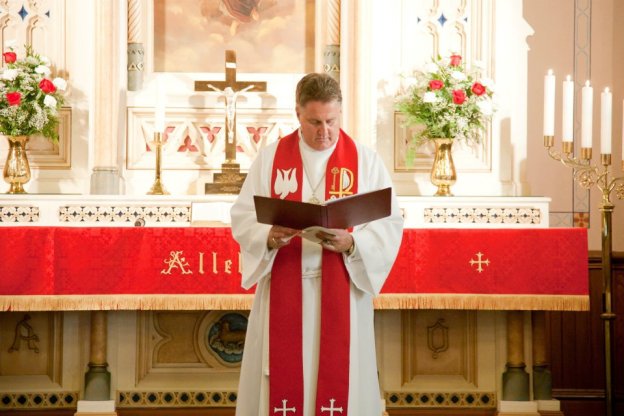
We make our beginning in the Name of God the Father and of God the Son and of God the Holy Spirit and all those who know the power of the Holy Spirit said … AMEN
The feast of Pentecost is the oldest continuous celebration that Christians observe. Reason being it was originally a Jewish festival that God directed Israel to remember going all the way back to Deuteronomy 16:10. It is originally referred to by Yahweh, as communicated to Moses, almost what we would think of as Thanksgiving in the United States. Israel was to raise up thanks to Yahweh for the “first fruits, the first harvest”. God reminds Israel: “I gave you a land on which you had not labored and cities that you had not built, and you dwell in them. You eat the fruit of vineyards and olive orchards that you did not plant.’ (Joshua 24:13) Israel would have a lot to be thankful for. The Israelites had to fight their way in, but when they made it, there is ready made homes, fields, vineyards. They had to make their way into Palestine/the Promised Land, but Yahweh intends that when they get there, they will be set, they will be free from the paganism they escaped from in Egypt and that surrounds them and they would be able to provide for themselves. Pentecost was also a day to remember that Yahweh gave Israel His Law. The Law is what Israel is built on. Jewish people believe that they are saved by the Law, so Pentecost is to celebrate what they perceive as their salvation in the Law. In response there was only continual griping. God is providing them with manna to live on, He gives them water, He gives them the Law, He gives them the promise of a fruitful life in the Promised Land and what is their response? “We are still in the desert, we’re sick of this manna and we don’t want to go to the Promised Land because we are afraid and we just don’t trust your promises.” So God hears the griping, He gets angry, that means Moses gets angry who whines to God and Yahweh tells Moses to bring the 70 elders of Israel together for a huddle. Moses is fed up with the complaining and so Yahweh promises: “Then I will come down and talk with you there. I will take of the Spirit that is upon you and will put the same upon them; and they shall bear the burden of the people with you, that you may not bear it yourself alone.” (Numbers 11:17) Life is not a bed of roses for Israel, but they are about to see the fulfillment of God’s promises. Considering everything God has promised them it’s a life that’s not to shabby and their response is to continue to fuss and whine.
Take out your bulletin. Look at the Numbers reading verse 25. “Then the LORD came down in the cloud and spoke to him [Moses], and took some of the Spirit that was on him and put it on the seventy elders.” What do you notice about “God’s Spirit”? It’s capitalized, a proper noun. “What” you say, “this is 1,500 years before the Holy Spirit descends on the disciples, what’s going on here?” Yahweh gave Moses the Holy Spirit probably right from the start of His revelations to Moses. William Wrede describes it: “…the Lord comes down in the cloud and gives them a gift. The same gift of the Spirit given to Moses is now shared with the seventy. Moses loses none of his gift, but as one candle lights another, the Spirit is given to each and they all begin to prophesy. This is God’s gift to his people to be a blessing to others.”1 I really like that imagery, while the Holy Spirit didn’t descend upon the Jews in the desert the same way He did on the disciples in Jerusalem, the outcome is still the same. Men possessed by the Holy Spirit and led by Him to prophesy. Clearly a preview of the Christian Pentecost here in the Sinai desert 1500 years before Jesus. These two men, Eldad and Medad, apparently didn’t check their e-mail or got caught in traffic, and didn’t make it to the elder’s meeting at the tabernacle and they are back in the camp, but the Holy Spirit doesn’t miss them. Joshua rushes to Moses to rat them out, contrary to expectation Moses is not at all disturbed: “Would that all the LORD’s people were prophets.”
Fast forward 1,500 years, we see a stark contrast. Where Israel had God’s promises of material satisfaction in Israel, they had the tangible tablets of the Law, and some of them even had the Holy Spirit. We find Jesus’ disciples huddled together in a house in Jerusalem. While everyone else in Jerusalem is probably out, celebrating the third most important feast-day in Judaism, the disciples probably still have a “bunker mentality”, they remember Jesus’ promise, ten days earlier: “…you will be baptized with the Holy Spirit not many days from now… you will receive power when the Holy Spirit has come upon you,” (Acts 1:5, 8) OK, fine, but when will that happen? In the meantime, “we’re going to hide out here, our Shepherd’s gone, no doubt there are people who want to arrest us and are looking for us. Until such time as Jesus does what He promised and we have no idea what that really means”, maybe they don’t remember Numbers 11, “we will make ourselves very scarce.”
Hiding away, cowering. Certainly an odd contrast to their ancestors who are standing out in the desert heckling Moses, demanding immediate satisfaction. The disciples are together, they are trusting in Jesus’ promise, they don’t know how that will happen, but in faith they wait. Their faith is rewarded, probably beyond anything they imagined: “…a sound like a mighty rushing wind..” You’ve probably heard people describe an on-coming powerful tornado,… they often say it sounds like an approaching freight train, concentrated power and fury. Can’t we imagine the Holy Spirit’s approach being at least like a freight train? The Greek is pneu,matoj a`gi,ou in English we have the word pneumatic, as in pneumatic tool, how is a pneumatic tool powered? … Compressed air, we have tools that use the power of compressed air. In Hebrew the word is x;Wr [ruach] which also means “wind, spirit”. Both usages imply momentous power. This wasn’t just a sudden burst of wind, but an enormous, continuous blast, a strong enough blast that all these people in Jerusalem, our reading says “…devout men from every nation under heaven..” rush together, “bewildered”, what is this noise! We don’t rush into the street at any random burst of wind, we might take a quick look out, but normally we don’t pay anymore attention. Then “…divided tongues as of fire appeared to them and rested on each one of them” Now that we have your attention, you will hear us preach in your native language. This is all the work of the Holy Spirit, a clear demonstration that God is at work, the Holy Spirit inspires Peter to preach in a way he would never have before (this is the same guy who didn’t want to talk about Jesus to a few people after Jesus had been arrested. Now Peter is proclaiming the Gospel to thousands.) From this Peter is used to bring three thousand souls to know Jesus as their Savior.
Remember they are here to celebrate the “Feast of the First Fruits” those who God chose to come to faith are now the “First Fruits” of the Christian church. Philip Schaff notes: “This festival was admirably adapted for the opening event in the history of the apostolic church. It pointed to the first Christian harvest … We may trace to this day not only the origin of the mother church at Jerusalem, but also the conversion of visitors from other cities, as Damascus, Antioch, Alexandria and Rome, who on their return would carry the glad tidings to their distant homes…”2
We who are chosen by God to be saved in Christ, baptized in the Name of the Father, Son and Spirit, disciples and apostles of Christ, we are called to proclaim Him just as the disciples did on the Festival of First Fruits. We are called to proclaim Him in the language and understanding of those we know, being used by the Holy Spirit to reach those He has put in our lives to point to the Lord Jesus Christ and the salvation that only He can promise. Take some time this week in prayer, help us Father to feel the power of the Holy Spirit in our lives and to live that life in Him and to the world. The Spirit’s power in the wind, but to also pass from you to those He leads you to, like a candle lighting another candle. And also as our young men are “lighted” by the Holy Spirit in recognition of their confirmation today.
The peace of God which passes all understanding keep your hearts and minds in Christ Jesus. Shalom and Amin.

I’m reading “The Study of Liturgy” by Cheslyn Jones, Geoffrey Wainwright, Edward Yarnold and Paul Bradshaw. It’s a very comprehensive of liturgy from the earliest times to the present, yea, definitely a little dense, but a great resource.
The debate is in terms of the nature of baptism. Reformed theology in the United States is very much about the individual, it is often referred to as “decision theology”. Meaning, it’s all about us and our decision, we wait until we are old enough to chose, that we can make some kind of informed decision and “decide” for Jesus.
The argument is often made that people don’t want to “force” their children to accept their religion. Those same people will expect their child to accept other aspects of the family, but, well, religion, should be a “choice”. Way too many people treat being a Christian as being a part of a lodge or VFW. Yea, let’s treat our eternal life as if it’s a matter of convenience, preference, taste, everything but what it is, the one true God who has revealed Himself through His Son Jesus Christ and through His revelation to His prophets of some 1,500 years. We are often taught we should be in fear and awe of God, I mean yea, come on He is the Creator and Sustainer of all things. Instead we treat Him like Burger King, we will have it our way. Afterall God is all about making our life easy, doing what makes us happy and He should be happy to accept just any old thing we present to Him. No, we should treat God reverentially, in fear and awe, that is in true respect. Not some cowering fear, but in a fear and respect and awe that is felt and loved right down to the core of our being.
For too many people the attitude really comes down to “I have nothing very important to share with you, to pass down to you, anything that I have chosen really shouldn’t influence you, I shouldn’t teach you anything or try to impose decisions on you in anyway. When you are old enough you go ahead and make your own decision. Which is just bizarre! We want to provide our children with security, with a sense of belonging, for that matter of eternal security, but we deprive them of the security of eternal salvation, of belonging to the Kingdom. Jesus says “let the little children come to Me and hinder them not”. Why wouldn’t we baptize them in His Name, along with the Father and Holy Spirit. If they really don’t want the gifts and grace of God they can certainly reject them, but as for me, I want to give my children security in Christ. After that they can decide to reject Him, but it won’t be without truly knowing what they’re doing.
Contrary to this idea that anything to do with God is up to us, Christian theology is really about what God does to and through us. Our “making a decision” for God is contrary to the idea that He is Lord of all creation. That it is according to His plan, those who are faithful look for and follow God’s will, not their own. There is even a hint that there is really a choice. No one has ever been able to explain to me what/who the other options are, if Jesus says “I am the way, the truth and the life, no one comes to the Father except through Me”, I don’t know what is left, but there you have it. One of Martin Luther’s most famous books is “Bondage of the Will”, where he makes it very clear there is no choice. There is Christ and every thing else. Every thing else is condemnation, it may be something that makes you happy, but the result is the same if you aren’t in Jesus, you will exist in eternal condemnation. Like to tell you otherwise, but well there you have it.
Referring back to “The Study of Liturgy”, the writers make another point that I think is important: “…Infant baptism emphasizes the corporate faith and the faith which the child shares with its parents’; by means of the sacrament ‘the promise and claim of the Gospel are laid on the child.” (p 171).
Another point, too many Christians claim that baptism is some sort of initiation, some sort of public proclamation and not a “sacrament”. Lutherans believe that there are two sacraments and they are very much from Christ and contain His power and His promises. In the Lord’s Supper we are very much receiving His Body and Blood and in baptism, we are very much born again in the spirit and saved. In both we receive the forgiveness of God and His grace. Nothing else gives us these eternally important promises.
Having said that, the writers make a great point, as we emphasize community, the “Body of Christ” in the sacraments, other Christians emphasize self, it’s my decision, it’s simply for my benefit and it’s my call. We say no, it’s all about “the Body”, whether we are taking His Body and Blood or we are sharing with others in the Body of Christ. Baptism is that inclusion in the Body, it is about us being saved because we are the Body of Christ. But doesn’t that create a compelling image? Here is the church, the parents, the pastor and in the presence of His church, He includes a baby in the eternal Body. Individual baptism is usually not that way, it’s about that one person, making all the promises, the decisions and commitments entirely about him/herself.
The writers also make the point that the parents, the God-parents, the church, all take more seriously their responsibility for the nurture of baptized children to mature commitment in Christ. Isn’t that the ideal, to raise children in the community, the Body of the church? All on an equal basis of being baptized, saved, grafted into the vine children of God? If a child isn’t baptized he/she are not saved, not part of the Body. You can make whatever sentimental argument you want, but there is no alternative.

First Saint Johns
April 9, 2014
This is from Concordia Publishiing House “Words of Life from the Cross” series
SERMON: THE DYING WORD (LUKE 23:46)
The sixth word is Jesus’ dying word, a word of committal, a word of trust. His dying words are faithful, full of trust in His Father, trusting that in His death His Father will receive Him in loving arms just as the father of the prodigal received his son with open and welcoming arms. Here again is the paradox of faith. Jesus had cried out in abandonment, “My God, My God, why have You forsaken Me?” and yet now He cries out in faith, “Father, into Your hands I commit My spirit!”
Isn’t that how it is with the life of faith? God seems so distant at times, especially those times of darkness and woe, those dark nights and days, and yet He stands ever near to embrace us in those strong, loving, fatherly arms. Jesus trusted His Father, and He did it on behalf of all of us. His trust is complete and unwavering. Though He dies, yet He trusts. Though He suffers, yet He trusts. Though the Father is silent and hidden, yet He trusts.
But take note of something—this dying word is not sighed or whispered. This is not a weak word of resignation by a man who is overcome by death. No. He shouts this word in a loud voice. He summons His strength and shouts it to the highest heavens. He wants the whole world to hear what He has to say. He is the Son of the Father, begotten and beloved from all eternity. He trusts His Father’s mandate that sent Him on this mission to the cross.
Jesus is not overcome by death. Rather, He overcomes death by dying. “O death, where is your victory? O death, where is your sting?” (1 Corinthians 15:55). Jesus has taken the sting of death and the venom of the Law into His own flesh, shed His own blood, and now He cries out in victory and triumph as He commits His life to the Father who sent Him. This strong word of the cross cuts through your doubt and disbelief. Adam’s death is conquered by this Second Adam’s death. Adam hearkened to the doubting word of the devil and became a transgressor, plunging the world into the chaos of sin. But this Second Adam, the new head of redeemed humanity, holds true to His Father and will not waver even as He dies. His life is in the hands of the Father.
With His final breath, Jesus shows Himself to be the faithful Son. Where we have failed, He has succeeded. Where we have sinned, He has proven sinless. Where we doubt, He remains strong.
Being self-absorbed and self-oriented, the old Adam in us resists this surrender. It fights like crazy against the loving embrace of the Father, like a small child throwing a temper tantrum who will not be held. We want to be in control, we want to be in power. We resent any notion that we sit not in the driver’s seat, but in the passenger’s seat of our lives. Like so many drowning victims, we think we can swim to shore ourselves. We do not need a lifeguard; we even resist the attempts to save us. We want it all on our own terms.
You know how it is in your own life—the bargaining, the denial, the transactions—anything but letting go and leaving to God our Father to hold us in safety. Jesus does it. On the cross, He entrusts His life, His mission, His death, everything to His Father. “Father, into Your hands I commit My spirit.”
The words are from Psalm 31. The psalms are the hymnbook of the living and the dying. Jesus takes up the words of David on His lips, for they are His words, too, wrought by the Spirit of Christ in David.
In you, O LORD, do I take refuge;
let me never be put to shame;
in Your righteousness deliver me!
Incline Your ear to me;
rescue me speedily!
Be a rock of refuge for me,
a strong fortress to save me!
For You are my rock and my fortress;
and for Your name’s sake You lead me and guide me;
You take me out of the net they have hidden for me,
for You are my refuge.
Into Your hand I commit my spirit;
You have redeemed me, O LORD, faithful God.
David, surrounded by his enemies, commits his life into the hand of God. Jesus, the greater Son of David, hanging in the darkness with the burden of humanity’s sin hanging heavy upon Him, commits His life to His Father. In committing Himself into His Father’s hands, He entrusts us as well, gathering all into His death that we might be gathered to Him in our death.
In Luther’s day, people were quite intentional about writing down their last thoughts and confession. What you said at your death was what would be remembered about you. This is Jesus’ last word of His being humbled unto death in obedience to the Law. This is the last word of His work that began with His Baptism where His Father voiced His approval over His beloved Son. Now at the end of His mission, His work completed, the Scriptures fulfilled, the redemption of the world accomplished, He closes His eyes and breathes His last breath with a faithful, trusting word.
Remember these words when it comes time for your last words and make them your “now I lay me down to sleep” prayer. Father, into Your hands I commend my spirit. Say them each night, as the Small Catechism instructs, in case you should die before you wake. Hold the cross of Jesus before your closing eyes, and rest in peace and joy, knowing that death has been swallowed up in the victory of Jesus’ death.
For Your last triumphant cry, for Your faithful trust to the end, for Your final breath of the old creation, for Your entrusting Yourself and us to Your Father, we give You thanks and praise, most holy Jesus. Amen.
Please cllick on the following link for a audio recorded version of this sermon
The following is an article from the Huffington Post, which is not a credible source of much of anything, no less history, religion, philosophy. If you want inflammatory headlines, you definitely want this, and not credible journalism. At the very best I would describe the following as disingenuous, at best complete ignorance of any of the applicable scholarly subject. So read this and then I have my comments following:
“An ancient, business-card-sized papyrus fragment that appears to quote Jesus Christ discussing his wife is real, Harvard University announced Thursday. The fragment caused international uproar when it was revealed by a Harvard historian in September 2012, with prominent academics and the Vatican swiftly deeming it a forgery.
Harvard officials said scientists both within and outside the university extensively tested the papyrus and carbon ink of the badly aged fragment, dubbed the “Gospel of Jesus’ Wife.” The document, written in Coptic, a language of ancient Egyptian Christians, is made up of eight mostly legible dark lines on the front and six barely legible faded lines on the back. The handwriting and grammar were also examined over the last year and a half to confirm its authenticity. Scientists have concluded the fragment dates back to at least the sixth to ninth centuries, and possibly as far back as the fourth century.
The document was never meant to prove Jesus was married, Harvard Divinity School professor Karen L. King emphasized Thursday. Instead, she argued, it’s meant to highlight that some early Christians may have believed Jesus was married. The distinction is significant because debates over sexuality and marriage have dominated contemporary discussions about Christianity; the Catholic Church cites Jesus’ celibacy as one reason its priests must not have sex or marry.
“The main topic of the fragment is to affirm that women who are mothers and wives can be disciples of Jesus — a topic that was hotly debated in early Christianity as celibate virginity increasingly became highly valued,” King, whose specialties include Coptic literature, Gnosticism and women in the Bible, said in a statement Thursday. “This gospel fragment provides a reason to reconsider what we thought we knew by asking what the role claims of Jesus’ marital status played historically in early Christian controversies over marriage, celibacy, and family.”
The legible lines on the front of the artifact seem to form a broken conversation between Jesus and his disciples. The fourth line of the text says, “Jesus said to them, my wife.” Line 5 says “… she will be able to be my disciple,” while the line before the “wife” quote has Jesus saying “Mary is worthy of it” and line 7 says, “As for me, I dwell with her in order to …”
“The main topic of the fragment is to affirm that women who are mothers and wives can be disciples of Jesus…” First, of course women can be disciples of Jesus’. Any who are in Jesus should be His disciples. Who ever said they weren’t? You really have to reread this article with a critical eye.
Because this is an ancient document does not make it factual, the Bible is an ancient document, based on Bible copies going back to at least the 5th century (around the same time as this fragment) we know that the Bible we have today is very well documented. Why is this one fragment credible, and a document (the Bible) that can be traced back to the earliest times not credible?
The proponents of this are trying to say that the rap against this is a forgery. I haven’t read anyone that takes issue with whether it’s a forgery or not, the issue is whether it’s credible. Anyone could write something to be found hundreds of years later, the fact that it was discovered doesn’t make it fact. We are supposed to change all of history, theology because one scrap of paper was found??? Really!!! We have credible evidence of Scripture and writers dating back to the beginning, in straight succession to today. How does one unassociated scrap of paper change anything? During this period there were other writings that have shown to have no basis in fact. My fun example is always the “Gospel of Judas”. Help me out folks, the man was a traitor, he ran off and hung himself, and he still had time to write his gospel? Actually “gospel” means “good news” in Greek, so in Judas’ case it’s “not so gospel”. I don’t know? Fact is there are a lot of people out there with an agenda, with little scruples who will try to make a case out of anything they oppose. Also please note, this was written in Coptic. The language Jesus and His apostles spoke was Aramaic, essentially all their writings were in Greek, which was the common academic language of the time. Coptic is an Egyptian language, relatively speaking, israel and Egypt were a long ways a way. Why something written in a language that had nothing to do with Jesus’ contemporary life, at least four hundred years after Jesus, is being given any kind of credibility is, again, a mystery to me. A scrap of paper, in Coptic no less, doesn’t prove a thing, doesn’t change a thing. Someone back in that time wrote down their opinion, in a country very distant from Israel, and as far as I can tell would have no reason to have any first hand knowledge of Jesus’ life at all. Now Matthew, Mark, Luke, John, Peter, James, Jude, did and they don’t mention anything of the sort. Well yea, I guess we’re going back to fiction in the DaVinci Code. Hey Dan Brown said it was entirely fiction, yet we have people who worship his book/movie. Yea, don’t try to confuse me with the facts, just tell me what I want to believe.

Justified by the faith that God gives us.
March 23, 2014 First St Johns
We make our beginning in the Name of God the Father and of God the Son and of God the Holy Spirit and all those who know the faith that God gives us, said … AMEN!
So Paul starts right out of the chute for us: “Therefore since we have been justified by faith, we have peace with God through out Lord Jesus Christ.” (Rom 5:1) Faith one of the four onlys. I got a little red line in my word processor when I wrote “onlys” there is only one only, yet in Christ, there are four onlys. Remember back in confirmation, the four onlys that guide our faith, yea, I don’t know how you can have four superlatives, there’s good, better, best right? Best is the superlative, the best, there can only be one best, yet in the mystery of the Christian faith, we have four bests, four ultimates. Go figure? Sola Scriptura, sola gratia, sola Christi, sola fide. Only Scripture guides our life in Christ, only grace guides our life, only Christ guides our life and only faith/fide makes us righteous. Paul says we are “justified”, because of our faith in Christ we are justified, we are just. If we were brought to court, if we were accused, we would be found innocent, justified. Why? Because we are innocent? Ambrosiaster writes: “Faith gives us peace with God, not the law, for it reconciles us to God by taking away those sins which had made us God’s enemies. And because the Lord Jesus is the minister of this grace, it is through him that we have peace with God. Faith is greater than the law, because the law is our thing, whereas faith belongs to God. Furthermore, the law is concerned with our present life, whereas faith is concerned with eternal life. But whoever does not think this way about Christ, as he ought to, will not be able to obtain the rewards of faith, because he does not hold the truth of faith.”1 So, where do we get this faith? We have a lot of churches that teach that you are responsible for generating your own faith, if you aren’t stacking up, if you’re not healthy or pretty, or talented, or rich, it’s because you lack faith, they teach that God wants us to be happy, healthy, wealthy, pretty, talented, but if we can’t crank up our faith ability, well then it’s our fault and if we don’t make it in these areas it’s a sign that our faith is lacking. Can we, being sinner, somehow miraculously generate our own faith? By grace “sola gratia”, we are given the faith that we need through Jesus. God’s grace gives us the free gift of faith, nothing we can do can give us faith, or help us to increase our faith. We pray, we journal, we attend worship and receive absolution and the Body and Blood of Jesus, we study scripture and through these God gives us faith, God gives us what we need, when we need it. We can reject it, we can decide it’s not fast enough and far enough, like Israel in our Exodus reading. They decided, they wanted what they wanted now! It’s tough to be in the desert, no water in sight, wondering when you’re going to get your next glass of water. We’re all guilty of that, I’ve decided that this is what I need and I need it now. The Hebrew word hsn means to test, as the “Keyword Study Bible” points out: “the Lord has the right to test the faithfulness of His people, Abraham, Moses, David the people complaining to the leaders or the leaders complaining to God or both. And also the sense that God can test our faithfulness.”2 You probably saw the story in the last couple of weeks of the 18 year old daughter who sued her parents, because she felt she was entitled to support even though she was technically an adult. She picked up and left her home, but still expected her parents to foot the bill. The judge in the case according to the New York Post even “blasts her for gross disrespect”. Pretty much every article I saw about her described her as a spoiled brat. That is how the Israelites come off in our reading. God has miraculously delivered them from their grinding slavery in Egypt, he has provided them with food every day in the desert, He has provided them with clothing that for forty years will not break down, He has provided them with water and at the right time would have provided them with the water they needed, but because they were acting like spoiled brats and threatening to stone Moses, God gave in and gave them what they wanted. But they failed the test, God had kept them alive and promised to continue to do so, but they decided they were too important, God was continuing to give them faith, but they rejected it, got what they wanted, but failed. The Hebrew word ,byrI means to quarrel but has the same sense as the spoiled woman, that Israel was somehow entitled to plead their case in court against God, that they felt they were unfairly treated and “deserved” what they wanted.
If God is giving us our faith, we should know that God is faithful and therefore we really don’t have a right to test His faithfulness. The faith that He gives us is intended to be sufficient, when we presume to be above testing, we make an idol of ourselves, we decide that we are above that, too important for testing. Instead of looking for what God is doing in your life through this test, just like taking a history test to show how much you’ve learned in school, when we are tested we look for the lesson, the advancement in our life and grow in our relationship with God, in our ability to be a good disciple a disciple is a student, but he/she is also a teacher. We have to learn in order to be able to teach those who God gives us to disciple. What better way for someone to learn, then by you being able to say, this is how God taught me faithfulness, how God put me into a situation that tested my faith, this is what I learned, how I learned to apply the lesson and now I’m teaching you because of what I learned through God’s testing. Because at some point, that person that you are discipling is going to come into his/her own testing, and the hope is that they will remember what you taught them, see how God is working in their life and we pray their attitude will be, “ok God, I can see this is testing, help me to see what this is about and help me Lord to, essentially, pass this test.” Your disciple learns through your teaching, through the testing that God gave them and they grow as disciples and have something to pass on to those that they disciple. The cycle of life in the Christian life.
We see great examples of faith and we admire those who have lived a life of great faithfulness, St Patrick in last weeks sermon showed great faith in going back to dark, dangerous Ireland. Mother Theresa in the dark streets of Calcutta, St Paul going from city to city preaching a man who is God, who was crucified, and then resurrected. The suffering and testing these people were put through and to what end? None of them really knew in their lifetime, but years later we still remember and admire them, because they did not resist the faith that God gave them.
Chuck Swindoll writes about Aleksandr Solzhenitsyn during his eight years in the Russian Gulag Archipelago: “…his parents died and his wife divorced him. Upon his release from prison he was dying of a cancer that was growing in him so rapidly that he could feel the difference in a span of twelve hours. It was at that point that he abandoned himself to God, in three lines of the incredible prayer that came in that dark hour: ‘Oh God, how easy it is for me to believe in You. You created a path for me through the despair … O God, You have used me and where You cannot use me, You have appointed others. Thank You.’” Do you want to be remembered as a spoiled brat? That it’s all about you and what God wants, what He is trying to do in your life doesn’t matter? Swindoll tells about a monument at Saratoga, the turning point battle in the American Revolution. The statue has four niches in it, one for each American general who participated in this vital battle, “the first stands Horatio Gates; in the second, Philip John Schuyler; and in the third, Daniel Morgan. But the niche on the fourth side is strangely vacant…” Anyone care to guess who should have been in that niche? … Benedict Arnold! “’The empty niche in that monument shall ever stand for fallen manhood, power prostituted, for genius soiled, for faithlessness to a sacred trust.’”3 We remember people like Arnold with contempt, we spit on the name when it’s mentioned. We remember the Israelites who so shamelessly rejected God’s faith and threatened His prophet and teach about them with contempt. We remember, someone like the Samaritan woman in our reading today and while she questioned Jesus, tested Him, she is remembered by us for her simple faith, she was the first woman evangelist. After she was given the faith to understand who Jesus is. She said to Jesus: “I know that Messiah is coming… and Jesus said to her ‘I who speak to you am he.” She rushed back to her village to tell everyone that Messiah was here and Jesus spent two days, with hated Samaritans and because of that many more were given the faith to believe “because of his word.” Do we want to live in faithfulness, to know true life in Christ, to daily remember our baptism in Him and His sacrifice for us and to trust in the hope and promises of our baptism? Or do we want to be remembered as the spoiled brat who sued her parents?
The peace of God which passes all understanding keep your hearts and minds in Christ Jesus. Shalom and Amin.

That heavy breathing you’re hearing is me putting down my Kindle and rushing back to my laptop keyboard to share these notes from Mike Breen.
Yea, these are observations that I have intuitively felt since I became a pastor. My Bachelor’s degree is in Business Management, I worked in corporate finance for twenty years. I’m certainly not averse to applying management principles, but every time it came up in discussions in church, I resisted 5-year plans, church-growth, mission statements. These have their place but as Breen observes:
“The Church is crying out for leaders who model a life worth imitating. Dan Kimball puts it this way: “Leadership in the emerging church is no longer about focusing on strategies, core values, mission statements, or church-growth principles. It is about leaders first becoming disciples of Jesus with prayerful, missional hearts that are broken for the emerging culture. All the rest will flow from this, not the other way around.” (Mike Breen Building a Discipling Culture on Kindle) Ya! Amen and Amen. As a pastor I have learned you do not “manage” church. Sure there are times when you have to apply the principles, but if you are busy “managing” and not open to the moving of the Holy Spirit, well frankly, you are in the wrong “business”.
“We need leaders who will step out of “managing church” and make discipling others their primary objective. The time has come to humbly acknowledge before God that we have failed to train men and women to lead in the style of Jesus. Whether through ignorance or fear, we have taken the safe option, training pastors to be theologically sound and effective managers of institutions rather than equipping them with the tools they need to disciple others.”
Yea, as Breen points out, we are being “managed” to death. I haven’t seen anyone in any sector of society who would disagree. No doubt we have different reasons, but we need leadership and we certainly need it in the church, which for too long has been a spiritual enabler versus, a spiritual leader. A working understanding of discipleship will make any church a place that will be used by the Holy Spirit.
A further amen to the following: “the Church is the best place to offer a genuine model of leadership. We have Jesus’ example to learn from and to share with the rest of the world. When we take on the lifestyle of Jesus as a leader, those outside the Church will see and respond. This is not just a message to senior pastors— Jesus calls us all to be leaders. The commission to go and make disciples is a call for leaders—you are leading when you are making a disciple.” Yea, I know Jesus ain’t a Type A Wall St type. I think we would all agree that is a good thing. Why would we then “lead” His church, by those kind of principles and the answer is of course, NO.
Our “business” is to be “fishers of men” and then to go and make disciples. Anything that interferes with that is not of God and is not about helping us to live under the Lordship of Jesus Christ and salvation in Him.
Salting and Lighting Your World
First ST Johns Feb 9, 2014
We Make our beginning in the Name of God the Father, and in the Name of God the Son and in the Name of God the Holy Spirit and all those who are the salt and the light of the world said… AMEN
Are you the salt of the earth? Reminds me of that great song from Godspell, “You are the salt of the world, but if that salt has lost its flavor, it ain’t got much in it’s favor, you can’t have that fault and be the salt of the earth.” Salt and light were precious commodities back in Jesus’ time. If He was talking to us today He might ask us if we are the petroleum oil and the Amana freezer of our time. Salt and light were valuable, unlike today where, relatively speaking oil and refrigeration are relatively cheap, everyone uses oil in some form and pretty much everyone has a refrigerator/freezer in their home. Tory Borst notes: “Salt is one of those common everyday items we use without thought. We grab the shaker and shake. According to the Salt Institute (www.saltinstitute.org), in the year 2002 over a billion dollars were spent on salt in the United States alone using about 24 ½ million tons of salt.” In Jesus’ time it was more the exception than the rule that you would be able to light your home at night or you would be able to salt your food to preserve it. For the average worker, they would do their work during the day, they would get paid on that day and they would buy what they needed to eat for the rest of that day, they simply didn’t have a way to preserve food for a month, even a few days as most people have today. The phrase “he’s not worth his salt” comes from around that period, Roman soldiers would be paid in salt, if they weren’t performing their jobs properly it was said they weren’t worth the salt they were being paid.
It really goes back to a very fundamental question that we should be asking ourselves all the time. Henry Blackaby‘s devotional raised the issue and he points out what should be a constant reminder to us, are we salt, are we that preserving agent in a corrupted, degenerating world. “Your life is designed and commissioned by God to enhance a community and to preserve what is good and right.” (Henry Blackaby Experiencing God Day by Day p 51) Origen writes: “As salt preserves meat from decaying, so also do Christ’s disciples, [that’s you and me, not just the 11 guys with Jesus, we are all Christ’s disciples], do Jesus’ disciples have a preservative effect?” That is do we simply decay and degrade along with the environment, or is there something active in us? That being the Holy Spirit. Chrysostom writing again says “The worldly are less like lamps than buckets, lacking in God, they are empty from above but full from below.” Do we want to be stretching toward what’s above instead of wallowing in what’s below? Those around us in the world deserve the same chance following the leading of the Holy Spirit and help those around you to be full from above.
Blackaby points out when we are focused on God and what He is guiding us to do, are we staying in front of God? This may be a digression, but it’s part of being a soldier of the Cross too. Do I go and worship, restrengthened, yes even rearmed in Christ. Have we been in His presence in worship, hearing the preached Word, strengthened by the Body of Christ, our brothers and sisters? If we haven’t been strengthened by the Body and Blood of Christ, can we truly be prepared to be salt to a world, that is decidedly unsalty and very corrupt and degenerate world. We are regenerated through the things that God gives us, baptism, Scripture, the preached Word and the Body and Blood. We are not only salt in the world, but we are also sufficiently armed to face the spiritual challenges that keep pushing back against everything that is Jesus. Worship, discipleship, the things that we do to serve and worship God give us our saltiness.
Blackaby asks: “How do we test the ‘saltiness’ of our life? Look at our family. Are we preserving it from the destructive influences that surround it? Examine our workplace. Are the sinful influences in our work environment being halted because we are there? Observe our community. Is it a better place because we are involved in it? What about our church?” Chromatius tells us: “Those who have been educated for heavenly wisdom ought to remain steadfast so as not to be made tasteless by the devil’s treachery.”
No one is saying that your environment is perfect, we are always going to live in a fallen world. But because of our saltiness, is the world around us being impacted? When I worked in finance and during my time on active duty, people did come to me, and they did kind of expect a little more from me, and they did want to “talk”. I was a light in my environment that people were drawn to. Chromatius again, says: “ Jesus’ disciples are called the light of the world because they are illumined by One who is the true and eternal light.” If we are in Christ, we cannot help but project His light. No, it’s not like a lighthouse, “hey look at Driskell over in his cube, all lit up”, but it’s a supernatural radiance that the Holy Spirit produces in you that people look for guidance like sailors looking at a lighthouse. I’m not saying that I was just all that, but it seems that I did make an impact. Many of us, who expect whiz-bang results, I can’t say my results were whiz-bang, but I can say that God was using me. Let’s make it a constant recheck, are we affecting our environment for Christ in the way the Holy Spirit is leading us to impact?
Kevin Haug, who labels himself a Lutheran preacher in Texas told a story written by Warren Hudson of Ontario, Canada. He writes, “One night at the end of a special Saturday night worship service a thunderstorm unleashed a bolt of lightning that plunged the church into darkness.” With the congregation seated in total darkness, the pastor felt his way to the kitchen to find some candles. The pastor handed out the candles to everyone present. Persons lit their candles in much the same way as many churches do on Christmas Eve, each person lighting the candle of the person next to them. The worshipers then made their way through the church’s winding hallways to the front door.
“Peering out, we could see the rain coming down in sheets,” Warren remembers. With traffic snarled, people were running for the nearest shelter. Looking around they realized that the entire city was in darkness. “There in the darkness we stood,” Warren writes, “a little band of Christians, each clutching a light, not sure whether to venture out into the storm or stay inside the church in hopes that the storm would soon blow over.”
Isn’t this an appropriate analogy for many of us in the church? We know there is a world out there enshrouded in darkness. A world out there that is bland and in need of spice. Yet, what do we do about it? Do we face the storm and shine our light? Do we add some spice to the world?”
You really can light up your environment and make it a lot more interesting, a lot more compelling and yes, a lot more challenging. But once you are hooked on jumping in and challenging, not in an arrogant way, or obnoxious, but in a compelling way and in a loving way, showing to others the love of Christ. It is exhilarating, you can’t see it, but as Jesus tells us: “Let your light so shine before men, that they may see your good works and give glory to your Father who is in heaven.” This isn’t to brag on yourself, but by letting your light shine, seeing what God does through you, You glorify God and others see you being glorified by God. God initiates, He raises you up to be salt and light, you become that to others and by virtue of what you’ve done God is glorified to all. It truly is amazing that by being salt and light God continues to raise us up, raise others through us and justly and deservedly brings glory to Himself.
Spend some time this week, get out your journal, I know all of you contribute so much to your church, your family, your associates, but do they see how God is taking something so ordinary as salt and light and using it to His glory, by glorifying you and turning others to Him through you? How can you help others to know that the true source of your spiciness and light is our Father in heaven?
The peace of God which passes all understanding keep your hearts and minds in Christ Jesus. Shalom and Amin.

Gordon MacDonald in Leadership Journal (winter 2014 p 29) writes about his experience attending an Alcoholics Anonymous meeting, I haven’t finished the article, but immediately I see so many parallels to what church should be:
“I was no sooner seated than the people on either side of me introduced themselves … and expressed gladness that I was there.” Shouldn’t that be what happens at church, a new person sits down and those around him/her make him feel welcome? “In fact, before the hour ended, four men, one after another handed me cards and said, ”I’m John, here’s my cell number. Call me anytime, and I’ll come and meet you if you need a friend.” What can I add to that? I also like that the meetings get right to it, no messing around, no one more quick word with your buddy. We are here for a reason, let’s get to it and do it.
MacDonald takes his turn to speak and tells them (since he’s not an alcoholic he doesn’t say “I’m an alcoholic”) but just says it’s my first time here. The response is “keep on coming, keep on coming”, he says that is said in the same way in church we might say “‘Praise the Lord”. He also notes as the others speak “change does not come easily, but it does come.” This is the same as church, as being a Christian, you do not automatically become right up to snuff, but God takes you, using the Body of Christ, the people there who make up Christ’s Body and begins to change you, begins the process of being more Christ-like. That is so great, everyone there encouraging the person “to keep coming, keep coming.” My take away is that we are all glad to be here, we are glad you are here, we look forward to knowing you better, and being good disciples. So don’t stop now, you’ve only begun!
No one feels they should somehow “chose”, AA , like the church, it is what it is and has stood the test of time. It’s not catering to the new generation or some secular fad, both have proven that when people become serious, about a serious form of worship (read liturgical) the church has been leading people to Christ and feeding them in this form of worship for centuries. Trying to make it into entertainment or buddy-buddy doesn’t move you closer to Christ doesn’t leave you in awe of a great, all knowing, all powerful God who can make real changes in your life, really can lead you into new life in Christ and will ultimately lead you into an eternal resurrection. When you have brothers and sisters in Christ they sometimes become closer to you then family. They are there to help you and guide you. They know that they are just beggars who know where the bread is and help others . They are excited to see you there and want to help you as much as possible. AA, like the church, isn’t there for your convenience or your comfort, it’s there to actually make you feel challenged, a little outside yourself, a feeling that there is so much more and I’m missing it and I’m also messing myself up more by not taking it in and growing in it. (After all the only alternative is the sinfulness, a lost, dead world)And it’s also there to make you very aware of what everyone else needs, for the Church everyone needs Jesus and we in the church have to understand that and look for what our individual role is in helping others to know Him as Savior and Lord.
When there’s someone new, go over and meet them, no pretense, no stuffiness, just simply an attitude of: “this is someone who the Holy Spirit has brought here to worship and since the Holy Spirit has put that person near me, then I have to greet that person as a brother or sister. Excited, enthusiastic (but not obnoxious), looking forward to what God has in store for us, and letting them know that just like any good brother or sister, I am there for them, that I look for what the Holy Spirit has for me to do in that person’s life. Isn’t that great? What an adventure!
 Pastor Jim Driskell