Tag Archives: Christian

Faithfulness in those who have vowed to be faithful

Yea, I popped off a few days ago. I guess I am getting a little thin skinned on one subject, The Lord’s Supper. I do not come from, really, resany Christian tradition.  I frankly used to think it was a little weird thinking that I was eating someone’s flesh or blood for a few different reasons. Principally I was thinking in terms of the individual as a “person”.  Sure Jesus was a man, but He is also God. To think in any other way is to just live in denial.  And today it’s hard to overcome the sexual connotations in respect to that. It was always meant in terms of how much closer could I be to any individual then when I take the Lord’s Supper. You can’t be any closer then when when we eat His Body, our Savior becomes physically a part of us and the Holy Spirit intertwines the souls of those who are in Jesus.

Obviously that is a difficult position to get into with those in the world who are spiritually dead, but for almost all the rest of Protestant Christians, who think of the sacraments as just symbolic, some sort of initiation instead of, what they are, a genuine spiritual act that Jesus gave us in order for us to be even more intimately in Him and He in us.

It is difficult to maintain, it is unquestionably true, but hey I’m human and I get beat down standing up for what is true.  I have to deal with reluctance with those in my parish. Those who just don’t feel it’s important enough or just really don’t accept it either. Seems among other pastors I’m seen as sort of a “company man” toeing the official position of the LCMS. Guess I’m probably naive, I’ve been used to being a part of groups that may disagree but when It goes down everyone pulls together. Seems I can’t have that assurance with those who are around me. Apparently I have peers who like to do the sort of “titter, titter, isn’t that silly” stuff that I had to endure with liberal “Christians” for many years. Apparently I can’t assume that people who I thought I could count on, have  my six.  Instead seems there are those who are a little too concerned about those in the world, even those in their congregations who would just as soon have things casual, not get caught up in all these issues. So yea, I popped off, I’m not going to enable silly little discussions about what is important. If you’re on my team let’s pull together. If there should be discussion so be it.  But if it starts to sound more like adolescents then people I should be trusting and relying on then we have a problem. If you have an issue, do the genuine hard work and study to really understand. Don’t just dismiss things because you’re uncomfortable with it. If you’ve taken vows, live up to those vows in good faith.  If you have genuine concerns don’t play around. It’s not cute, it’s not clever. It’s important and deserves your respect.

Offending non-Christians? Be more concerned with offending genuine Christians Answers in Genesis

Christians Should Never Offend Anyone

Clearing Up Misconceptions

by Jeremy Ham on January 25, 2011

Do Christians need to avoid offending anyone? What does Paul mean when he says to “give no offense in anything”? Jeremy Ham, AiG–U.S., explains.

Clearing Up Misconceptions

Over time, many beliefs with little to no Biblical basis have crept into common Christian thinking. This web series aims to correct some of the most commonly held misconceptions about the Bible.

In this current world, offending someone seems rather easy. We probably have all offended or hurt someone’s feelings, whether it was intentional or not. Is the belief that Christians should never offend anyone a biblical guideline? This supposed guideline could be a result of ideas like the following:

  • We need to avoid offending our weaker brother.
  • We should not offend non-Christians because we might lose the opportunity to witness.
  • Paul stated that we should never offend anyone: “We give no offense in anything, that our ministry may not be blamed” (2 Corinthians 6:3).

After close examination, we will not only find the guideline of never offending anyone to be unbiblical, but we will also find the supposed biblical ideas used to support it are unbiblical. Taking Scripture out of context to support an idea can be very easy to do, and so we must carefully examine all ideas with Scripture.

If we are defending and living the truth of God’s Word, is it possible to always avoid offending a weaker brother or a non-Christian, and should that be our focus? This article explains why never offending anyone is not a biblical guideline.

What Does It Mean to Offend Someone?

Before discussing the belief that we should never offend anyone, we need to define what we mean by “offend.” If we offend someone, we did something that causes a person to get vexed. While true, this definition is vague and does not give any principles on how to avoid offending someone. The best way to understand the definition of this word is to look at some examples.

One common example from Scripture of an offense is the eating of food that had been sacrificed to idols. Paul wrote the following:

Yet for us there is one God, the Father, of whom are all things, and we for Him; and one Lord Jesus Christ, through whom are all things, and through whom we live. However, there is not in everyone that knowledge; for some, with consciousness of the idol, until now eat it as a thing offered to an idol; and their conscience, being weak, is defiled. But food does not commend us to God; for neither if we eat are we the better, nor if we do not eat are we the worse. But beware lest somehow this liberty of yours become a stumbling block to those who are weak. (1 Corinthians 8:6–9)

We can apply the basic principle from this passage to words we say. Some Christians believe certain words should never be said while others believe they can say them. For example, what would happen if I was with a person who believed we should never say “cabbagehead,” and I used it (in an edifying manner, of course)? I would have defiled that person’s conscience. In other words, I would have offended that person by being a stumbling block. Based on Scripture, we need to be wary of becoming a stumbling block to others (see also Luke 17:1–4). However, some go an extra step and say we should never offend our weaker brother, but Scripture does not command this.

Another way to offend is by getting non-Christians angry not only at us but also at Christianity. For example, imagine driving and unintentionally cutting a non-Christian off in traffic. The person cut off would probably get angry. Furthermore, if the car had a Christian bumper sticker, the person might also get mad at Christianity. As Christians, we need to strive to have the utmost integrity in all areas, including driving (Titus 2:7).

In both cases, the offense was not deliberate, but unfortunately, someone was still offended. Some people use these or similar examples to support the idea that we should be careful to never offend anyone. While we should keep these biblical examples in mind to avoid offending people, God’s Word does not state that we should never offend.

What About 2 Corinthians 6:3?

Some have pointed to 2 Corinthians 6:3 to justify the belief that we should never offend anyone. Paul wrote, “We give no offense in anything, that our ministry may not be blamed.” In other words, Paul said he would not offend anybody in anything, right?

Well, the word translated “offense” is προσκοπήν (proskopen), and it refers to an obstacle, difficulty, or stumbling block (the same word is used in 1 Corinthians 10:32). In fact, the NIV translates the verse this way: “We put no stumbling block in anyone’s path, so that our ministry will not be discredited” (2 Corinthians 6:3, (NIV)). This is perfectly consistent with Paul’s earlier statement to the Corinthians, which warned about becoming a stumbling block to others (1 Corinthians 8:9).

Are There Instances Where Offending Someone Is Okay?

When we read Scripture about not being a stumbling block to your weaker brother or about having the utmost integrity, we must be careful not to extrapolate unscriptural ideas. A closer look at Scripture reveals that if we follow and proclaim the truth of Scripture, we will inevitably offend people!

IF WE FOLLOW AND PROCLAIM THE TRUTH OF SCRIPTURE, WE WILL INEVITABLY OFFEND PEOPLE!

In Galatians 5:11, Paul stated that he was being persecuted for not preaching circumcision. Instead of preaching circumcision, he was preaching the Cross, which was an offense to those who still held to the law of circumcision. The Greek word translated “offense” in this verse is σκάνδαλον(skandalon), a noun referring to that which causes offense and arouses opposition.Sadly, even today some people hold to laws rather than the saving knowledge of the Cross. In the Great Commission, Jesus commanded His followers to make disciples. To accomplish that goal, we need to spread the word about Jesus, and we will inevitably run into people that are offended by this message (1 Corinthians 1:18, 23).

When Jesus spoke with the Pharisees, He was more concerned with the truth than their feelings. Jesus spoke the truth, which often aggravated the Pharisees because it conflicted with their beliefs. At one point, the disciples even came to Jesus and told Him the Pharisees were offended by what He had been saying (Matthew 15:12). Jesus answered that the Pharisees’ failure to see the truth right in front of them would be their downfall. Jesus continued to spread the truth, even when it offended people.

Places like the Creation Museum tend to offend atheists, but does that mean we are doing something unloving toward them? Psalm 14:5 gives insight into the hearts of atheists by stating that “they are in great fear, for God is with the generation of the righteous.” Why would they be afraid if they believe there is no God? In reality, they do not want to acknowledge God and be accountable to Him for all their deeds. The Creation Museum displays the truth of the Creator and Redeemer, but atheists want nothing to do with God. For the Creation Museum not to offend atheists, it would need to be based on man’s word rather than God’s Word. Obviously, this would require us to compromise our Christian beliefs.

A friend of mine told me that he was offended and his feelings deeply hurt when his doctor gently told him that he had leukemia. Was it unloving of the doctor to announce this offensive news? Not at all! This was the most loving thing the oncologist could have done for my friend so that he would not only recognize what was wrong with him but he could also seek a cure. If the doctor remained silent because he was afraid of offending him, then my friend would have died. In the same way, we must never remain silent for fear of offending the unbeliever when we have an opportunity to share the only truth that can save them from an eternity apart from God.

In all of these instances, the truth is what offended people. Paul taught in Ephesians 6:14 that a Christian’s foundation is the truth of God. Therefore, Christians will offend certain people if they are living by God’s truth.

Conclusion

As Christians, we need to have the utmost integrity in all areas and be careful not to be a stumbling block to a fellow Christian. We should make every effort to live at peace with others (Romans 12:18). This does not mean, however, we will never offend a fellow Christian if, for example, a rebuke is needed. Even though we speak the truth in love (Ephesians 4:15), we might still offend. We must live by the truth of God’s Word, and those people who are living contrary to the truth are often offended. Non-Christians may be offended as well. After all, the message of the gospel declares that they are sinners who need to repent and put their faith in Jesus Christ. In a sense, we need to offend unbelievers in order to witness to them!

Although we cannot keep people from getting offended, we should make sure that it is the truth that offends rather than our attitude, actions, or approach. We must follow biblical principles in all areas. At times, offending is wrong, and at other times, it is necessary. As we spread the truth of God’s Word, we should do so in love, humility, and boldness, making sure we are living by the truth.

Relationships, strength, encouragement, shared joy, on and on, only come through the smaller, Bible believing Christian church

Another blogger opined that since the millenials (ages from about 18 years old to 30 years old), don’t go to church and use their computers, almost exclusively, for socializing, that we should have “on-line” church.

I’m not opposed to putting worship on-line. We have plans for doing that here at First St Johns. Sure there are people out there who we should be reaching and need to be included in church and, for whatever reason, cannot attend brick and mortar churches. I get it.

The problem is this, how much do you really encourage this growing dependence on using a computer for “fellowship”. A great deal of being in church is to fellowship, is to show support and be a part of something bigger. We already have way too many people who huddle away in some part of their house, all by themselves and genuinely think they have a lot of “friends”, that is the Face Book, Twitter, Snapchat, type friends. Sorry but this is, in no way, shape or form a healthy trend. How do you baptize someone on line? How do they receive the Body and Blood of Jesus? On-line confession and absolution? No, that’s just a phoney way out. How do you really build relationships on line? You don’t!

Being a part of the Body of Christ is being with a group of people who have shared beliefs and shared doctrine in Jesus. Please don’t hand me the lame line that it’s all about “love”, first off, how do you really “love” on-line? Ya, there are those who do. Look me in the face and tell me that’s healthy.

You need that contact with people, we encourage each other, strengthen each other, learn from each other, often help in material ways. Sorry, but I’m not going to jump through hoops for someone who can’t even schlep down to worship on a regular basis, who could otherwise. I’ve had people try it on me. Ya, no! Go to the big-box churches, if you will settle for the illusion of worship and fellowship. Otherwise drag yourself down to First St Johns.

In some ways it’s like saying that it’s the same as being at Fenway Park, being part of the crowd, having it all in front of you, being able to personally booh the Yankees. You can sit at home and listen on the radio, but who you going to fuss at when Papi grounds out in the shift?

But really, being in, sharing with, showing support of worship has always been what is a fundamental part of being a Christian. It’s not just what you benefit from, but often what you do in order to help others. How about the elderly man or woman in the pew in front of you. Quite often, their only genuine human contact is church. To those of you who are children, young man or woman, the 20 something family with the little boy and girl. I really want you to realize that you give real joy and encouragement to others around you who have very little contact with younger people, who often only see people in their own age group. Are you away from your family, but you’d still like your children to have a whole bunch of spiritual grandparents, aunts, uncles? Take ’em to church, your cup will overfloweth.

The person who is going through some kind of crisis and who comes to church to share, maybe he’s led there by the Holy Spirit in order to be in front of you who can readily help. Seriously where is that in the rest of our society?

It’s tough enough being a Christian in today’s world. For the people who are out in the work force and hardly ever encounter a fellow Christian. For the mom at home who often has little adult contact and also, not often with another Christian. Children who need real contact with other kids their age who are Christians. The world is not a friendly place to Christians. Where are you going to get that contact, that encouragement, that strength to carry on? On-line? No! You’re just not and you know it. It’s truly sad to imagine how many people thought they could see the world through their computer and because they had no one else, no other Christian to be there for them that they lost hope in the Holy Spirit which is only truly efficacious when they share with other Christians.They forgot about the promise of Jesus, because the guy who stands with them at the altar to receive the Lord’s Supper, isn’t beside you, because you’re not there.

The writer of Hebrews directs: “ESV Hebrews 10:24 And let us consider how to stir up one another to love and good works, 25 not neglecting to meet together, as is the habit of some, but encouraging one another, and all the more as you see the Day drawing near.” (Bibleworks) Certainly we see “the Day drawing near.” How can you show brotherly love over the computer, really? How can you show Christian hospitality. All the virtues that are being lived out in Christian worship, will simply not be obvious.

I have this posted on First St Johns FB page: “WORSHIP – Rekindles our hope, reenlists us for service, renews our confidence, restores our perspective, restores our joy, releases our anxieties, reconnects us with God.”  I would add that sitting at home, simply reminds us how sad our life has become and not only does not equip us with those benefits, but reminds us how far away we are. That is not going to give us the hope and promise of Jesus, but sink us into further despair and make us feel even more distant from Jesus.

And since I’m riding this hobby horse, I would also like to point out that the opposite is true. You can sit at home and be isolated, and you can also sit in a big crowd and be isolated. Want to talk to the pastor? Yea, good luck with that. These “big box” pastors have more important things to do than make house calls or hospital calls to give you personal attention. Everybody around you, they’re there for the same reason you are, to hide in the open. They’re not interested in you, they’re only interested in what they want. Jesus did the first two plus years of ministry among groups and very much in the public. He didn’t hide away, he was right there in the middle of people. Not some new-age big screen television, talk about “Big Brother”. In a smaller congregation you build those relationships, I’ve only been a pastor for just less than five years. In my first twenty or so years as a Christian I probably have, at least, a half dozen each spiritual mothers, fathers, brothers, sisters and pastors that I have had the opportunity to grow in Christian love with. Ya, tell me you’re going to get that at home on the computer or at the “big box”. Find a smaller, vibrant, liturgical, Bible believing, truly Christian church. You want growth, encouragement, strength for the journey, joy, service, confidence, connections, being in God’s presence with serious believers. It’s churches like First St Johns that will provide it. The “millenials” are all hung up on authenticity, being genuine and then hide at home instead of being where it’s at? And that goes for more than just the twenty-somethings. Try really being genuine and authentic. Put the phones and ipads etc away and get with real people. Otherwise, you should just put a cork in it, because you have no clue what genuine authenticity it.

For God so loved all peoples, all heritages John 3: 14-21 First St Johns Mar 15, 2015

[For the audio version of this sermon please click on the above link]

We make our beginning in the Name of God the Father and in the Name of God the Son and in the Name of God the Holy Spirit, and all those who are brothers and sisters in Jesus said … AMEN!!

You may have heard me refer to St Patricks as the “high holy day”, if you grew up where I grew up, it would be easy to come to that conclusion. I went to the St Patrick’s Day mass in Boston, once. It was conducted, by then, Cardinal Law. You wanna talk “high holy day”, that was it. The worship service, for what was during the week, was very ornate and well attended. This was at the Cardinal’s seat at Holy Cross Church in Boston. Say what you will about the Roman Catholic Church, but I left there very much feeling as if I had been in worship.

The story is told of Mayor James Michael Curley of Boston. Mayor Curley was quite the character, sort of a Robin Hood figure at the time, which was pretty much during the depression. He couldn’t make March 17 a holiday for a Christian Saint, he tried to find an historical event to commemorate. He hit upon the fact that March 17 is when the British evacuated Boston during the Revolutionary War. Well the fact that our Boston ancestors drove the mighty British out of Boston wasn’t something that not only the old Boston Yankees would happily commemorate, but also the Irish-American population would also buy into. Call it what you would, there was a holiday on March 17 and we all know what it’s really about. Evacuation Day is still a recognized holiday in Middlesex and Suffolk counties where Boston is located in. And it is duly celebrated.

Heritage is an important thing, it should be shared and celebrated. Right here we have at least four different groups in First St Johns Lutheran Church that are very serious in the living and celebrating of their heritage and there is nothing wrong with that. In a society that has become so splintered and so alienated, I submit that those people who remember their heritage, share that heritage with others of the same group, make sure that their children, grandchildren and other relatives remember that and don’t surrender to what has become an increasingly homogenized society. As much as diversity is promoted in today’s society, it really is putting away ethnic and religious heritages, to be bound together under an increasingly secular and humanist heritage. Many talk a good game about heritage, the lack of knowledge of American and ethnic history is getting to be scandalous. Too many young people can’t even think in historical terms, as if what came before them doesn’t matter and yet has very much made them what they are. This lack of anchoring in our society, to our Christian heritage and our family heritage has left us with a society that is increasingly detached and alienated.

When you were baptized, you became a new person. In Baptism you are “born again”, you are given real life, in Jesus Christ, you are that new man or woman. Because of that you are born into a new heritage. You may be of German ethnicity or Irish or Spanish, African-American, Italian, but as the song says “…in Christ alone…” We share a heritage that goes back to the beginning in Jesus. As Paul wrote to the Galatian brothers: “There is neither Jew nor Greek, there is neither slave nor free, there is neither male nor female, for you are all one in Christ Jesus.” (Galatians 3:28)

Because it is the “high holy day”, I bring this up because I do try to make St Patricks a little special. I know it’s the middle of Lent and should be somber. Sundays, though, even in Lent, are still festival days on the church calendar. It’s odd how it works out and if you would like me to explain it, I will, but I see St Patricks as a way to kind of stay in touch with the culture that I was brought up in and even as a Lutheran was included in. I have to admit, being of Irish/Yankee ethnicity, makes me an oddball in the Lutheran Church. Although it’s not the only thing that does, but I see St Patricks as a way to remember not just our ethnic identity, but so much more importantly our identity in Jesus.

One reason that I have felt it was so important to recite the Apostle’s and Nicene Creeds with the word “catholic” is to emphasize that the Lutheran Church is very much a universal church. We should not concede that to any other church. We are universal and the Lutheran Church has members and churches in almost every country in the world. There are countries where Christianity is seriously repressed, so we really don’t know what church is or isn’t represented. The fastest growing Lutheran population in the world is not in the United States or Europe, it’s in …. Africa, by far. “…there are over 16 million Lutherans in Africa?  To put that in perspective, that’s more Lutherans than in all of North America. Unlike the Church in Europe and North America, Africa as well as Asia is seeing phenomenal growth in membership.” Put in perspective, from Dr Luther grew the churches of modern Protestantism. [1] Anglicans, Baptists, Methodists, genuine Protestant Christian, excluding Anabaptist churches, churches are the result of what Martin Luther did 500 years ago. We are all truly brothers and sisters in Christ. Often more brothers and sisters than the people that we share physical parents with.

I may use St Patricks Day to add a little twist into worship, I try to do it better, but it never seems to come about. But we have a shared heritage that far transcends what countries our ancestors were born in, we have a heritage that matters for eternity. Jesus died for all of us equally, we are all equally saved in Jesus, whether you were baptized last week, or seventy years ago. I am no more saved because I’m of Irish descent than you are of German descent, or Spanish, African American. In the eternal resurrection our heritage is solely in He who died so that we could be saved. He who is the Lord of our life, in this life and in the life eternal. “For God so loved the world that He gave His only Son…” World, ko,smoj in Greek means “…the inhabitants of the earth, men, the human race”[2] We are all brothers and sisters in the Holy Catholic, universal Lutheran church of Jesus Christ.

The peace of God which passes all understanding keep your hearts and minds in Christ Jesus. Shalom and Amin.

[1] See more at: http://www.messiahlacrescent.org/2010/09/lutherans-in-africa/#sthash.x7ApeFjD.dpuf

[2] BibleWorks

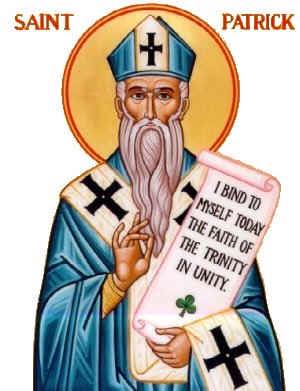
Patrick’s method of evangelizing the Irish reblogged from David Mathis

Remember Saint Patrick

March 17, 2014

Remember Saint Patrick

Saint Paddy’s Day is for the pagans.

You might say it that way, and then carefully wash your Christian hands of all the carousing and empty revelry that makes all things Irish into an excuse for a godless spring party. But you might say the same thing, and mean it not as a call to circle the wagons, but to charge the hill.

Deep beneath much of what the day has become is the inspiring mission of Patrick pioneering the gospel among an unreached people, despite the frowning face of the church establishment. Saint Patrick’s Day, in its truest meaning, is not about avoiding the lost, but bringing them good news. It turns out Saint Paddy’s Day really is for the pagans.

The Gospel to the Irish

The March 17 feast day (first declared in the early 17th century) remembers Patrick as the one who led the fifth-century Christian mission to Ireland. Unlike Britain, the Emerald Isle lay beyond the bounds of the Roman Empire. The Irish were considered uncivilized barbarians, and many thought their illiteracy and volatile emotions put them outside the reach of the gospel.

But Patrick knew better. In a strange and beautiful providence, he had spent six years among them as a captive, learned their language, and developed a heart for them. Like Joseph sold into slavery to one day save Egypt and his brothers, God sent Patrick into slavery to ready Ireland for a coming salvation.

The Surprising Turn

Patrick was born in the late fourth century — many speculate around 385 — in what is now northeast England. He was born among the Celtic “Britons,” to a Romanized family of Christians. His father was a deacon, and his grandfather a priest. But his parents’ faith didn’t find a place in his heart in his rearing. In his youth, according to George Hunter, “he lived toward the wild side” (The Celtic Way of Evangelism, 13).

But God soon arrested him with severe mercy. Kidnapped at age sixteen by Irish raiders, he was taken back to the island, where he served as a slave for six years under a tribal chief, who was also a druid. While in bondage in Ireland, God unshackled his mind and opened his eyes to the gospel of his childhood.

“God sent Patrick into slavery to ready Ireland for a coming salvation.”

And so, as a captive, “he came to understand the Irish Celtic people, and their language and culture, with a kind of intuitive profundity that is usually possible only, as in Patrick’s case, from the ‘underside’” (14). When he eventually escaped from slavery in his early twenties, he was a changed man, now a Christian from the heart. He studied for vocational ministry, and led a parish in Britain for nearly twenty years.

Reclaiming Retirement

That could have been the end of the story. But at age 48 — “already past a man’s life expectancy in the fifth century” (15) — Patrick had a dream, which proved to be his own Macedonian Call (Acts 16:9). An Irish accent pled, “We appeal to you, holy servant boy, to come and walk among us.”

Having known the language and the customs from his captivity, and having long strategized about how the gospel might come to the Irish, he now answered the call to return to the place of his pain with the message of joy. The slave returned to his captors with good news of true freedom.

Back in Saint Patrick’s Day

But this would be no ordinary mission. The Irish Celtics were “barbarians.” They may have had a few Christians among them, but as a people, they were unreached, with no thriving church or gospel movement.

“Patrick, the former slave, returned to his Irish captors with good news of true freedom.”

Patrick would take a different and controversial approach to the prevailing missionary efforts of the fifth-century church. Instead of essentially Romanizing the people, by seeking to “civilize” them with respect to Roman customs, he wanted to see the gospel penetrate to the bottom of the Irish culture and produce an indigenous movement. He didn’t mean to colonize them, but truly evangelize them.

Understanding the People

Hunter tells the story in the first chapter of his book on Celtic evangelism.

The fact that Patrick understood the people and their language, their issues, and their ways, serves as the most strategically significant single insight that was to drive the wider expansion of Celtic Christianity, and stands as perhaps our greatest single learning from this movement. There is no shortcut to understanding the people. When you understand the people, you will often know what to say and do, and how. When the people know that the Christians understand them, they infer that maybe the High God understands them too. (19–20)

Patrick knew the Irish well enough to engage them as they were, and build authentic gospel bridges into their society. He wanted to see the gospel grow in Irish soil, rather than pave it over with a Roman road.

Ministering with a Team

Essential to Patrick’s strategy was that he not fly solo. Just as Jesus sent out his disciples together (Luke 10:1), and Paul and Barnabas went out together (Acts 13:3), so Patrick assembled a close-knit team that would tackle the work together, in the same location, speaking the gospel and making disciples, before moving on together to the next tribe. It was, what Hunter calls, a “group approach to apostolic ministry.”

We have no detailed record of Patrick’s ministry teams and strategies, but according to Hunter, “from a handful of ancient sources, we can piece together [an] outline of a typical approach, which undoubtedly varied from one time and setting to another.”

“Patrick wanted to see the gospel grow in Irish soil, rather than pave it over with a Roman road.”

Patrick’s teams would have about a dozen members. They would approach a tribe’s leadership and seek conversion, or at least their clearance, and set up camp nearby. The team “would meet the people, engage them in conversation and in ministry, and look for people who appeared receptive” (21). In due course, “One band member or another would probably join with each responsive person to reach out to relatives and friends” (22).

They would minister weeks and months among them, eventually pursuing baptisms and the founding of a church. They would leave behind a team member or two to provide leadership for the fledgling church and move, with a convert or two, to the next tribe. With such an approach, the church which grew up among the people would be “astonishingly indigenous” (22).

Priority Time with Pagans

While Patrick’s pioneering approach is increasingly celebrated today — and is a model, in some respects, of the kind of mission needed in our increasingly post-Christian society — most of his contemporaries weren’t impressed. “The British leaders were offended and angered that Patrick was spending priority time with ‘pagans,’ ‘sinners,’ and ‘barbarians’” (24).

But Patrick knew such an approach had good precedent. The one who saved him while a nominal Christian and an Irish captive was once called a “friend of tax collectors and sinners,” and said, “I came not to call the righteous, but sinners” (Mark 2:17). The stakes were high, but he knew it was worth the risk.

Something Worth Remembering

Instead of acquiescing to the religious establishment, Patrick took the gospel to the uncouth, and ventured all for the unreached Irish. Instead of coasting toward a cushy retirement, he gave nearly three decades to the nation-transforming evangelization of Ireland. Patrick truly was for the pagans.

According to tradition, Patrick died March 17. Many think the year was 461, but we don’t know for certain. While today’s trite celebrations may leave much to be forgotten, for those who love Jesus and the advance of his gospel, Patrick has left us some remarkable things to remember. And to learn from.


Related Articles

“Patrick took the gospel to the uncouth, and ventured all for the unreached Irish.”

Death Cafes Mark 8: 27 – 38 First St Johns, York, Pa March 1, 2015

For the audio version please click on the link above.

We make our beginning in the Name of God the Father and in the Name of God the Son and in the Name of God the Holy Spirit and all those who know that death in this world is only the beginning of life in the Resurrection said … AMEN!!

I’ve got news for youse, in case you didn’t know it, the world just keeps getting weirder. Shawn Kumm writes about nice little dinner parties that are becoming popular. There’s all the trappings china, linen, small sandwiches, pastries, comfortable coffee house setting, these are known as “Death Cafes”. These started in 2011 by an Englishman named Jon Underwood. “The stated objective is ‘to increase awareness of death to help people make the most of their (finite) lives”. I’d say to check it out, they of course have a website deathcafe.com. “Groups gather together to discuss death over refreshing drinks and nourishing food – and cake -.” Hey we’re all going to die, we might as well eat cake. Pastor Kumm goes on to say “but, ‘with no intention of leading people to any conclusion … or course of action.”[1] Well of course, because heavens, it’s the post-modern age, whatever we say goes, and we’re just going to have our nice little designer eternity, fit to our specifications. Folks, people really live these kind of deluded lives. We have a world that really is out of control. We can’t even stop the radicals in the Middle East who continue to burn alive, decapitate, bury alive, brother and sister Christians. Yet we have those who live deluded, self-obsessed, degenerate lives, sitting around and having little coffee parties, talking about death and coming to no conclusion, but being sure that things after death will be just fine.

In today’s reading Jesus tells His disciples, for the third time: “…the Son of Man must suffer many things and be rejected by the elders and the chief priests and the scribes and be killed…” It’s as if the disciples, like those in their delusional little coffee klatches, simply remain in denial. To the extent that Peter, and yes I really do love that guy, he is a stand up guy and then drops the ball again. A few lines earlier, Peter is confessing exactly who Jesus is, “You are the Christ.” In Matthew’s Gospel Peter goes on to say: “…the Son of the Living God.” Everyone of those disciples that heard Peter’s confession, knew exactly what he was saying. This is Messiah, Mesheach, this is He who has been promised since the beginning of God’s revelation. He’s not another prophet, who were all men. This is God the Son, the Son of the Living God, David’s Son, David’s Lord, He who is the salvation of the world. Jesus has told them twice already, that He would die. Granted, He didn’t exactly fill in the blanks of what His death and resurrection meant to them, but regardless, their reaction was a sort of, … yea OK, but is it possible you might be overreacting just a little.

There’s Peter and he has stepped right up, inspired by the Holy Spirit, but let’s face it, many people have been inspired by the Holy Spirit and have fumbled the ball. Not Peter! I’d like to think that he knew where the inspiration came from and was not going to be denied. Jesus tells Peter in Matthew, “yup you got it, you have been blessed to know exactly who I AM.” But then Jesus, the Son of God, the Messiah, adds, for the third time, having said that and being recognized as the promised Messiah, men are going to take me, beat me, torture me and then kill me. Well Peter likes the Messiah idea, but ya … no, the killing thing, well that just doesn’t fit into his, still, worldly paradigm. The Messiah is going to physically lead all his followers, as His father David would, and drive out the hated Romans and establish God’s kingdom here on earth. Peter is just not at the point where he can understand anything but that Israel needs to be delivered in the here and now. He cannot grasp Jesus’ eternal perspective. Oh yes, the Kingdom of God is here, Jesus is saying I AM here, but the plan is that the Kingdom of God is not yet recognized.

While Peter gets who Jesus is, that He is the Son of God, Peter takes it upon himself to let Jesus know the being killed part just doesn’t work for him. That Jesus is going to stay alive and be the conqueror king. Jesus certainly will conquer. But not according to Peter’s agenda and drive out the Romans. Jesus will conquer death! He will overcome the true enemy of man, He will be the agent of God’s plan to reconcile man to Himself. He will be the propitiation, the payment, the Redeemer of all our sins. Those who are in Jesus will still be in the world, but now we will be saved from the world. We will now be delivered from the world of death, disease, suffering, evil and in our baptism in the Triune God, be adopted into the family of God, reborn into the Spirit. Still in this world, but now new creations in relationship with God the Father, redeemed by God the Son and guided in this world by God the Holy Spirit.

Jesus has to drive these things home. According to Mark’s Gospel, in chapter 10, they were on the road going up to Jerusalem. In just a few days will be the triumphant entry. Jesus will enter into Jerusalem riding on a donkey. This is no small thing, he will be hailed by the crowd, cheered welcoming the Messiah, but not in the sense that Peter expects. They are welcoming Him who will deliver them from the Romans. In today’s reading Peter takes Jesus aside to set Him straight; He’s not going to be killed, Peter doesn’t say it, but when Peter criticizes Jesus, it’s to tell Him, “no, you’ve got it wrong, this is going to be the Kingdom where we all rule with you.” The Concordia Self-study Bible’s reads: “Peter’s attempt to dissuade Jesus from going to the cross held the same temptation Satan gave at the outset of Jesus’ ministry (Matt 4: 8-10).”[2] Jesus’ 40 days in the desert, being tempted by Satan: “All this I will give you, he [Satan] said, ‘if you will bow down to me.’” Peter is saying as much as Satan said: “Forget all that dying stuff Jesus, we can do what’s really important, rule the whole world. Don’t worry about salvation for all those people. What’s dying going to do? What’s important is ruling and running Your own agenda.” Of course what would that mean to them, to us, to people all down through history? Jesus didn’t die for us, He didn’t redeem us, He didn’t pay for our sins? The only thing affected is this part of the world and we are not saved in Jesus’ death. Jesus came to redeem us from death, from all the evil of the world, to redeem our sins and give us the promise of eternal salvation. He made that very clear to Satan in the beginning of His ministry and now as that ministry comes to an end Jesus makes it very clear to Peter and by extension us. Certainly Satan was not happy being stripped of his authority and surely Peter wasn’t happy that his vision of Jesus’ ministry wasn’t going to occur. Of course Peter, all the disciples, would be filled with the Holy Spirit and they would come to know how they were saved and they, like us, would know the promise and hope of Jesus in eternal salvation in the resurrection.

Sad, isn’t it? Those people at the coffee houses, who subscribe to deathcafe.com. They don’t have that hope and promise. They think they can talk death to death and they will have their very own designer eternity, probably sitting around a coffee house in their superficial, phoney, non-existent, little eternity.

Sorry to say, they will be lost and condemned. They refuse to be guided by the Holy Spirit to true life in the resurrection and think it’s all about them. So take out that journal this week. Really pray over what Jesus has said, remember that He is summing up His earthly ministry and preparing for His death. He doesn’t want to endure this, but through His love for us, that agape, sacrificial love He has for us, that His Body and Blood will suffer and be spilled as the sacrifice that will conquer all and give us the hope and promise of eternal life in the resurrected world. Write about what that hope means to you and how you can give hope to those you know through Jesus Christ.

The peace of God which passes all understanding keep your hearts and minds in Christ Jesus. Shalom and Amin.

[1] Shawn L. Kumm  “Concordia Pulpit Resources” Vol 25, Part 2, Series B, p 6

[2] Concordia Self Study Bible p 1518

Vocations that Christians would not be involved with?

I’d like to think that I’d be surprised, maybe even shocked, that I see this. But to be frank, what surprises me is that it took this long, if it even did, this guy is just the one to actually make it happen.

Guy in question is Noel Biderman, who frankly by the picture in the article, looks like the kind of guy who thinks he’s so clever and is actually just kind of creepy and smarmy. Reason? Mr Biderman has established an on-line company: “…Ashley Madison a website that facilitates extramarital romance and sex. ‘There are times that I have told people, and that’s the end of the conversation.'” Again judging by the tone of the article he actually seems surprised by that. (Adam Tanner  Forbes Feb 9, 2015, pp 46-48).

The only other thing that actually does surprise me is the amount of revenue generated. Gross revenue for 2014 was $115 million, up from $78 million in 2013. Mr Biderman won’t be making his first billion (total personal fortune), anytime soon, but, that an on-line venture like this could generate $115 million in one year is a substantial sum and a substantial commentary on contemporary America. It’s sad to think that the state of the United States is such that there are enough unfaithful people out there to pay enough to generate this much revenue. Between Biderman’s site and a few others, there are 30 million registered users. That would be one-tenth  the the population of the United States, if you exclude the under-age and over-age, you could imagine that up to twenty percent of American, one out of five American adults are actively participating in extra-marital affairs.

Adam Tanner, the author, does note: “Even in an era of ubiquitous Web porn, a site promoting adultery (after murder in the Ten Commandments) still has the power to offend…” You might want to consider that Microsoft’s Bing will not run ads for Ashly Madison, although Google will. Most television stations in the U.S. won’t. So, there is some reassuring news, but continued vigilance and integrity are necessary on the part of the rest of us. Hey I don’t want to sound like some sort of hysterical huckleberry, but on the other hand, when is enough, enough? When do we people in Christ, who live in integrity, who want what is best for all, instead of standing by while all around us continues to slide into just gross depravity?

Yea I know, getting all moralistic, heck anything goes, right? Now of course this is all cloaked with this thin veneer of “serving”,: “I understand the problems of monogamy and the people who need (emphasis mine) my service.” Really? Wow, PT Barnum was right. Any lameo excuse to make a hundred million, just take it right down to the lowest common denominator. This guy thinks he’s Dr Albert Schweitzer, serving a bunch of people who are unfaithful sneaks. I get it, I’m a man, we feel lust, we all know the drill. The answer, Mr Biderman is not to make it easier to do, to prey on others weaknesses and to boot make a lot of money out of that. Just how far have we fallen into corruption in this country. Sure this is a quiet corner of cyber space, that only wants attention to make money. But I do wonder why there isn’t more of an outcry? Oh yeah, “it’s victimless”. People will actually say that?! Sure, right, just ask innocent spouses and children of broken homes. Other relatives, friends, fellow Christians. Right, no victims. But when people lust and grasp, they will use any justification, just like a drug addict. Just get the fix, right man? It gets to be almost as lame and ridiculous as 1970’s porn.

I feel safe in assuming that Biderman is not a Christian, although with some definitions, he or others like him, might call himself that. But when you are facilitating busting the seventh commandment, you can call yourself what you want, you ain’t no Christian. But this does call into question the issue that some try to make in terms of “well I’m a good Christian drug dealer” or “I’m a good Christian porn star” etc. Are there vocations, professions, trades, practices that would by definition preclude a practitioner from presuming to call themselves a Christian. Can you be a pornstar (obviously an extreme example), but still call yourself a Christian? If we are called, guided by the Holy Spirit in all facets of our life and certainly vocation is a huge part of our life, would He call us to be a good Christian porn star?

OK, so ya I’m kind of stacking the deck, but if you want to start a discussion, bring it on.

We can also discuss it Wednesday, coffee shop corner of Beaver and W King Sts downtown York, Pa. You are welcome to park behind the church and walk about fifty yards. We meet at ten am, ya, kind of an odd time, but in the middle of the week, might be worth it for you. If you have suggestions as to other times and functions for a group to meet around the subject of living your Christian life in the workplace, I would be very interested in hearing it. I was part of a really great group in Boston, and I’d like to pull together a like group here. No charge or obligation and I will buy the coffee for first timers. God bless.

NFL’s Benjamin Watson Urges ISIS Victims, Christians to ‘Stand Firm’ With Jesus in the Face of Death; Says Rise of Persecution Indicates Christ’s ‘Imminent Return’

The following is from christianpost.com dated March 4, 2015

NFL’s Benjamin Watson Urges ISIS Victims, Christians to ‘Stand Firm’ With Jesus in the Face of Death; Says Rise of Persecution Indicates Christ’s ‘Imminent Return’

1
Sign Up for Free eNewsletter ››
BY SAMUEL SMITH , CP REPORTER
March 4, 2015|4:49 pm
Benjamin Watson is a tight end for the New Orleans Saints.(PHOTO: EAG SPORTS MANAGEMENT)

Benjamin Watson is a tight end for the New Orleans Saints.

Outspoken Christian NFL player Benjamin Watson recently issued a powerful Facebook post writing about the Islamic State and the rise of Christian persecution throughout the world, asserting that all Christians should be ready to die for upholding their faith in Jesus Christ.

“The images keep flooding our timelines and news feeds. Men being burned alive or beheaded by masked assassins. Stories of families on the run, fleeing their homes while they are pillaged and burned,” Watson’s Saturday Facebook post explained. “Their testimonies hold a familiar chord: ‘Convert, Pay or Die!'”

Watson, an 11-year NFL veteran who’s a tight end for the New Orleans Saints, wrote that although extremist groups like ISIS and Boko Haram in Nigeria have risen to prominence and are out to destroy Christianity, believers should never deny Christ in order to save their lives.

Watson cited Luke 12:8 and further explained that Jesus specifically told his followers that those who deny Him in in the face of death will be punished.

“‘And I say to you, everyone who confesses Me before men, the Son of Man will confess him also before the angels of God; but he who denies Me before men will be denied before the angels of God’ Luke 12:8,” Watson wrote.

Although Watson admits that the idea of being killed over his faith in Jesus is a frightening thought, he wrote that it’s important to remember that some of the bravest followers of Christ were killed for refusing to denounce Jesus.

“The persecution of Christians is not a new concept. As early as the first century we read about the Spirit-filled boldness of Christians, like Stephen and Paul, who proclaimed the Gospel through beatings and imprisonment, torture and death,” Watson wrote. “We remember Christ’s disciples, most of whom were killed just like their master. Roman emperors like Nero executed Christians in the most ghastly ways, using them as torches to light the evening sky.”

Although Christians have been beaten, killed and tortured for thousands of years over their faith, Watson further emphasized that the light of Christ continued to spread because of the brave followers who stood firm in their faith.

“In spite of all this adversity, Christianity continued to spread because men and woman, empowered by the Holy Spirit, stood strong in the face of certain death; some being delivered and others falling,” Watson wrote. “As I sit here in a 21st century United States, I can’t help but wonder when we, too, will face martyrdom for our faith. On this very day nearly 50 countries have laws that restrict or outlaw Christianity, leading to the harassment, imprisonment and death of those who follow Christ.”

The post continued by listing the number of countries today that prevent Christians from practicing their faith, such as North Korea and China.

“On this day, in countries like North Korea and China, Christians gather for church underground to avoid being arrested by police. On this day, in Nigeria thousands mourn the deaths of their loved ones killed by Boko Haram in their quest to overthrow the government and create an Islamic state. On this day, in Cuba, Christian ministries continue to risk their freedom as the country continues to feel the effects of Communist rule,” Watson continued. “BUT, on this day, Jesus’ words in Luke still ring true.”

Although many Christians live safe, well-protected lives in America and other countries that protect religious freedoms, Watson contends that persecution of Christians in America will come sooner or later.

“Rest assured, fellow Americans, if it hasn’t already, our day WILL COME,” Watson asserted. “My only hope in such trying times is the power of the Holy Spirit. He is the X factor. He will give us the strength, words, and vision when our backs are against the wall. Jesus promised the believer many things. Eternal life, abundant life, peace, purpose and forgiveness to name a few. He also promises that they, like him, WILL be betrayed, hated and persecuted, even to death. (Luke 21:12-19).”

When that day arrives, Watson encourages Christians not to tremble in fear when in the face of persecution because it’s a sign of the nearing return of the Messiah.

“[W]e must WAKE UP from our slumber, be on guard and stand firm. A house divided against itself cannot stand,” Watson added. “Spiritual unity in the body will help us weather the coming storms. We must REMEMBER that as terrible as things are and will become, they are simply signs pointing to one thing; His imminent return.”

Church renewal suggestions

I’m still, kind of, a new pastor. As part of my seminary education I was vetted as a “church planter”, then the district president whose district I was called to thought that I should apply those skills in an effort to conduct a renewal program. I was called to an ancient/stately church in York, Pa. that just cried out for a renewal effort and so here I am.

Now that I’m approaching five years here, I have a few lessons that I thought I should share. As a disclaimer this is not a shot at anyone or any group, simply observations things that I would recommend to anyone else who might be starting a renewal.

This is in no particular order, unedited, but should be sufficiently readable for anyone interested:

One thing I would do if I was to do another Renewal is to sit everyone down together, right at the beginning, employees, leaders, EVERYONE and make it very clear. If I’m being called here to do a renewal, you need to understand right here, right now, this is not about you. It is about you supporting what is going to happen, it’s about you (no matter what you are) making sacrifices, putting in extra time, going the extra mile, supporting efforts that you may not “like”, making an extra effort for new people. Agreeing that there needs to be small groups and you need to lead them. If you don’t feel “qualified” then agreeing to put in the time to learn about discipling and actively discipling. Making the extra effort to invite people and to do “faith sharing moments”. If you are not going to do this, right here/right now, then say so and the “Renewal” will stop right here. This will be, at least, a three year commitment [I would give them the slips that I gave to the Discipling Group.] Sign them and commit to doing what you’re supposed to be doing. If these things don’t happen, then it ends right there.

No fussing because you have to push a little harder, you might be inconvenienced, you might have to adjust to different things. If you do not understand at the outset that this is not about you and is about team, it is about the Body of Christ, then own up to it now and forget it. It’s not about you, it’s never been about you, but you seem to think it is. It is about the Body of Christ, it is about making the church an effective witness to Jesus and effective discipling group of Christian disciples.

You also understand that you are there to be cheerleaders, for the pastor, for new members, for those who have stepped out to do new things, those who are about making Christian disciples. Yes there are other things that are necessary, but the celebration is for those who are going out and saving the dying, reaching out to those in a dying world who would otherwise be lost for eternity. Those who have a conscience and truly understand that they will be used by God to reach those who are lost, who cannot stand the idea that someone may be lost because of what they did not do. Those who understand that God is never going to have a problem with those who make a good faith effort to reach the lost, but will hold them accountable who refuse to make the effort because they don’t think they’re ready or capable or yada-yada. Those who understand that when God calls us we are to respond, not when we think we’re ready. Those who understand that their procrastination, they’re phoney perfectionism is just an excuse. It’s not a virtue, it’s a sinful, straight from the pit of Hell cop-out.

That they will ask and have an open minded conversation about things they “don’t like or bothers them”. Sure if things are being done arbitrarily or capriciously then it’s certainly acceptable to question, but if there’s a lot of thought and research, then accept it, do what is necessary to adjust, but don’t sit there and refuse to make necessary adjustments in order to make the church more effective and more welcoming.

If you don’t have something positive to say, don’t say it, forget about it. Seems that the MO is that no one does anything, because if someone does do something, it’s open season for people to pick apart the other person’s efforts. If you haven’t done something about it and it’s been hanging for too long and someone has done something, then you are to say how wonderful it is that person is doing, that you are so pleased that something’s being done that should have been done a long time ago.

There has to be an understanding that we are not here to celebrate the same old/same old. I am only interested in celebrating those who have stepped out in faith, have taken up the gauntlet, have taken a chance. I’m going to be much faster to celebrate someone who took the chance, even if it might be sloppy, and I’m not going to celebrate the person who just criticizes and doesn’t have a better idea. A spirit of criticism of gossiping is sin, it’s not acceptable. If you’re not going to find a way to do it better, then you need to keep your mouth shut about anyone else who is actually doing.

So, that’s it, so far. Again these are various lessons not meant to impugn anyone or whine and complain, but I think that lessons that I’ve learned that should be shared with others. I will continue to blog on this, infrequently and probably incompletely. If anyone is interested and wants to set up a dialogue on it, I would welcome the opportunity.

Do all to the glory of God

This is a subject that is near and dear to my heart. I have not always been a Christian. So when I discuss this, it’s not from the perspective, “well that’s what Christians do their whole lives”. I’ve been involved in athletics pretty much all my life. I was on and off swim teams since I was about 8 years old. I played football from when I was eleven years old until I was seventeen. I worked at the local YMCA where I played basketball, racquetball, weights, and other stuff here and there. I’ve stayed active for the last 40 odd years mostly training and participating in triathlons, also kickboxing and a little basketball mixed in. If anyone can get me into to a racquetball regular game, I’d love it if someone could hook me up with a regular racquetball game again.

Having said all that, yes, it’s been a regular part of my life. And frankly, while I do try, I’ve never been good at anything. It was necessary, serving in the Coast Guard Reserve, my job was operational. I had to stay in condition, because I could be called on at any time to be involved in very physically strenuous situations. So yes, I’ve had a reason to stay active for a long time and it’s been an important part of my life. It really drags me down when I don’t keep up a regular routine. So who knows, maybe I need those endorphins, dopamine etc in order to feel good. But as I grew as a Christian and have become a pastor, I’ve realized that we do have a responsibility to maintain the body God gave us and to especially not abuse it. Now believe me, I’m not any “George Gorgeous”, if you saw me I look pretty much of a dumpy old guy. But… a year ago, I did get a stress test done because of a minor issue. The technician asked me if I worked out because she could see it on the results I was producing and when the doctor looked at my results, he pretty much told me to “get outta here, you’re wasting my time”.

Having said all this, in no way shape or manner am I saying that to be a “good Christian” you need to be in great shape. It’s not a works thing, but in my continual discussion about our “relationship” with Jesus, He gave us our body, mind, everything we have. Don’t most of us want to be in good shape and look good for our spouse, SO? Don’t we want to feel good, have energy, all the benefits of good health? The better we maintain ourselves, the better we serve our Savior, our family, our brothers and sisters in Jesus, the church etc. So don’t we serve and relate better to everyone involved when we do the best we can to maintain ourselves?

Now, IN NO WAY SHAPE FORM OR MANNER, am I saying that you can only be a good Christian if you’re in good physical condition, you’re all pretty and photogenic and all that stuff. Too many “churches” have some need to be all pretty and everyone associated all pretty, that is straight out phoney, hollow and misguided. It’s sort of in the sense of the “cool kids” table in high school. No that’s unacceptable in a Christian church. We need churches that are authentic, phoniness in the church is killing the church and is leaving too many others to die without Jesus. I’ve known plenty of great saints who could barely lift themselves, no less a dumbbell. And believe me I have my own issues that need to be dealt with, I’m not trying to sell that I’m perfect. What I am trying to say is that we still strive to be the best we can with what God gives us. There is way too much mediocrity, and excuses out there. We are called to be perfect as our Father is perfect. Let’s do what we can to strive for that goal, but accepting that no matter what, all of us will fall short and most (like me), miserably so.

An article in Christianity Today (June 2013 pp 39-43) discussing this very subject and I think is a really good perspective. One beef I do have with many Christians is their ability to phoney themselves, their church, their lives in general up. Which certainly does not enhance our witness in the world and refers back to my “cool kids table”. If you’re a Christian and concerned about being part of the “cool kids”, you are already way off track. The world is phoney beyond all question. Why do we keep trying to emulate the world? The church has to be authentic, warts, chubby pastors (like me), lack of talent, but authentic, faithful disciples of Jesus Christ.

Leslie Leyland Fields makes some great points and does sternly caution against a wrongheaded approach to encouraging all that God’s given us. We should be strong in mind, body and spirit. Doesn’t always work out that way, sometimes due to circumstances beyond our control But we should work on what is in our control, not because it makes us better, but frankly makes us a better witness to Christ. Ms Fields quotes Charlie Shedd: “…if our bodies are to be [or already are] temples of the Holy Spirit, we had best get them down to the size God intended.” Fair enough.

“PraiseMoves cites 1 Corinthians 6: 19-20 as its foundational verses: ‘Do you not know that your bodies are temples of the Holy Spirit, who is in you, whom you have received from God? You are not your own; you were bought at a price. Therefore honor God with your bodies.’ … Many in the faith and wellness movement cite the apostle Paul: ‘Whether you eat or drink, do all to the glory of God.”

I really like Ms Fields point: “…outside the church, it challenges the prevailing notion that our bodies belong to us alone – either as machines to be hacked and fueled, or as ‘plastic’ to be reshaped, starved, pierced and used for pleasure or vanity. and inside the church, it challenges the dualistic worldview that God cares only about ‘spiritual’ matters.”

To be sure, as Ms Fields points out, we do not become stupid, obsessive and phoney over the subject of physical fitness and conditioning. We do it with intelligence, planning, something that we will benefit from on many levels. With the mind-set of serving God, that we want to build our relationship with Him, that we want to serve our family, fellow Christians, our church to the best of our ability and this is one way to do it. Realizing that regardless of our physical condition we are to always serve the Lord and the Body of Christ. But to quote Nike “just do it”. How about a church filled with people who do strive, who do want to bless each other, who are spiritually, mentally and physically doing their best in order to disciple others to strive to be their best for Christ who gave us His best.