Category Archives: Christian discipleship

Where are you being guided to in Jesus? First St Johns, York, Pa. October 26, 2014

Please click on the above link to hear the audio of this sermon

We make our beginning in the Name of God the Father and in the Name of God the Son and in the Name of God the Holy Spirit and all those who are led by and follow the Holy Spirit said … AMEN
Paul’s charge to the Thessalonians tells us that: “…we exhorted each one of you and encouraged you and charged you to walk in a manner worthy of God, who calls you into His own kingdom and glory.” (1 Thess 2:12) Those who are faithful brothers and sisters in Christ are constantly being guided, are constantly being charged to walk, to follow the leading of the Holy Spirit. Marge and I were moved to pick up our lives in Massachusetts to go to St Louis for a season, complete education and then to be led to where? We didn’t know, but as things unfolded and we were faithful, we were guided to be in York, Pa. Dr Jerry Kieschnick asked me, as I received my call papers if I knew where York, Pa was? Not really, but in our faith we didn’t question where York was, we were led here and have been made a part of this great family in Jesus here in York.
On this Reformation Day, we remember Dr Martin Luther, posting the 95 Thesis on the door of the Castle Church in Wittenberg on All Saints Day. As I’ve said before, Dr Luther wasn’t looking for some kind of showdown, too many times we see him depicted as a Christian version of a gunfighter at the OK Corral. That was not his intent. He was a brilliant man who never stopped studying, as he studied, the more he realized that there were problems with the doctrines that the Roman church was teaching. He was a teacher at the time and the more he had to deal with these doctrines, the more he felt led to start a journey of inquiry. He never anticipated what would happen as he nailed his document to that door. His whole intention was to raise these issues in a genuinely collegial sense. He wasn’t looking for a brawl, a battle, but I have no doubt that God led Luther to do this in order to raise issues about God’s church that demanded discussion. The Roman church, at the time, chose not to discuss those issues. Luther wrote: “In the year 1516. I began to write against the pope. In the year 1518 Doctor Staupitz released me from obedience to my order and left me alone at Augsburg when I had been summoned before Emperor Maximilian and the pope’s legate, who was then at the place. In the year 1519 Pope Leo excommunicated me from the church and so I was released a second time. In the year 1521 Emperor Charles excommunicated me from his empire and so I was released a third time. But the Lord took me up.”1
Many times when we are led to leave, by God, we’re told to leave by the world. Luther has the distinction to be told to leave three times, you think you have it rough, you may be told to leave your work, your school, wherever, because of your Christian beliefs, but probably only once. Luther got “shown the door” by the head of the Augustian Order where he had lived and served as a monk, by the head of the Roman Catholic Church and then by the head of state of the largest empire in the world. Luther could honestly say that he had been thrown out of better places then most people. Sometimes to be thrown out of places that are just frankly not good to be in to begin with, is a badge of honor. No one wants the shame of being publicly asked to leave, but afterwards you realize that being thrown out was the right thing, was something that needed to happen in order to glorify God, then so be it and God speed.
It is then usually a case of not just being led somewhere, but also a commentary on being thrown out of somewhere. Jesus told His disciples that they would be thrown out of houses and towns; “And if anyone will not receive you or listen to your words, shake off the dust from your feet when you leave that house or town.” (Matt 10:14, Mark 6:11 and Luke 9:5), each of the Synoptic Gospels. The Synoptic Gospels, do not tell all of the same events or sayings, but apparently they were all so aware of the fact that they would get tossed out of places, that they all made a point of relating this direction of Jesus. Did that mean that they had failed, or were somehow not completely adequate disciples? No, it could well mean that Jesus was making sure everyone knew that they had a chance to hear the Gospel, if they rejected it, well too bad for them, Matthew 11:23-29: “And you, Capernaum, will you be exalted to heaven? You will be brought down to Hades. For if the mighty works done in you had been done in Sodom, it would have remained until this day.” If any place had its chance it was Capernaum. Jesus had been led there, most of the disciples lived and worked there, all sorts of miracles and preaching went on there. What happened? Luke 4: starting at verse 17, do you remember what Jesus did? After reading Isaiah He declared that He fulfilled Isaiah’s prophecy that “The Spirit of the Lord is upon Me…” Jesus was the anointed of God, the Messiah. Their response? Woe, wait a minute there, this is Joseph’s son, He’s saying that He’s the Messiah? No, I don’t think so. Jesus responded, yea, kinda figured, because no prophet is acceptable in his hometown, and that is when the people in the synagogue tried to hustle Jesus down to a cliff to throw Him off of it. Yea Jesus got run out of Dodge, but did that make Jesus find a corner to sit and cry? “They threw me out of my hometown, wah, what will I do?
Sometimes we are moved as Paul described to the Thessalonians. Now Paul had certainly been moved around by the Holy Spirit, a lot of places we don’t know about. But he tells the Thessalonians: “…like a father with his children, we exhorted each one of you and encouraged you and charged you to walk in a manner worthy of God, who calls you into His own kingdom and glory.” (1 Thessalonians 2: 11). The Greek word Paul used peripate,w like the English can mean how we conduct ourselves and to also literally walk. No doubt Paul expected that some of those in Thessalonica that he was preaching to would be led on their own literal walk or journey.
Luther was led on a walk, to initiate that walk he was thrown out of somewhere else. The door was closed on him at the monastery he was at the church he preached at and even the country he lived in. Clearly God was using an exclamation point to emphasize that it was time for Luther to step out in his Christian faith. That wasn’t Luther’s perception, no doubt he was otherwise comfortable and at home where he was. God emphatically moved Luther so that Luther was left without any choice. He had to pursue the issues that he raised. These issues weren’t going to be in terms of some hypothetical debate, something that maybe would result in changes or maybe not. No! God didn’t leave any room for Luther to maneuver, there was only a straight line and that was to see through the establishment of a church that would faithfully preach the Word of God. A church that would be faithful to Scripture, God’s Law and the Gospel of Jesus Christ.
The question before you is this: Are you truly listening to what God is saying to you? Are you faithful in prayer, not the kind of prayer that’s “OK God listen up, this is what I need from You and what I need You to do!” But prayer that is also asking and seeking God’s will in your life, where he wants you to walk to? I doubt that most, if any of you, are being asked to pick up and leave York. Dick and Gloria have already gone and returned from their mission trip in Liberia. But, God might be guiding some of you to short term mission in Africa, Haiti, Guatemala, or maybe to Helen Thackston charter school, your next door neighbor, the man or woman in the cube next to you at work, to a young man or woman who may be making bad decisions and needs someone to turn them to Jesus. You might have to walk across the world or across your lawn.
Ya, here we go, take out that journal and pray over it and listen for God’s guidance. Where is He directing you to and who is He directing you to witness to or to serve, to faithfully build a relationship with in order for them to come to know the love of Christ? What comfortable place are you being asked to move out of? You may have to stand up against the powers, but the Holy Spirit will give you the words.
The peace of God which passes all understanding keep your hearts and minds in Christ Jesus. Shalom and Amin.

God uses all creation, because He made all creation. Isaiah 45: 1-7 First St Johns October 19, 2014

Please click on the above link to hear the audio sermon:

We make our beginning in the Name of God the Father and in the Name of God the Son and in the Name of God the Holy Spirit and all those who know that in all things God works for the good of those who love him said … Amen!
“Thus says the LORD to his anointed Cyrus…” That’s rather odd, who is Cyrus?… Why is God telling Isaiah that Cyrus is His anointed? … Isn’t anointing reserved for those who are God’s? Cyrus is a pagan from Persia. Quoting from the Chronological Study Bible; “In 559 BC Cyrus the Great became the ruler and founder of [a dynasty] of Persia which expanded quickly in all directions to become a world empire. … Cyrus ultimately conquered the Neo-Babylonian Empire …”1 The writer goes on to point out that those in the ancient world would ask “What God has empowered this Persian king, Cyrus?” Well ancient people had it right in the sense that God does empower us. They had it wrong in the sense of trying to figure out “what ‘god’”. Why … Ya, there’s only one God. Cyrus would have worshiped Marduk, Bel and/or Nebo. Did any of them give Cyrus what it took to conquer most of the known world? No! Why? It says right here in our reading in Isaiah; “Thus says the LORD to His anointed, To Cyrus, whose right hand I have held – to subdue nations before him … For Jacob [when we see that, we know Yahweh is talking about … Israel] My servant’s sake, and Israel My elect, I have called you by your name; I have named you, though you have not known Me. I am the LORD, and there is no other; There is no God besides Me… I form the light and create darkness, I make peace and create calamity; I, the LORD, do all these things.” (Isaiah 45: 1, 4-5, 7 NKJV) So for all those in the world who like to say; “Well my ‘god’”. Well that’s all it is, their ‘god’. Even in writing that’s twenty-five centuries old, I don’t hear any mumbling here, do you? Yahweh is clearly saying … I am the LORD, and there is no other and in the Hebrew I am, there is are all forms of the name that God told Moses what His Name is, what Jesus told the Jews who questioned Him, God’s Name is the great I AM and there is no other.
Sure we can make it up, we can live a life that is deluded and full of lies. We can make these little idols in our lives and call them “god”, rely on them, but as Yahweh speaks to Cyrus, He is telling us; “I am the LORD, and there is no other”. Scripture is God’s word to us and when He tells us who He is and what He does, that’s the way it is and we need to get over anything else we think or do about Him.
There is a cylinder, which is the form of writing that the people in the Middle East used at the time, dated 538 BC that announces that Marduk chose Cyrus to conquer the world.2 Well … NO! Have you seen that cylinder? I haven’t. It is one archaeological artifact that’s certainly interesting, but what writing from that period has survived from then until now that the entire world knows? The Bible, Holy Scripture, which says very clearly, “I am the LORD, and there is no other.” We know that from 2500 years ago until now, I’m pretty sure that what Marduk “says” today, doesn’t matter to anyone.
The Babylonians had originally conquered Israel and Judah. They deported the best and the brightest of Israel to Babylon and they abused the Israelites and had shown them no mercy. Israel may have been conquered by Babylon as a judgment on the Jewish people, but contrary to the thinking of the time, that did not give Babylon the right to abuse God’s chosen people, they were still God’s elect. It’s like with my little brother, I can pick on him, but no one else better try to pick on him. In Isaiah 47 God makes it very clear to the Babylonians what happens when they picked on Yahweh’s people: “I was angry with my people [Yahweh says in chap 47] I have profaned my inheritance, And given them into your hand. You showed them no mercy: For you have trusted in your wickedness; You have said, ‘No one sees me’; Your wisdom and your knowledge have warped you; And you have said in your heart, I am, and there is no one else besides me.’ Therefore evil shall come upon you; You shall not know from where it arises. And trouble shall fall upon you; You will not be able to put it off. And desolation shall come upon you suddenly,”…(Isaiah 47: 6, 10-11 NKJV) God is now going to use Cyrus to bring judgment on the Babylonians who have abused His people. Remember when God says: “Vengeance is mine, I will repay, says the Lord.” (Rom 12:19) He’s making it very clear to the Babylonians that is the case and His vengeance, through Cyrus on behalf of His people, Israel, will not be pretty.
God tells us He’s a jealous God, well this is partly what it means, He can take us out behind the woodshed and let us have what-for, but He’s not going to stand by while we are being abused by the world. We are His, and He expects us to trust in Him, to put our faith in Him, the faith that He give us. When we fail to do that, when we sin, when we make ourselves, our own idol, He is going to discipline us. That’s a good thing, do you really want God to just stand by and watch you sink into sin, to fall away from Him and be swallowed up by the world? Would a Holy, faithful, loving father do that? No! So He will resort to discipline to get our attention, to get our focus back on Him and away from a violent and cursed world. He may use people like Nebuchadnezzar and Cyrus to impose that discipline, does that mean He loves us less? No, it means He loves us enough to do what it takes to keep us in His will and not lost in the world’s.
God uses many trials and enemies to focus on Him. In the movie God’s Not Dead there is a twenty-something young lady who is right on the top of her game. She has built a big-media following, she is on the go, interviewing the movers and shakers of entertainment, her boyfriend is a wealthy and powerful financier, the sky’s the limit and then one day she goes in for a medical exam. “You have cancer, the doctor tells her and you may not live.” Her response: “I don’t have time for cancer.” I’m not going to tell you how that plays out, you have to come and see the movie, but she was her own idol, it was all about her and how she had created her own world. God forces His way into that world and tells her, that it’s all about Him, not about her. She may have done all these things in her life, but at some point there will be a day of reckoning and she will have to surrender to the fact that it is all about God. We will all have that time of reckoning. For her that time was when she was told she had cancer. You can be in denial of these things, you can run your own game. But in the end God makes it very clear to all of us, that we will have to turn to Him. We may still resist, but it will be a done deal and God will have His way, just as He did with a king, Cyrus, who did not know Him and a people, Israel, who rejected Him.
Rev Dr Dale Meyer in his “Meyer Minute” for October 17 talks about how God can use the result of our sin to bless and benefit many generations. We certainly watch with concern the events surrounding the Ebola virus. We forget that there have been many serious diseases that have spread through our country. Only about 60 years ago, polio spread through the United States. Dr Meyer writes about a cholera epidemic that swept through St Louis in 1849. “The epidemic was devastating to Johann Friedrich Buenger, an immigrant and Lutheran pastor.” His first wife died in the epidemic and their three sons had died in infancy before the epidemic. He remarried and had four daughters with his second wife, two who died in infancy. He was led by God to establish the Lutheran Hospital in 1853, from which the Lutheran Foundation of St Louis, Lutheran Senior Services and Lutheran Family and Children’s services now serve thousands.3
Ebola is not of God, war and abuse are not of God, cholera is not of God and a king in the Middle East 2,500 years ago may not know God. All the evil in the world is the result of man’s sin, yours, mine, the whole world’s. We certainly don’t like it, we are certainly going to have fear about it, but as those who are saved in Christ, we trust that our fear is rapidly turned into faith. Not because of what we do, but because through the sacrifice of Jesus, we are saved, we know how the story ends, for the world, and for us individually. Remember our reading from a few weeks ago: “And we know that for those who love God all things work together for good, for those who are called according to his purpose.” (Rom 8:28 ESV) God will unleash evil on those, like the Babylonians, who were evil, we who are saved in Jesus, who are made holy in His sacrifice, we will also deal with evil, but out of that God will use it according to His purpose. As Dr Meyer notes: “the love of Christ motivates God’s people to meet human need and God multiplies the blessings.” How is that agape love that we have from Jesus motivating you? You trust that God is just and will repay those, like the Babylonians, who abuse His people. Since we are freed from the hate and bitterness of the world, we go on to the things of God. He guides His Israel, us, back to our promised land and by doing so enables us to serve Him and all of His creation. How can you trust that God is protecting you? You don’t have to fuss about the evil that’s going on around you, and because you are free from that, what do you do in order to serve those in the world to the glory of our God, Father, Son and Holy Spirit.
The peace of God which passes all understanding keep your hearts and minds in Christ Jesus. Shalom and Amin.

Repentance, Confession,

Confession in the Lutheran Church is a sorta/kinda sacrament. Dr Luther never really tried to decide on it one way or the other, but whether it’s a sacrament per se, it is still a vitally important part of every worship. Every Lutheran worship begins with corporate confession and absolution. Lutherans also encourage individual confession. I must admit that at the beginning of my fifth year of ministry, I have not had a lot of participation, frankly hardly any, but I will faithfully be available for confession. I schedule every Thursday at 5:30, you don’t have to be Lutheran either.

My first experience with individual confession was at Seminary where the Seminary Chaplain held weekly confession. I found it to be a great way to come before the Lord, His minister, and face the sins that I’ve been committing. Through His minister I am assured of my forgiveness and the knowledge that my sins shouldn’t hinder my life and keep me focused on keeping on the track of the plan He has for me. I would point out that in the individual confession liturgy it’s not necessary to enumerate each sin, you can, but I think that until there is high level of trust and comfort between the confessor and the one hearing the confession. Even if you don’t enumerate the sin, the assurance of God’s minister in front of you telling you you’re forgiven and absolving you strengthens and encourages you.

One thing I do want to remind the reader, confession is not the only part, there’s also repentance. I have heard people get this arrogant attitude “I don’t confess my sins to any man!” Yea sounds all self-righteous and all about me, but it’s arrogant, we are told to confess our sins to each other: James 5:16- “Therefore, confess your sins to one another and pray for one another, that you may be healed. The prayer of a righteous person has great power as it is working.” Hmmm, not to God, but to each other, why?
Now Rev’s Blackaby and I might disagree a little here, or this might be hair splitting, but James tells us to “confess” to each other, not to the Father. Why? When we confess we are telling someone who does not know anything about our act, we may be confessing to them for forgiveness, or to a brother or pastor, who we trust, very much, who can give us the assurance we need. We don’t confess to the Father, we repent to the Father. In the sense of: “Father I know you know my sin and I am raising it up to you in heartfelt repentance and asking for your forgiveness.”

I do like their discussion on prayer; “Significantly, James linked confession with prayer. Your prayers will be hindered if you hold on to unconfessed sin. When James promised that the ‘effective, fervent prayer of a righteous man avails much,’ he did so in the context of confession. If you wish to have a powerful prayer life, you must regularly confess your sin. Only when there are no obstacles separating you from God and others will your prayers be effective.” (Henry and Richard Blackaby “Experiencing God Day by Day” p 272). God hears the prayer of the Christian believer. But I do think that sin inhibits us and since our sin is taking us out of God’s plan, His will, that it does tend to nullify our prayers, like any sin in a relationship, sin does tend to strain and even put a kink in the relationship. I’m not saying that God is going to ignore your prayers out of spite, or it somehow overrides the fact that we are completely righteous in Christ, but I am saying that the Holy Spirit is working in us and it seems logical that our sin can disrupt and derail that work, so we are simply not in God’s will and our prayers aren’t in accordance with His will. “Whatever you ask in my name, this I will do, that the Father may be glorified in the Son.” (John 14:13) When we ask in His Name, we ask according to His will, tough to do if we aren’t acting in His will.
“Confession is not a sign of weakness; it is evidence of your refusal to allow sin to remain in your life.”(Ibid) I may disagree to the extent that we will always have sin, but to the extent of asking God for help to overcome the sin at issue, and to move on in His will I would agree. It certainly is a consideration that when I go back to prayer and really haven’t dealt with a sin that will be hanging over my head and be something of a barrier. The sooner God absolves me sometimes through His minister, the sooner He can begin His work and I can move in my life according to His will.

We are called to confess and repent, when we do, we know we are focused  on God’s will, we know that we are forgiven and in God’s will, reminded of our forgiveness through Christ. Blackaby suggest that “if you want to have a powerful prayer life, you must regularly confess your sin.” That may be a little legalistic, but I think regular confession would certainly enhance and make your prayer life more meaningful and certainly enhance all aspects of your life in Jesus. But we are told to confess and repent and when we obey is there any doubt we grow in Christian life and maturity?

Our brains designed by God to be receptive to Him, our sin messes up that design.

I’ve seen a lot has been written lately on the unique design of the brain. That the case could be made that  the human brain was designed by God to be receptive to God’s guiding. The point is also made that the human brain is very elastic, very malleable. This means that the brain was made one way and intended by God for His guidance. Because the brain is so elastic, though, it is very subject to being changed from its intended purpose and to our human thoughts and deeds. Meaning, by our sin, by our lusts, obsessions, hatreds, substance abuse, lack of exercise, poor diet, anger, bitterness, we change our brains to be very different from what God intended them to be.

The research I’ve seen has shown that damage to the brain either physical or psychic can impact the brain very negatively. The “prefrontal regions” of the human brain is responsible for what is referred to as the “executive functions of the brain”. This part of the human brain is vastly different than any other animal brain. As Gary Sibcy PhD points out: “Spirituality is not some separate part of our functioning, but refers to how well all the different components work together in a synchronized and coherent fashion. Just as the term ‘team’ is about how well all the players work together, spirituality is about how well our thinking, feeling, behaving, relating, communicating and problem-solving operate in relation to others and God. Jesus’ life itself represents a living example of perfect harmony across all these domains.” (Christian Counseling Today Vol 20 No 3 p 42)

One thing that does come out in the research is that this part of the brain is rather vulnerable, subject to physical trauma and also psychic trauma (issues like bullying, sexual abuse, trauma, stress etc). I know that there are people who have been affected this way and have become bitter and anger, often against God and those who try to help them. But, it does seem to me, albeit my lay mind, that the elasticity of the brain can be used to shape the brain back to being receptive to God and away from anger and bitterness. Seems to me, that secular ways of dealing with this simply reinforces the anger and bitterness, trying to find a way to justify the anger and bitterness and resentfulness against Christians who are trying to help someone by adjusting their brain away from the bitterness and toward the love, care, compassion of Christ and Christians.

Well this doesn’t seem to play well into the secular. It frankly seems that the secular is much more interested in justifying the anger, justifying striking back and dispensing with any hope that they can come back into a healthy relationship with others.

Anyway, the prefrontal regions regulate/coordinate the higher functions of the brain. The claim seems to be that when the brain is operating properly, when we are allowing God to guide the Executive functions, instead of what people usually do and resort to the use of the lower functions of the brain. Sibcy writes: “…the prefrontal region … plays a critical role in spirituality because it provides the underlying biological platform that supports a wide number of neurocognitive processes and allows us to achieve ‘maturity in Christ’.

I’m not going to camp on this or bet the house, but it seems logical; God operates the higher functions of the human brain, we take our brain to the lower functions. It’s not to say someone is “smarter” because, I believe, there are other parts of the brain more engaged in just pure intelligence. But it seems that we are allowing God to manage and coordinate the brain when we rely on Him to guide us by our prefrontal regions and that does give us maturity, emotional depth, warmth, patience, humility etc. I’m sure you know someone who is quite brilliant but has little ability to effectively coordinate their brain between their brilliance and having emotional depth, empathy, humility etc., a great example is Sheldon the off the chart brilliant astro-physicist on the television program “Big Bang Theory”.

Again, I am a lay person, but for some reason, lately, I’ve been reading some very deep material in the elasticity of the brain. This is a rather new development in science and a factor that isn’t taken into account in secular psychological treatment. It seems as if secular treatment allows the mind to be hardened into the trauma by repeating the trauma,  establishing who is the victim and villan and allowing the patient to be divided and enabled in their trauma, instead of trying to use the plasticity of the brain in order to overcome and move beyond the trauma.

As Christians we have to continue to pray and encourage those who are dealing with trauma, but we also need to challenge them to grow in maturity. We need to encourage them to trust healing in the Holy Spirit who, I have no doubt, will influence the patient, as He does with all of us, through the higher/executive functions of the brain. Through our encouragement and prayer I have no doubt that we are helping this person to use these executive functions in order to coordinate all the parts of the brain to rest and trust in God and follow His leading. It frankly seems that the secular says, “no you have to do everything by yourself, continually relive the trauma and let your brain harden into the bitterness and resentment of your trauma and you can simply sit and stew in your anger at the world and God.” We are called to a higher solution. God’s love, compassion, comfort, healing works through the prefrontal parts and heals, the world appeals to the lower parts of the brain and allows bitterness and anger to build. Obviously we are called to encourage, pray, include in community and turn from anger and bitterness to God in Christ.

Questions can often only be answered by doing and not fussing.

Having been a still, relatively, recent seminary graduate, Master of Divinity (2010 – Concordia Seminary St Louis, Mo.), I think I can comment with some authority on Henry Blackaby’s comment”…merely ‘talking about the Christian pilgrimage is not sufficient. We must actually set out on the journey! We can spend many hours debating and discussing issues related to the Chritian life, but this means little if we never actually step out and follow Christ!” (“Experiencing God day by day” p 24). Yea and amen, it doesn’t just apply to seminary students, although it seemed as if too many thought that ministry was all about sitting around thinking great thoughts and then on Sunday morning coming down to dispense their great wisdom. Yea, well neither one applies to anyone that I met, and I think that after 4 years of actual ministry (my anniversary was this past August), I think I can say with some authority that I didn’t meet any students that had many, if any great thoughts.
The same can be said for many who have spent years, decades in the church. Sure we are to study Scripture, right up until they are throwing dirt on our face, but as Blackaby writes “Christianity is not a set of teachings to understand. It is a Person to follow. As he walked with Jesus, Andrew watched Jesus heal the sick, teach God’s wisdom, and demonstrate God’s power. Andrew not only learned ‘about’ God; he actually experienced Him!”
OK, point taken Christianity is about being a disciple, unless you are in unusual circumstances, discipling means being taught by another person and teaching another person, at the same time. While also continuing to study and be encouraged by Scripture.
I disagree that “Christianity is not a set of teachings to understand…” Yea, it really is, you always have Jesus and He will disciple you, but there may be unusual times when you just have Scripture and no one to disciple, be discipled by. Certainly we turn in prayer to God and are guided by the Holy Spirit. But point taken, bottom line being a Christian is being in relation with Jesus.
In that discipling relationship there will no doubt be questions. Certainly it is our nature to have our questions answered before we start out. In the Coast Guard you had these guys who had to have every question answered before they got underway, generally they just got shoved out the door. You can stand around talking it to death or you can get underway, get on scene, and you will get answers and rely on your training, experience and greater minds at the station to address the situation. In the meantime, yapping about it at the station and instead of getting there produces very little.
In my Christian walk it has been uncanny how many times the answers have come while I was in the process. Sometimes they wouldn’t come until after you were settled in the lane you were guided to travel and realize that the only way those questions could have been answered was to actually follow the Holy Spirit’s leading and play it out. I’ve had many experiences of looking back and thinking “ohhhh, that’s how that was supposed to be, that’s so cool, I would have never have thought that.” Like it or not, the Holy Spirit is going to do it much better than you and in a way that often just leaves you in awe. “I would never have done it that way.”
Despite what you think, you are not entitled to answers to everything, often the whole point is for you to get underway and the answers come. Your growth comes in being guided by the Spirit, getting answers on the way and it’s the only way it could have happened.
Many think that they have a “choice”, well yea, the right way (God’s way) or the wrong way (your way). Some people like to go to God with an attitude of; “You answer all my questions, give me your pitch and then I”ll think it over and get back to you.” As if God’s Son is some kind of vacuum cleaner salesman.
Blackaby suggests that Jesus might say, ‘Put on your shoes, step out onto the road and follow Me.’ As you walk daily with Him, Jesus will answer your questions, and you will discover far more than you even knew to ask.”
Get off your high horse, listen, quit quibbling. There are no better offers and when you really submit yourself to God and trust in His Word instead of listening to your own, often, pompous nonsense, you will find that you really do understand, and that you aren’t even close to really understanding. That you realize you don’t need to know everything. You can trust Jesus and His Lordship and you can get on with what you need to do.

Make church and worship a little challenging for yourself.

Yea, “Leadership Magazine” is out (Summer 2014 p 92) and Skye Jethani has written an editorial to challenge our idea of what a sermon should be like. I will take his column a little further. Lutheran worship has always espoused a sermon that is “Law and Gospel”, remind people why they are in worship. We are sinners, we need to be reminded that we violate God’s Law on a regular basis, so we are reminded of what His Law is. But God doesn’t stop there, because we also have the Gospel, the Good News, that Jesus came to be the sacrifice, the payment, the propitiation for our sin. The Law and our regular violation of the Law separates us from God. God is holy, just, righteous. If there is a violation of His Law then His justice requires that there be payment for that violation. Jesus made that payment for us on the cross, through His death and sacrifice. Jesus restored our relationship with God the Father through that sacrifice, when God sees us, He sees His Son. Jesus is perfect, sinless, God the Son and the only One who could make a sacrifice sufficient to pay for the sins of the world. When the Father sees you or me who are in Jesus, He sees His Son and we are restored in the relationship with the Father.
But in this day and age, too often, pastors downplay our sin and give us a more “rose-colored” view of the world and ourselves. We continue to sin, but that gets soft pedaled. Skye writes “…we only grow when we are uncomfortable, and too much comfort can be downright dangerous.” For me it’s dangerous in a couple of ways, it makes us complacent towards the content of the sermon and to the seriousness of the sin that separates us from God the Father and leaves many condemned because we don’t take our Christian discipleship seriously enough for those who don’t know Jesus.
Skye writes: “…With the best intentions, we have tried to make worship a comfortable place for both believers and seekers to learn about God.” And I might add, to learn about our relationship with Him and how we separate ourselves from Him.
Skye points out that our brain functions on two levels. One is when we kind of coast, take it in, but don’t think about it too critically. Our other level is when we are “…required to rethink assumptions, challenge ideas, and construct new behaviors and beliefs. System two must be active to learn. Research shows that the brain shifts from system one to system two when forced to work; when challenged and uncomfortable.” So he asks the question, “…should we be seeking engagement that requires more work on the part of our listeners rather than less?” Shouldn’t my sermons be more challenging, more critical, uplifting, but in terms of remembering what we have to be thankful for and why. We should be able to take what we get from a sermon, examine our own life, our family’s and to be able to articulate that to a person who does not know Christ as Lord of their life? In order to do that I have to push you in my sermons and not make them easy or comfortable.
Skye writes about how: “…Jesus was a brilliant communicator, … it is obvious that the comfort of his audience was not a significant consideration. In fact, Jesus taught in a manner that challenged (sometimes baffled) his listeners. He expected them to work in order to understand his teaching. He asked them questions wrapped his teaching in opaque parables, and often taught in distracting settings.”
Speaking for myself, I want people to be even a little baffled when they leave worship. I would love it if they came up to me and said “hey pastor, what did that mean when you said … and how does that apply to me?”
There’s an old pastoral saying, that we are “to comfort the afflicted and afflict the comfortable.” When you sit in those pews in front of me, I want you to feel challenged, convicted, not beat up on, but in a way that makes you want to fight to that next level. When you really confront what the Law is, what Jesus did for you and how that applies to you and those around you, it should raise a host of questions. When you leave on Sunday morning I will feel I have achieved my goal as a “seel sorger” a soul healer if you leave feeling a little challenged. Not because I’m so smart or so good, believe me, that sermon should reach both of us and remind us that only by God’s grace, by the life, death and resurrection are we saved in Christ. And when we remember that, we should also feel that we’ve been pushed and prodded to grow in the faith.

“Tolerance” in the church is undermining the integrity and credibility of the church

Yea, rant alert, I’m not even sure how this is going to come out, but I’ve really felt I have to deal with this. I’m hoping instead of the usual knee jerk reaction of the world that I be given the benefit of the doubt, so try to over come the narrow minded lashback and hear me out. While this discussion was prompted by an “Inc Magazine” article about integrity. The discussion has been rattling around in my head and was prompted by an encounter with at least a couple with whom I have the issue.
(The article at issue is from the “The Art of Strategic Influence” produced by GE Capital, the article is in the Dec 2013/Jan 2014 issue p 8), we good with all the attribution stuff?
“…the factor that often spells the difference between success and failure is ‘strategic influence’. Today, an executive’s strategic influence is not nearly as dependent on authority as it is on integrity, and on the strong ties forged with people inside and outside the organization who respect that executive’s knowledge and point of view and respond positively to them.”
OK, now my perspective in this context, the world seems to think that all the churches should come together, you know the cheesy “coexist” bumper sticker, ya, I know, bumper sticker philosophy. Well frankly that’s where most of these people are coming from, about an inch thick and an inch wide, i.e. do not know from whence they speak. That is an issue of integrity, where does anyone come off throwing their “opinion” around, when they just don’t know what they’re talking about. It’s not a matter of perspective or opinion, it comes down to what is genuine, has integrity. As a proof of that, we have become more detached from God and what He has taught us and we have more dishonesty (think corporate, political scandals of the last thirty years), more corruption, violence on a scale that is becoming out of control, on a scale that was unimaginable even a century ago, warfare in the twentieth century resulted in more death and violence then every century in history, combined. All of this while the world continues to deny genuine belief and worship to God and worship of self, of personal opinion and choice. There is no integrity and no one cares the least about it, it’s my way or no way.
Well that effect extends to those who profess Christ. I’m not saying that they are not genuinely saved in Christ what I am saying is that without any real preparation, they presume to teach and preach on Christ’s behalf and often just don’t know what they’re talking about. At the same time they presume to criticize the established church, because the church won’t recognize their ministry. Ya, sort of like asking the American Medical Association to recognize a guy who with no medical training sets up in the strip mall doing heart surgery. Ya! Really! To that extent. There is spiritual poison in the world, poison that will kill physically and spiritually, that is, it messes up people’s minds and bodies and puts there eternal life in the resurrection in jeopardy. To those who presume to be a pastor, they really don’t care, it’s all about them and what they teach and don’t try to confuse them with the facts.
These little groups are usually the result of one person, maybe a husband and wife or small group and they decide to pull together a group. As far as that goes, great, but then they decide, well with no other background they go ahead and start telling people how they should worship, that it should be about what they want and what makes them feel good and really nothing much in terms of what God wants, what He’s trying to do in people’s lives and how He is trying to make us mature in Christ. Nasty stuff like Jesus’ passion, martyrs, standing up for Christ in a hostile world, well they don’t want that, what a buzz kill! They want a “god” whose there to make them all happy and smiley, gives them what they want, when they want it.
These are people who haven’t put in the time to genuinely learn what God has been teaching His people in His revelation for two millenia, no, they have a better idea and if God wants He can get on board, but they really know what’s best. There is no attempt to lead from a position of preparation and truly being trained to really help people in Christ, creating an environment of respect and integrity, they’ve learned how to put together an organization that is all about people pleasing and God? Well He should just respect that, and the established church should too. I’m not letting the Church off the hook, the liberal/flatline, uhmm mainline church has been caught up in the people-pleasing mode also and has made itself look pathetic and irrelevant, which most of these churches are. Hey, even as a Lutheran, I will give credit to the Roman Catholic church, we may not agree on a lot, but the Roman church has maintained, doctrinal and liturgical credibility, albeit credibility has suffered in other areas. But ya, let’s get over that too, really from business, to government to education to the medical establishment, there’s been enough lack of integrity and credibility to go around. Let me fire back on those who love to quote the Bible but don’t know enough about the Bible to fill a thimble, “let those who are without sin cast the first stone”. Those in any other institution, have at least, if not more, than their share of sin, so get over your bigoted attitude toward the Church of Christ.
Let me cut to the chase, if you don’t put in the time and work to truly become a legitimate Christian leader, pastor, than you have cheated and that is a lack of integrity.
As the writer of the Inc article writes: “It begins with networking, progresses to relationship building and culminates in a strong bond characterized by a high level of trust and respect, to the point where the person values your opinion over most.” These little groups expect the church to endorse their little efforts, they tell me I should trust and respect them, but then give me no basis whatsoever to do so. If you want to truly be what you profess, put in the time, make the sacrifice and continue to do so. There is way too much mediocrity in the world as a whole, why should I lower my standards, compromise all my work and effort to indulge someone’s uninformed opinion?
The lack of integrity of these little groups and frankly many in the flat line/main line church reflects on the credibility of the Christian church as a whole. When the church is raising up men who are genuinely (or should be) concerned with the spiritual health of society as a whole and each individual and when there are a bunch of groups who think it’s all about jumping around, doing people-pleasing productions, just plain “make me feel good”. Groups that make the church, as a whole, look frivolous and irrelevant. Look at society. Do you see a lot of genuine spiritual health? Luther said that a Christian pastor is a “seel sorger” a “soul doctor”, one who is responsible for the spiritual health of those He is called to lead. Is it spiritual health when the prescription isn’t about you and the cancer of sin that’s eating your soul, and it’s about making you happy, simply being a people pleaser? A lot of these people who presume to take spiritual leadership really need to take a hard look and remember that those who teach and preach are going to be held to a higher account at the final judgment. If these people are seen to be frivolous or worse, spiritual poisoning, how can a truly righteous, holy, perfect God not condemn them? Maybe they should get over themselves and submit to genuine Christian discipling. How long will the church tolerate being a joke, because a bunch of people presume to speak for Christ and make us all look like a laughing stock to the world. How long will this damage to the church be tolerated by those who truly want to be disciples of Christ and are indulging and supporting false churches? When will we as leaders in the church take Christian spiritual health seriously instead of as a party and realize the tremendous benefit that we can bestow on society as a whole? How can the church be a positive influence, a credible partner with all the aspects of society, when we do not denounce those who treat being a faithful Christian as just a frivolous party?

The Gates of Hell

We make our beginning in the Name of God the Father and in the Name of God the Son and in the Name of God the Holy Spirit. And all those who say “You are the Christ, the Son of the Living God” said … AMEN.
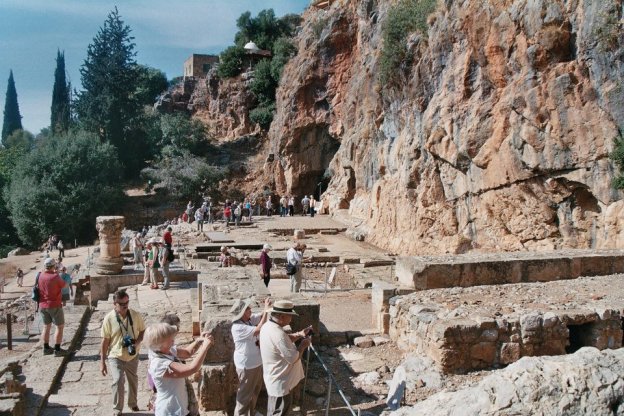
Jesus and His disciples are in the district of Caesarea Philippi. which is north of Capernaum, in the north of Israel, near the Syrian/Lebanon borders. Look at the cover of your bulletin, this is a temple of Zeus and Bacchus that was built by Philip the Tetrarch of this district. Philip was the son of Herod the Great, one of the few surviving sons. Since both he and his father owed heir titles to the Romans, they were careful to flatter the Romans to keep them happy and Philip built this temple to Roman Gods. Philip wasn’t exactly Jewish, he used his quasi Jewish status when it suited him and likewise switched to Roman “gods” when it suited his purpose. Philip married Salome, you might remember that Salome was the daughter of Herod and Herodias and after she danced for Herod asked for John the Baptist’s head. Yea, these people were more than a little messed up. Philip had enlarged the city and named it after Caesar and himself, which seems a little presumptuous. You can imagine, the Jews in this area hated Philip for his various offenses and saw this temple as a blasphemy, a sacrilege against their Jewish religion and they referred to this temple as the “Gates of Hell”. According to legend, this is where Jesus and the twelve disciples were camping when today’s reading took place. You can kind of picture them sitting around the campfire. Things are starting to come to a head, in the very next chapter the same Peter, with John and James are going to climb a mountain with Jesus and see Him transfigured and God the Father declaring Jesus to be His Son. For those who like to deny that Jesus is God the Son, seems pretty hard to dispute Peter’s confession, Jesus’ confirmation and then the Father confirming His Son. If Jesus isn’t God the Son, seems a big fuss is being made.
There are a few things going on in this passage and they might seem a little random.
Peter has his failures, and they’re pretty huge and he also has his high points, no question this is a high point. No doubt Peter is sure that this Jesus is someone pretty special. But when Jesus says “…who do you say I am”, Peter didn’t seem to hesitate. ‘Thou art the Christ, the Son of the living God.” Peter’s saying a few things here and this temple is the effective backdrop of this exchange. You are the promised one. Christ isn’t a name, it’s a title. The Hebrew word Mesi,an is the equivalent word of Christ or cristo,j which means anointed one. According to John MacArthur Mesian in the Hebrew: “refers in the Old Testament to prophets (1 Kings 19:16), priests (Lev 4:5, 16) and kings (1 Sam 24: 6, 10). In the sense that all of them were anointed with oil. This anointing symbolized a consecration for ministry by God. Jesus Christ, as the Anointed One, would be the ultimate Prophet, Priest and King (Is 61:1, John 3:34) … Peter declares his faith in Jesus as the promised Messiah.”1
Peter really stepped up and Jesus proclaims, “Blessed are you Simon Barjona, because flesh and blood did not reveal this to you, but My Father who is in heaven.” Jesus is saying that you are special Peter, God has chosen you to proclaim this, you know who I AM to the depths of your soul. Not because you had some great insight but because the Father chose you to declare that I AM the promised Messiah, the one who is the promised Savior of mankind.
Jesus builds on this, since you know this, I can also declare that I will build my church on your proclamation and the gates of Hell shall not prevail against My church. Church in the Greek refers to those who are called out, the Christian community of saints. Not just this building, or the Lutheran Church, all the saints, all those who are hagios, holy, separated people of Jesus, you.
If you look at this picture again, you might be able to tell that this temple has been carved out of stone, this whole thing is one big rock. So when Jesus says on this rock, on top of this pagan temple is where my church, my people will be. When I was there, hearing the tradition, I could almost see Jesus pointing over His shoulder. You see that big rock, that people here call the gates of Hell, my church is going to be built on this temple to false “god’s” and it will never prevail against My church, My church will always be on top.
I also took from this, that Jesus is making a direct reference to the idea that all false “gods” are of Satan. That all false “gods” are actually demons, evil spirits who have corrupted people to believe that they are “gods”. Jesus is saying that these false “gods” and we know that Satan is referred to as the “god of this world” John 12:31, 14:30, 16:11 will never overcome the Kingdom of Heaven.
In four more chapters Jesus will make His triumphant entry into Jerusalem to establish His victory over the world. He will be sacrificed then, He will die as payment for all of our sins and then will rise again in triumphant victory over sin and death. Sin and death are the very essence of Satan and His demons. They may rule the world now, but Jesus’ promise to His disciples and we are His … disciples, that in the end when it really matters He will defeat Satan and reestablish the world the way that God had created it.
In establishing His church, Jesus begins to empower His church. His church will possess the keys to heaven on earth. This means He has given His church the authority to declare what is sin and bind that sin. No other institution has that authority, only the church of Jesus, which the Lutheran Church certainly is. Our authority is based on Scripture and we bind or loose based on God’s Word. Because of God’s Word, we know what God has already bound, who He has locked heaven against. We are simply declaring what has been bound, and in a sense, enforcing that binding from what God has declared.
The world may try to deny the authority and even the legitimacy of the church, but Jesus has certainly declared the church’s authority in this passage. The church, made up of those who are separated, declared holy, will be those who have not just authority, but also responsibility to be the instrument of God’s will.
To those who ignore the church, deny the church has any real meaning, Jesus is clearly establishing His church. The disciples, represented by Peter, have recognized who Jesus is and that He is the promised One of God. He is the anointed One, anointed Prophet, Priest and King and now Jesus has established His church and declared that His disciples make up that church and they have the authority to represent Jesus. As His apostles, His sent ones they, and us, will do the things that the church is responsible to do, to declare the will of Jesus in the world. For those who think that “worship” is on the golf course or the beach, Jesus is saying these people are my church, they will lead in worship, do the work of the church. Anything else will only be personal preference and idolatry.
Take some time this week to think about how that looks, what does that mean to the world? Certainly it is proclaiming the Gospel, He who died to pay for our sins and who rose to give us the only way to eternal life. It is also going to those who are living a life that rejects Jesus and chooses to only be concerned with their own desires. The church is the institution that Jesus empowered to baptize, to be His instrument to bring people into the Kingdom of heaven. His church has been given the responsibility to offer the life saving Blood and Body of Christ. His church is responsible for preaching His proclaimed Word so that all will be able to hear the Good News of forgiveness and salvation in Jesus. Take some time to think of how that should look to the world as we exercise that authority here at First St Johns.
The peace of God which passes all understanding keep your hearts and minds in Christ Jesus. Shalom and Amin.

Being Liked or Being Respected? First St Johns Church August 17, 2014

https://soundcloud.com/jim-driskell/risk-is-there-really-risk-with-godwma

We make our beginning in the Name of God the Father and in the Name of God the Son and in the Name of the Holy Spirit and all those who know that it really isn’t about the risks we take for the Kingdom of Christ, it’s about faith in Him said AMEN!
Risk Management has become one of those compelling corporate buzz words of the last generation. There is all sorts of “risk analysis” that goes into a decision of any consequence, this determines the risk versus the reward. The higher the risk, the higher the reward, but the higher the risk also means the higher chance of failure, more chance of loss.
Corporate America today is very much aware of the risks, part of risk management is the realization that all risk cannot be avoided. The old saying, “if it’s easy anyone can do it”. Corporate America is very much aware that it’s primary mission is about shareholder satisfaction, that is making money so that it can pay dividends to those people who own stock in that corporation. If shareholders/stockholders are not making money, they will sell their shares, possibly for less than they paid for them, and at some point the company will run out of money because no one wants to invest and it will go out of business. Risk aversion cuts both ways, if you don’t take risks you will eventually fade out of existence, if you do take silly risks you are likely to explode out of existence, neither is a desirable outcome.
The church, for the last century, has become very risk averse. I have a degree in Business Management I worked in corporations for twenty years, I’ve interacted with businesses across the spectrum, so I think I say the following with some authority. The church has become much too concerned about pleasing man and not so much about pleasing God. The church is very different from any other kind of organization. Why do you think that is? Do I have “stakeholders” that I’m responsible to? You betchum, many of you here today put so much of your lives to make this church what it is and I do have to respect that. But who is another “stakeholder”? Yeah, the big one, in the end we all answer to Him. He is the ultimate Chairman of the Board, He is the One we are all responsible to. Remember the Judgment Day, you think your boss asks you tough questions. I try to remember that on Judgment Day, as a pastor I’m going to get some really tough questions. Take a moment and think, is God, Father, Son and Holy Spirit what we would think of as “risk averse”? No! Read the Bible! The Bible is a history of crazy stuff. People in the world look at the Bible and they say “this stuff is crazy, I could never buy into this”! But God says “my ways are not your ways” and He demonstrated that all through the Bible. Look at all the craziness, it starts with Genesis and goes right to the end. Who asks an 80 year old man, Abraham, to pick up and leave to go to a place hundreds of miles away that he’s never heard of. And then tells him, you are going to have a son and your descendants will be like the stars in the sky. Then waits another twenty years to make it happen. That’s just crazy talk!
Soren Kierkegaard was a Christian philosopher, in the 1800s, he began a movement called existentialism. Even in his time and up to now, he was considered to be a little crazy, but, in seminary we still study Kierkegaard. Listen to what he says about risk:
“Marry and you will regret it. Do not marry, and you will also regret it. Marry or do not marry, you will regret it either way. Laugh at the stupidities of the world and you will regret it; weep over them and you will also regret it… Whether you trust a girl or do not trust her, you will regret it either way. Hang yourself and you will regret it. Do not hang yourself and you will also regret it… This gentlemen is the quintessence of all the wisdom of life … My wisdom is easy to grasp, for I have only one maxim and even that is not a point of departure for me … My maxim is not a point of departure for me, because if I made it a point of departure, I would … regret it and if I did not make it a point of departure, I would also … regret it … The point is that I do not stop now, but I stopped when I began. My philosophy, therefore, has the advantageous characteristic of being brief and irrefutable.”1 The story of the Bible is a history of crazy stuff, of being “counter-cultural” in the time it was happening and now. In other words, God acting contrary to the expectations of man.
God sends His only begotten Son, the Son leaves the glories of heaven and chooses the humiliation of life in a gritty, nasty, time with equally gritty, nasty people. He has come not to scold them or chastise them, punish them, which He would have been perfectly justified and capable of doing. He doesn’t measure the risk, have extensive council meetings pouring over spread sheets, checking out the current conditions. He puts all of the “risk management” aside and in His sovereign plan decides: “I have compassion for these people, they have no other way to cope, they have put themselves outside of God’s sovereignty and have left themselves with no way to ever be saved. I have to take the risk of rejection, of ridicule, of being marginalized and I have to live the perfect life for them. That in itself would have been enough, but contrary to any rational plan He also decides: “I will be a sacrifice for My people, I will be the bridge to the Father, the answer to the question, ‘how does the sinful and unrighteous be reconciled to the completely, holy, righteous and sovereign Lord of all? I will endure suffering, torture and death to make the payment for their sins and be their Lord and their righteousness. Do I do that by telling them and demanding of them and making them pay their sin debt to me? No! I come to serve them and be their Savior.” Nuts right? Taking the risk that these people would be led to come to God, these people who reject God day after day to satisfy their own petty wants and jealousies.
It was strongly suggested by our Congregation President that I do a sermon on prayer. Well first, I want to make one of my principal bosses happy, right? Second, you don’t have to hit me over the head with no tire tool to get me to preach on prayer. I would like to think, by the grace of God, that I am all about prayer. Why would Mrs Hollinger think that preaching on prayer is necessary? Because her perception may be that not enough prayer is going on around here. We have a prayer room downstairs that, well I could throw a handgrenade in their anytime, and no one would get hurt. We have a prayer group attended by a mere handful. We have a prayer breakfast that, well, ditto. Most people don’t pray. Why? We are taking a risk. We are coming before the Almighty Creator and Sustainer of everything and hoping that we can lay before Him all of our wants and desires and He’s going to jump right on that and give us all that we want, like some genii in a bottle. Well maybe God won’t hear me. I can’t take that risk, I have to jump right in and take control, what I want has to happen, the way I want it to happen. Really? Maybe we haven’t checked lately and forgotten whose church this really is. But there’s another risk and oh I’m not sure I want this. Maybe God’s going to get all counter-cultural on me. Like He did with Abraham, Moses, Elijah, David, Jeremiah, Paul on and on. This might be uncomfortable for me. People might ask you “what are you crazy people doing at that church?” Elijah’s an interesting guy, he was called the Prince of the Prophets, but if there’s a winner for craziest he would be it. When we pray, we have to pray in a way that is God pleasing, not man pleasing.
Do we want to be respected or loved? Machiavelli says respected. Why? Sebastian Marshall opines that to be loved is fickle, a feeling that we can turn off and on. Respected however, is more predictable and is externally based. In terms of the world we need to be respected in our faith in Christ, that is what matters now and forever. But our Savior says it is about love, for our brothers and sisters in Christ and for a Savior who would die for us. Paul was respected by the world, although he would have seemed a little crazy, but he was loved by his brothers and sisters. He took risks that led to a life that by our standards was hard, as did the Roman brothers that he wrote to in today’s lesson. He risked all for his Lord and it ended by him losing his head. But because of his faithful service, the Holy Spirit used him to bring millions to faith, to plant the church of Christ all across the empire. God risks all for His people, He did so through our Lord Jesus Christ. We, however, risk very little and in the end, we realize that it’s not really about the ‘risk’ we took. Why? Because it was the Father who was taking the risk on a people who are fickle, are more concerned about being loved and not about loving. It is about the faith that God gives us. Yes, there is risk, but in faith in God? No not really.
So let’s cut all the “risk management” blah-blah. We aren’t a corporation, we are the priests of the all mighty God. Priests who have been empowered for two thousand years to have only the faith of a mustard seed in order to move mountains, but spend way too much time worried to death that we might be crushed under that mountain. We aren’t called to be stupid, maybe, in the eyes of the world, we are called to be a little crazy and to be more concerned with what the Father’s plan is, then what our risk analysis tells us.
Take some time and really think about what Kierkegaard says, we may have regrets, but we don’t want those regrets to be that we were unfaithful to the Father when we could have been a little crazy to the world, a good and faithful servant to Him who saves us. Journal about it, do you have regrets? Maybe, but did you in the end do what was necessary to glorify God? Then the other regrets, they don’t matter.
The peace of God which passes all understanding keep your hearts and minds in Christ Jesus. Shalom and Amin.

Wired by God, for God

Interesting how you can hear of the Higgs-Boson particle (yeah, I know what?). The so-called God particle from a year ago, published all over until reporters and editors found out what it really meant, then not so much yada-yada.
But when genuine scientific findings are made confirming over and over how, not only are we designed, but how the entire universe is designed, well that doesn’t get any newspaper ink.
Case in point, the recent “Leadership Journal” (Summer 2014) which goes into detail as to how our brains can be or are wired to be receptive to God.

Leadership Journal develops this rather extensively and it goes into some heavy detail, which I will attempt to lighten. I’m going to do a few blogs on this so that I can digest it betterand hopefully spew it out to you somewhat intelligentyl . I would like to add that if you are in ministry or any kind of lay leadership you really should get Leadership Journal it’s just an outstanding publication.

John Ortberg points out that our brains are wired so that “mostly our behavior does not consist of a series of conscious choices. Mostly, our behavior is governed by habit.” (p 21)
We usually think in terms of “bad habits”, which we all have much too much of. Ortberg points out: “Habits are enormously freeing. They are what allows my body to be driving my car while my mind is planning next week’s sermon.” Yea, right, texting on my phone, shaving, applying makeup, eating a big sloppy burger (not my imagination, I’ve seen each in real life). Point is, there is so much we do in life that doesn’t require us having to make a deliberate action, much of what we do is habit and happens because of conditioning.
“But sin gets into our habits. “…what Paul meant when he talked about sin being ‘in our members.’ He was talking about human beings as embodied creatures – sin is in the habitual patterns that govern what our hands reach to and where our eyes look and words our mouths say. Habits are in our neural pathways. And sin gets in our habits. So sin gets in our neurons.” (p 21)

Quoting St Paul “…there is nothing good in our sinful nature.” Ya, I know a little harsh, but let’s face it, we have developed a lot of bad habits. “Paul is a brilliant student of human life who knows that evil, deceit, arrogance, greed, envy and racism have become ‘second nature’ to us all.” Harsh? Ya, but true. Even our best qualities when you hold them up to the perfection of our God, then ya, our “bad” habits are much more obvious and our good habits, at best, ho hum.

Ortberg notes that our willpower is just not going to cut it. Let’s face it, we try to do it alone and usually we are back to the races. “…acquiring new habits through which we can receive power from God to do what to do what willpower never could.”

Ortberg’s next line is compelling because there has been a long standing belief that the physical really doesn’t affect the spiritual. The physical is certainly about the mind. Is there really any doubt that when we abuse our body it affects our mind. I doubt that anyone would seriously question that physical abuse, bad diet, drugs, lack of exercise, affects the mind, certainly affects the chemical composition of the mind. Couldn’t the physical/mental attributes of the mind, if they are abused, affect our spiritual outlook? Trying to separate the physical/mental/spiritual is just a false paradigm. As Ortberg notes: ” Neuroscience has helped to show the error of any spirituality that divorces our spiritual life from our bodies.”

I say AMEN! There are many belief systems that try to make it just about the spirit, that the body is just a husk. POPPYCOCK. Gnosticism, an heretical Christian belief tries to make the material evil, the spiritual, as it were, good. That when the spiritual separates from the physical then it will be hunky-dorey. That attitude has infused itself through orthodox Christianity. the image of spirit beings sitting on clouds in heaven. Certainly physical beings can’t sit on clouds, but the question is; is heaven the end? Eastern religions believe that once we get it right, we leave the evil of the bodily and the material world and then (yippee, skippee), we become some sort of ethereal being and then drop into the ocean of all ethereal beings where our ethereality (no I doubt seriously that’s a real word) merges us with the universe. Again, yippee, skippee.

Why the gratuitous sarcasm? God created the material and He pronounced it good. This also includes our body which He intended to be perfect, incorruptible and eternal. Where else could it have come from? Unless the rapture happens tomorrow, our body will give out and we will, in the spiritual, be in the presence of the Lord. But again, is that the end? No! Not by a long shot. At the final judgment we will all be restored to physical bodies, those who are in Christ, the “Lamb’s Book of Life” will proceed from the judgment to the New Jerusalem. The New Jerusalem will be the world as God had intended. No doubt, it will be much like the world that we left, but it will be restored to perfection, it will be familiar but it will be restored to a perfection that we can’t imagine. Certainly we will be restored to our physical bodies, again, the way they were intended to be before we messed them up with our sin. These bodies will be strong, healthy, immune to injury or damage. We were made by God to be both physical/mental/spiritual and we will be restored to eternity perfectly in all aspects of our being.

In the meantime we will continue to discuss how the physical/mental changes our spiritual outlook as we continue to affect the mental by our habits old and bad or new and good. OK, at least hopefully.