Author Archives: Pastor Jim Driskell, Lutheran Church

Unknown's avatar

About Pastor Jim Driskell, Lutheran Church

I am the pastor of Trinity Lutheran Church in Chestertown, Md. I pray that you will come and worship with us, worship is 10 am Sundays. We are a renewal church and we are lifting God up in classical worship, and being faithful disciples of our Lord Jesus Christ. 101 Greenwood Av, Chestertown. Plenty of parking behind the church.

Man of God (by Len Winneroski)

Being a “Man of God” can mean taking a lot of flak. But I’d rather take flak for the truth then be thought well of for any/all the lies of the world.

winneroski's avatarh.o.o.d

braveheartWhat is a man of God? How does a man of God differ from a man of the world? Is the title “man of God” reserved for priests and pastors?

This morning I was reading 1 Timothy, chapter 6. Paul referred to Timothy as a “man of God” in this letter and laid out some basic principles for godly men to follow:

  • a man of God does not teach false doctrines, he teaches and fights for truth.
  • a man of God does not enjoy and provoke controversy and quarrels.
  • a man of God does not see godliness as a means to financial gain.
  • a man of God puts his hope and trust in God, not money.
  • a man of God finds his contentment in Christ, not in wealth.
  • a man of God pursues righteousness, godliness, faith, love, endurance and gentleness.
  • a man of God is generous and rich in good…

View original post 153 more words

Growth Is Not An Optional Luxury

Would you leave your child to just figure things out for themselves? No God doesn’t either he wants to teach us and guide our growth.

birdchirp's avatarRedbird's Roost

“But grow in the grace and knowledge of our Lord and Savior Jesus Christ.” 2 Peter 3:18a (NASB)
Growth is not an optional luxury for the sincere Christian. When one becomes a Christian, that person realizes how much unlike the Master he or she really is and determines to become more like Him. The road to maturity is long and painful, but the development of the ability to minister to others in the name of Christ is a most satisfying reward.
“But speaking the truth in love, we are to grow up in all aspects into Him who is the head, even Christ.” Ephesians 4:15 (NASB)

View original post

John the Baptist proclaims the arrival of Jesus John 1 19-34 homily and Bible study on KFUO radio

The following is the text for my homily message on KFUO radio on February 5, The first link is for the discussion on John the Baptist. The second link is my homily on John 1: 19-34

ESV John 1:19 And this is the testimony of John, when the Jews sent priests and Levites from Jerusalem to ask him, “Who are you?”20 He confessed, and did not deny, but confessed, “I am not the Christ.”

21 And they asked him, “What then? Are you Elijah?” He said, “I am not.” “Are you the Prophet?” And he answered, “No.”

22 So they said to him, “Who are you? We need to give an answer to those who sent us. What do you say about yourself?”

23 He said, “I am the voice of one crying out in the wilderness, ‘Make straight the way of the Lord,’ as the prophet Isaiah said.”

24 (Now they had been sent from the Pharisees.)

25 They asked him, “Then why are you baptizing, if you are neither the Christ, nor Elijah, nor the Prophet?”

26 John answered them, “I baptize with water, but among you stands one you do not know,

27 even he who comes after me, the strap of whose sandal I am not worthy to untie.”

28 These things took place in Bethany across the Jordan, where John was baptizing.

29 The next day he saw Jesus coming toward him, and said, “Behold, the Lamb of God, who takes away the sin of the world!

30 This is he of whom I said, ‘After me comes a man who ranks before me, because he was before me.’

31 I myself did not know him, but for this purpose I came baptizing with water, that he might be revealed to Israel.”

32 And John bore witness: “I saw the Spirit descend from heaven like a dove, and it remained on him.

33 I myself did not know him, but he who sent me to baptize with water said to me, ‘He on whom you see the Spirit descend and remain, this is he who baptizes with the Holy Spirit.’

34 And I have seen and have borne witness that this is the Son of God.”

John 1:19 – 34  Sermonette on KFUO for February 5, 2015

I’m from Boston, where politics is as much of a spectator sport as the Red Sox, Celtics, Patriots or Bruins. One of the great events is the politician, office holder who gets stopped by the police. Doesn’t matter the offense, the retort is always “do you know who I am?”. That’s almost always a tip off that the person knows they got busted, that they’re in trouble and now they’re trying to use their position to weasel their way out.

Seems we often get too caught up in the person and not the message.

There certainly is a time and a place, a need to know what someone is doing, who it is that’s doing it. Why do we get so caught up, so often needing to know the messenger and not focused on the message? Yes, we get some really messed up messages today and from multiple sources: Television, computers, radios, music recordings. How do we know that they are not of God? Because they don’t communicate the Gospel message. As Christians we should be able to discern what the Gospel message is from the message of the world.

Why do we get so caught up in the “Who are you?” In this day and age, it’s not so much “Who are you?” But “Who are you to tell me?” The message doesn’t seem to matter any more..There is no discernment today, there is simply blind allegiance to whoever it is that is conveying the message. If it’s the right athlete or the right recording artist or the right author, politician yada, yada. The right Bible teacher? Ahhhh, not so much… Unless he’s telling us what we want to hear.

The priests, the Levites, just weren’t that terribly concerned with what John the Baptist preached. Just not really interested, they were interested in who he was. They did that a lot with Jesus too, “where is your authority?”, “What gives you the right?” Not so much like the Bereans, they knew perfectly well who Paul was, good and bad. What did they do, just fall in love with the fact that Paul was talking to them? No! Acts 17:11: “Now these Jews were more noble than those in Thessalonica; they received the word with all eagerness, examining the Scriptures daily to see if these things were so.”

The priests and Levites didn’t seem to be terribly impressed with John or his message, they wanted him to be Elijah, or someone with a rockstar name for them to fall in love with and listen to. Despite the fact that John was saying all the right things, mostly quoting out of Isaiah and continually steering attention away from himself, something else that made him suspect, at least to the priests and Levites. He was odd, odd clothing, odd food, odd practices, baptizing people, and like Jesus did not fit the mold that they were looking for. They weren’t interested in the validity of the words. They didn’t take down his words and go back to study if John was validly preaching Scripture, God’s revelation, especially as it related to the coming Messiah. No, they wanted the messenger to be Elijah, “the prophet”, who was this guy John?

The take away is this. We are not called to fall in love with the messenger. John the Baptizer was the last of the Old Testament prophets, he was an odd duck, as they all were, none of them were rockstars that you’d fall in love with. But they did convey God’s Word, they did give us God’s revelation? This passage in John’s Gospel quotes John the Baptizer as quoting or alluding to passages in Isaiah, Daniel, Malachi, Genesis and Psalms. The priests and the Levites, the rest of the house of Israel missed the point, getting so caught up in “do you know who I am?”, They missed the message of the Gospel. They stuck with their Laws and rules, relying on them to save them, when they had actual grace and forgiveness in their presence, right before them. They missed salvation in the Gospel. As a pastor, as a minister of Christ I am charged with preaching the truth, I am charged with giving the hope and promise of the Gospel. Not what someone wants to hear, but what God the Father tells us is true salvation in His Son Jesus Christ. I’m definitely not a rock star, but if I am telling you what you need to hear and giving you what you need; Baptism, the Body and Blood of Jesus, the Word, the Father’s Absolution of your sins, you should listen. By all means, be a Berean and take my word back and study it. I love it when someone pushes me on something I said in a sermon or wrote in a blog. But trust that I was placed here as a minister, as a representative of Jesus in order for Jesus to use me to give to you what you need for salvation in Jesus. I’m definitely not going to say “do you know who I am?” Because you wouldn’t. But I can say, as any disciple in Jesus can say, do you know that I am a brother in Christ and that true salvation is in Jesus? It’s not the messenger, it’s whether it’s the message of Jesus Christ in Scripture that is telling you that God the Father has saved you in Jesus. John would have told them: “And I have seen and have borne witness that this is the Son of God.” They just wanted to ask the questions when they could have stopped and listened to the one who prepared the way for the Lord.

Live discussion on KFUO radio on John Gospel 1:19-34

You can listen on live streaming at http://www.kfuo.org we will be talking about John the Baptist proclaiming the beginning of Jesus’ ministry “behold the Lamb of God who takes away the sin of the world.” John the Baptist the last of the Old Testament prophets. The prophets were preparing the world for Jesus, the disciples would proclaim who Jesus is and is the promised Messiah, the Savior of the world. Please listen, let me know what you think .

You can call in too, at 800-730-2727. Come on, call in and give me your best shot, it will be great.

Do you go to Nineveh or blow off God? Really? Jonah First Saint Johns January 25, 2015

We make our beginning in the Name of God the Father and in the Name of God the Son and in the Name of God the Holy Spirit and all those who follow God’s lead, even to their own Nineveh said … AMEN!

The Ninevites were bad people, to quote Charles Dickens you must remember that or nothing good will come from what I tell you, they were very bad people. Jonah had every reason in the world to avoid going to Nineveh. Side note, up until the 1800’s scholars chocked the entire Jonah story up to fable, one reason being that they felt that Nineveh was a myth, that it had never existed. Well surprise, archeologists found it and it does exist. In fact it was a very important city, to deny it existed, as many skeptics today try to deny many aspects of the Bible, would be to deny a great deal of antiquity.

Nineveh was a great city for it’s time. The writer of Jonah says: “Now Nineveh was an exceedingly great city, three days’ journey in breadth.” It’s estimated that it had a population of 120,000 people. By today’s standards, that’s really a small city, York has a population of about 50,000, Boston has about 600,000, New York City over 8 million. But for a time when most people farmed or raised livestock, most people didn’t live in a city, it was pretty huge. We have to remember that cities really didn’t become so massive until the industrial revolution and even then not until the early 1900s, when people went to cities to work in factories. Are there difficulties with the Jonah account? Yes. There are really no whales in the Mediterranean and it’s hard to reconcile what kind of “fish” would have swallowed Jonah. There are accounts of men, in the whaling ship days, who were swallowed by a whale and recovered, but can’t really make that case with Jonah. But when we are talking about God, who made all and sustains all of creation, I think it’s a small thing that He created a fish to turn Jonah around.

Nineveh was the capital of the Assyrian Empire and as I said, they were, straight out, bad people. A Wikipedia article quoting King Sennacherib about a recent military victory: “ “Its inhabitants, young and old, I did not spare, and with their corpses I filled the streets of the city.” The Wikipedia article also refers to stone carvings of “many battle scenes, impalings and scenes showing Sennacherib’s men parading the spoils of war before him.”1 These were not nice people. Jonah had every reason in the world not to go there, chief among those reasons was, that he may not come out alive. That was a very real concern. But, as the Chronological Study Bible points out; “Two features stand out in the book’s theology. One is the universal love and compassion of God for all nations. Another is the sovereignty of God.”2

A case could be made that Jonah was written about 700 BC. As I said the Assyrians were widely hated. The Chronological Study Bible states: “Few armies were as hated as the Assyrian army. Even in a time and culture that was not known for respecting human life, Assyrian tactics and policies toward their enemies were notoriously brutal.”3

So when we wonder what the point of this story is about, it certainly has to do with faithfulness and obedience. When God calls us to do something, many times He sets up the circumstances to make sure that His something gets done. If it takes an extraordinary story of a man being thrown into the ocean, swallowed by a big fish, delivered up to the destination that He wants Jonah delivered to, to drive home the point that God’s will is to be done and He can put us where He wants us, then so be it. Even if it’s to a people who are widely hated. You also have to remember that at this point in history, the people of Israel saw God as the universal God, as the creator of all, but still, somehow, thought of Yahweh as their God, exclusively in favor of Israel. Nineveh was the center of worship for the goddess Ishtar, who the Ninevites worshiped. Odd contrast, the Ninevites considered her the goddess of fertility, love, war and sex. I suppose you could reconcile some of those together, but for pagan “gods”, that seems to be a rather wide portfolio. Obviously war, among other things was a priority for the Ninevites/Assyrians. Going to a pagan people to tell them about the real God must have struck Jonah as plain crazy.

Rev Stephen Gaulke writes in Concordia Pulpit: A Sunday school teacher asked her class, ‘What can we learn from Jonah?’ One girl blurted out, ‘When whales swallow people, they get real sick?’”

I was with a group of pastors when I heard that silly Sunday School story. One pastor told the punch line, ‘People make whales really sick.’ Another pastor joked, ‘That’s funny, I always thought the point of Jonah’s story is you can’t keep a good man down!’

Jonah went to Nineveh not because he thought, ‘I’m a good guy.’ He painfully knew, ‘ I was the bad guy, running from God?’ And Jonah joyfully believed, ‘God loves me anyway. The Lord forgives me, gives me new life. He’s the God of second chances!’

What do you think? ‘I’m better than the person God wants me to help? No. The only difference between us and them is that we know who gives life, who forgives!’”4 And I might add that in gratitude, if the Father wants to use me or you, anyone, to see God’s forgiveness and salvation, can I really in good conscience refuse to do what God is guiding me to do? No!

Jonah by his actions said to God; “Forget it, I’m not going to Nineveh. Those people are evil! Go ahead and destroy them! They deserve it! They don’t deserve grace, they deserve to be nuked and I’m not going!” I really can’t say that Jonah was wrong. I can’t say that if God put me on a boat to North Korea or some place in the Middle East, I would certainly have mixed emotions, if not outright rejection of the idea. But God does push on us, if we are a disciple of Christ, if we have received grace and forgiveness from our baptism and from Jesus’ sacrifice on the cross, if God sustains us and His Son saves us, shouldn’t we follow where He leads us?

Our Gospel reading today is Jesus calling Simon, Andrew, James and John saying: “Follow me and I will make you become fishers of men.” Certainly Jonah’s story is a graphic illustration. As it says in your call to worship: “We hear of God’s call to Jonah in the Old Testament and how, after trying to run away, he was given a second chance. Before he became a ‘fisher of men’, he literally became fish bait! God calls us both to salvation for ourselves and to be fellow [fishermen and women] speaking God’s grace to others.” Those ‘others’ may be people who are different, they may be people we think could be violent or hurt us, they could be people that we just don’t personally like. But all people are God’s creation and in His sovereignty He chooses those who will be saved. He may use you or me, in order to save those people. Jesus was tortured and crucified in order to be the sacrifice for all the sins of the world. Jesus’ sacrifice restored our relationship with God, this gives us hope and the promise of eternal, resurrected life. So the question is, if Jesus did all that for us, if we are His, if we are His disciples, do we really have the right to blow Him off and refuse to go to our Nineveh? Jonah did go to Nineveh, he preached what God told him to preach, the Ninevites did repent of their sin and God did not destroy them. Jonah was faithful and used by God to save many people.

For this week’s assignment, read the whole book of Jonah. Get a real feel for how Jonah felt about his calling. Are there things that God calls you to do that you think are unreasonable? They may be unreasonable to you, but if this is in God’s will, the only unreasonable thing is your refusal to follow God’s leading. He will supply you with what you need to follow Him. He will give you the faith to trust that what He’s asking is according to His will. Are you really going to run off to Tarshish and refuse Him?

The peace of God which passes all understanding keep your hearts and minds in Christ Jesus. Shalom and Amin.

2Chronological Study Bible pp 576-577

3Ibid p 576

4Stephen E Gaulke Concordia Pulpit Volume 25 Part 1 pp 14-15

Stupid behavior of others does affect other people

I will qualify this by saying that in terms of substance abuse that I have frankly just never got it. Don’t understand why anyone would, so yea I’m lacking in empathy.
Having said that, for someone to use that as an excuse is for that person to continue to live in their own little world of denial, just another excuse which some many abusers are so good at. So grow up and get a grip.
The usual abusers excuse is “what I do doesn’t hurt anyone else”. Wow! If you believe that I have a bridge you might like to buy.
There has been a reality series on television that has really driven this home for me. One particular episode is a father with three sons where the oldest son is abusing OxyContin and he is enabling that son with money and excuses and the father has his own gambling addiction. He has two younger sons and they are victims of all this. They are living in a hotel and will probably be on the street shortly and they often don’t get anywhere near enough to eat. They are early adolescence. Lack of food at this stage of development will affect them through their whole life, because of someone else’s abuse and neglect.
The father had a good job but was finally fired for embezzling. He probably should be in jail for that which would impact his sons.
To say that the bad habits of the two older ones doesn’t affect others is to live in your own little world of denial and we’re not even talking about how it affects extended family members.
The answer? Legalizing marijuana? So now we condone bad behavior and create even more problems? We see that legalized gambling has created a whole set of social problems. People going into debt, health issues, living on the street because of wasting money on government gambling. Both government regulated gambling and drugs are more expensive than what’s on the street. Those who don’t have money are just wasting more?
The family who usually gets sucked into giving them money and just enabling the problem. Who suffer financial loss, anxiety and often abuse for enabling?
I submit that putting any kind of abuser in jail helps everyone. Get treatments? Sure but make it legal? That’s just dumb. The public is safer by putting abusers away. Family doesn’t have to suffer by losing money, not being taken care of, going through all the drama and violence that abusers put families through. They’re in jail they’re relatively safe. They’re being treated, fed, sheltered and others can get on with their lives without having to spend the time and energy on substance abusers.
Legalizing drugs, gambling is not an answers it exacerbates the problem for everyone. Government has a stake in it and won’t give it up because it’s getting revenue from this and in the meantime everyone else suffers.
Anyone who believes in “victimless” crimes is ridiculously naive. The amount of damage caused by “victimless” crimes rips through our society.
Do we extend compassion to people who suffer like this? Sure but once they are in a place where they have to confront their issue, stop living in their denial. As Christians we should do what we can to get those on the street to deal with those problems. But as a pastor I have people who need attention for real issues and not just problems they created themselves or government enabled them to do. Do I focus on the person who has wrecked their life through their ignorance and selfishness? Or the person who is trying and is in need of strengthening? Yet government, society keeps enabling people and then dumping the problems that enabling causes on someone else, often the church. The church barely has enough resources to deal with what it’s supposed to do in Jesus. As a pastor I’m not really in a position to undo the problems government has created.
We pray we encourage, but at some point we need to help those who are dealing with reality and have to cut the cord with those who want to drag me down, their family down and anyone else who gets dragged in. Just so they can have another drink, another joint, place another bet?

Evolution vs Creation, you might want to read what Darwin wrote a little more closely, not as edifying as you might think

The following is a chapter from a new book from “Answers in Genesis”. Evolution keeps popping up in the church and other parts of society, despite its implausibility, frankly that’s putting it nicely, really its impossibility. Check out this article and you might want to look a little deeper and use some of the links to “Answers in Genesis”.
Do Evolutionists Believe Darwin’s Ideas about Evolution?

Chapter 28

Do Evolutionists Believe Darwin’s Ideas about Evolution?

by Dr. Terry Mortenson and Roger Patterson on January 26, 2015

Few people have actually read the works of Darwin, and if they did they might be shocked to read some of Darwin’s ideas.

Creation and Evolution: Compatible or in Conflict?

This controversy can’t be solved by merely listing both views of the facts. Extremely intelligent and knowledgeable scientists in both camps show that it can’t just be about facts. Discover what makes the difference!

Charles Darwin first published his ideas on evolution over 150 years ago. In those 150 years we have come to understand the complexity of life, and many new scientific fields have shed light on the question of the validity of Darwin’s evolutionary hypothesis. Few people have actually read the works of Darwin, and if they did they might be shocked to read some of Darwin’s ideas. In this chapter we will take a look at what Darwin and other early evolutionists believed and how those ideas have changed over time.

Darwin was wrong on many points, and there would be few who would disagree with this claim. But if Darwin was wrong on some points, does that mean that the entire hypothesis of evolution is proven wrong?

What Is Evolution?

Like many words, evolution has many different uses depending on its context. The general concept of the word is “change over time.” In that sense, one might say that a butterfly evolves from an egg to a caterpillar to a winged butterfly and a child evolves into an adult. There is no disputing that individual organisms change over time. However, using the word in this way is quite misleading for the origins debate. Darwin’s hypothesis involves a very different concept.

As evolution is used in this chapter and in all science textbooks, natural history museums, and science programs on television, it refers to the biological idea that all life on Earth has descended from a single common ancestor. There are many different variations on this theme as well as several explanations of how the first organism came into existence from non-living matter. Examining some of the historical evolutionary positions and comparing them to the ideas that are popular in scientific circles today shows how much those concepts have changed. In general, evolution will be used to refer to the concept of molecules turning into men over time. This concept of evolution is in direct opposition to the biblical account of creation presented in the book of Genesis.1

Evolution—An Ancient Idea

The concept of molecules-to-man evolution is certainly not a new idea. Several Greek philosophers before the time of Christ wrote on the topic. For example, Lucretius and Empedocles promoted a form of natural selection that did not rely on any type of purpose. In De Rerum Natura (On the Nature of Things) Lucretius writes:

And many species of animals must have perished at that time, unable by procreation to forge out the chain of posterity: for whatever you see feeding on the breath of life, either cunning or courage or at least quickness must have guarded and kept that kind from its earliest existence. . . . But those to which nature gave no such qualities, so that they could neither live by themselves at their own will, nor give us some usefulness for which we might suffer to feed them under our protection and be safe, these certainly lay at the mercy of others for prey and profit, being all hampered by their own fateful chains, until nature brought that race to destruction.2

This stands in opposition to the thinking of Aristotle, who promoted the idea of purpose in nature. Aristotle also imagined forms of life advancing through history, but he believed nature had the aim of producing beauty.3 This idea of purpose in nature, or teleology, is later seen in the works of Thomas Aquinas and other Christian philosophers.

THE CONCEPT OF EVOLUTION WAS NOT LOST FROM WESTERN THINKING UNTIL DARWIN REDISCOVERED IT.

The concept of evolution was not lost from Western thinking until Darwin rediscovered it—it was always present in various forms. Because much of the thinking was dominated by Aristotelian ideas, the idea of a purposeless evolutionary process was not popular. Most saw a purpose in nature and the interactions between living things. The dominance of the Roman Catholic Church in Europe (where modern science was born) and its adherence to Aristotelian philosophies also played a role in limiting the promotion of evolution and other contrary ideas as these would have been seen as heresy. As the Enlightenment took hold in Europe in the 17th and 18th centuries, explanations that looked beyond a directed cause became more popular.

Erasmus Darwin

Coming to the mid-to-late 18th century, Kant, Liebnitz, Buffon, and others began to talk openly of a natural force that has driven the change of organisms from simple to complex over time. The idea of evolution was well established in the literature, but there seemed to be no legitimate mechanism to adequately explain this idea in scientific terms. Following the spirit of the Greek poets Lucretius and Empedocles, Erasmus Darwin, the atheist grandfather of Charles, wrote some of his ideas in poetic verse. Brushing up against the idea of survival of the fittest, Erasmus spoke of the struggle for existence between different animals and even plants. This struggle is a part of the evolutionary process he outlines in his Temple of Nature (1803) in the section titled “Production of Life”:

Hence without parent by spontaneous birth
Rise the first specks of animated Earth;
From Nature’s womb the plant or insect swims,
And buds or breathes, with microscopic limbs.4

And he continues:

Organic Life beneath the shoreless waves
Was born and nursed in Ocean’s pearly caves;
First forms minute, unseen by spheric glass,
Move on the mud, or pierce the watery mass;
These, as successive generations bloom,
New powers acquire, and larger limbs assume;
Whence countless groups of vegetation spring,
And breathing realms of fin, and feet, and wing.5

Starting with spontaneous generation from inanimate matter, Erasmus imagined life evolving into more complex forms over time. He did not identify any mechanisms that may have caused the change, other than general references to nature and a vague driving force.

In the introduction to this work, Erasmus Darwin states that it is not intended to instruct but rather to amuse, and he then includes many notes describing his ideas. Despite his claimed-to-be-innocent intentions, this poem lays out the gradual, simple-to-complex progression of matter to living creature—a view very consciously different from the biblical account of creation which the vast majority of his contemporaries knew and believed. He traces the development of life in the seas to life on land with the four-footed creatures eventually culminating in humans and the creation of society. There is no doubt that when Charles began his studies, the idea of evolution apart from the supernatural was present in Western thought (even in his own extended family). The arguments in support of special creation were certainly prominent, but evolutionary ideas were being pressed into mainstream thinking in the era of modernism.6

To underscore the early acceptance of evolution, the following passage from Zoonomia (3 vol., 1794–1796) illustrates Erasmus Darwin’s belief that all life had come from a common “filament” of life.

From thus meditating on the great similarity of the structure of the warm-blooded animals . . . would it be too bold to imagine that, in the great length of time since the Earth began to exist, perhaps millions of ages before the commencement of the history of mankind would it be too bold to imagine that all warm-blooded animals have arisen from one living filament?7

Lamarckian Evolution or Use and Disuse

In France, and at the same time as Erasmus, Jean Baptiste Lamarck developed his theories of the origin and evolution of life. Initially, he had argued for the immutability of species, but in his later works he laid out a clear alternative to the special creation of plants and animals. Lamarck believed that the geology of the Earth was the result of gradual processes acting over vast periods of time—a view later to be known as uniformitarianism. Lamarck developed four laws of evolution and put them forward in his Philosophie Zoologique published in 1809. Lamarck proposed that an internal force and the need for new organs caused creatures to develop new characteristics. Once developed, the use or disuse of the organs would determine how they would be passed on to a creature’s offspring. This idea of the transmission or inheritance of acquired characteristics is the hallmark of this model of evolution.
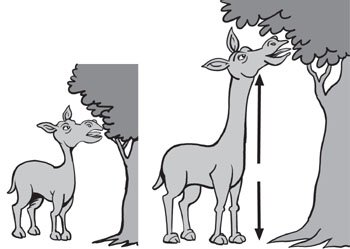
Lamarckian EvolutionIn Lamarckian evolution, animals change due to environmental factors and the use or disuse of a feature. For example, a giraffe’s neck will get longer over time as it continually stretches it to reach higher leaves on trees.

Lamarck’s mechanism of use and disuse of characters was widely rejected in his lifetime, especially by the prominent French naturalist Georges Cuvier, and was never supported by observations. Lamarck did attempt to explain how the characteristics were inherited, but there was still no clear biological mechanism of inheritance that would support his claims. Lamarck also proposed a tree of life with various branching structures that showed how life evolved from simple to complex forms. Much of what Lamarck proposed seems unreasonable to us today with a modern understanding of genetics. A husband and wife who are both bodybuilders will not have an extraordinarily muscular child—that acquired trait does not have any affect on the genetic information in the germ cells of the parents’ bodies. However, recent research has revealed instances of bacterial inheritance that appear to be very Lamarckian in nature. Future research in this area may reveal that Lamarck was correct to some degree. But there are many good reasons to expect that this would provide no support for the idea of molecules-to-man evolution.8

Darwinian Evolution

Charles Darwin was at least familiar with all of these different views, and their influence can be found throughout his writings. Darwin often referred to the effects of natural selection along with the use or disuse of the parts. The legs and wings of the ostrich, the absence of feet and wings in beetles, and the absence of eyes in moles and cave-dwelling animals are all mentioned by Darwin as a result of use or disuse alongside natural selection.9 Exactly how this process happened was a mystery to Darwin. He proposed the idea of “pangenesis” as the mechanism of passing traits from parent to offspring. This idea is not significantly different from Lamarck’s, for it relies on the use and disuse of organs and structures that are passed on to offspring through pangenes over vast ages.

Natural Select + Millions of YearsDarwin originally proposed that natural selection would be the primary mechanism acting to change organisms over millions of years. He was not aware of the role of mutations in heredity.

In his work The Variation of Animals and Plants under Domestication, Darwin suggested that gemmules are shed by body cells, and that the combination of these gemmules would determine the appearance and constitution of the offspring. If the parent had a long neck, then more gemmules for a long neck would be passed to the offspring. In Darwin’s defense, he was not aware of the work of his contemporary, Gregor Mendel. In his garden in the Czech lands, Mendel was studying the heredity of pea plants. Neither man knew of the existence of genes, or the DNA genes are composed of, but both of them understood there was a factor involved in transmitting characteristics from one generation to the next. Despite evidence from experiments conducted by his cousin Francis Galton, Darwin clung to his pangenesis hypothesis and defended it in his later work Descent of Man.

Darwin believed that all organisms had evolved by natural processes over vast expanses of time. In the introduction to Origin of Species he wrote the following:

As many more individuals of each species are born than can possibly survive; and as, consequently, there is a frequently recurring struggle for existence, it follows that any being, if it vary however slightly in any manner profitable to itself, under the complex and sometimes varying conditions of life, will have a better chance of surviving, and thus be naturally selected. From the strong principle of inheritance, any selected variety will tend to propagate its new and modified form.10

Darwin’s belief that slight modifications were selected to produce big changes in organisms over the course of millions of years was the foundation of his model for the evolution of life on Earth. We know today that Darwin’s notion of gemmules and pangenes leading to new features or the development of enhanced characteristics is a false notion. However, that does not mean, by itself, that Darwin’s conclusion is wrong—just that his reasoning was faulty.

Neo-Darwinian Evolution and the Modern Synthesis

The discovery of DNA and the rediscovery of Mendel’s work on heredity in pea plants have shown that Darwin’s hereditary mechanism does not work. But his conclusion of molecules-to-man transformation over millions of years is still held as true by proponents of evolution. In the early 20th century, Mendelian genetics was rediscovered and it came to be understood that DNA was responsible for the transmission and storage of hereditary information. The scientific majority was still fixed on a naturalistic explanation for the evolution of organisms. That evolution happened was never a question—finding the mechanism was the goal of these naturalistic scientists.

Mutation of genetic information came to be viewed as the likely mechanism for providing the raw material for natural selection to act on. Combining genetic studies of creatures in the lab and in the wild, models of speciation and change over time were developed and used to explain what was seen in the present. These small changes that resulted from mutations were believed to provide the genetic diversity that would lead to new forms over eons of time. This small change was referred to as “microevolution” since it involved small changes over a short amount of time. The evolutionists claim that the small changes add up to big changes over millions of years, leading to new kinds of life. Thus, microevolution leads to “macroevolution” in the evolutionary view. However, the acceptance of these terms just leads to confusion, and they should be avoided.

Natural Select + Millions of Years + MutationAfter the discovery of DNA and its role in inheritance, evolutionists pointed to mutations in the DNA as the source for new traits. These accidental mutations provide differences in the offspring that can be selected for. This selection is believed to lead to new kinds of life.

This is not fundamentally different from what Charles Darwin taught; it simply uses a different mechanism to explain the process. The problem is that the change in speciation and adaptation is heading in the opposite direction needed for macroevolution. The small changes seen in species as they adapt to their environments and form new species through mutation are the result of losses of information. Darwinian evolution requires the addition of traits (such as forelimbs changing into wings, and scales turning into feathers in dinosaur-to-bird evolution), which requires the addition of new information. Selecting from information that is already present in the genome and that was damaged through copying mistakes in the genes cannot be the process that adds new information to the genome.

IT HAS BECOME SO PLASTIC THAT IT CAN BE MOLDED TO EXPLAIN ANY EVIDENCE, NO MATTER HOW INCONSISTENT THE EXPLANATIONS MAY BECOME.

Today, evolution has been combined with the study of embryology, genetics, the fossil record, molecular structures, plate tectonics, radiometric dating, anthropology, forensics, population studies, psychology, brain chemistry, etc. This leads to the intertwining of so many different ideas that the modern view of evolution can explain anything. It has become so plastic that it can be molded to explain any evidence, no matter how inconsistent the explanations may become. Even Darwin was willing to admit that there may be evidence that would invalidate his hypothesis. That is no longer the view held by the vast majority of evolutionists today—evolution has become a fact, even a scientific law (on par with the law of gravity), in the minds of many.

To help us see this more clearly, let us take a look at the idea of different races. Darwin published his views on the different races in Descent of Man. Though Darwin spoke against slavery, he clearly believed that the different people groups around the world were the result of various levels of evolutionary development. Darwin wrote the following:

At some future period, not very distant as measured by centuries, the civilized races of man will almost certainly exterminate and replace the savage races throughout the world. At the same time the anthropomorphous apes . . . will no doubt be exterminated. The break between man and his nearest allies will then be wider, for it will intervene between man in a more civilized state, as we may hope, even than the Caucasian, and some ape as low as a baboon, instead of as now between the negro or Australian [Aborigine] and the gorilla.11

This is the conclusion Darwin came to—that different rates of evolution would lead to different classes of humans. He often refers to the distinction between the civilized Europeans and the savages of various areas of the world. He concludes that some of these savages are so closely related to apes that there is no clear dividing line in human history “where the term ‘man’ ought to be used.”12 Consistent with his naturalistic view of the world, Darwin saw various groups of humans, whether they are distinct species or not, as less advanced than others. This naturally leads to racist attitudes and, as Dr. Stephen J. Gould noted, biological arguments for racism “increased by orders of magnitude following the acceptance of evolutionary theory,”13 though this was likely only an excuse to act on underlying social prejudices.

Dr. James Watson (co-discoverer of the double-helix structure of the DNA molecule and a leading atheistic evolutionist) was caught in a storm of evolutionary racism in 2007. The Times of London reported the following in an interview:

He says that he is “inherently gloomy about the prospect of Africa” because “all our social policies are based on the fact that their intelligence is the same as ours—whereas all the testing says not really,” and I know that this “hot potato” is going to be difficult to address. His hope is that everyone is equal, but he counters that “people who have to deal with black employees find this not true.” He says that you should not discriminate on the basis of colour, because “there are many people of colour who are very talented, but don’t promote them when they haven’t succeeded at the lower level.” He writes, “there is no firm reason to anticipate that the intellectual capacities of peoples geographically separated in their evolution should prove to have evolved identically. Our wanting to reserve equal powers of reason as some universal heritage of humanity will not be enough to make it so.”14

Though he later stated that he did not intend to imply that black Africans are genetically inferior, he is being consistent with his evolutionary beliefs. His remarks were considered offensive, even by those who endorse evolution.

THOSE WHO WOULD SUGGEST THAT EVOLUTION CAN EXPLAIN WHY ALL HUMANS HAVE VALUE MUST BATTLE AGAINST THOSE EVOLUTIONISTS WHO WOULD DISAGREE.

This exposes an inconsistency in the thinking of many evolutionists today—if we evolved by random chance, we are nothing special. If humans evolved, it is only reasonable to conclude that different groups have evolved at different rates and with different abilities, and mental ability could be higher in one group than another. If the data supported this claim, in the evolutionary framework, then it should be embraced. Those who would suggest that evolution can explain why all humans have value must battle against those evolutionists who would disagree. This exposes the inconsistent and plastic nature of evolution as an overarching framework—who gets to decide what evolution should mean? Darwin and Watson are applying the concepts in a consistent way and setting emotion and political correctness aside, when it is deemed necessary. Darwin noted that “it is only our natural prejudice and . . . arrogance” that lead us to believe we are special in the animal world.15

Without an objective standard, such as that provided by the Bible, the value and dignity of human beings are left up to the opinions of people and their biased interpretations of the world around us. God tells us through His Word that each human has dignity and is a special part of the creation because each one is made in the image of God. We are all of “one blood” in a line descended from Adam, the first man, who was made distinct from all animals and was not made by modifying any previously existing animal (Genesis 2:7).

Saltation and Punctuated Equilibrium

Contrasted with Darwin’s view of a gradual process of change acting over vast ages of time, others have seen the history of life on Earth as one of giant leaps of rapid evolutionary change sprinkled through the millions of years. Darwin noted that the fossil record seemed to be missing the transitions from one kind of organism to the next that would confirm his gradualistic notion of evolution. Shortly after Darwin, there were proponents of evolutionary saltation—the notion that evolution happens in great leaps. The almost complete absence of transitional forms in the fossil record seemed to support this saltation concept and this was later coupled with genetics to provide a mechanism where “hopeful monsters” would appear and almost instantaneously produce a new kind of creature (e.g., changing a reptile into a bird). These “monsters” would be the foundation for new kinds of animals.

Saltation fell out of favor, but the inconsistency between the fossil record and the gradualism promoted by Darwin and others was still a problem. The work of Ernst Mayr, Stephen J. Gould, and Niles Eldredge was the foundation for the model of “punctuated equilibrium.” This model explained great periods of stasis in the fossil record punctuated with occasional periods of rapid change in small populations of a certain kind of creature. This rapid change is relative to the geologic time scale—acting over tens of thousands of years rather than millions. This idea is not inconsistent with Darwin’s grand evolutionary scheme. However, it seems that Darwin did not anticipate such a mechanism, though he commented that different organisms would have evolved at different rates. Whether evolution has occurred by gradual steps or rapid leaps (or some combination) is still a topic of debate among those who hold to the neo-Darwinian synthesis of mutations and natural selection as the driving forces of evolutionary change.

Natural Select + Millions of Years + Mutation + Bursts of ChangeContrary to Neo-Darwinism, punctuated equilibrium tries to account for the lack of fossil intermediates by appealing to rapid bursts of change interspersed in the millions of years. They still rely on mutations and natural selection, but at a much faster rate.

Conclusion

Sir Isaac Newton provided us with a general theory of gravity (and described laws in support of that theory) based on observational science. Even in light of modern understandings, those laws still apply today. Einstein did expand the concepts, but the functionality of Newtonian physics still applies today as much as ever.

WHAT IS CALLED DARWINISM TODAY BEARS LITTLE RESEMBLANCE TO WHAT DARWIN ACTUALLY WROTE.

The same cannot be said for Darwin’s ideas. Darwin’s hypothesized mechanism of natural selection (even with the added understanding of mutations) has failed to provide an explanation for the origin and diversity of life we see on Earth today. His confident expectation that the fossil record would confirm his hypothesis has utterly failed, and the mind-boggling irreducible complexity seen in biological systems today defies the explanations of Darwin or his disciples. To say that evolutionary thinking today is Darwinian in nature can only mean that evolutionists believe that life has evolved from simpler to complex over time. Beyond that, what is called Darwinism today bears little resemblance to what Darwin actually wrote.

All of these ideas of the evolution of organisms from simple to complex are contrary to the clear teaching of Scripture that God made separate kinds of plants and animals and one kind of man, each to reproduce after its own kind. As such, these evolutionary ideas are bound to fail when attempting to describe the history of life and to predict the future changes to kinds of life in this universe where we live. When we start our thinking with the Bible, we can know we are starting on solid ground. Both the fossil record and the study of how plants, animals, and people change in the present fit perfectly with what the Bible says about Creation, the Flood, and the Tower of Babel in Genesis 1–11. The Bible makes sense of the world around us.

The New Answers Book 3

The New Answers Book 3

Do you have answers to the big questions about the Christian faith, evolution, creation, and the biblical worldview? Now you get the important information you need regarding the existence of God, global warming and climate change, cloning and stem cells, human and chimp DNA, the importance of Mount St. Helens, and more.

Read Online Buy Book

Footnotes

  1. For an explanation of some of the contradictions between the biblical creation account and the widely held evolution story, see the article “Evolution vs. Creation: The Order of Events Matters!” atwww.answersingenesis.org/articles/2006/04/04/order-of-events-matters.
  2. Sharon Kaye, “Was There No Evolutionary Thought in the Middle Ages? The Case of William of Ockham,” British Journal for the History of Philosophy 14 no. 2 (2006): 225–244.
  3. Henry Fairfield Osborn, From the Greeks to Darwin (London: Macmillan, 1913), p. 43–56.
  4. Erasmus Darwin, The Temple of Nature (London: Jones & Company, 1825), p. 13.
  5. Ibid., p. 14–15.
  6. Modernism was the dominant philosophy in Western culture from the late 18th to the late 20th centuries. This philosophy placed science as the supreme authority for determining truth. Science was viewed as the “savior” of mankind—eventually finding cures for all diseases, ending war, famine, etc. Though it has been largely replaced by post-modernism, this modernist thinking is still very prominent among scientists and many others in our culture. Post-modernism, on the other hand, is a radical skepticism about anyone’s ability to know truth. Post-modernists argue that truth and morality are relative—there are no absolutes. It also reflects disenchantment with the promises made by modernist philosophers and scientists. Both philosophies reject Scripture as authoritative truth and are based on evolutionary thinking.
  7. Erasmus Darwin, Zoonomia, volume 1 (Philadelphia, PA: Edward Earle, 1818), p. 397.
  8. Even if Lamarckian mechanisms are uncovered, the fossil record would not support the evolution story. See Duane Gish, Evolution: The Fossils Still Say No, (Santee, CA: Institute for Creation Research, 1996); Carl Werner,Evolution: The Grand Experiment, vol. 1 (Green Forest, AR: New Leaf Press, 2007); and Living Fossils, vol. 2 (Green Forest, AR: New Leaf Press, 2008). Natural selection can only “select” from existing genetic information (it cannot create new information), and mutations cause a loss or reshuffling of existing genetic information. See Terry Mortenson’s DVD Origin of the Species: Was Darwin Right? (Answers in Genesis, 2007) and John Sanford,Genetic Entropy and the Mystery of the Genome (Lima NY: Elim Publishing, 2005). Also, what bacteria can do should not be directly applied to other forms of life because bacteria are categorically and significantly different. This is explained in Georgia Purdom’s DVD All Creatures Great and Small: Microbes and Creation (Petersburg, KY: Answers in Genesis, 2009).
  9. Charles Darwin, The Origin of Species (New York, NY: The Modern Library, 1993), p. 175–181.
  10. Ibid., p. 21.
  11. Charles Darwin, The Origin of Species and The Descent of Man (New York, NY: The Modern Library, 1936), p. 521.
  12. Ibid., p. 541.
  13. Stephen Jay Gould, Ontogeny and Phylogeny (Cambridge, MA: Belknap Press of Harvard University Press, 1977), p. 127.
  14. Charlotte Hunt-Grubbe, “The Elementary DNA of Dr Watson,” Times Online [London], October 14, 2007, http://www.entertainment.timesonline.co.uk/tol/arts_and_entertainment/books/article2630748.ece.
  15. Darwin, The Origin of Species and The Descent of Man, p. 411–412.

Recommended Resources

We are called to take risks and be bold as the church and as individual Christians.

I worked in corporate finance for 20 years, mostly for very large corporations and organizations. I spent 29 years in the Coast Guard always in an operational capacity and I worked in other capacities in other sectors. The common denominator with these is that the status quo is just not acceptable. Standing still, same ole/same ole, “we never did it that way before”, however, is the MO with most churches. I’m not talking creative worship or “user friendly”, any of the quasi Christian attempts to entertain or be “relevant”. (I just read recently about a woman serving on the “worship team”, who wasn’t sure she was ready to go on stage.)

When did worship become entertainment?

In terms of risk in the church, it’s not about monkeying around with age-old worship in favor of “entertaining”, people-pleasing. Worship is worship. Frankly if we got serious about it, we would begin to realize the benefits of genuine worship, plus genuinely lifting up our Creator/Sustainer/Savior up to praise, glorify and give thanksgiving to.

But yes, in other ways we need to take “risks”. Way too many churches discourage anyone they somehow consider “different”. Far too many people have a very general definition of “different”.

“Success” as a Christian, in the church, is always about Jesus and those who are truly disciples of Jesus, those who are saved. Period. Yes, numbers, money, activities are great. But that is not success. It is in the world and that’s the way it will be, but the church is about becoming and living as the Body of Christ. But does that mean just passivity or are we expected to risk, to step out and be bold for Jesus? The answer, obviously, is to be bold for Jesus.

This is probably self-evident, but Inc Magazine writes: “The INC 500 ENTREPRENEURS excel in every area identified by Gallup. But they absolutely dominate in three strengths: risk-taking, business focus and determination -compared with the national sample. Those strengths are, not coincidentally, the ones most universally associated with business starts, survival and scaling.”

These are not areas that Christians excel in. There is no risk taking, there is an excessive focus on being conservative. Nice, non-commital worship, restrictive use of the facility, nice-pleasant studies- don’t want to get into the controversial. One area that’s especially showing up in the church is; that Jesus isn’t the only way. Too much accommodating the individual and less and less faithfulness to true worship and what we do to serve the Lord. It is risky to tell someone that they have to be a member of the church in order to receive the Body and Blood of Jesus. Too many encourage you to follow the easy path and worry more about the person than the Lord.

It’s easy to turn people away from using the church facility. One thing that bugs me is that with few exceptions, the church sanctuary is used once a week. There should be more worship during the week, not to use the sanctuary for other things, but to increase worship opportunities, making worship more accessible and meaningful. The rest of the facility should be in regular use for small groups, groups that serve the community. Too often it’s easier to just say no, or only accept the “safest” groups or situations.

I’m not saying that churches, for the most part, do this with mean-spirited. I’m sure most people feel a genuine duty to protect what is there, especially when there’s been a long familial relationship with a particular church. You certainly don’t want to tear up Great-Great-Aunt Tilly’s whatever. It may have nothing to do with church or worship or be obsolete or beyond repair, but who wants to be the one to do the deed? Having said that, tough decisions do need to be made. Not arbitrarily, not because “well that’s so old”, but with the intent of what is going to serve best, what glorifies God and helps people in their Christian-disciple lives. To do that means stepping out in risk. The group that would like to use the facility may not be the “right” kind of people, but you need to welcome them, integrate them into the life of the congregation and help them to grow in Jesus. You disciple them, you take the risk. God put them there for a reason, for you to take the opportunity to be a good disciple of Jesus.

This can be fun, it can be exciting, it can be a rush like you’ve never known. The exhilaration of being used by the Holy Spirit to bring someone to salvation in Jesus is unforgettable and frankly even addicting. When you really do step out and take that risk, you are going to want to keep going.

“Gallup says those with a talent for risk-taking possess a highly optimistic perception of risk but are also rational decision makers who have an extraordinary ability to mitigate that risk. The assessment shows that Inc 500 founders are more likely than other entrepreneurs to take more and bigger risks. But they are also more likely to optimize their chances for good outcomes and, consequently, rapid growth.” (Leigh Buchanan Inc Magazine September 2014 p 30).

We are children of God, the Creator of all, the great sustainer. How can we not be optimistic, how can we take such a negative view when the Holy Spirit is really pressing on us to do something? How can you not be excited about the opportunity? Yea, I guess the vast majority of people in the world see risk as scary and unproductive (why try? It’s not going to work). OK. So? If we are His, it doesn’t necessarily mean we will always “succeed”, but really is their any doubt that it’s not going to be an experience that is rewarding, in terms of growth, in terms of strengthening, in terms of building relationships, on and on? We are the children of God He who will do miracles, they will usually be subtle, but when you think back, you will see the miracle. We need to start taking the risks that the world does. Our risk-taking results in eternal reward, where people in the world are so less reluctant to take risks for material gain that will just end up destroyed. Yea, I don’t want to knock down, Great-Grandfather Elwood’s desk, not lack of respect, but what is truly helping people to come to Christ and what is truly glorifying God. Within those parameters we need to take risks, everything else are lesser considerations and should never keep us from our greater calls.

And I am not saying “name it and claim it”, but it has been my experience that when you do take a risk, we Christians call it faith, that people see that and respond. Often you will get the support you need for a particular “risk” and sometimes you even get more from people who want to encourage the church to continue to step out in faith.

How do we as risk takers in the world, readily understand how that looks as a Christian and how to we live that as disciples of Jesus and part of a church? Join us on our Wednesday morning Coffee Breaks, shop at the corner of Beaver and W King Sts, 10am, park behind the church and walk about 20 yards. First timers? I will buy you a cup of coffee. God bless.