Tag Archives: Church

The Gates of Hell

We make our beginning in the Name of God the Father and in the Name of God the Son and in the Name of God the Holy Spirit. And all those who say “You are the Christ, the Son of the Living God” said … AMEN.
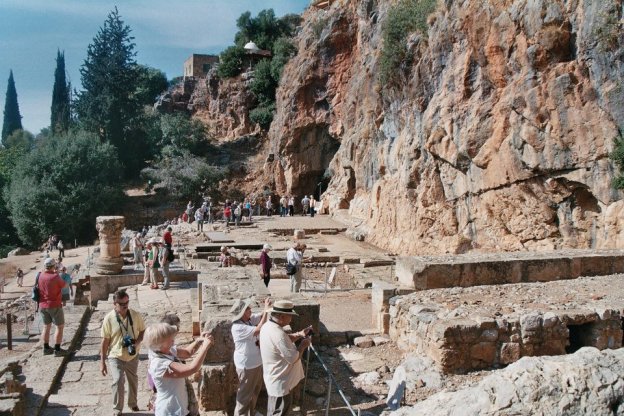
Jesus and His disciples are in the district of Caesarea Philippi. which is north of Capernaum, in the north of Israel, near the Syrian/Lebanon borders. Look at the cover of your bulletin, this is a temple of Zeus and Bacchus that was built by Philip the Tetrarch of this district. Philip was the son of Herod the Great, one of the few surviving sons. Since both he and his father owed heir titles to the Romans, they were careful to flatter the Romans to keep them happy and Philip built this temple to Roman Gods. Philip wasn’t exactly Jewish, he used his quasi Jewish status when it suited him and likewise switched to Roman “gods” when it suited his purpose. Philip married Salome, you might remember that Salome was the daughter of Herod and Herodias and after she danced for Herod asked for John the Baptist’s head. Yea, these people were more than a little messed up. Philip had enlarged the city and named it after Caesar and himself, which seems a little presumptuous. You can imagine, the Jews in this area hated Philip for his various offenses and saw this temple as a blasphemy, a sacrilege against their Jewish religion and they referred to this temple as the “Gates of Hell”. According to legend, this is where Jesus and the twelve disciples were camping when today’s reading took place. You can kind of picture them sitting around the campfire. Things are starting to come to a head, in the very next chapter the same Peter, with John and James are going to climb a mountain with Jesus and see Him transfigured and God the Father declaring Jesus to be His Son. For those who like to deny that Jesus is God the Son, seems pretty hard to dispute Peter’s confession, Jesus’ confirmation and then the Father confirming His Son. If Jesus isn’t God the Son, seems a big fuss is being made.
There are a few things going on in this passage and they might seem a little random.
Peter has his failures, and they’re pretty huge and he also has his high points, no question this is a high point. No doubt Peter is sure that this Jesus is someone pretty special. But when Jesus says “…who do you say I am”, Peter didn’t seem to hesitate. ‘Thou art the Christ, the Son of the living God.” Peter’s saying a few things here and this temple is the effective backdrop of this exchange. You are the promised one. Christ isn’t a name, it’s a title. The Hebrew word Mesi,an is the equivalent word of Christ or cristo,j which means anointed one. According to John MacArthur Mesian in the Hebrew: “refers in the Old Testament to prophets (1 Kings 19:16), priests (Lev 4:5, 16) and kings (1 Sam 24: 6, 10). In the sense that all of them were anointed with oil. This anointing symbolized a consecration for ministry by God. Jesus Christ, as the Anointed One, would be the ultimate Prophet, Priest and King (Is 61:1, John 3:34) … Peter declares his faith in Jesus as the promised Messiah.”1
Peter really stepped up and Jesus proclaims, “Blessed are you Simon Barjona, because flesh and blood did not reveal this to you, but My Father who is in heaven.” Jesus is saying that you are special Peter, God has chosen you to proclaim this, you know who I AM to the depths of your soul. Not because you had some great insight but because the Father chose you to declare that I AM the promised Messiah, the one who is the promised Savior of mankind.
Jesus builds on this, since you know this, I can also declare that I will build my church on your proclamation and the gates of Hell shall not prevail against My church. Church in the Greek refers to those who are called out, the Christian community of saints. Not just this building, or the Lutheran Church, all the saints, all those who are hagios, holy, separated people of Jesus, you.
If you look at this picture again, you might be able to tell that this temple has been carved out of stone, this whole thing is one big rock. So when Jesus says on this rock, on top of this pagan temple is where my church, my people will be. When I was there, hearing the tradition, I could almost see Jesus pointing over His shoulder. You see that big rock, that people here call the gates of Hell, my church is going to be built on this temple to false “god’s” and it will never prevail against My church, My church will always be on top.
I also took from this, that Jesus is making a direct reference to the idea that all false “gods” are of Satan. That all false “gods” are actually demons, evil spirits who have corrupted people to believe that they are “gods”. Jesus is saying that these false “gods” and we know that Satan is referred to as the “god of this world” John 12:31, 14:30, 16:11 will never overcome the Kingdom of Heaven.
In four more chapters Jesus will make His triumphant entry into Jerusalem to establish His victory over the world. He will be sacrificed then, He will die as payment for all of our sins and then will rise again in triumphant victory over sin and death. Sin and death are the very essence of Satan and His demons. They may rule the world now, but Jesus’ promise to His disciples and we are His … disciples, that in the end when it really matters He will defeat Satan and reestablish the world the way that God had created it.
In establishing His church, Jesus begins to empower His church. His church will possess the keys to heaven on earth. This means He has given His church the authority to declare what is sin and bind that sin. No other institution has that authority, only the church of Jesus, which the Lutheran Church certainly is. Our authority is based on Scripture and we bind or loose based on God’s Word. Because of God’s Word, we know what God has already bound, who He has locked heaven against. We are simply declaring what has been bound, and in a sense, enforcing that binding from what God has declared.
The world may try to deny the authority and even the legitimacy of the church, but Jesus has certainly declared the church’s authority in this passage. The church, made up of those who are separated, declared holy, will be those who have not just authority, but also responsibility to be the instrument of God’s will.
To those who ignore the church, deny the church has any real meaning, Jesus is clearly establishing His church. The disciples, represented by Peter, have recognized who Jesus is and that He is the promised One of God. He is the anointed One, anointed Prophet, Priest and King and now Jesus has established His church and declared that His disciples make up that church and they have the authority to represent Jesus. As His apostles, His sent ones they, and us, will do the things that the church is responsible to do, to declare the will of Jesus in the world. For those who think that “worship” is on the golf course or the beach, Jesus is saying these people are my church, they will lead in worship, do the work of the church. Anything else will only be personal preference and idolatry.
Take some time this week to think about how that looks, what does that mean to the world? Certainly it is proclaiming the Gospel, He who died to pay for our sins and who rose to give us the only way to eternal life. It is also going to those who are living a life that rejects Jesus and chooses to only be concerned with their own desires. The church is the institution that Jesus empowered to baptize, to be His instrument to bring people into the Kingdom of heaven. His church has been given the responsibility to offer the life saving Blood and Body of Christ. His church is responsible for preaching His proclaimed Word so that all will be able to hear the Good News of forgiveness and salvation in Jesus. Take some time to think of how that should look to the world as we exercise that authority here at First St Johns.
The peace of God which passes all understanding keep your hearts and minds in Christ Jesus. Shalom and Amin.
All the Lord’s people prophets

We make our beginning in the Name of God the Father and of God the Son and of God the Holy Spirit and all those who know the power of the Holy Spirit said … AMEN
The feast of Pentecost is the oldest continuous celebration that Christians observe. Reason being it was originally a Jewish festival that God directed Israel to remember going all the way back to Deuteronomy 16:10. It is originally referred to by Yahweh, as communicated to Moses, almost what we would think of as Thanksgiving in the United States. Israel was to raise up thanks to Yahweh for the “first fruits, the first harvest”. God reminds Israel: “I gave you a land on which you had not labored and cities that you had not built, and you dwell in them. You eat the fruit of vineyards and olive orchards that you did not plant.’ (Joshua 24:13) Israel would have a lot to be thankful for. The Israelites had to fight their way in, but when they made it, there is ready made homes, fields, vineyards. They had to make their way into Palestine/the Promised Land, but Yahweh intends that when they get there, they will be set, they will be free from the paganism they escaped from in Egypt and that surrounds them and they would be able to provide for themselves. Pentecost was also a day to remember that Yahweh gave Israel His Law. The Law is what Israel is built on. Jewish people believe that they are saved by the Law, so Pentecost is to celebrate what they perceive as their salvation in the Law. In response there was only continual griping. God is providing them with manna to live on, He gives them water, He gives them the Law, He gives them the promise of a fruitful life in the Promised Land and what is their response? “We are still in the desert, we’re sick of this manna and we don’t want to go to the Promised Land because we are afraid and we just don’t trust your promises.” So God hears the griping, He gets angry, that means Moses gets angry who whines to God and Yahweh tells Moses to bring the 70 elders of Israel together for a huddle. Moses is fed up with the complaining and so Yahweh promises: “Then I will come down and talk with you there. I will take of the Spirit that is upon you and will put the same upon them; and they shall bear the burden of the people with you, that you may not bear it yourself alone.” (Numbers 11:17) Life is not a bed of roses for Israel, but they are about to see the fulfillment of God’s promises. Considering everything God has promised them it’s a life that’s not to shabby and their response is to continue to fuss and whine.
Take out your bulletin. Look at the Numbers reading verse 25. “Then the LORD came down in the cloud and spoke to him [Moses], and took some of the Spirit that was on him and put it on the seventy elders.” What do you notice about “God’s Spirit”? It’s capitalized, a proper noun. “What” you say, “this is 1,500 years before the Holy Spirit descends on the disciples, what’s going on here?” Yahweh gave Moses the Holy Spirit probably right from the start of His revelations to Moses. William Wrede describes it: “…the Lord comes down in the cloud and gives them a gift. The same gift of the Spirit given to Moses is now shared with the seventy. Moses loses none of his gift, but as one candle lights another, the Spirit is given to each and they all begin to prophesy. This is God’s gift to his people to be a blessing to others.”1 I really like that imagery, while the Holy Spirit didn’t descend upon the Jews in the desert the same way He did on the disciples in Jerusalem, the outcome is still the same. Men possessed by the Holy Spirit and led by Him to prophesy. Clearly a preview of the Christian Pentecost here in the Sinai desert 1500 years before Jesus. These two men, Eldad and Medad, apparently didn’t check their e-mail or got caught in traffic, and didn’t make it to the elder’s meeting at the tabernacle and they are back in the camp, but the Holy Spirit doesn’t miss them. Joshua rushes to Moses to rat them out, contrary to expectation Moses is not at all disturbed: “Would that all the LORD’s people were prophets.”
Fast forward 1,500 years, we see a stark contrast. Where Israel had God’s promises of material satisfaction in Israel, they had the tangible tablets of the Law, and some of them even had the Holy Spirit. We find Jesus’ disciples huddled together in a house in Jerusalem. While everyone else in Jerusalem is probably out, celebrating the third most important feast-day in Judaism, the disciples probably still have a “bunker mentality”, they remember Jesus’ promise, ten days earlier: “…you will be baptized with the Holy Spirit not many days from now… you will receive power when the Holy Spirit has come upon you,” (Acts 1:5, 8) OK, fine, but when will that happen? In the meantime, “we’re going to hide out here, our Shepherd’s gone, no doubt there are people who want to arrest us and are looking for us. Until such time as Jesus does what He promised and we have no idea what that really means”, maybe they don’t remember Numbers 11, “we will make ourselves very scarce.”
Hiding away, cowering. Certainly an odd contrast to their ancestors who are standing out in the desert heckling Moses, demanding immediate satisfaction. The disciples are together, they are trusting in Jesus’ promise, they don’t know how that will happen, but in faith they wait. Their faith is rewarded, probably beyond anything they imagined: “…a sound like a mighty rushing wind..” You’ve probably heard people describe an on-coming powerful tornado,… they often say it sounds like an approaching freight train, concentrated power and fury. Can’t we imagine the Holy Spirit’s approach being at least like a freight train? The Greek is pneu,matoj a`gi,ou in English we have the word pneumatic, as in pneumatic tool, how is a pneumatic tool powered? … Compressed air, we have tools that use the power of compressed air. In Hebrew the word is x;Wr [ruach] which also means “wind, spirit”. Both usages imply momentous power. This wasn’t just a sudden burst of wind, but an enormous, continuous blast, a strong enough blast that all these people in Jerusalem, our reading says “…devout men from every nation under heaven..” rush together, “bewildered”, what is this noise! We don’t rush into the street at any random burst of wind, we might take a quick look out, but normally we don’t pay anymore attention. Then “…divided tongues as of fire appeared to them and rested on each one of them” Now that we have your attention, you will hear us preach in your native language. This is all the work of the Holy Spirit, a clear demonstration that God is at work, the Holy Spirit inspires Peter to preach in a way he would never have before (this is the same guy who didn’t want to talk about Jesus to a few people after Jesus had been arrested. Now Peter is proclaiming the Gospel to thousands.) From this Peter is used to bring three thousand souls to know Jesus as their Savior.
Remember they are here to celebrate the “Feast of the First Fruits” those who God chose to come to faith are now the “First Fruits” of the Christian church. Philip Schaff notes: “This festival was admirably adapted for the opening event in the history of the apostolic church. It pointed to the first Christian harvest … We may trace to this day not only the origin of the mother church at Jerusalem, but also the conversion of visitors from other cities, as Damascus, Antioch, Alexandria and Rome, who on their return would carry the glad tidings to their distant homes…”2
We who are chosen by God to be saved in Christ, baptized in the Name of the Father, Son and Spirit, disciples and apostles of Christ, we are called to proclaim Him just as the disciples did on the Festival of First Fruits. We are called to proclaim Him in the language and understanding of those we know, being used by the Holy Spirit to reach those He has put in our lives to point to the Lord Jesus Christ and the salvation that only He can promise. Take some time this week in prayer, help us Father to feel the power of the Holy Spirit in our lives and to live that life in Him and to the world. The Spirit’s power in the wind, but to also pass from you to those He leads you to, like a candle lighting another candle. And also as our young men are “lighted” by the Holy Spirit in recognition of their confirmation today.
The peace of God which passes all understanding keep your hearts and minds in Christ Jesus. Shalom and Amin.

Memorial Day is also praying for peace, but there is only peace in Jesus

Peace, never in the world, always in Jesus
First St Johns May 24, 2014
We make our beginning in the Name of God the Father and in the Name of God the Son and in the Name of God the Holy Spirit. And all those who know the peace of Christ said …AMEN
Peace, when we think of Memorial Day, we really don’t think in terms of peace, we think in terms of loss, of death, of valiant sacrifice for a cause. Simran Khurana is quoted as saying: “On Memorial Day, pay a tribute to the sentinels of peace. Sing praises of the brave soldiers who marched forth on unfriendly terrain, come rain or snow, so that we could sleep peacefully knowing that our country is safe.” To be sure we should think of our American soldiers as those “sentinels of peace”. With a couple of disquieting examples America has been the sentinel of peace, at least peace in the worldly sense. Our fellow Americans have been sent abroad in the hope that their efforts would bring world peace. World War II would be the brightest example of those efforts. As a result many countries had been helped to recover from economic depression and the devastation of war to establish societies that have grown in peace and prosperity. Through history countries have conducted war thinking that they will be able to neutralize threats to the peace and establish a peaceful climate. Gordon MacDonald notes: “In its largest sense, it [peace] describes any system in which there is order, justice and security. The Romans talked about peace (Pax Romana), but their system was sustained through violence and intimidation. The Jews of Jerusalem had their own concepts of peace: a kingdom that mirrored the ancient reign of David. [which was founded and maintained by military force]” So we take from these examples of countries that set their ideas of peace on, “so long as you do what you’re told you won’t get hurt. Step out of line and you will be violently slapped down. Otherwise have a nice day.” The One we call the Prince of Peace was crucified in order to maintain control. Remember the chief priest’s word, “this man must die in order for the nation to survive.” That plan really didn’t work out as Jerusalem was reduced to rubble 40 years later, by the Romans in order to maintain “peace”.
Believe it or not, I am sensitive to the fact that people want to hear the pastor say all sorts of gratuitous nice things, tell everyone that it’s ok, that things will work out according to their plans. Frankly in a worldly sense, I’d feel like Kevin Bacon at the end of Animal House in the midst of a frantic, fleeing crowd, he’s standing there in his official ROTC uniform screaming: “Remain calm, all is well, remain calm.” In a worldly sense that entire scene is total fiction, all is not well. Of course we have to remain calm, but to proclaim that all is well in any sense, regardless of the economy, politics, education all is not well and never will be.
We talk about peace, but for too many of us Christians we have bought into the world’s idea of peace, which will never happen, or we cherry pick Jesus’ quotes and convince ourselves that there will ultimately be some kind of world wide utopia. In the world’s sense it will never happen. What does Jesus say about the end times, in the Gospels and in Revelation? They will be enormously violent times:“ESV Revelation 6:4 And out came another horse, bright red. Its rider was permitted to take peace from the earth, so that men should slay one another, and he was given a great sword.” The Holy Spirit has maintained “peace” in the world. When that peace is removed in Revelation 6:4, those who are still in the world will see violence on a scale never before seen, even in the most violent episodes of history. The evil of man will truly show itself and all those who have been in denial of Christ and His peace, those who thought they were somehow entitled to any and all kind of peace and prosperity, on their own terms, will be left in the middle of terror and poverty. While they ignored Jesus and relied on their own means, they will find that what they trusted on earth, does them no good when God removes His protecting hand. There is no peace with man, in the entire 5,000 year history of the world, there has only been about 100 years of genuine peace. Man does not understand peace, he will never be able to bring the earth to peace and when God removes His hand at the end of time, the entire concept of peace will fall under the horrors of man’s inhumanity to man.
Many of you here have seen that inhumanity. Those in the world like to point out the times when Christians forgot Christ and took things into their own hands. The crusades, the Inquisition, the Salem witch trials. They conveniently seem to ignore the twentieth century, a time when government shoved God out of the center stage and the result? The bloodiest century in the entire history of man, bloodier then all the previous centuries combined. For a lot of you here today you have seen some form of imperialism, some form of fascism, most of us have seen communism and we are witnessing “Islamo-Fascism” in many countries of the world today. When we saw the Berlin Wall come down, too many thought that this was the beginning of world peace, about a decade later a jetliner smashing into the World Trade Center sparked a war, in at least two countries, that has lasted almost fifteen years. I’m not being a pessimist, I am being very much a realist in Christ.
MacDonald notes: “Jesus said his peace was not compatible with the “world’s” view of peace (John 14:27) “Peace I leave with you; my peace I give to you. Not as the world gives do I give to you. Let not your hearts be troubled, neither let them be afraid.” MacDonald also notes that “Paul referred to this as ‘the peace of Christ.” There should be no doubt in your mind that as in everything else, the peace of Christ is far different from what the world sees as “peace”.
I do love you, all of you, you are brothers and sisters in Christ, that is a really good thing. There is no better way to love another then in Christ, because in the eternal resurrection, it will be all about how we love another in Jesus. Too many like to equate it to “I’m a member of the Loyal Order of Buffalo and I love our fellow members.” Being a Christian isn’t a club or fraternity or some benevolent society. When I tell you I love you in Christ, as part of the Body of Christ, in the Fatherhood of God, that is a peace, a love that is forever, deeper than any corruptible, earthly emotion. It does not mean the superficiality of the world, it is a promise of Christ for true peace: “My peace I give you … don’t let your hearts be troubled,” There is nothing, no one, no where, on earth that gives you this true assurance of peace. There is a whole lost world out there, it blames everything and everyone, except themselves, for the lack of peace. The evil of humanity will never be overcome in the world. If anything it will become more evil and more violent.
In the violence and greed of the world we have to remember Paul’s words: “ESV Philippians 4:11 Not that I am speaking of being in need, for I have learned in whatever situation I am to be content. 12 I know how to be brought low, and I know how to abound. In any and every circumstance, I have learned the secret of facing plenty and hunger, abundance and need.13 I can do all things through him who strengthens me.”
There is only one peace for the world, that peace is, has been in Jesus. We call Him the “Prince of Peace” and so He is, the peace that will be eternal, a semblance of peace we have in the world now. But Jesus knew that there was no peace on earth and never would be and told us straight out: “ESV Matthew 10:34 “Do not think that I have come to bring peace to the earth. I have not come to bring peace, but a sword.” The world rebels against Christ and like the Pax Romana believes that peace will prevail in our own way. The world can’t get Jesus right, it certainly doesn’t get “peace” right. You and I, we do have peace, we have it right here, right now. This is a peace that you cannot give to someone else, even in the middle of the violence, the greed and poverty, the hysteria of the world, I can quote Kevin Bacon and you can know calm and peace in the middle of all the hysteria. I can say: “Remain calm, all is well, remain calm.” Because in Christ we do know peace in any and every circumstance. All is well in Him.
At this Memorial Day I want to remember Petty Officer Nathan Bruckenthal, the only Coast Guardsman killed in the War on Terror. Please keep his wife Pattie and his daughter Harper in your continued prayers.
No doubt as Christians we are to continue to pray for peace, but with the expectation that true peace will only be realized in Christ and in His return. We who are in Him know true peace and we want to let others know that true peace is in Him. Share that reality with all you those you know.
The peace of God which surpasses all understanding keep your hearts and minds through Christ Jesus. Shalom and Amin.

The Dying Word

First Saint Johns

April 9, 2014

This is from Concordia Publishiing House “Words of Life from the Cross” series

SERMON: THE DYING WORD (LUKE 23:46)

The sixth word is Jesus’ dying word, a word of committal, a word of trust. His dying words are faithful, full of trust in His Father, trusting that in His death His Father will receive Him in loving arms just as the father of the prodigal received his son with open and welcoming arms. Here again is the paradox of faith. Jesus had cried out in abandonment, “My God, My God, why have You forsaken Me?” and yet now He cries out in faith, “Father, into Your hands I commit My spirit!”
Isn’t that how it is with the life of faith? God seems so distant at times, especially those times of darkness and woe, those dark nights and days, and yet He stands ever near to embrace us in those strong, loving, fatherly arms. Jesus trusted His Father, and He did it on behalf of all of us. His trust is complete and unwavering. Though He dies, yet He trusts. Though He suffers, yet He trusts. Though the Father is silent and hidden, yet He trusts.
But take note of something—this dying word is not sighed or whispered. This is not a weak word of resignation by a man who is overcome by death. No. He shouts this word in a loud voice. He summons His strength and shouts it to the highest heavens. He wants the whole world to hear what He has to say. He is the Son of the Father, begotten and beloved from all eternity. He trusts His Father’s mandate that sent Him on this mission to the cross.
Jesus is not overcome by death. Rather, He overcomes death by dying. “O death, where is your victory? O death, where is your sting?” (1 Corinthians 15:55). Jesus has taken the sting of death and the venom of the Law into His own flesh, shed His own blood, and now He cries out in victory and triumph as He commits His life to the Father who sent Him. This strong word of the cross cuts through your doubt and disbelief. Adam’s death is conquered by this Second Adam’s death. Adam hearkened to the doubting word of the devil and became a transgressor, plunging the world into the chaos of sin. But this Second Adam, the new head of redeemed humanity, holds true to His Father and will not waver even as He dies. His life is in the hands of the Father.
With His final breath, Jesus shows Himself to be the faithful Son. Where we have failed, He has succeeded. Where we have sinned, He has proven sinless. Where we doubt, He remains strong.
Being self-absorbed and self-oriented, the old Adam in us resists this surrender. It fights like crazy against the loving embrace of the Father, like a small child throwing a temper tantrum who will not be held. We want to be in control, we want to be in power. We resent any notion that we sit not in the driver’s seat, but in the passenger’s seat of our lives. Like so many drowning victims, we think we can swim to shore ourselves. We do not need a lifeguard; we even resist the attempts to save us. We want it all on our own terms.
You know how it is in your own life—the bargaining, the denial, the transactions—anything but letting go and leaving to God our Father to hold us in safety. Jesus does it. On the cross, He entrusts His life, His mission, His death, everything to His Father. “Father, into Your hands I commit My spirit.”
The words are from Psalm 31. The psalms are the hymnbook of the living and the dying. Jesus takes up the words of David on His lips, for they are His words, too, wrought by the Spirit of Christ in David.
In you, O LORD, do I take refuge;
let me never be put to shame;
in Your righteousness deliver me!
Incline Your ear to me;
rescue me speedily!
Be a rock of refuge for me,
a strong fortress to save me!
For You are my rock and my fortress;
and for Your name’s sake You lead me and guide me;
You take me out of the net they have hidden for me,
for You are my refuge.
Into Your hand I commit my spirit;
You have redeemed me, O LORD, faithful God.
David, surrounded by his enemies, commits his life into the hand of God. Jesus, the greater Son of David, hanging in the darkness with the burden of humanity’s sin hanging heavy upon Him, commits His life to His Father. In committing Himself into His Father’s hands, He entrusts us as well, gathering all into His death that we might be gathered to Him in our death.
In Luther’s day, people were quite intentional about writing down their last thoughts and confession. What you said at your death was what would be remembered about you. This is Jesus’ last word of His being humbled unto death in obedience to the Law. This is the last word of His work that began with His Baptism where His Father voiced His approval over His beloved Son. Now at the end of His mission, His work completed, the Scriptures fulfilled, the redemption of the world accomplished, He closes His eyes and breathes His last breath with a faithful, trusting word.
Remember these words when it comes time for your last words and make them your “now I lay me down to sleep” prayer. Father, into Your hands I commend my spirit. Say them each night, as the Small Catechism instructs, in case you should die before you wake. Hold the cross of Jesus before your closing eyes, and rest in peace and joy, knowing that death has been swallowed up in the victory of Jesus’ death.

For Your last triumphant cry, for Your faithful trust to the end, for Your final breath of the old creation, for Your entrusting Yourself and us to Your Father, we give You thanks and praise, most holy Jesus. Amen.

Please cllick on the following link for a audio recorded version of this sermon


Jesus married? No….

The following is an article from the Huffington Post, which is not a credible source of much of anything, no less history, religion, philosophy. If you want inflammatory headlines, you definitely want this, and not credible journalism. At the very best I would describe the following as disingenuous, at best complete ignorance of any of the applicable scholarly subject. So read this and then I have my comments following:

“An ancient, business-card-sized papyrus fragment that appears to quote Jesus Christ discussing his wife is real, Harvard University announced Thursday. The fragment caused international uproar when it was revealed by a Harvard historian in September 2012, with prominent academics and the Vatican swiftly deeming it a forgery.

Harvard officials said scientists both within and outside the university extensively tested the papyrus and carbon ink of the badly aged fragment, dubbed the “Gospel of Jesus’ Wife.” The document, written in Coptic, a language of ancient Egyptian Christians, is made up of eight mostly legible dark lines on the front and six barely legible faded lines on the back. The handwriting and grammar were also examined over the last year and a half to confirm its authenticity. Scientists have concluded the fragment dates back to at least the sixth to ninth centuries, and possibly as far back as the fourth century.

The document was never meant to prove Jesus was married, Harvard Divinity School professor Karen L. King emphasized Thursday. Instead, she argued, it’s meant to highlight that some early Christians may have believed Jesus was married. The distinction is significant because debates over sexuality and marriage have dominated contemporary discussions about Christianity; the Catholic Church cites Jesus’ celibacy as one reason its priests must not have sex or marry.

“The main topic of the fragment is to affirm that women who are mothers and wives can be disciples of Jesus — a topic that was hotly debated in early Christianity as celibate virginity increasingly became highly valued,” King, whose specialties include Coptic literature, Gnosticism and women in the Bible, said in a statement Thursday. “This gospel fragment provides a reason to reconsider what we thought we knew by asking what the role claims of Jesus’ marital status played historically in early Christian controversies over marriage, celibacy, and family.”

The legible lines on the front of the artifact seem to form a broken conversation between Jesus and his disciples. The fourth line of the text says, “Jesus said to them, my wife.” Line 5 says “… she will be able to be my disciple,” while the line before the “wife” quote has Jesus saying “Mary is worthy of it” and line 7 says, “As for me, I dwell with her in order to …”

“The main topic of the fragment is to affirm that women who are mothers and wives can be disciples of Jesus…” First, of course women can be disciples of Jesus’. Any who are in Jesus should be His disciples. Who ever said they weren’t? You really have to reread this article with a critical eye.

Because this is an ancient document does not make it factual, the Bible is an ancient document, based on Bible copies going back to at least the 5th century (around the same time as this fragment) we know that the Bible we have today is very well documented. Why is this one fragment credible, and a document (the Bible) that can be traced back to the earliest times not credible?

The proponents of this are trying to say that the rap against this is a forgery. I haven’t read anyone that takes issue with whether it’s a forgery or not, the issue is whether it’s credible. Anyone could write something to be found hundreds of years later, the fact that it was discovered doesn’t make it fact. We are supposed to change all of history, theology because one scrap of paper was found??? Really!!! We have credible evidence of Scripture and writers dating back to the beginning, in straight succession to today. How does one unassociated scrap of paper change anything? During this period there were other writings that have shown to have no basis in fact. My fun example is always the “Gospel of Judas”. Help me out folks, the man was a traitor, he ran off and hung himself, and he still had time to write his gospel? Actually “gospel” means “good news” in Greek, so in Judas’ case it’s “not so gospel”. I don’t know? Fact is there are a lot of people out there with an agenda, with little scruples who will try to make a case out of anything they oppose. Also please note, this was written in Coptic. The language Jesus and His apostles spoke was Aramaic, essentially all their writings were in Greek, which was the common academic language of the time. Coptic is an Egyptian language, relatively speaking, israel and Egypt were a long ways a way. Why something written in a language that had nothing to do with Jesus’ contemporary life, at least four hundred years after Jesus, is being given any kind of credibility is, again, a mystery to me. A scrap of paper, in Coptic no less, doesn’t prove a thing, doesn’t change a thing. Someone back in that time wrote down their opinion, in a country very distant from Israel, and as far as I can tell would have no reason to have any first hand knowledge of Jesus’ life at all. Now Matthew, Mark, Luke, John, Peter, James, Jude, did and they don’t mention anything of the sort. Well yea, I guess we’re going back to fiction in the DaVinci Code. Hey Dan Brown said it was entirely fiction, yet we have people who worship his book/movie. Yea, don’t try to confuse me with the facts, just tell me what I want to believe.

What you need or what you want? Often a big difference.

I’m just going to go for this. It may seem that I am trying to antagonize people, I’m not, I’m really not. But on the other hand, I’m really trying to push people to really look at their relationship in Christ and the church, if any, that is supposed to be discipling you in a real relationship with Christ.

I am sure that you are all smart enough to realize that you need to trust, rely on and get the right information from the people you hire to do the job, whatever job they do. Oh yeah, I think we all know the type of person who can surround themselves with “yes-people”, we also knows what happens in most of those situations, hmmm let’s see Ken Lay of Enron and Dennis Kozlowski of Tyco jump immediately into my head. I’m sure we all know it wouldn’t take long to come up with a long list. We know that most of the time those kind of people ride the vessel down to disaster. You expect your lawyer, accountant, CIO, to give you the most prudent advice, to be successful, but to also trust that their practice is in keeping with real doctrine and teaching. Every profession has doctrine and teaching, however we also know that a lot people kind of make it up as they go along, it’s the same in “churches”.

It occurs to me that you should also have that kind of faith and trust in your pastor. It’s always been a mystery to me why people will


insistImageon the most expert direction in other parts of their life, but when it comes to your eternal soul, uncritically turn to clergy who they know will tell them what they want to hear, as if church only functions to make them feel good. There are times when it is entirely appropriate to comfort, it’s always appropriate to give the hope of Christ as Savior. But as Paul teaches Timothy: “All Scripture is breathed out by God and profitable for teaching, for reproof, for correction, and for training in righteousness,  that the man of God may be competent, equipped for every good work. I charge you in the presence of God and of Christ Jesus, who is to judge the living and the dead, and by his appearing and his kingdom:  preach the word; be ready in season and out of season; reprove, rebuke, and exhort, with complete patience and teaching. For the time is coming when people will not endure sound teaching, but having itching ears they will accumulate for themselves teachers to suit their own passions, and will turn away from listening to the truth and wander off into myths.
As for you, always be sober-minded, endure suffering, do the work of an evangelist, fulfill your ministry.” (2 Timothy 3: 4:1-5)
Timothy is a student of Paul’s, being trained for ministry, what Paul is teaching Timothy, well, we are there. We’ve been there for a long time and I will readily admit, the church has been its own worst enemy, clergy are all too often more concerned with telling people what they want to hear, taking the path of least resistance, that too often people see that as the way church is supposed to be, and it’s been happening for decades, probably at least since the 1950s.

Ya, I’ve probably said this ad nauseum but if you went to your doctor do you want him/her to tell you the truth, or pat you on the head and send you away with “don’t you worry about that cancer”. We all have a cancer, it’s called sin. It eats your soul up just like cancer eats your body. It’s the clergy’s job to tell you this and not let you die in your cancerous state, smiling and comfortable the whole way down. Seriously, you run into a pastor who, figuratively speaking, pats you on the head and tells you to your face, ‘don’t you worry about that sin thing, that’s so old-fashioned”, I suggest you run not walk and find someone who will help you deal with reality. Anyone who has the slightest clue knows full well that we all have sin issues.

Let’s be honest, you work in the world, you know when you have to confront reality in your work. Isn’t it time to deal with the reality of that vacuum in your soul? You know the reality of your sin, the reality of Christ dying for you, the reality of Him controlling your life and not you. But you keep putting it off, avoiding it. Your spouse, your children? And ya for guys, you know it’s on you. You don’t get your life together, so you give the rest of the family, let’s use the political phrase, “plausible deniability”. Yea, cute, but are you living up to your responsibility as a husband and father?

Yea, it is the church (that is the wrong churches that are out there) and many are not providing the teaching and guidance it should. But you’re the one who is leaving your critical thinking at the door, you’re buying into it and even, uncritically, precipitating it. You are uncritically accepting what you get and not looking critically at what is being taught and practiced. Do you run your business that way? Why on earth would you trust your eternal soul to someone who won’t sit down with you, look hard at your life, get you to think critically and eternally? Instead, you trust someone who just smiles, tells you what you want to hear and sends you on your way. Does that make sense?

It does kind of amaze me you get these smart/tough business types: “I want the straight story from everyone. I want to know how it is!” But they then expect their pastor to give them some little puff-piece as if the Christian thing really isn’t true, but “I’m paying for someone to magically make it true” (i.e. the pastor is supposed to work out everything for me. Yeah, right?) Huh, really? I guess your world is reality and church just there to throw in your money and you get  what you want. If that’s what you really think, I would take a really hard look at your life as a whole. Salvation is in Christ, Christ established His church, Matthew 16:18, in His church is baptism, His Body and Blood, others to disciple you, and those for you to disciple. In His church is the Word of salvation through His Word in the Bible, and His preached Word through His Ministers. It’s His way, it’s not throw in your money and get what you want. It’s to learn to get your life in line with your Savior, being guided by the Holy Spirit, that’s reality! Do yourself a favor and get to First St Johns, sit in a pew and listen (promise you don’t have to talk to anyone) and I don’t care if you throw in a dollar or five hundred. If you feel I’ve really wasted your time after a couple of months, I will happily pay you your $8 back.

Business people love to tell you how hard core they are and how serious they are “Just the facts mam”, market share, ROI, EPS, my personal favorite EBITDA, analyzed financial statements for twenty years, can throw around all the jargon you can imagine. Hey that is important and I liked the challenge of the corporate world. But the ultimate reality isn’t production, cycles, financials, .WSO/DSO, market share, it is your eternal soul. Let’s start dealing with the ultimate reality and live your life in that reality.

First St Johns is at 140 W King St in York, Pa. Worship is at 10:30, before that we have our “Coffee Break Bible Study”, Wednesdays at 10am at the corner of W King and Beaver Sts. So come on down, see what you’re missing in your life, in your family’s life, OK, I’ll buy you coffee! May God richly bless you.

Hi, my name is Jim and I’m a sinner

Gordon MacDonald in Leadership Journal (winter 2014 p 29) writes about his experience attending an Alcoholics Anonymous meeting, I haven’t finished the article, but immediately I see so many parallels to what church should be:

“I was no sooner seated than the people on either side of me introduced themselves … and expressed gladness that I was there.” Shouldn’t that be what happens at church, a new person sits down and those around him/her make him feel welcome? “In fact, before the hour ended, four men, one after another handed me cards and said, ”I’m John, here’s my cell number. Call me anytime, and I’ll come and meet you if you need a friend.” What can I add to that? I also like that the meetings get right to it, no messing around, no one more quick word with your buddy. We are here for a reason, let’s get to it and do it.

MacDonald takes his turn to speak and tells them (since he’s not an alcoholic he doesn’t say “I’m an alcoholic”) but just says it’s my first time here. The response is “keep on coming, keep on coming”, he says that is said in the same way in church we might say “‘Praise the Lord”. He also notes as the others speak “change does not come easily, but it does come.” This is the same as church, as being a Christian, you do not automatically become right up to snuff, but God takes you, using the Body of Christ, the people there who make up Christ’s Body and begins to change you, begins the process of being more Christ-like. That is so great, everyone there encouraging the person “to keep coming, keep coming.” My take away is that we are all glad to be here, we are glad you are here, we look forward to knowing you better, and being good disciples. So don’t stop now, you’ve only begun!

No one feels they should somehow “chose”, AA , like the church, it is what it is and has stood the test of time. It’s not catering to the new generation or some secular fad, both have proven that when people become serious, about a serious form of worship (read liturgical) the church has been leading people to Christ and feeding them in this form of worship for centuries. Trying to make it into entertainment or buddy-buddy doesn’t move you closer to Christ doesn’t leave you in awe of a great, all knowing, all powerful God who can make real changes in your life, really can lead you into new life in Christ and will ultimately lead you into an eternal resurrection. When you have brothers and sisters in Christ they sometimes become closer to you then family. They are there to help you and guide you. They know that they are just beggars who know where the bread is and help others . They are excited to see you there and want to help you as much as possible. AA, like the church, isn’t there for your convenience or your comfort, it’s there to actually make you feel challenged, a little outside yourself, a feeling that there is so much more and I’m missing it and I’m also messing myself up more by not taking it in and growing in it. (After all the only alternative is the sinfulness, a lost, dead world)And it’s also there to make you very aware of what everyone else needs, for the Church everyone needs Jesus and we in the church have to understand that and look for what our individual role is in helping others to know Him as Savior and Lord.

When there’s someone new, go over and meet them, no pretense, no stuffiness, just simply an attitude of: “this is someone who the Holy Spirit has brought here to worship and since the Holy Spirit has put that person near me, then I have to greet that person as a brother or sister. Excited, enthusiastic (but not obnoxious), looking forward to what God has in store for us, and letting them know that just like any good brother or sister, I am there for them, that I look for what the Holy Spirit has for me to do in that person’s life. Isn’t that great? What an adventure!

Mystery of the liturgy

The Study of Liturgy (editors: Cheslyn Jones, Geoffrey Wainwright, Edward Yarnold SJ and Paul Bradshaw)

OK, over the introductions, Image

I think one of the biggest beefs with “contemporary” Christianity (CC) and frankly I really don’t take it seriously as “Christianity”, but OK, let’s not fuss at this point. But CC has this obsession with making Jesus out to be our buddy, our friend, “Jesus my co-pilot”). Come on, it’s cheesey, it’s phoney, and it’s just not true.

Jesus loves us, He did an incredibly manly thing through His life, suffering and sacrifice, but He is God! Therein is one of the mysteries of Christianity. How can God be man and God? We want it to be familiar and buddy/buddy, but it simply isn’t, it just isn’t. The church is the Bride of Christ. I would compare being that bride with our worldly marriage. Done right, marriage is a mystery, we come together, pretty much strangers, God brings us together to make us one-flesh. How? We don’t know, but, again when done right, we are brought together with a mysterious person, and as we grow together that other person usually remains a mystery. In God’s leading, the marriage relationship will probably be the closest relationship we will ever have. There is no biological relationship, but in Christ we are brought together in a mystery, a relationship so close, but we can’t really say why it is that close.

Other mysteries are of course the Trinity, baptism, communion (Lutherans teach that we receive the true Body and Blood of Jesus in communion), the redemption of mankind. We can go on and on, but true Christianity is very much wrapped in mystery: “…the NT term ‘mystery’ is not a cultic term and most modern exegetes do not see it as borrowing from the mystery religions. None the less, it has a long history in liturgy, especially in the Roman liturgy,..Keeping to purely NT (New Testament) sources we can see that the mystery exists on three levels:

1. There is the mystery that is God ‘dwelling in light inaccessible’ (1Tim 6:16) and in a plenitude of love that is always giving itself, always being communicated from Father to Son and Holy Spirit and back again. This love God freely communicated outside himself first in creation and then in the redemption so that all could share in it.

2. The mystery, as we have seen, exists in the historical order as we read in 1 Tim 3:16, Christ is the mystery of God: …

3. The third level at which the mystery exists is the liturgy . It is concerned with past events, the saving work of Christ, but it is not concerned with them as past. It seeks to bring about an encounter between the worshippers and the saving mystery. If an event is to be experienced, it has to be experienced as present. As Dom Odo Casel liked to say (and apparently Kierkegaard before him), Christ has to become each one’s contemporary. This is perhaps best expressed by Leo the Great, who in a  sermon the Ascension said: Quod … redemptoris nostri conspicuum fuit, in sacramenta transivit  (what our Redeemer did visibly has passed over into the sacraments). He is considering how, after the forty days of Christ’s resurrection-life, he was lifted up to remain at the right hand of his Father until he should come again Now all that he did in his earthly life is to be found in the sacraments, the liturgy that he and his hearers were celebrating.

Let us take two other examples from the Roman liturgy if only because the word ‘mystery’ is used. an ancient prayer for Holy Week asks that what we are doing in mysterio we may lay hold of in reality. The second is a collect for Good Friday, when the major part of the service consists of words (OT, a Pauline epistle and the singing of the passion according to St John). There is no Eucharist, simply the giving of Holy Communion from the reserved sacrament, and after it we pray: ‘Almighty and merciful God, you have renewed us by the blessed passion and death of your Christ preserve in us the work of your redemption (operis misericordias) that by our partaking of this mystery we may always live devoted to your service’. These texts and a hundred others that could be cited show the Church’s conviction that when Christians celebrate the liturgy they encounter Christ in his passion, death and resurrection and are renewed by it.

What, then, is the particular significance of the use of ‘mystery’ in this third sense? First, it is a link between the past and the present or, rather, it looks to the past to recover the power of the primordial event and makes its power present in the here and now so that the worshipper can encounter the redeeming Christ. What gives it a particular quality is that it does this through symbols which manifest the presence and activity of Christ and, because they are the sacraments to which he committed himself, he through them can convey the saving power of his passion and resurrection. The liturgical mystery can be seen as l’entre deux mondes, and that is part of the difficulty in understanding it. It is not simply an historical event (through its celebration takes place in time), and it certainly does not seek to reproduce historical events. It will have nothing to do with the allegorizing of the writers of the ninth and subsequent centuries,… nor is it sufficient to say that he mystery is a way of remembering the past, … By the liturgical mystery we are actualizing the past event, making it present so that the saving power of Christ can be made available to the worshipper in the here and now…(pp 13-15)

Christianity is in fact wrapped in mystery, it’s not an effort to be familiar with the Creator and Sustainer of the entire universe, it’s to glorify Him, to worship Him, be in fear and awe, not to be His buddy. This is the whole point of liturgical worship. Dr Martin Luther talks about the deus Absconditus “the hidden God”. We have revelation, what God intends us to know, and is there any doubt that what He revealed to us, is a tiny scintilla of what there is to know about Him. We worship in mystery, we worship according to the guiding of the Holy Spirit in a time honored way of ordered worship, intended to strengthen and fortify us for another week, to confront the world in Christ, an alien, secular, sinful, sick, depraved world. We do that in the mystery of faith, we do it in the mystery of being saved in Christ, His baptism, His Body and Blood. We don’t do it being happy and clappy “Jesus is just alright by me, Jesus is just alright”, as seen by those learned theologians the “Doobie Brothers”. But through another mystery of Christianity, through the liturgy, our omniscient, omnipotent, omnipresent God brings us into real time with the incarnation, the trials of Christ, the crucifixion and of course the resurrection. This is not a reenactment, the Roman practice of the sacrifice at every mass is incorrect. What Jesus did once in Jerusalem has power for all eternity, the sacrifice/redemption of Christ has power for all times, it is through that mystery of the liturgy that we are brought into the very act, once and for eternity.

This is through the liturgy, this is through the faithful serving of the sacraments, through confession and absolution. People gathered together being entertained, conducting discussions about “how to be better”, or some kind of intellectual dissection, or jumping around, can be inspiring, get you all pumped up for Jesus. But it is through the liturgy, time tested through the centuries that bring us into the presence of all the mysteries of being a Christian, a disciple, an adopted child of God the Father. Jesus isn’t my “buddy”, He is the all powerful Savior, Redeemer, Lord of my life, through Him all creation came into existence. I don’t need Him to be my “buddy”, as with any strong leader, father-figure there is an element of mystery, a degree of separation. With Jesus it is almost entirely wrapped in mystery, the mystery of Jesus is that we take His Body and Blood, but He is also so far above, and exponentially so much greater and powerful that me. That is a great thing, my Savior, my Lord is so much more powerful then anything in creation and yet He died for me, He knows everything about me, but only through the liturgy are we put back into that presence of time, place and familiarity.

Church, liturgical worship a new/old paradigm

The church is not the world. Whether or not the world can be the church? Yeah, probably not, but for the world to try to force the church, or worse yet for the church to capitulate to the world is not acceptable. The more the church tries to conform to the world the more irrelevant the church becomes.

That simply cannot happen, the church is not the world’s, it’s not the pastor’s, it’s not the people’s who “built” it. They may have raised the money for the brick and mortar, the ornaments, the furnishings and they can take pride in what they’ve done. But a Lutheran will always say it’s not what I’ve done, it’s what the Holy Spirit has done through me. The church building is the outward symbol of the Christ, it should be the way it is to stick out in the world as that physical landmark, that bright light of Christ into a dark world. But as Luther points out, there is the “visible” church, it’s of the world, but it’s not necessarily the church that will be the be the Bride of Christ. It is a place where people can come to spend time in worship, by themselves or corporately. I love it when people come in, people I know and I don’t know and ask to spend time in the chapel. The church is where the pastor is, I welcome people who come in and say “I need to talk”. It’s a place where the pastor can be called out to tend to someone, a member of the church or not, any time. Where do you find a place like that in the world? You don’t! The motivation is serving God, by serving people. Glorifying God by serving people to the best of our ability. With a few exceptions, the world is not motivated that way. So the building is a highly visible symbol of God’s presence in the community, but the church, the Body of Christ is the people who know Jesus as Lord and Savior and come together to worship in that building.

The church is an entirely different paradigm. As the pastor of a old and glorious church I know what it’s like for a person to walk into the narthex and get a hint and then turn the corner into the sanctuary. It’s not a “oh, that’s nice” kind of coo. It’s more of an intake of air and “wow” in some form, getting that little hint of the Glory of God. The paradigm is this; it’s not about you, it’s not about what you “like” or what makes you comfortable. It’s about the glory of God, it’s about you realizing how insignificant you are, and how magnificent, all-encompassing, all-powerful God is. It’s not to assail your self-esteem or hurt your feelings, it’s to get you to realize it’s about far more then you. That’s a good thing. I don’t want the universe to be about me, to think that it revolves around me. Sorry, but truth be told, that is exactly what too many people think. There are people whose attitude is I don’t want to think about something far more powerful, far greater and glorious because that would make me feel bad about myself. When you really understand what you are in relation to God and how glorious He is and how that is to your benefit, being the creation of an omniscient, omnipotent, omnipresent, transcendant God, that the universe is under control, we should feel empowered through Him, not themselves. We have a God who has given us promises and an entire paradigm through His Word, Scripture, that should give us security and assurance that these things will play out the way He has promised. He created all things, He controls all things, He sustains all things. It’s going to happen the way He decides. Yes, we can get off the bus anytime, where does that leave you? Dead, cutoff, condemned. If you reject God, you condemn yourself. There isn’t a second choice.

The world’s paradigm tries to convince you that there’s just a whole multitude of choices, so long as that choice isn’t Jesus. Part of those choices is church “your way”, nice and comfy, happy/clappy, you leave church all bouncy/bouncy. But after awhile you realize how fleeting and phoney it is, that it’s work and not really worship. There’s no assurance, no real supernatural power, just you being entertained. Henry Blackby writes: “


If you find that Christianity exhausts you, draining you of your energy, then you are practicing religion rather than enjoying a relationship. Jesus said that a relationship with Him would bring rest to your soul. Your walk with the Lord will not make you weary, it will invigorate you, restore your strength and energize your life.”

All the “entertainment”, appealing to the world, that takes a lot of day in/day out effort, it becomes all about what you do, instead of what God does for you in worship. Will that wear you out, drain you? Of course, it’s not about coming to God, facing the altar, lifting our hands up to Him, it’s about your efforts, the pastor’s efforts, the musician’s efforts, the creative director … blah, blah. No wonder people don’t take the church seriously, it’s not about coming before God, it’s about a new production week after week. There’s little about God working on you and a lot about all the things we do for a new whiz-bang wahoo.

So the point is this, we cannot come into church and take the paradigm of the world in with us. Everything is different for a reason, it is to take you out of the world and point you to something timeless. Something that is valid and compelling today as much as it was 2,000 years ago and will be compelling and valid until Jesus returns. It connects us to Christians all around the world and for all time. The sanctuary should be something that evokes a “wow”, makes you draw in your breath makes you a little about the glory of God. The symbols around you are there to remind you that you are link, a part of the history the church, you are part of that visible church, in my case a building that’s been around 140 years and, God’s will, will be part of well into the future. There’s a cross, at First St Johns there are stain glass windows of the first disciples, of Martin Luther and, rather oddly, CFW Walther, the first president of the Lutheran church in the United States. There are timeless representations of “All Glory to God”. There are representations of bread and wine, the Body and Blood. There is Jesus the Lamb, Jesus crucified, Jesus’ ascension and Jesus ruling in glory. All of these are representations that would be known to the Acts Christians and will be known, again, until He returns. These are all intended to remind you that you are not in the world, that you have come into Jesus’ church, you are connected to the Body of Christ.

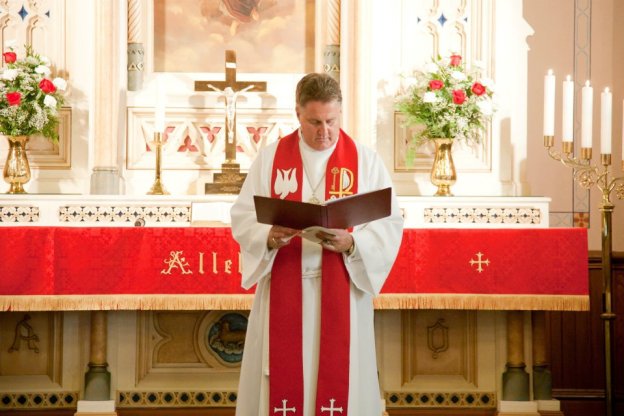
You see a man in a plain white robe, around his neck is a stole the color representing the season of the church, usually with different Biblical symbols and represents the “yolk of Jesus”. That he is there to be the voice and face of Jesus to the congregation. I’m not Jesus, but I’ve been ordained to be His minister, His representative. I am the one charged with maintaining the spoken Word, teaching about Scripture, administering the timeless sacraments. Baptism that actually washes away sin, the Lord’s Supper that is His actual Body and Blood for the forgiveness of our sins. That plain white robe is intended to separate me, not to be more or less special, but different, separated.

We come to Him on terms that have guided worship through the ages. I and other men who are not concerned about our media presence, like others in their $600 suit or the other ridiculous extreme, t-shirts and holes in their blue jeans. There were and are men who were focused on worship on coming to the Father on His terms to honor, glorify and raise Him up. Coming to Him in our weakness, with nothing in our hands only raising to Him in prayer. Not trying to force my music on Him, but to take in everything around us and remember ‘be still and know that I am God.”

Church is not the world, stop trying to force the church into world’s mold. God is in control both in the world and in the church, but it is the church that saves to eternity. Anyone who thinks that there is any permanence about the world is just not dealing with reality. What we see today, even in ten years will be different. God’s kingdom has been and will always be, and that is the paradigm that we should encounter when we go into worship. It’s not about you, it’s about God, any other attitude is idolatry, that is you are putting yourself above God. It’s not about your likes, dislikes, tastes, your preferences. It is about coming in with a reverent spirit, what is the Holy Spirit going to bring to us. Can it seem repetitious? Yes, but again for a reason. When you encounter the trials, when you experience hardship, what do you want running in your mind, what is the background program in your soul? All happy-clappy, everything is beautiful? Or is it what you have heard in worship, “In the Name of the Father and the Son and the Holy Spirit”, “as it was in the beginning is now and will be forever, Amen.” The Apostle’s Creed, the Lord’s prayer. When, not if, you encounter tragedy in your life, do you want the background program in your soul being the latest staged production at the church of “it’s all about me”? Or do your want it to be “Lord have mercy, Christ have mercy, Lord have mercy”?

God tells us in Isaiah 55:8 “For my thoughts are not your thoughts, neither are your ways my ways, declares the LORD.” (ESV) We keep trying to drag God down to us, to make Him answerable to us. Instead we need to aspire to ever higher worship, coming before Him with empty hands and open hearts. Ready to hear the true Gospel. Frankly I’m not really interested in people leaving worship happy, or feeling good, or entertained. Frankly, when I write a sermon, I usually feel convicted, sometimes I think I’m just writing to myself. There’s no doubt that the Holy Spirit is guiding my sermon. Thoughts, references, pop into my head seemingly out of no where. I want to preach God’s Word, I want to be guided by Him. No one wants to hear my thoughts, they come to church to hear God’s Word preached. “Our way” says that I should be there to please my listeners, to “tickle” their ears, make them like me. Which are things that God’s Word warns us/me, away from. I’m there to preach His Word. I welcome anyone to challenge my exegesis and how I present/preach on Scripture. If I am wrong, I sincerely want to know, sometimes I do miss the target. If people leave happy and have been truly spiritually fed, fine. If they feel comforted, that’s good, because God’s Word should comfort. But if I feel convicted after I finish a sermon, I have to believe that there are others who will feel convicted by the sermon. How about feeling compelled, or inspired? When people walk by me and shake my hand, I hope that I see a look of determination, that others may be as convicted as I am, a look of going back into the world with the Holy Spirit guiding me, that more and more I am His and less of me.

Too many times people buy in to this attitude that “God owes me”, because of what they did, or who they are. Essentially anyone who passes by me in that church will encounter trial or tragedy. If they are not prepared for that, if they can’t come to terms with the fact that the Christian life is challenging, that there will be trials, then anything that rocks their world could leave them bitter, disconnected and possibly rejecting God. If they have a great life, great! I hope all do. But Jesus promises us that the world hates Him and will hate us. A Christian in the world, in general, will often have a more difficult life. In order to cope with that, the Christian needs that different paradigm. It can’t be the world’s paradigm because frankly the world is just going carelessly on its way to destruction. The Bible promises that. If you don’t believe that, you should reassess your understanding of the Bible. The Christian paradigm has to be one of understanding that it is all to the glory of God, it’s not about us and our entertainment, it is to be strong in Christ in confronting life and the world and we need to worship that way, God’s paradigm, not the world’s.