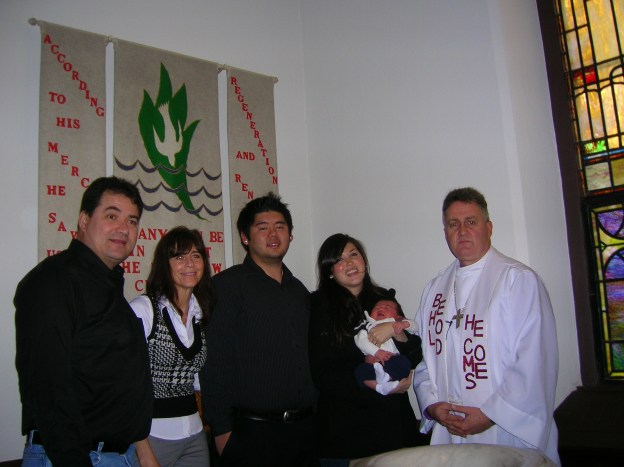
Tag Archives: baptism

Baptism, Death, Eternal life all in Jesus First Saint Johns, January 11, 2015 Luke 2:21

Please click on the above link to hear the audio of this sermon

We make our beginning in the Name of God the Father and in the Name of God the Son and in the Name of God the Holy Spirit and all those who have died to the world in baptism and have been reborn in Jesus Christ said … AMEN

I want to start by remembering our brother Sam Null who went to be in the presence of the Lord. Sam’s funeral will be this Friday here at First St Johns. We pray for Norma and their son Sam and we praise God that Sam is free from suffering and in the presence of our Lord Jesus Christ.

As you see in today’s introduction to worship, I will be saying the words that I say in a funeral. We Christians do not live In fear of death. We died that day we were baptized. We are still in the world when we are baptized, but now we are no longer of the world we are reborn in Christ. This is another area where we are at odds with other Christian belief systems. Other Christians see baptism as sort of an initiation into the faith, a public act, on their part, in accepting Christ. For Lutherans, we see baptism as our new birth, where, when I baptize someone the Holy Spirit is using the words I say and the act of pouring the water as a way to, as Dr Luther would say, to drown the old person and from that the new person in Christ is reborn.

It’s been a really rough week, heck for me as a pastor, throw a bout of flu into the mix of Advent, two Christmas Eve worships, Holly Tea, German Christmas worship, a wedding, a few deaths, it’s been a tough last few weeks. Death has been a very real presence just in the past few days. My Aunt died up in Maine, the Rev Dr Mike Ramey’s mother died in Texas, a fellow pastor and classmate’s mother died, we said farewell to our bother Rev Don Biggs a few weeks ago, we had other funerals this past year of brothers and sisters in Jesus. But here is the upshot, here is the Gospel, the Good News. All of them “died” in Jesus. Yes, they aren’t here with us in the body, but we know for sure, because we have the promise of Jesus Christ, that all of these brothers and sisters are now in the perfect bliss and comfort of heaven, the very real presence of our Lord.

How can we be so sure of this? Was it because of something they said or did? No! We have many Christians who believe that it’s all about them, it’s all about what they do or don’t do. One of the main reasons we baptize babies is to emphasize our understanding of what baptism is. Baptism is when we are called by the Holy Spirit to come into the new life of Christ. It is not a decision we make to “accept Jesus”. Doesn’t it really seem presumptuous to think that it’s our decision to be saved? “Oh, okay, I’ll accept Jesus as Lord, well because I can and I’m going to. I will walk down the aisle and make a declaration for God.” I’ve had more than one person tell me that after making some sort of public declaration of accepting Jesus, they did not feel as if they really knew salvation. I often hear that there is this doubt, that they might have done something wrong, that somehow it wasn’t enough, wrong time, wrong way, etc. In our baptism into Jesus it is not about what we do, it’s not about how we do it, when we do it, why we do it, yada, yada, yada. It’s about the fact that we have the knowledge and assurance that we were called to be baptized, we were called to be saved, we were baptized in the Name of Father, Son and Holy Spirit and by that, the Holy Spirit brought you to salvation in Jesus. The Holy Spirit took you up out of the depths of your baptism and gave you the new life, made you the new person in Jesus. It’s not up to you, it’s not your call and that is why, for Lutherans, it is about baptizing babies. I am certainly not saying you have to be baptized as a baby. Certainly God decides when we come to know Christ and that is not always as an infant. I wasn’t baptized until I was in my mid-twenties, I’m sure there are others here who weren’t baptized as babies and others who haven’t been baptized at all. I pray that those who are adults and haven’t been baptized, that God is leading them through the words that He has given me for you to come to new life in Jesus. But I want to make this very clear, it’s not about your decision, it’s not about you making the call. You may have some idea that you don’t need to be baptized, or that you are somehow unworthy. Heck I’d like to know who here, me included, could ever be worthy enough for new life in Jesus. I’ll tell you who, no one, not you, not me, not anyone who hears this is worthy. We are not saved on the basis of whether we are worthy. Sola gratia by grace alone are we baptized. The grace of God, His forgiveness of us, His desire, not yours, not mine, to save you in Jesus. There are no mistakes in God, if you have not been saved in the waters of baptism whether you are 8 months or 80 years you are saved only by God’s grace and united with Jesus in His death through baptism. His death, His sacrifice, His atonement on the Cross that saved us. So no, you are not worthy enough for baptism and neither am I, no one is.

Jesus was baptized and He was baptized as an adult. Why? He was baptized by John the Baptist, John was designated by God to baptize Jesus in the way and at the time that He was baptized. No, Jesus didn’t need to be baptized, but as Jesus lived the life that we live, that He came down from heaven, born as a baby, He identified with us in every way and part of that is to be baptized. We are baptized because He was baptized, we are saved because He sacrificed His perfect life, the life that He lived as a man in complete perfection, a life that we could not live, He lived in order to be that perfect sacrifice, that perfect price to be paid for the payment of all our sins. More and more in the world, you will meet people who feel that baptism is unnecessary or that they are not worthy. You have to know that God is going to speak through you to them for them to hear that they need to be baptized, they need to be saved in the baptism that Jesus had in order to be saved. Paul tells us in today’s reading: “For one who has died has been set free from sin.” OK, sure, after you die you can’t sin anymore. How does that help us during our earthly life? Because Paul gives us God’s promise: “Do you not know that all of us who have been baptized into Christ Jesus were baptised into His death?” We are free from sin because we have been baptized, we have been brought into new life by the Holy Spirit by the act of baptism. Do we still sin in our life? Yes! But those sins are forgiven, we are freed from those sins. Paul says: “We were buried therefore with Him [baptism as being buried in the waters of baptism] by baptism into death, in order that, just as Christ was raised from the dead by the glory of the Father, we too might walk in newness of life.” (Rom 6: 4) We have newness of life in Jesus through our baptism in Him. It’s not about us, we will continue to live and sin, but we turn it over to God, we repent and ask for His forgiveness. We should also ask for His power to overcome our sin, but we are saved in what He has done for us. We may have been a baby when we were baptized, but as that baby, we are brought by faithful parents, who have heard God’s Word, have known the urging of the Holy Spirit and faithfully bring their child to the saving waters of faith and new life in Jesus. Paul gives us these great promises: “Now if we have died with Christ [that is the death and rebirth of baptism] we believe that we will also live with Him. We know that Christ, being raised from the dead, will never die again; death no longer has dominion over him… So you also must consider yourselves dead to sin and alive to God in Christ Jesus.” What an incredible promise, what an incredible assurance. All those that we have lost, we know that they are very much alive, saved completely by what Jesus did for them in His life, death and resurrection and our baptism in Him. We too have that promise and that is a promise that we need to share with anyone we know who still does not know Jesus as Lord. It’s not what they’ve done, do or will do, it’s entirely what Jesus has done for us. He was baptized to identify with us and He gives us the promise of forgiveness and eternal life in Him in the baptism in the Name of the Father, Son and Holy Spirit.

The peace of God which passes all understanding keep your hearts and minds in Christ Jesus. Shalom and Amin.

The faithful telling of the Bible

It seems to be easy lately to think that the there is just a remnant of Christians, only a few that are left to raise up God Father, Son and Holy Spirit. But then a long comes an event or a message that demonstrates that Christians are very much alive, faithful and active.

Case in point the production of the television series The Bible produced by husband and wife Mark Burnett and Roma Downey. I will qualify this upfront by saying that I really did appreciate The Bible that it really was a faithful portrayal of the Bible. It always amuses me when people call the Bible ‘boring’. That is biblical illiteracy. If I can be a little tacky, the Bible has it all violence, intrigue, sex, infidelity, charity, faithfulness, sacrifice, integrity, pride and strength. The Bible has good, bad, somewhere in the middle, ordinary people confronting extraordinary circumstances. The last thing I would describe the Bible as is boring. One of the things that always annoyed me was the way different people/beings of the Bible have been portrayed in movies and media. Jesus always seems to be sort of soft and prissy, and that just could not have been the case. He was probably a carpenter, He spent so much of His earthly ministry outside, traveling around, even out on the boats with some of His disciples. There is no doubt in my mind that Jesus was very much a manly man and nothing in the Bible contradicts that. Another is this idea that angels are sort of beautiful, poofy women. Again that is not biblical. Any description of angels in the Bible depicts them as male. The depiction in the television series of angels as more like ninjas would be a lot more faithful to the biblical narrative.

Angel in The Bible Does kind of create an interesting contrast with Ms Downey’s portrayal of an angel in the television series Touched by an Angel 

Forbes Magazine did a feature on the couple and their production of The Bible and future productions based on the Bible. Their success, that I would consider a lot more biblicaly based, then most contemporary productions (yea, just ask me about Noah ugh), anyway “The Bible made its debut in 2013, and even on a relatively esoteric cable channel was able to outdraw the networks; at one point Burnett had the No. 1 show in America five nights out of the week. And viewers couldn’t get enough: The Bible has sold over 1 million copies via DVD and Blu-ray….the movie spinoff, which Burnett and Downey spent an estimated $1 million to bankroll, has done $68 million worldwide…” (Zack O’Malley Greenburg, Dorothy Pomerantz  Forbes Magazine July 21, 2014 pp 55 – 60)

Clearly a faithful rendering of the Bible, not too pious, not too imaginary (yea like Noah) are greatly in demand. God’s story is the most compelling ever: “There are not a lot of books being read these days’, says Paul Telegdy, NBC’s president of late-night and alternative programming. ‘But there is one that’s being read and reread, and that’s the Bible.”

Burnett points out that a lot of contemporary television and movies are biblically based: “…he says take their dominant influence from the world’s most popular book: Lord of the Rings, The Chronicles of Narnia, The Matrix.” The Matrix??? I guess he’d know better than me. Point being is that too much media has either dumbed down the Bible, or made it too sugar coated or made it to ham handed, none of which are faithful renderings. Straightforward, human portrayal of the Bible is what God inspired the writers of the Bible to write and that has what guided the faithful for 2,000 years. There is plenty of hunger in the world for the real Bible. Let’s faithfully teach, preach and relate the Bible. The Holy Spirit will use that to lead and inspire others, we don’t need to embellish what was perfectly inspired by God.

Holy Communion continued I

My Christian background is a little odd, although more and more it’s becoming common among younger generations and is not out of the question with in my “baby boomer” generation. I was dedicated as an American Baptist (“Baptists” don’t baptize infants. Parents “dedicate” their children, promising that they will raise their child as a Christian in the Baptist Church.) I was married by a “Congregational” minister (it’s now called United Church of Christ). I was baptized by a United Methodist Minister and ordained by a Lutheran minister. I cannot say I was “raised’ as a Christian, no less in any particular tradition. I’m not saying that based on my checkered past that I’m an expert on various traditions of the Lord’s Supper, but my experience might give me a little bit of a unique perspective.

To be clear, yea, I have a firm conviction about the Lord’s Supper, I’m very serious about the Lord’s Supper. Lutherans would agree with Roman Catholics that the Bread and Wine in the Lord’s Supper is the true Body and Blood of Jesus. There’s disagreement as how that’s arrived at and dealt with, but just to give you a place to start to understand what the church’s position is. Having been a Methodist, I’ve seen the Lord’s Supper treated more like a cookie and coco break during worship, I’ve seen it treated pretty cavalierly in other traditions too, it’s offensive, it’s really offensive, it’s the Holy Body of our Lord and Savior.

I know I’m kind of stacking the discussion, but Jesus told us: “Take, eat; this is my body.”, Not this is a symbol, this is something I’m doing to be chummy, this is some weird mystical thing. No this is My Body, this is My Blood. This is what has been sacrificed for you, this is what has been given to be a part of you, this is what was given in order to assure you I paid the price for you sin and you are now forgiven, there should be no doubt in your mind about this.

OK? Don’t think there’s a lot of room to maneuver. When we treat the Body and Blood less than that, then it’s hard to take seriously those who treat His Body so lightly. For those of you who are so easily offended, this is real offense, mistreating the true Body and Blood of your Savior, the One who died to pay for your sins.

Rev Dr Peter Kurowski has written a really great book “Close Communion Conversations”, discussing issues associated with the Lord’s Supper. Since different denominations have different perspectives on the Lord’s Supper, most denominations try to specifiy with whom it is appropriate to allow to share communion with outside the denomination. For most of Protestant Christianity all you have to do is profess some acceptance of Christ and be able to fog up a mirror. Lutheran Church Missouri Synod takes our most solemn sacrament very seriously and, I feel at least, that it should be treated seriously by everyone, regardless of church or lack of church.

Therefore I refer to Dr Kurowski’s book to discuss the concepts of “Open Communion”, “Closed Communion” which are the two contrasts, and “Close Communion” which Dr Kurowski labels the middle ground.

Open Communion in the extreme is the notion that the Lord’s Supper is administered to all people who come to the altar without any due diligence on the part of the administering pastor. This is not how Jesus wants His supper distributed. (1 Corinthians 4:1; Matthew 28: 18-20) Such a position is reckless and loveless. It creates Corinthian confusion. Church bodies that run this direction invariably will lose a true gospel centeredness lapsing into lawlessness. The person of Christ is diminished and “It is finished!” is rarely heard by the famished (John 19:30).”

Closed Communion” in the extreme is the notion that the Lord’s Supper is administered only to people who are communicant members of a denomination that has publicly declared altar fellowship. Though well meaning, this brittle approach is a reproach to many a saint who comes to the Lord’s Table hungering for righteousness but is met with a stone wall rather than a cup of compassion. The damage done when one’s position is too narrow is chilling, devastating and at times causes irreparable harm turning the Church – a hospital for sinners – into a kind of “Club Christ”, or a “Christ who clubs!”

Close Communion Conversations” seeks to pursue the good golden gospel middle of genuine evangelical theology on altar fellowship issues…The guideline in service of the gospel runs this way: Although we have as a general rule closed communion we have exceptions to the rule. Both the general rule and the exceptions to the rule are for the sake of the gospel. At the same time the exceptions ought not t become the rule.”

“Because of this evangelical guideline, I prefer the term close communion. It captures the theological tensions in which evangelical Christianity must live. It brings with it a paradoxical Lutheran edge.” (pp 9-10)

This sets the discussion and I want to emphasize that when in doubt, my preference is to have “closed’ communion. I’ve written about this before, but it is not to set some sort of “more worthy Christian”, but to assure that the recipient truly understands and accepts a correct understanding of what the Lord’s Supper truly is. I often tell those who are new to the Lutheran Church that we don’t want them to feel excluded, we want them to understand how seriously we take the Lord’s Supper, that it is for their spiritual health. As a member eligible to receive the Lord’s Supper a person stands before the church that, as a part of membership, they vow to accept the true understanding of what the Lord’s Supper truly is. I want to give people the Lord’s Supper, believe me it is one of the great parts of being a pastor. But I want to do it to the recipients spiritual health and nourishment and knowing that we both understand what we are doing.

Please feel free to discuss and I plan to have more discussion.

Remembering our sin in preparation for the Child First St Johns November 30, 2014 Isaiah 64: 1-9

For the audio version of this sermon, click on the above link, or copy and paste it into your web browser. Thank you and God bless.

We make our beginning in the Name of God the Father and in the Name of God the Son and in the Name of God the Holy Spirit and all those who prepare for the coming of the Son in the new liturgical year said … AMEN!

Happy New Year, sounds a little weird, aren’t we supposed to have Christmas first and then have New Year? Today is the first Sunday of the church New Year, the time of Advent, the time where we wait in anticipation, our whole life is a time of waiting in anticipation of the coming of Jesus in the clouds of His power and glory. But for now we wait on the feast, the celebration of the coming of the Christ child. The Advent of His Kingdom in the world. We joined together in the Apostle’s Creed to remember that He will come again, to judge both the living and the dead. Those who have died in Christ will be raised to the resurrection the eternal Kingdom, the New Jerusalem.

Isaiah says “Be not so terribly angry, O LORD, and remember not iniquity forever. Behold please look, we are all your people.” (Is 64:8-9) Ya, Isaiah is addressing the Old Testament God. Remember Isaiah 6? Isaiah is raised into the presence of God: “Woe is me, I am a man of unclean lips… for my eyes have seen the King, the Lord of Hosts!’ (Is 6:5)? From the beginning of Isaiah to the end, our reading today, Isaiah is readily acknowledging the fact that we are sinful and unclean, we are simply not suitable to be in the presence of a pure, holy, God. Clearly God has revealed to Isaiah that we are sinful and there needs to be a solution to our condition. Yahweh makes it very clear to Isaiah that the sacrifices of Israel; rams, bulls, lambs, just doesn’t cut it. Read all through Isaiah 1: 10-15. But then what does God do? He promises that they will be made as white as snow… our sins will be like wool, nice and white, cleaned, made pure. He makes it very clear all through Isaiah’s book that we are sinful, and Isaiah is completely aware of his own condition. Imagine being brought straight into the presence of our completely holy God, just being overwhelmed by His holy presence, His Holy being and our being, the complete opposite, totally depraved and sinful. It must be an overpowering experience. Many people demand that God come into their presence, we couldn’t begin to cope with that, we would be consumed by our sinfulness in contrast to His holiness, we would be completely blown away and that’s why God won’t do it.

Until we completely internalize Paul’s words in our epistle reading: “I give thanks to my God always for you because of the grace of God that was given you in Christ Jesus… who will sustain you to the end, guiltless in the day of our Lord Jesus Christ.” ( 1 Cor 1: 4, 8) Only in Christ are we guiltless, that we can then be in the presence of the Father, totally righteous and holy, but only through our baptism-new life, we are made holy, we don’t have to be reduced to the fear and disgust that Isaiah felt. In Christ, in the Father’s presence we are lifted up to joy, we can rejoice. I have no doubt that it will be an overwhelming feeling of love and freedom in Christ, in the Father’s presence.

Isaiah is making a plea for restoration. He has been made completely aware of how unworthy he is, how unworthy we all are. Isaiah is no better or worse then we are, none of us is any better or any worse. Isaiah is making this plea that we can be restored. In what way are we restored? We can now be in the Father’s presence, we are no longer separated from Him, alienated from Him. We are alienated from Him because we are aliens in relation to Him. No we aren’t green or odd-shaped, we don’t have antenna’s in our head, but our nature, as Isaiah has been made profoundly aware of, is totally opposite to His. He is completely holy, completely perfect, we are imperfect and deeply sinful. Walter Roehrs in the Concordia Self-Study Commentary writes: “Isaiah devotes the remainder of his book to correct two misconceptions his hearers and readers are prone to harbor about the way God wants to lead them to glory.” I might add that this is the way we think today, probably more so, then what the people in Isaiah’s time thought. “It is a fatal mistake on the one hand, to … walk with God with one foot, and with the other to stalk through the sewer of sin.”1 That’s the way we think today, “I’m good enough, I haven’t killed anyone, there are others much worse than me.” So we continue to live our lives in this mind-set that I can give God what ever I decide and He has to take what I give Him and deal with it. God is not a half-way kind of guy, it’s His way or no way. How the world comes to another conclusion totally baffles me. Why should a perfect, holy God be happy with some scraps that we throw Him, bring us into His presence and just allow whatever phony, mooshy, sentimental whim we chose over His perfect being? Why would He let our lusts and greed overcome His Holiness. Through our sin, we’ve messed up what God created, away from Him, cutoff from Him. He drove Satan out of heaven when Satan presumed to be better than God, why would He let us in to do the same thing Satan did? He’s not and if you think otherwise, you’re only kidding yourself. Dr Roehrs writes: “Isaiah had to set Israel straight [and by extension us who are now Israel] on both counts. He [Isaiah] foretold certain disaster for a sinful nation, a people laden with iniquity’ and so depraved as to lift ‘hands … full of blood’ to the Lord in a pose of prayer.” (Is 1: 4, 15)2 That’s us, and that’s not going to work in the presence of God the Father, but in Christ we become cleansed and pure and suitable enough to be saved to eternity in God’s salvation in Jesus.

Isaiah is acutely aware of the human condition in relation to God: “We have all become like one who is unclean and all our righteous deeds are like a polluted garment. We all fade like a leaf and our iniquities, like the wind, take us away.”

So what now, what needs to happen. Can we do anything that is going to make us closer to God, to make us more desirable, more deserving of being in His presence? No… But earlier in his book, Isaiah knew that God was going to move, to do something. It was going to take about 700 years, for us that would be intolerable! We want the solution, we want it now and well, if you can’t make it happen on our time table, we’re just going to have to get ourselves a new “god”. But in God the Father’s time, it is perfect, complete, not a band-aid fix, an eternal, complete, perfect fix: “For to us a child is born, to us a son is given; and the government shall be upon his shoulder, and his name shall be called Wonderful Counselor, Mighty God, Everlasting Father, Prince of Peace.” (Is 9:6) I like what David Johnson says: “…Advent is not just anticipatory of a saccharin sweet nativity story, but bona fide bitter judgment against sin! Heaven and earth collide and are mingled in Jesus! God and man! Jesus is wrapped in human flesh; the world is wrapped in divine grace…”3 The seasonal color for Advent is usually blue, although purple is acceptable also. What other season is purple the seasonal color? Lent. The blue, and some say it’s bluish-purple, is a symbol of waiting, it represents Mary waiting with the rest of the church for her child. But the more traditional color is purple and like Lent means a time of repentance, in the sense of preparing for the coming of the Savior in repentance, being prepared for Him by repenting of our sins. That’s why we don’t normally sing Christmas carols, which are celebration, we are faithfully preparing and repenting so that in the Christ Child we are saved and we spend the Christmas season in joy and celebration. Spend the Advent season raising up your sins for forgiveness, clean out your heart, like you clean your house on Shrove Tuesday and you will be prepared to receive the child on Christmas Day as we receive the risen Christ on Easter.

The peace of God which passes all understanding keep your hearts and minds in Christ Jesus. Shalom and Amin.
1Roehrs, Franzman Concordia Self-Study Commentary p 490

2Ibid

3David A Johnson Concordia Journal Fall 2014 p 322

Sheep protected and led by the Great Shepherd First St Johns, York, Pa. Ezekiel 34: 11-16, 20-24 November 23, 2014

to listen to the audio of this sermon, please click on the above link or copy and paste into your browser

We make our beginning in the Name of God the Father and in the Name of God the Son and in the Name of God the Holy Spirit and all those who will be together in the glory and plenty of eternity in Christ shouted out … AMEN

Our readings today are about eschatology, these are eschatological studies, don’t try saying that at home, I’m a trained professional. I’m thinking in terms of the ultimate Thanksgiving. You think you need a big kitchen table at your house for Thanksgiving? Think about how big God’s table is going to be that He will need for His promised time of life in the Resurrection. “And I will bring them out from the peoples and gather them from the countries, and will bring them into their own land. And I will feed them on the mountains of Israel.” (Ezekiel 34:13)

If you’ve ever been to Quincy Market in Boston, there is a restaurant named Durgin Park. This restaurant goes back to the turn of the 20th century and if you’re in the right parts, well you can tell how old it is. They have great seafood, they have great prime rib, lots of other dishes, but here’s the deal, it’s served to you family style. You don’t have little tables all around, you have big long tables and you just grab your seat. There’s no maitre di, no pretense, you get a menu on the way, grab your seat, order your food and while you wait get to know the people all around you. It’s one reason you go there. It’s not for the service, the wait staff seems to make it their mission to see how uncomfortable they can get you, the food is great, like I said the atmosphere is early 20th century, but it’s great food, in an “interesting” facility. There are plenty of other people around you and you all know you’re there to meet people and you do, very little in terms of being bashful. Get a great dinner, stay for awhile, you have to because there’s so much to eat, and enjoy the impromptu goings on.

This is what it will be like at the dinner that God is promising Ezekiel. Being invited to the White House for dinner is a series of hoops and rolls, waiting, anticipating. How will the feast that God is talking about happen? “I myself will search for my sheep and will seek them out… I will rescue them from all places where they have been scattered on a day of clouds and thick darkness…” You won’t be expecting anything and then you will be in His presence and He is going to give you the ultimate offer you can’t refuse. Durgin Park’s food is good, but how much better, how much more, how much more fun will the feast, the banquet at the end of time be? The ultimate open menu; You want New England Lobster, here it is. Cheasapeake Bay crab cakes? The best you’ve ever tasted. Chicago prime rib? New York City pizza, … what, huh? Really pizza, at the marriage feast of the Lamb? OK, you got it.

He promises us that we will be with people scattered from all places. Places that for a day were cloudy and dark, that’s where we are right now. Life…, in terms of eternity? It’s a day, it’s over before you know it, life is not reality, the resurrection is reality, this is eternal reality. You may be in those dark, cloudy places where you know you don’t belong. Not because you’re good or too smart or even unworthy, you’re there because He took you up, the Father saw His Son in you. Jesus came to you and said “Come, you who are blessed by my Father, inherit the kingdom prepared for you from the foundation of the world.” (Matt 25: 34). You will be there for one reason and one reason only and it has nothing to do with anything you did, it’s all about how you were saved by Christ. You were saved in baptism, you became that new creation in baptism, you were faithfully led by the Holy Spirit to worship, to take the Body and Blood of Jesus. Those small bits of bread and wine, His Body and Blood, are only a reminder of the immensity of what you will inherit, of what the Father will bring you to “…the kingdom prepared for you from the foundation of the world.”

In our passages today God is showing you the ultimate Thanksgiving Day feast. You didn’t do a thing for it. Moms, you aren’t going to cook, you aren’t going to serve, you aren’t going to clean up, you will be there with Christians from around the world, rejoicing with each other that you are saved, that you are eternally going to enjoy all the great gifts of the resurrection, the new world, the world the way it was intended to be, life and life more abundant. Abundance you can never imagine in the here and now.

A friend of mine had relatives in Lithuania, his parents were from Lithuania. My friend took them to the grocery store and when they got inside and saw all the marvelous food just waiting to be taken off the shelf and put in the shopping cart they were so overwhelmed some of them actually started to cry. That will be us when we’ve been rescued from the clouds and darkness of the world and brought to the marriage-feast.

I know for many people this may not sound initially inviting, you will be sitting with people that you may have never met, Christian brothers and sister, and they will be from all the places that God scattered them in life. Many will probably have gone through difficult, even serious trials, some life or death trials because of their faith. But they won’t talk about the unpleasantness of those trials, they will talk about how thankful they are that even through difficult times God provided, God gave them the hope and promise of being provided for. They will be celebrating their deliverance, we all will be, we all will be celebrating how faithful God was to provide in life, even in those times of pain and loss. The pain and loss of earth will be a dim memory, even if it was only a few hours ago for some.

The idea of sitting with a bunch of what you might think of as strangers might seem a little uncomfortable to some of you, but if you’ve ever had to do a lot of traveling, which often involves being in an unfamiliar place, with unfamiliar people, meals are often a chore and often uncomfortable. That’s why Durgin Park is appealing to many who are traveling to Boston, they will be with a bunch of other people who want to be with a friendly group and I can assure you I’ve never had a bad dinner there. But in the resurrection we will be with people who are true brothers and sisters in a world that will dazzle even us who think that we’re hard to impress. We will be like the relatives from Lithuania, overwhelmed in delight at what God has provided for us and for those whose earthly life might have been in material poverty and need.

In his book “Heaven” Randy Alcorn writes: “We know that people in Heaven have lots of feelings – all good ones. We’re told of banquets, feasts and singing. People will laugh there (Luke 6:21) Feasting, singing and rejoicing involve feelings.”1

Alcorn quotes Seneca the Roman philosopher who said, “The day thou fearest as the last is the birthday of eternity.”2

I have no doubt that you will enjoy your Thanksgiving celebration with family and friends, it will be a time of pleasure and belonging. But it will be a snack compared to what you will be given when you are picked by the Lord and brought to that banquet, eternally in the presence of the crucified and Risen Savior, our Redeemer. It won’t be a feast of just food and companions, it will be a feast of life and life more abundant, a world that will be just waiting for you to enjoy it’s splendour, its activity and its vastness, a world where even in eternity you will not be able to experience everything it has to offer. God is an infinite God, He delights in the pleasure of His children. To be sure, the world is often not very delightful, if not downright troubling. But the world that God brings us to will be a continuous celebration of life, eternal life to His glory, forever and ever …

The peace of God which passes all understanding keep your hearts and minds in Christ Jesus. Shalom and Amin.

1Randy Alcorn Heaven p 284

2Ibid p xvii

Infant Baptism completes the circle of family and God

I’m reading “The Study of Liturgy” by Cheslyn Jones, Geoffrey Wainwright, Edward Yarnold and Paul Bradshaw. It’s a very comprehensive of liturgy from the earliest times to the present, yea, definitely a little dense, but a great resource.
The debate is in terms of the nature of baptism. Reformed theology in the United States is very much about the individual, it is often referred to as “decision theology”. Meaning, it’s all about us and our decision, we wait until we are old enough to chose, that we can make some kind of informed decision and “decide” for Jesus.
The argument is often made that people don’t want to “force” their children to accept their religion. Those same people will expect their child to accept other aspects of the family, but, well, religion, should be a “choice”. Way too many people treat being a Christian as being a part of a lodge or VFW. Yea, let’s treat our eternal life as if it’s a matter of convenience, preference, taste, everything but what it is, the one true God who has revealed Himself through His Son Jesus Christ and through His revelation to His prophets of some 1,500 years. We are often taught we should be in fear and awe of God, I mean yea, come on He is the Creator and Sustainer of all things. Instead we treat Him like Burger King, we will have it our way. Afterall God is all about making our life easy, doing what makes us happy and He should be happy to accept just any old thing we present to Him. No, we should treat God reverentially, in fear and awe, that is in true respect. Not some cowering fear, but in a fear and respect and awe that is felt and loved right down to the core of our being.
For too many people the attitude really comes down to “I have nothing very important to share with you, to pass down to you, anything that I have chosen really shouldn’t influence you, I shouldn’t teach you anything or try to impose decisions on you in anyway. When you are old enough you go ahead and make your own decision. Which is just bizarre! We want to provide our children with security, with a sense of belonging, for that matter of eternal security, but we deprive them of the security of eternal salvation, of belonging to the Kingdom. Jesus says “let the little children come to Me and hinder them not”. Why wouldn’t we baptize them in His Name, along with the Father and Holy Spirit. If they really don’t want the gifts and grace of God they can certainly reject them, but as for me, I want to give my children security in Christ. After that they can decide to reject Him, but it won’t be without truly knowing what they’re doing.
Contrary to this idea that anything to do with God is up to us, Christian theology is really about what God does to and through us. Our “making a decision” for God is contrary to the idea that He is Lord of all creation. That it is according to His plan, those who are faithful look for and follow God’s will, not their own. There is even a hint that there is really a choice. No one has ever been able to explain to me what/who the other options are, if Jesus says “I am the way, the truth and the life, no one comes to the Father except through Me”, I don’t know what is left, but there you have it. One of Martin Luther’s most famous books is “Bondage of the Will”, where he makes it very clear there is no choice. There is Christ and every thing else. Every thing else is condemnation, it may be something that makes you happy, but the result is the same if you aren’t in Jesus, you will exist in eternal condemnation. Like to tell you otherwise, but well there you have it.
Referring back to “The Study of Liturgy”, the writers make another point that I think is important: “…Infant baptism emphasizes the corporate faith and the faith which the child shares with its parents’; by means of the sacrament ‘the promise and claim of the Gospel are laid on the child.” (p 171).
Another point, too many Christians claim that baptism is some sort of initiation, some sort of public proclamation and not a “sacrament”. Lutherans believe that there are two sacraments and they are very much from Christ and contain His power and His promises. In the Lord’s Supper we are very much receiving His Body and Blood and in baptism, we are very much born again in the spirit and saved. In both we receive the forgiveness of God and His grace. Nothing else gives us these eternally important promises.
Having said that, the writers make a great point, as we emphasize community, the “Body of Christ” in the sacraments, other Christians emphasize self, it’s my decision, it’s simply for my benefit and it’s my call. We say no, it’s all about “the Body”, whether we are taking His Body and Blood or we are sharing with others in the Body of Christ. Baptism is that inclusion in the Body, it is about us being saved because we are the Body of Christ. But doesn’t that create a compelling image? Here is the church, the parents, the pastor and in the presence of His church, He includes a baby in the eternal Body. Individual baptism is usually not that way, it’s about that one person, making all the promises, the decisions and commitments entirely about him/herself.
The writers also make the point that the parents, the God-parents, the church, all take more seriously their responsibility for the nurture of baptized children to mature commitment in Christ. Isn’t that the ideal, to raise children in the community, the Body of the church? All on an equal basis of being baptized, saved, grafted into the vine children of God? If a child isn’t baptized he/she are not saved, not part of the Body. You can make whatever sentimental argument you want, but there is no alternative.