Learning to Listen
Leave a reply


First Saint Johns
April 9, 2014
This is from Concordia Publishiing House “Words of Life from the Cross” series
SERMON: THE DYING WORD (LUKE 23:46)
The sixth word is Jesus’ dying word, a word of committal, a word of trust. His dying words are faithful, full of trust in His Father, trusting that in His death His Father will receive Him in loving arms just as the father of the prodigal received his son with open and welcoming arms. Here again is the paradox of faith. Jesus had cried out in abandonment, “My God, My God, why have You forsaken Me?” and yet now He cries out in faith, “Father, into Your hands I commit My spirit!”
Isn’t that how it is with the life of faith? God seems so distant at times, especially those times of darkness and woe, those dark nights and days, and yet He stands ever near to embrace us in those strong, loving, fatherly arms. Jesus trusted His Father, and He did it on behalf of all of us. His trust is complete and unwavering. Though He dies, yet He trusts. Though He suffers, yet He trusts. Though the Father is silent and hidden, yet He trusts.
But take note of something—this dying word is not sighed or whispered. This is not a weak word of resignation by a man who is overcome by death. No. He shouts this word in a loud voice. He summons His strength and shouts it to the highest heavens. He wants the whole world to hear what He has to say. He is the Son of the Father, begotten and beloved from all eternity. He trusts His Father’s mandate that sent Him on this mission to the cross.
Jesus is not overcome by death. Rather, He overcomes death by dying. “O death, where is your victory? O death, where is your sting?” (1 Corinthians 15:55). Jesus has taken the sting of death and the venom of the Law into His own flesh, shed His own blood, and now He cries out in victory and triumph as He commits His life to the Father who sent Him. This strong word of the cross cuts through your doubt and disbelief. Adam’s death is conquered by this Second Adam’s death. Adam hearkened to the doubting word of the devil and became a transgressor, plunging the world into the chaos of sin. But this Second Adam, the new head of redeemed humanity, holds true to His Father and will not waver even as He dies. His life is in the hands of the Father.
With His final breath, Jesus shows Himself to be the faithful Son. Where we have failed, He has succeeded. Where we have sinned, He has proven sinless. Where we doubt, He remains strong.
Being self-absorbed and self-oriented, the old Adam in us resists this surrender. It fights like crazy against the loving embrace of the Father, like a small child throwing a temper tantrum who will not be held. We want to be in control, we want to be in power. We resent any notion that we sit not in the driver’s seat, but in the passenger’s seat of our lives. Like so many drowning victims, we think we can swim to shore ourselves. We do not need a lifeguard; we even resist the attempts to save us. We want it all on our own terms.
You know how it is in your own life—the bargaining, the denial, the transactions—anything but letting go and leaving to God our Father to hold us in safety. Jesus does it. On the cross, He entrusts His life, His mission, His death, everything to His Father. “Father, into Your hands I commit My spirit.”
The words are from Psalm 31. The psalms are the hymnbook of the living and the dying. Jesus takes up the words of David on His lips, for they are His words, too, wrought by the Spirit of Christ in David.
In you, O LORD, do I take refuge;
let me never be put to shame;
in Your righteousness deliver me!
Incline Your ear to me;
rescue me speedily!
Be a rock of refuge for me,
a strong fortress to save me!
For You are my rock and my fortress;
and for Your name’s sake You lead me and guide me;
You take me out of the net they have hidden for me,
for You are my refuge.
Into Your hand I commit my spirit;
You have redeemed me, O LORD, faithful God.
David, surrounded by his enemies, commits his life into the hand of God. Jesus, the greater Son of David, hanging in the darkness with the burden of humanity’s sin hanging heavy upon Him, commits His life to His Father. In committing Himself into His Father’s hands, He entrusts us as well, gathering all into His death that we might be gathered to Him in our death.
In Luther’s day, people were quite intentional about writing down their last thoughts and confession. What you said at your death was what would be remembered about you. This is Jesus’ last word of His being humbled unto death in obedience to the Law. This is the last word of His work that began with His Baptism where His Father voiced His approval over His beloved Son. Now at the end of His mission, His work completed, the Scriptures fulfilled, the redemption of the world accomplished, He closes His eyes and breathes His last breath with a faithful, trusting word.
Remember these words when it comes time for your last words and make them your “now I lay me down to sleep” prayer. Father, into Your hands I commend my spirit. Say them each night, as the Small Catechism instructs, in case you should die before you wake. Hold the cross of Jesus before your closing eyes, and rest in peace and joy, knowing that death has been swallowed up in the victory of Jesus’ death.
For Your last triumphant cry, for Your faithful trust to the end, for Your final breath of the old creation, for Your entrusting Yourself and us to Your Father, we give You thanks and praise, most holy Jesus. Amen.
Please cllick on the following link for a audio recorded version of this sermon
The resurrection is the bedrock of the Christian faith. The most consistent event of Christianity is remembering the Resurrection, come on now… What am I talking about? … Christians worship on Sunday in remembrance of the resurrection, of the promise of Christ of eternal life. There is more to life, in Christ this life really is a brief season. Regardless of how difficult this life it, life in the resurrection will be life and life more abundant, as Jesus promised. The hope and promise in Jesus, in the Resurrection gives meaning to our life, our true life is eternal in our Resurrection, in life in Christ, in the New Jerusalem.
Now this is of course pooh-poohed in the world. The world will either give us some vague idea of being part of the universe, being a drop in the eternal sea. Or that our life really has no meaning, once and out, rotting in the ground, or eternal birth, death and rebirth. These are not of a gracious God, these are of a sadist, who wants to take away any hope or meaning. In the resurrection, I will still be Jim, I will be in a very physical body, I was made to be physical and while there will be a time in the spiritual, assuming the Lord returns before I’m called home. But the resurrection will be life that God had originally intended, the ideal world of the Garden. In the resurrection, the world that we have will be familiar, but it will be a perfect world.
So as you can see the resurrection isn’t just a quaint notion, some esoteric bizarre promise, but it is that which through Christ’s death we are made holy/righteous/just through Him. That we are saved to eternity to be resurrected in a perfect body, a perfect world that will not deteriorate, where there will be no sickness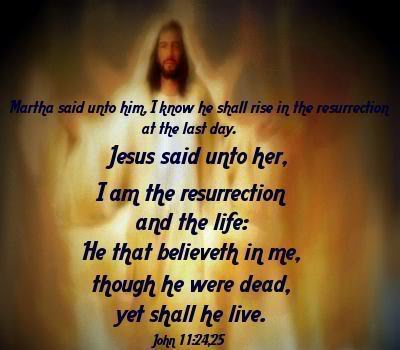 there will be life eternal, no death. Our lives will be challenging, rewarding, enriching, always something new, there will be love, compassion, encouragement. It will be life on an upward slope. certainly challenges, but always a way to achieve, learning and ultimately over coming, because we will be in the presence of Him who “These shall make war with the Lamb, and the Lamb shall overcome them: for he is Lord of lords, and King of kings: and they that are with him are called, and chosen, and faithful.”
So when we listen to the world, a world sunk in sin, death, no hope, no promise, that it will result in death and destruction just like the death Satan will suffer, you are listening to a world that does not know what it’s talking about and is lost in death, destruction. When we know the resurrection by faith, when the Holy Spirit has put that promise on our heart, we really don’t need “proofs”, but when we witness to others, we can point them to the facts and away from the fantasy and hopelessness of the world.
Tim Chaffey in “Answers Magazine” (April – June 2014 pp 34-37) discusses what the world proposes as “answers” to the resurrection. That it was a case of mistaken identity. Really? On its face its pretty weak, why would the people involved buy into something they knew to be false? Would the Romans execute the wrong person? No! The disciples were good, strong, intelligent men, would they willingly teach something they knew to be nonsense? To what end, at what price? ‘
There’s the “swoon theory” as if a Roman soldier wouldn’t know when someone was dead and would allow him to be taken before he was. That is just ignoring historical fact.
The body was moved. Again ignoring fact, if the Romans, Jews, anyone involved knew where the body was they would have revealed it. Why would people afterward go out and perpetrate an obvious lie?
Visions, that is, the disciples pretty much imagined this whole thing. The premise of a lot of these theories is that the disciples were just kind of stupid country bumpkins, they don’t say so explicitly, but the inference is clear. Jesus’ appearances were attested to by a number of people, one person who was completely antagonistic to Him, Saul of Tarsus, who Jesus renamed Paul when He gave Paul the charge to witness to Him among the Gentiles. There are others, that there was a family tomb. Which is just weak, what difference does it make? If Jesus was dead, where He was buried would be common knowledge. Seance? Really, come on, now we’re just kind of projecting our current culture on to a people who just wouldn’t go there. Annihilation, some unexplained reason the body was destroyed and no one’s discussed it since, that it’s some kind of coverup. Again, that would just be a serious ignorance of history. Wrong tomb?
Chaffey lists out the following: Jesus testified to His resurrection before and after the fact. Luke writes in Acts 1:3, that “Jesus presented Himself alive after His suffering by many infallible proofs. There are at least ten “post-resurrection” appearances of Jesus. He appeared to Paul, Peter, James, individually, the rest of the apostles and over five hundred at once. “Most of these people were still alive when Paul wrote these words, implying that his readers would check with these witnesses if they didn’t take his word for it.”
James, Jesus’ half-brother, in fact all of His siblings, thought that Jesus “was out of His mind”. After the resurrection, James becomes, essentially, the first Christian bishop of Jerusalem. He continued to be an important Christian leader until he was martyred, dying for the truth of the life, deity and resurrection of his half-brother.
When Jesus was arrested the disciples ran away, after Pentecost, these men willingly went out into the world to proclaim Jesus and were martyred as a result. The resurrection was preached by the disciples from the beginning, the resurrection was the center piece of their teaching, it was what the Christian church was built on. These people weren’t in a position of power to force these teachings on anyone, and yet they were believed, and the church grew, even through martyrdom, persecution and deprivation. Chaffey points out that they did not help their cause by reporting that the first witness to the resurrection was a woman. Like it or not, in that time, the testimony of a woman and one who, may or may not, have been a prostitute, but attested that she had seven demons cast out of her. This would not be a well received testimony, certainly would not have improved the case of ordinary men, making an extraordinary claim.
There is no plausible argument to deny the resurrection, many have been tried, but these arguments deny and/or contradict the historical facts. The resurrection is fact, not just to prove a point, to make a case. But it is fact according the the life and promises of God incarnate, Jesus the Lord, but it is also to give hope to a hopeless world. The world is lost in sin and death, there is no other possible outcome, except for the resurrection promised to us by God the Son 2,000 years ago, by His resurrection from the dead.

An article in Inc Magazine talks about how leaders are perceived. This was a study done by Maia Young, an associate professor of human resources and organizational behavior at UCLA with Michael Morris and Vicki Scherwin who are also business professors. Participants were, basically, asked whether the best leaders are gifted, charismatic or hardworking. I think there is something to the fact that there are people who can sort of light things up, versus the person who sort of grinds things out. There is an upside and downside to both. If one can generate excitement, get people stimulated, then he/she may have that certain je ne sais crois. I’ve seen that kind of person and good for them. The downside being is that person can also be kind of an empty suit (or collar if you’re talking about pastors). The guy who genuinely does the hard work, can kind of be overlooked, taken for granted. Some research has shown that the “perfectionist” is more of a procrastinator and less a hard-worker. My radar has always gone up when I heard someone try to show me how much they care because they are a “perfectionist”, even before the research I kind of had the feeling this was someone who was more concerned about making a mistake that might cause them embarrassment, then being concerned with getting the job done. I’ve seen plenty of hard-working done by someone who wasn’t terribly concerned about looking pretty, but getting the job done.
“The findings seem to suggest that leaders should keep the nitty-gritty details of their jobs under wraps.” (J.J. McCorvey Inc Magazine Oct 2011 p 28). I would agree with that, an old Coast Guard axiom “the world doesn’t care about the labor pains, they just want to see the baby.” Lots of times we had to “gerry-rig” things in order to make something work, do the rescue, effect the arrest. It took extra time, work and creativity, and was often something that wasn’t pretty, but it worked. It might have been just enough to get to someone in time or prevent violence. I think a lot can be said about that in terms of ministry. There are people in ministry, who seem to be more concerned about the looking pretty, versus the actual content (ok, I guess this is my way of saying “look at me”). Yea, this is another shot at the Joel Osteen sort, put in a lot of work on the aesthetics, not so much on the content. Osteen was a salesperson (nothing against salespeople, been there/done that, myself). But I also got the education, did the work, spent the time, and money to get a degree, did as much as I could to learn to be a seel sorger a “soul healer”. Is it really about making God so user friendly? Or is it about doing what God leads you to do to be a true disciple, someone who is genuinely looking to be led and grow in Christ?
Yea, there is hard work in doing the glitzy and I shouldn’t use this as an excuse to not try to up the pizzazz in what I do. Having said that, and yes, I guess I am stacking the deck a little, but is it about someone who is interested in your spiritual health, or someone who is perceived to be more charismatic, puts on a better show? Other than “it puts butts in the pews, (or actually theater seats which is more the case for most of those ministries), can anyone really make the case for how the “charismatic/showmanship” really makes us more fit for the Kingdom?
Jesus said: “Jesus said to him, “No one who puts his hand to the plow and looks back is fit for the kingdom of God.” (Luke 9:62 ESV). Putting the hand to the plow seems to mean “doing the hard work”, “looking back” seems to mean relying more on the superficiality of the world. As for me, I’m putting my hand to the plow. But at the same time, will work harder to make it more fun. So let me know.
Our “Coffee Break Bible Study” is on Wednesdays, 10am, corner of W King and Beaver Sts in downtown York. Park behind the church. And by the way, I know this may be kind of an odd hour, always looking for input, if there is a better time/place for doing these kind of studies, (we’re doing Gene Veith’s book on taking Jesus into the workplace), please let me know, I’m really looking for input and how I can better fill people’s schedules.

I’ve been struggling with the issue that Kevin Miller raises in a Leadership Journal article (From Relevant Dude to Spiritual Father Summer 2011 pp 45 – 49) whether I am supposed to be somehow “secularly relevant”, your buddy, someone who is cool. Or, am I supposed to be the seel sorger the “soul healer” or “soul doctor”. It doesn’t mean I have to be stuffy or have to put on some kind of superior airs. But to be sure, to be solidly in Christ and not driven by the current fads or worried about my popularity. It’s an issue that I’ve had with a lot of what the church has been in the past few decades, at least dating back to the 1960’s. That somehow I’m supposed to be everyone’s pal, just the cool pastor guy.
First, I have had a lot of experience in the secular in my past life and I am doing things now, such as “Christian in the Workplace”, our employment support group, our pro-life efforts, helping to organize a community radio station here at the church and other areas where I am doing things that are very relevant, as it were, to the individual’s life in the world. I’ve done the politics thing and the government thing, and that’s fine. Martin Luther’s church isn’t opposed to or ignorant of the secular. Luther was very straight forward in terms of his teaching about the two kingdoms. There is the kingdom of the left (the secular, government, commerce, etc) and the kingdom of the right (the church). Luther talked a lot about vocation and how we relate to our neighbor whether he/she is Christian or otherwise. In respect to those teachings, I am responsible for the furtherance of the church in the world. It seems that I am expected to be somehow cool, to somehow be a bud, sometimes even an enabler. Does God love you? Yes? “For God so loved the world, that He sent His only begotten Son.” Somehow though, many see that as the promise of the “Great Enabler”. “God wants me to be happy.” “God wouldn’t want me to “suffer”” (that is without alcohol, or drugs, or sex or fill in what you want). That one’s bizarre, I want to ask them “you have no idea what suffering is do you?” Many attribute this to a growing disrespect of authority. Perhaps, but it seems more like a selective attitude towards authority. It’s not about what is truly good and edifying for me, it’s all about tell me what I want to hear. Is it better to be popular or is it better to be faithful? Am I a minister of the people, or of God (Richard Foster’s question).
I’m not here to enable, to let you have guilt free indulgence. I’m here for you to grow in your relationship with Jesus, to become spiritually mature, and in doing this, to help you to serve others, to become a meaningful member of the Body of Christ. Where you are helping others to grow and mature in Christ, not to constantly take and require attention, but to contribute and serve others who are in legitimate need, to help others know true life and salvation in Jesus. But today it’s all about me, what’s in it for me. Rector Miller relates the following: “Chris, a young guy in my church …explained to me: ‘The highly relevant pastor is bro’. There’s certainly a place for pastors to be in tune with culture and to be relatable. But where do i find a man of God who will nurture my spiritual life? That’s what I need. Relevance is easy to find. But when I stumble in that same old sin that I keep slipping in, I need someone with wisdom and maturity to go to. It’s fine if that person also happens to know about some great new indie bands, but in those moments, I need something else. I need depth.'” Yea, sounds like he’s on his way. But too many aren’t and frankly just don’t care.
Miller also observes: “…though people resent church discipline and push back against it, usually deep down they know they need it. And even if they don’t like it (or me), to be a spiritual father means I must take the risk and plunge into bringing guidance and living discipline to my spiritual children…When people sense that your correction comes because you know them and you love them, the majority of people accept discipline and grow through it.
Sometimes I shake my head and wonder, Why do they stay? My theory: They’ve never known a world without internet porn and access to strong, compulsive powers. Deep down, they are saying, ‘Protect me from the forces in my life that are raging out of control and threaten to consume me.’ Discipline, caringly administered, makes them feel loved and secure.”
That has to be the focus, dealing with the forces of evil that are pressing in around us. It’s not just the obvious sources, but there are things that seem so benign and we get taken in and trapped. We all need help with that. I’ve had spiritual mentoring from the start and it is important to be dedicated and consistent. It takes a long time, it takes patience, it’s understanding that it’s about you digging deep and being guided to the things that are in you. You don’t sit and take notes, you get into deep discussion, helped along and making the decisions that truly bring you into that relationship with the Father and with your pastor and with your brothers and sisters in Jesus.
So this is what Rector Miller suggested and what I will be working on. (I will need someone to work with me, you are most welcome to take me up on this). “…’Transformation Conversations’, extended times of listening to another man helping him form a spiritual-growth plan for the coming year… It generally takes two 90-minute conversations before I feel I know the shape of someone’s soul well enough to offer a few ‘pastoral invitations.'”
“At times I look at how much time these conversations take, and I think, This is painfully slow and inefficient. The raw truth is that spiritual fathering is something you can’t accelerate, microwave, chart, whiteboard, measure or scale.
But there is no substitute for being known by another. This is parenting, meaningful spiritual intimacy. People say these conversations are changing them, but even if they weren’t, I know they are changing me: as I listen deeply to someone , I care more deeply for him and I can’t help but pray for him.”(p 47) Growth in anything is very uneven, very time consuming and also very emotionally draining. But as in anything, it’s worth it and when it’s worth it there is a price.
We all have things to deal with, that we struggle with. We have a pastor who is there to serve, by truly helping you in your relationship with God. As I’ve written before, the church is a unique place, there’s a pastor there who in an emergency can be there pretty much 24/7, but is available to meet with on a regular basis. Hmmm, tell me another place where you can call someone and they will take time to talk to you and setup a time to meet in person. Who knows you, who’s been there to provide guidance, maybe married you or even baptized you? Who wants to spiritually guide you and raise you up to be a leader in your home, in your church and in your community? To be spiritually grounded and to grow into a person that others will look to for discipling.

Uhhhmmm, I don’t know… “Of importance to the courage of leadership is cultivating spiritual and religious humility, which is an attitude of respect and esteem developed when encountering people of other faiths.” (Fr Leo Nkwasibwe Business Courage p 397)
A Christian should never be disrespectful to any other person, regardless of anything; religion, race, sexual preference. But it seems to me that Christians are a little too quick to defer, to willing to back off, to me that’s a little too, well I’ll say it, gutless to Christ. Jesus didn’t back down one bit when confronted by the Jewish leaders, by Pontius Pilate, by anyone who some how called Him out. He directed demons, He took control of the situations He was in. He didn’t concede the field to anyone, now a lot of that can be attributed to the fact that He is God. He created the people He was confronting, He knew more in an instant, than they’d ever know in a lifetime. So that’s a little difficult for me to reconcile how Jesus, who is God, confronts, as compared to me. One way I am looking at it, is that Jesus’s life is the example that I should follow. No question, Jesus was never obnoxious about it, but He was always assertive. This is the way it is, this is the truth and you need to deal with it.
As a Coast Guard Petty Officer, I was trained as a law enforcement officer. A law enforcement officer by the nature of the vocation is going to encounter confrontation. It is incumbent on the officer to handle a situation as safely and expediently as possible, this in the best interests of everyone. This reduces the possibility losing control, injury of any parties, and getting the parties involved to where they need to be.This is analogous to Christian witnessing.
I’m not saying that Jesus wasn’t meek and humble, certainly the incarnation itself was a demonstration of Jesus’ willingness to humble Himself in order to do what was necessary for man. John MacArthur quotes the NASB:
Have this attitude 1in yourselves which was also in bChrist Jesus,
6 who, although He aexisted in the bform of God, cdid not regard equality with God a thing to be 1grasped,
7 but 1aemptied Himself, taking the form of a bbond-servant, and cbeing made in the likeness of men.
8 Being found in appearance as a man, aHe humbled Himself by becoming bobedient to the point of death, even cdeath 1on a cross.
We should always look to serve. But perhaps I see service not as caving in, but as doing what is best for those involved. Certainly I serve Christ by being an assertive witness for Him. Christ died for the sins of the world, it is not God’s will that any should die, but all should be saved. Sorry, the fact of the matter is this, only in Christ are we saved. Same old discussion, I can tell people what they want to hear and not offend, or I can tell them what they need to hear. In an assertive way, no one is hurt, in fact ultimately they are saved from eternal hurt. I have stayed in control and kept the focus on Christ, too often these discussions end in everyone either genuinely considering what was said or being offended, frankly I’m more concerned about offending Jesus, then offending people who are misguided to begin with. Jesus said the Gospel would offend, we can’t help how other people react, we can only be faithful and assertive.
“Assertive”, does not mean loud, obnoxious, pugnacious, it means “this is where it’s at, this is how it is. You can chose to accept it or not, but this is how it’s going to be. If someone is being arrested for cause, they can be offended (they usually are), they can talk all kinds of smack about you, your momma etc, but the fact of the matter is this, they’re under arrest and just as in Christ there will be a judgment. All are going to be judged, I want to be judged faithful to Christ, when others are judged and found to be not in Christ, well… suffice to say, it’s not going to be pleasant for them. A secular judge can send someone to jail, the ultimate Judge will condemn those who have rejected Him, and jail will seem like a luxury resort compared to where they will be condemned.
These aren’t my words, they are Jesus’. I’m not making this stuff, it is the way God the Son promised that it would be. I’m not doing my co-worker, family member, neighbor, other guy I play basketball with, a favor, by patting them on the head and sending them on their way because they were offended. Hopefully not by the way I said it, because those in the world will always use that as an excuse, but as respectfully and in love, wanting what is best for them.
Maybe Father Nkwasibwe has a different definition of esteem, I esteem the fact that we were all made in the imago dei. But I’m sorry I do not “esteem” someone else’s wrong opinion. You can condemn yourself, but I wouldn’t esteem your killing yourself with pills versus hanging. Either are evil and so is spiritual poison, that kills, not just the body but for eternity. I have to be serious and assertive about the Gospel, not antagonistic, because I don’t want anyone hurt, but in a way that conveys that I am very serious, that I have full confidence in what I’m doing and if the other person doesn’t want to end up spiritually damaged they would do well to listen to what I have to say.
People do respond to assertiveness and confidence, they may not comply as if they were under arrest, but they will think about it. We often don’t see the results of our witnessing, we are told that we will be used to plant. Don’t quit because there are no results, we are called to be faithful, when we witness with confidence, assurance and in genuine love, we are being as faithful as we can be.
So, no, don’t start a holy war at work, there is such thing as discretion. But don’t be too fast to just concede the field. I’ve had Christian pastors tell me that other pastors shouldn’t be allowed to say the Name of Christ in their public prayer. Why? Well they don’t want to offend. The Gospel offends, Jesus told us it would, we are called to faithful, if that offends, well, there’s not a lot I can do about that, except to continue to faithfully serve the Lord of Life.
We meet on Wednesday’s 10am the Green Bean Coffee Co. corner of W King and Beaver Sts in downtown York, parking behind the church.
The temptations of us
March 9, 2014 First St Johns
There is no doubt Father that we are weak vessels, we are constantly being tempted, we know that our strength is only in You, but there are times when that Old man/the Old Jim will prevail, where we will fail and give in to temptation. We also know that when we bring our failure to You, You forgive us, that You always welcome back Your prodigal child. We ask for your protection every time we pray what Jesus taught us, to remind us that it is through Your strength and power that we resist temptations, but when the Old man overtakes us, it is in Your strength that we are forgiven. Help us to remember Jesus’ example and every time we are tempted we resist by remembering Scripture, remembering our baptism into new life in our Lord Jesus. We make our beginning in the Name of God the Father and in the Name of God the Son and in the Name of God the Holy Spirit and all those who will remember their baptism and the promises of Jesus in the face of temptations said … AMEN
I know, that’s kind of a tall order, to remember Scripture, to remember our baptism in the face of temptations but it is what the Father gives us to resist temptations. That is why we take time to be at worship, to be with brothers and sister in Jesus, to study Scripture, to take time to journal about our experience in confronting and over coming temptations.
Arlo Pullmann takes an illustration from C.S. Lewis: “Turkish delight is a tasty confection used by the White Witch, the self-proclaimed Queen of Narnia, to deceive poor Edmund, the son of Adam. The queen offered the Turkish delight to sate Edmund’s hunger, but the more he ate, the more he desired it. The fact is, she didn’t have what was necessary to satisfy Edmund’s most basic needs. Since she didn’t have it, she could not give it. Instead, through her deception, she caused Edmund’s downfall. He became enslaved to the wicked White Witch and brought trouble on many others, including his own brother and sisters. The deed that brought about the end of trouble and the freedom of Edmund was the self-sacrifice of the ever-good, mysterious lion, Aslan. Aslan had life and was therefore able to give it for Edmund’s sake.
Edmund, by talking to an evil one and eating what the evil one offers, mimics not only Eve in the Garden of Eden (Gen 3: 6-7), but he’s like all of us in that we, too, [give in] to evil temptations that ultimately are not able to satisfy but leave us wanting life. Like Aslan, the Lord of life comes to our rescue. What he has, he gives. He does have life and by giving up his life on the cross, he gives us life and heavenly delight.”1
So we have bookend readings today having to do with Satan and each have to do with temptation, Satan trying to, and succeeding in, tempting the first Adam/Eve. The next, Satan trying to, and failing, to tempt Jesus, the second Adam. Satan is attempting to get Jesus to put His immediate needs, probably: hunger, thirst, fatigue, general discomfort, cold/heat, to put those needs ahead of humanity’s eternal needs, that of being in relationship with God, to be saved, to have eternal life in the resurrection.
People often say how “unfair” it is that we should all be condemned because of one man’s action. Let’s look at the facts. There they were in the Garden of Eden, does anyone doubt for a second that they had all they needed in the Garden? We all want peace, we all want to feel safe, we all have material needs. Do you think that God did not provide for all these needs in the Garden? There was nothing to be afraid of, I have no doubt that there was plenty of food and drink, that Adam and Eve lived very well, safely, peacefully, they were fully content. All they were told to do was: “See that tree over there, yea that one in the middle of all these good things, all the things that you will ever need, there is nothing I have denied you, so just leave that one little tree over there alone.” But as much as we have, there is always one temptation; to be in control, to run things, essentially, to be God. And that is exactly what Satan appealed to, “For God knows that when you eat of it your eyes will be opened and you will be like God…” And so it goes, at some point, someone, as Satan himself did, was going to decide; “I can do things better, I should run things, I should be God” and would give in to the temptation.
So let’s be honest here, we would probably all give in to the promise of ultimate power and authority. Satan succeeded in deceiving us. Deitrich Bonhoeffer notes: “It makes no difference whether it is sexual desire or ambition or vanity or desire for revenge or love of fame and power or greed for money or, finally, that strange desire for the beauty of the world, of nature. Joy in God is … extinguished in us and we seek all our joy in the creature. At this moment God is quite unreal to us, he loses all reality and only desire for the creature is real’ the only reality is the devil. Satan does not fill us with hatred of God, but with forgetfulness of God.” Even though Adam and Eve had daily fellowship with God, Satan found a way to make Eve forget, just for a moment, God’s will and insist on her own will. We can readily see why Eve would cave, we are as human as she is, we just might cave. Jimy Akin raises a good question, “How could Jesus be tempted?”. He is God, what could Satan possibly tempt Him with. Akin goes on to say: “The Greek word used here for temptation (peirazo) does not indicate that Jesus had the disordered desire that we refer to in English as temptation. Instead, it means “to try,” “to attempt.” Here the devil tries to get Jesus to sin–and fails.”2 Yes, but, let’s never forget, Jesus is as much human as any of us, He is fully God, He is fully human. Why? We don’t know, frankly we don’t need to know. He was born of Mary, He was intended to be human and intended to experience life as much as any of us do. The writer of the epistle to the Hebrews tells us: “For we do not have a high priest who is unable to sympathize with our weaknesses, but one who in every respect has been tempted as we are, yet without sin.” (Heb 4:15) If you’ve been watching the “Bible” series on television, the way this scene was portrayed really drove this home for me. Jesus knows how this plays out, He knows that in a very short time, He is going to be unmercifully beaten, tormented and nailed into a rough cut tree, where He will be left to hang until He dies. So the scene cuts back and forth between Jesus being tortured and crucified and Jesus being crowned, I think one shot has Pilate condemning Him and in the next Pilate is crowning Him. Jesus makes the right call, but that human part of Him had to be divided: “I could be king and not have to go through all that!” But He, the Father, the Spirit are in one purpose, anything other than the sacrifice of Jesus will not free us, will not pay for our sins and that is the main purpose of the incarnation. Jesus knows full well how this has to play out and it will play out that way, but the temptation was real, as the writer of Hebrews tells us. Jesus knows, first hand, what we deal with and in the mercy of the Godhead, and in the righteousness of Christ when we give in to temptation we know we are forgiven. We will be tempted, and temptation is not a sin, Jesus was very much tempted, He showed us that temptation can be resisted, He was confronted with life and power or brutal death. But that is with the realization that we are weak and fallible vessels, we do give in to temptation, but in Him we have forgiveness.
So take some time this week, take that journal out and write out, deal with, some of the main temptations in your life. Remember Scripture, how Jesus refused to give in. If we remember our baptism and how it has made us reborn, born in the Spirit, adopted sons and daughters of the Father, how will that help us to resist the temptations, turn them over to Him and how will we feel when we have won the victory over temptations in the strength and power of Christ our Great High Priest, our Lord and our Savior?
We can act like we are a victim, we can complain that God is trying to keep us from pleasure, we can whine that we’re being cheated or we can trust the promises of Him who endured temptation and endured the humiliation of a Roman Cross, He in whose Name we are baptized and born again and defeat the temptations in our life.
The peace of God which passes all understanding keep your hearts and minds in Christ Jesus. Shalom and Amin.
1Arlo W Pullmann, What Truly Delights “Concordia Pulpit Vol 24, Par 2 Series A p 7
2http://www.ncregister.com/blog/jimmy-akin/9-things-you-need-to-know-about-the-mysterious-temptation-of-jesus#ixzz2vPYj1Uhx
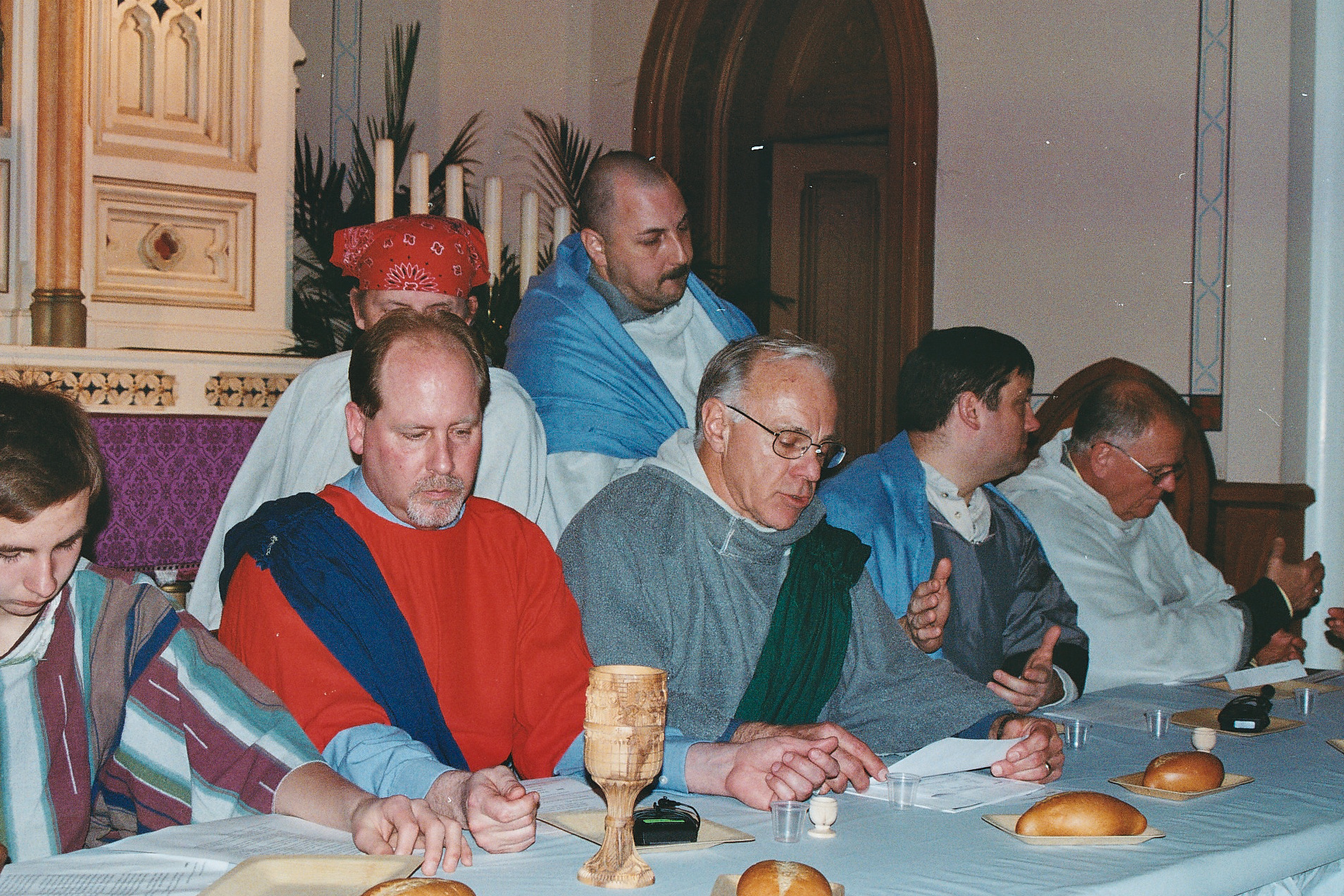
As part of our Renewal process at First St Johns, we have decided to make a concentrated effort in terms of modeling, teaching and living discipleship. One of the big things that we have identified in terms of discipling is that we all have to be much better equipped, we have to be much more outwardly focused and we have to recognize that we are in a very different world. Most of us would agree that we are in a “post-Christian” society. Where before the fundamentals of Christianity, church, worship were assumed to be almost universal, that is not the case in this day and age. I was not raised a Christian and I had to “learn” church as an unchurched person.
We may not like it, but as the church is different from what it was 500 years ago and 2,000 years ago, it will be different in the not too distant future. If anything, it will resemble the Acts Church more than anything we have been familiar with. As the Acts church grew in the midst of pagans and philosophies of all types, we see that all around us now. It has been my experience and I genuinely feel a leading of the Holy Spirit that if anything, the church will become much more liturgical, much more of an anchor in the storm vs what seems to be now at full sail in a storm. When a storm came up a ship’s crew would be desperate to quickly “reef” the sails. Three reasons: It would improve the ships stability, if the ship took a heavy wave midships and wind at the same time it might be enough to push it over. Second, it would be difficult enough to maintain a course or try to maintain a position without the sails, reefing would help the ship to maintain a position. Third if the wind tore up the sails, the ship’s main means of propulsion would be gone.
More and more I hear people saying that the church has to return to its roots, that the storm has been brewing and is about to be upon us. We need to be as solid as possible in the midst of the storm. More and more people are realizing the lack of stability in their lives. Government that can’t live up to its promises. Most people in the younger generations come from broken homes; stability at home is rare and very disabling at so many levels. They are moving into an economy that if you can get a job you are doing well, counting on that job being there too long is not realistic. So even while they are employed they are on the lookout for their next job. They are realizing that the  that was focused on “entertainment”, on making people feel comfortable, is not realistic. The mega-churches are seeing that, they’ve focused on the unrealistic and when people encounter the trials and tragedies they realize they are not prepared, when this happens (not if). Who do they blame? Sure their unstable upbringings, their unstable income prospects, the instability of the all sorts of institutions, up to and including the church. There were more Christian martyrs in the twentieth century then in all history combined. Yet the places that are primarily responsible for Christian persecution and martyrdom are the places that have seen the fastest growth in Christianity. Those places are, primarily, Africa and Asia. Latin America has also seen substantial growth, not because of persecution, but much of Latin America still struggles with serious economic hardship as do Africa and Asia. The areas where Christianity has at least plateaued and even declined, significantly, North America and Europe. We are comfortable, we don’t need the church, the church doesn’t deal with the realities of contemporary life, too much of church even at the adult level, is really only advanced Sunday school and when (not if) the trials and tribulations of life come along, the people in the pews aren’t equipped to handle them in a discipling way. Church is seen as heavy on platitudes and pleasure and not as a place that is supposed to instill trust and faith in God’s plan for our lives. We have promises, but it is of some vague ethereal place that when we talk about it is rather boring, there is no promise, hope and faith in Christ. We read the Bible stories, but we really don’t take them seriously, we are Americans, nothing threatens us, until it does and then it’s too late. The church can step in, but is not taken seriously. We as pastors are patronized, endured and then hurriedly sent on our way. Why? We never gave any hope, promise, faith before, how are we supposed to do it in the few hours before a funeral, an operation, a difficult childbirth, job loss, home loss, on and on.
This is where discipleship comes in. We are finishing a Bible study on the Book of Judges. When was the last time you did a study on Judges? There are a lot of creepy, gritty, nasty books in the Bible, but Judges has to rank at or near the top. (Always cracks me up when people say they don’t read the Bible because it’s boring. Just another example of the failure of the church.) That’s not a bad thing, the Bible is describing real life. Remember the repeated line in Judges: “In those days there was no king in Israel. Everyone did what was right in his own eyes.” (Judges 17 and again in 21) The whole point to the book of Judges was how Israel would be in right relationship with God and then would decide to do it their own way and God would give them a smack down. Judges is then, what contemporary America is.
Bet you didn’t know there were two Micahs in the Bible? One of the minor prophets and also in Judges 17. I will give you a brief buzz through about Micah: He took a lot of silver from his mother to make an idol. He decided to make a Levite his resident priest and actually ordained him (Jud 17:12). A bunch of Danites came, took his priest, took his stuff which consisted of “ephod, household gods, a carved image, and a metal image”, none of which (priest included) Micah had any business having in his house. But since everyone did what was right in their own eyes, Micah went ahead and set up the quasi church of Micah.
So, as for me and my house, we are going back to “classical worship”, something that does resonate today, something that does have a feeling of stability, of true worship versus entertainment, it is not meant for “itching ears” (1 Timothy4:3 “For the time is coming when people will not endure sound teaching, but having itching ears they will accumulate for themselves teachers to suit their own passions,”
…hmmm sounds like Micah.
This is where discipleship comes in, why we do what we do, in his book “Building a Discipling Culture”, Mike Breen observes: “The problem is that most of us have been educated and trained to build, serve and lead the organization of the church. Most of us have actually never been trained to make disciples. Seminary degrees, church classes and training seminars teach us to grow our volunteer base, form system and organizational structures or preach sermons on Sunday mornings and assimilate newcomers from the Sunday service. As we look around, as Christendom is crumbling and the landscape of the church is forever changed, a stark revelation emerges: Most of us have been trained and educated for a world that no longer exists.” (Truth be told, we weren’t trained in seminary or anywhere else to grow, form or assimilate, heck that would at least be some semblance of discipling – Driskell)
Breen goes on to say: “If you make disciples, you always get the church . But if you make a church, you rarely get disciples.” Hmmmm, wasn’t that the way the Christian church started?
So the question is how to do that? Not with programs, not with show, not with entertainment, but getting people to sit down (whether they are 8 or 80), getting a good curriculum, Breen’s book was recommended by Dr Seaman, and starting from scratch. I’m here to tell you that the few churches I’ve been in there were people there who thought they knew everything they needed to, but upon closer questioning, it was obvious they had no idea. So don’t let anyone tell you they don’t need this, we all need it (yes even you and I fellow pastor). We are called to be disciples of Christ, you, me, everyone in those pews. The pastor has particular responsibility because as Paul wrote to the Ephesians (4:11-13) “And he gave the apostles, the prophets, the evangelists, the pastors and teachers, to equip the saints for the work of ministry, for building up the body of Christ, until we all attain to the unity of the faith and of the knowledge of the Son of God, to mature manhood, to the measure of the stature of the fullness of Christ,” This is our responsibility as pastors and I can tell you, that we are not measuring up to this call. We are called to equip the saints, not entertain and amuse the audience. Our Renewal Team is all excited and charged to start two small groups of discipling. We have been wrestling with this, praying over this, studying, journaling and we feel we have a firm basis. We have to make disciples to build/restore/renew/grow the church, otherwise “And everyone who hears these words of mine and does not do them will be like a foolish man who built his house on the sand.” (Matt 7:26)
 Pastor Jim Driskell