Category Archives: History/Apologetics

Offending non-Christians? Be more concerned with offending genuine Christians Answers in Genesis

Christians Should Never Offend Anyone

Clearing Up Misconceptions

by Jeremy Ham on January 25, 2011

Do Christians need to avoid offending anyone? What does Paul mean when he says to “give no offense in anything”? Jeremy Ham, AiG–U.S., explains.

Clearing Up Misconceptions

Over time, many beliefs with little to no Biblical basis have crept into common Christian thinking. This web series aims to correct some of the most commonly held misconceptions about the Bible.

In this current world, offending someone seems rather easy. We probably have all offended or hurt someone’s feelings, whether it was intentional or not. Is the belief that Christians should never offend anyone a biblical guideline? This supposed guideline could be a result of ideas like the following:

  • We need to avoid offending our weaker brother.
  • We should not offend non-Christians because we might lose the opportunity to witness.
  • Paul stated that we should never offend anyone: “We give no offense in anything, that our ministry may not be blamed” (2 Corinthians 6:3).

After close examination, we will not only find the guideline of never offending anyone to be unbiblical, but we will also find the supposed biblical ideas used to support it are unbiblical. Taking Scripture out of context to support an idea can be very easy to do, and so we must carefully examine all ideas with Scripture.

If we are defending and living the truth of God’s Word, is it possible to always avoid offending a weaker brother or a non-Christian, and should that be our focus? This article explains why never offending anyone is not a biblical guideline.

What Does It Mean to Offend Someone?

Before discussing the belief that we should never offend anyone, we need to define what we mean by “offend.” If we offend someone, we did something that causes a person to get vexed. While true, this definition is vague and does not give any principles on how to avoid offending someone. The best way to understand the definition of this word is to look at some examples.

One common example from Scripture of an offense is the eating of food that had been sacrificed to idols. Paul wrote the following:

Yet for us there is one God, the Father, of whom are all things, and we for Him; and one Lord Jesus Christ, through whom are all things, and through whom we live. However, there is not in everyone that knowledge; for some, with consciousness of the idol, until now eat it as a thing offered to an idol; and their conscience, being weak, is defiled. But food does not commend us to God; for neither if we eat are we the better, nor if we do not eat are we the worse. But beware lest somehow this liberty of yours become a stumbling block to those who are weak. (1 Corinthians 8:6–9)

We can apply the basic principle from this passage to words we say. Some Christians believe certain words should never be said while others believe they can say them. For example, what would happen if I was with a person who believed we should never say “cabbagehead,” and I used it (in an edifying manner, of course)? I would have defiled that person’s conscience. In other words, I would have offended that person by being a stumbling block. Based on Scripture, we need to be wary of becoming a stumbling block to others (see also Luke 17:1–4). However, some go an extra step and say we should never offend our weaker brother, but Scripture does not command this.

Another way to offend is by getting non-Christians angry not only at us but also at Christianity. For example, imagine driving and unintentionally cutting a non-Christian off in traffic. The person cut off would probably get angry. Furthermore, if the car had a Christian bumper sticker, the person might also get mad at Christianity. As Christians, we need to strive to have the utmost integrity in all areas, including driving (Titus 2:7).

In both cases, the offense was not deliberate, but unfortunately, someone was still offended. Some people use these or similar examples to support the idea that we should be careful to never offend anyone. While we should keep these biblical examples in mind to avoid offending people, God’s Word does not state that we should never offend.

What About 2 Corinthians 6:3?

Some have pointed to 2 Corinthians 6:3 to justify the belief that we should never offend anyone. Paul wrote, “We give no offense in anything, that our ministry may not be blamed.” In other words, Paul said he would not offend anybody in anything, right?

Well, the word translated “offense” is προσκοπήν (proskopen), and it refers to an obstacle, difficulty, or stumbling block (the same word is used in 1 Corinthians 10:32). In fact, the NIV translates the verse this way: “We put no stumbling block in anyone’s path, so that our ministry will not be discredited” (2 Corinthians 6:3, (NIV)). This is perfectly consistent with Paul’s earlier statement to the Corinthians, which warned about becoming a stumbling block to others (1 Corinthians 8:9).

Are There Instances Where Offending Someone Is Okay?

When we read Scripture about not being a stumbling block to your weaker brother or about having the utmost integrity, we must be careful not to extrapolate unscriptural ideas. A closer look at Scripture reveals that if we follow and proclaim the truth of Scripture, we will inevitably offend people!

IF WE FOLLOW AND PROCLAIM THE TRUTH OF SCRIPTURE, WE WILL INEVITABLY OFFEND PEOPLE!

In Galatians 5:11, Paul stated that he was being persecuted for not preaching circumcision. Instead of preaching circumcision, he was preaching the Cross, which was an offense to those who still held to the law of circumcision. The Greek word translated “offense” in this verse is σκάνδαλον(skandalon), a noun referring to that which causes offense and arouses opposition.Sadly, even today some people hold to laws rather than the saving knowledge of the Cross. In the Great Commission, Jesus commanded His followers to make disciples. To accomplish that goal, we need to spread the word about Jesus, and we will inevitably run into people that are offended by this message (1 Corinthians 1:18, 23).

When Jesus spoke with the Pharisees, He was more concerned with the truth than their feelings. Jesus spoke the truth, which often aggravated the Pharisees because it conflicted with their beliefs. At one point, the disciples even came to Jesus and told Him the Pharisees were offended by what He had been saying (Matthew 15:12). Jesus answered that the Pharisees’ failure to see the truth right in front of them would be their downfall. Jesus continued to spread the truth, even when it offended people.

Places like the Creation Museum tend to offend atheists, but does that mean we are doing something unloving toward them? Psalm 14:5 gives insight into the hearts of atheists by stating that “they are in great fear, for God is with the generation of the righteous.” Why would they be afraid if they believe there is no God? In reality, they do not want to acknowledge God and be accountable to Him for all their deeds. The Creation Museum displays the truth of the Creator and Redeemer, but atheists want nothing to do with God. For the Creation Museum not to offend atheists, it would need to be based on man’s word rather than God’s Word. Obviously, this would require us to compromise our Christian beliefs.

A friend of mine told me that he was offended and his feelings deeply hurt when his doctor gently told him that he had leukemia. Was it unloving of the doctor to announce this offensive news? Not at all! This was the most loving thing the oncologist could have done for my friend so that he would not only recognize what was wrong with him but he could also seek a cure. If the doctor remained silent because he was afraid of offending him, then my friend would have died. In the same way, we must never remain silent for fear of offending the unbeliever when we have an opportunity to share the only truth that can save them from an eternity apart from God.

In all of these instances, the truth is what offended people. Paul taught in Ephesians 6:14 that a Christian’s foundation is the truth of God. Therefore, Christians will offend certain people if they are living by God’s truth.

Conclusion

As Christians, we need to have the utmost integrity in all areas and be careful not to be a stumbling block to a fellow Christian. We should make every effort to live at peace with others (Romans 12:18). This does not mean, however, we will never offend a fellow Christian if, for example, a rebuke is needed. Even though we speak the truth in love (Ephesians 4:15), we might still offend. We must live by the truth of God’s Word, and those people who are living contrary to the truth are often offended. Non-Christians may be offended as well. After all, the message of the gospel declares that they are sinners who need to repent and put their faith in Jesus Christ. In a sense, we need to offend unbelievers in order to witness to them!

Although we cannot keep people from getting offended, we should make sure that it is the truth that offends rather than our attitude, actions, or approach. We must follow biblical principles in all areas. At times, offending is wrong, and at other times, it is necessary. As we spread the truth of God’s Word, we should do so in love, humility, and boldness, making sure we are living by the truth.

Human development through history and carbon dating. Answers in Genesis

Cave Dwellers—Are They Ancient?

by David Livingston on February 11, 2008; last featured October 24, 2010

Though people who live in caves are usually considered prehistoric, there is no such thing as Neo-, Meso-, or Paleolithic man! In spite of all that archaeologists and anthropologists contend about these early Stone Age cultures and their supposed long ages, it simply cannot be true.

Why? Because the Bible speaks of the very earliest cultures as being highly civilized, with musical instruments, woven tents and clothes, metal working, animal husbandry, etc. (Genesis 4:3–4, 17–22). The fact that we find people in the very earliest times living in caves simply means that they lived in caves instead of houses. We find people around the world doing this very thing today. For instance, some families living along a 40 mile stretch of the Rhone River in France dwell in the caves that are situated there.

IN CAPPADOCIA, TURKEY, ALMOST EVERY FAMILY LIVING THERE HAS CARVED OUT A CAVE HOME FROM THE STRANGE FORMATIONS.

In Cappadocia, Turkey, almost every family living there has carved out a cave home from the strange formations. And there appear to have been cave dwellers in every generation since the beginning of time. Even Jesus was born in, lived in (His traditional home in Nazareth was partly a cave), was buried in, and was resurrected from a cave. As reported in an issue of National Geographic, “stone age” cave dwellers in the Philippines appeared so authentic to a research team that they published an entire book about them, The Gentle Tasadays. It was only later that the team discovered that the government paid the people to live like that as a tourist attraction. I do not mean to infer that such misreading of the data is common. However, it does illustrate that we must always be careful not to quickly conclude that our discoveries are the “last word” in our field of expertise.The Bible has incidents of cave dwelling also. Refugees lived in caves (Genesis 19:30; Judges 6:2; 1 Samuel 13:6).

And we wonder why other reasons have not been considered for cave dwelling.

Pre-dynastic People in the Ancient Near East Were Few in Number

After the Flood of Noah’s day, it took some time for enough people to gather together and build cities. But it did not take thousands of years!

As researchers write about this situation, they grossly overestimate the time from early man to modern man. For instance, highly respected anthropologist Robert Braidwood said,

“Prehistory means the time before written history began. Actually, more than 99 per cent of man’s story is prehistory. Man is probably well over a million years old, but he did not begin to write history (or to write anything) until about 5,000 years ago.”1

We should be shocked at such a statement. To see why, look at the diagram below. It is true that there was no writing before 5,000 years ago. That is because the Great Flood occurred ca. 2450 BC and everything before that time was destroyed. Thus, all pre-Flood humans were wiped out. A time line shows the fallacy in Braidwood’s statement:

HISTORIC MAN PREHISTORIC MAN
5,000 years 995,000 years!
I_I_____________________________________________________________________
1/4 inch Line extends 6 more feet!

It seems ridiculous that we should be expected to believe man could not read or write for all that time, then suddenly within a very short time, perhaps not even a hundred years, he was writing all over the Middle East in a number of languages!

Radioactive Isotopes Do Not Help

The use of Carbon-14 does not help in this situation. Carbon-14 and other isotopic elements should not be used to determine the absolute age of a specimen, according to Willard Libby, founder of the method. Only measured are the amounts of the remaining 14C against stable 12C.2

Consider the following quotes from “Rolling Back the Years”:

“With radiocarbon, it’s not possible to obtain absolute dates—there’s always a bit of the unknown.”3

Some archaeologists use it because they feel it gives absolute dates. During 25 years of excavations in Israel we have never used 14C dating because it is too inconclusive. Even though there have been some noteworthy improvements in the radioisotope methods, the same problems still persist. And this goes for all radioisotopes used in dating.3

“[Carbon-14 is g]arbage in garbage out. . . . One of the biggest issues . . . is contamination . . . . It soaks up anything in the ground . . . even very small amounts of modern contamination can be fatal for old samples.”3 [emphasis added]

“What scientists are really holding out for is tree ring data that can calibrate absolute radiocarbon dates back to 60,000 years. . . . This hinges, of course, on whether they can find sufficiently old trees and samples that represent a continuum of ages throughout the past.”3

However, these secular researchers know, and so do we who accept the biblical timeframe, that they will never find successive tree rings with which to date 60,000 or 30,000, or even 10,000, years ago.

“At the moment we have a floating chronology. . . . It is not connected.”3

That is, the researchers have calibrated back around 5,000 years, but tree rings can take them no further.

What he is saying is that they can only go back 5,000 years using hard tree ring evidence. What they are hoping for is to go back 60,000 years, but there is no way to calibrate the time in between. Isn’t it interesting that 5,000 years ago was roughly the time Noah and his family members were saved by the Ark!

Three problems that 14C faces are true for all isotopic methods. They are:

  1. We cannot know what the ratio of daughter element to parent element was in the formation of the specimen.
  2. We cannot know whether there has been leaching in or out of the elements.
  3. We cannot know whether the decay rates have changed through time, perhaps due to what one archaeologist suggested while trying to determine some dates from ruins in Mesopotamia. The prominent British archaeologist, M.E.L. Mallowan once said, “ . . . at this end of the third millennium (BC) there was some physical disturbance in the solar magnetic field, which may have affected the level of the carbon-14 activity in the carbon exchange reservoir. . . . Published dates are more than 500 years too low.”4

Some evangelicals find it difficult to reconcile biblical dates with “scientific” dates. But maybe biblical dates are correct and the secular scientists are wrong! The Bible is God’s inerrant Word. Is it possible that some evangelical scholars are afraid of what their contemporaries will think of them if they oppose the “scientists” of today? Biblical archeologists are not against actual science and hard evidence. But we are against arbitrary estimates and interpretations that contradict the clear revelation of history given by God in His Word.

It may seem rather drastic to consider that early post-Flood man lived only around 4,500 years ago. We have heard so much from the opposite camp. I wonder whether they have carefully examined the slipshod way high dates were arrived at before 14C was discovered.

The Development of Language and the Inerrancy of Scripture

A major difficulty is to take data from secular archaeologists and make it fit with an inerrant Bible. For instance, the Hebrew Bible says in Genesis 5:1 that the history of Adam was written! The word for “book” used here, sefer, always means the account is written. Also, Adam and God spoke to each other in some language.

Later, in Genesis 26:5, the writer tells us that Abraham kept four kinds of God’s commands. They were all written commands. The Hebrew is very clear on this. One command, chukot, means an inscribed writing. What this (and other material) means is that the men of God mentioned in the early chapters of Genesis apparently used an ancient form of alphabetic Hebrew that could be written down.

Alphabets of thirty signs, more or less, are easy to learn compared with cuneiform characters, which frequently have several possible syllables for just one sign. In contrast, anyone could use the primitive Hebrew alphabet, including children.

Thus, it is more probable that the Northwest Semitic languages came out of Hebrew and not vice versa, as most scholars think. Those that claim Hebrew came out of some other already existing language(s) follow each others’ ideas instead of starting with the Bible and checking it out with other literature.

Finally, Genesis 5:1 is not an anachronistic (or later) insertion into the text by later scribes! We cannot absolutely prove that it isn’t, but we think every reason is there to adopt it as written. Conversely, no one can prove Hebrew derived from Northwest Semitic, either.

Admittedly, there are some tough problems to explain in correlating ancient history with the Bible. And we cannot be dogmatic about these things, but our modern youth are hearing so much bad thinking. Neither are they given enough information and guidance to think things through biblically. They—and every one of us—need to learn how to question what they are hearing from their teachers and the media, while constructing alternative interpretations that honor the Bible and the best methods of archaeology

More devolved or further away from God?

Someone responded to a post of mine, which was critical of evolution. I grew up mindlessly accepting the secular gospel, that evolution is just a given, a scientific fact and did not give it another thought. The writer/respondent wondered if instead of “evolving”, we were really “devolving”. In some ways man has, in some sense, become better. But in so many ways, the things that are truly important, we have become more depraved, more alienated, more fixated on the true object of our affection, that being “me, myself and I”.

Obviously evolution is a rather pitiful attempt to deny God and to create some kind of phoney paradigm where, given enough time over “millions and millions of years”, that somehow, completely by chance, an incredibly sophisticated environment, would create incredibly sophisticated beings, all by complete chance. (Unless of course you believe the outside of the evolution fringe which tries to convince us aliens came here and started the human race, if not the entire ecosphere. That of course begs the question how aliens came about, but the evolution fringe element really doesn’t go that far, and frankly doesn’t seem to think that deeply.) Most real scientists today are rejecting Darwinian evolution and are growing in their perception of a design of the universe that is more and more incredibly complicated. The idea that says that this happened all by accident is becoming more and more discredited.

I am certainly not anti-intellectual, but those who pose as “intellectuals”, seem to more and more be anti-intellectual. There seems to be this element that thinks that education is more of an indoctrination, a learning of essential facts in order to continue to maintain the status quo, instead of what true science is, which is to continue to question, There is not supposed to be a science orthodoxy, a faith system that dictates that these are “facts” and not to be disputed. But there certainly is a scientism faith system. At least a deistic system (like Christianity)provides for some kind of tangible reality of creation. But the evolution, fringe element, moves even more to the fantastic, when it’s high priest, if not Pope, Stephen Hawking decides ex cathedra, that obviously there has always been gravity and that is what continues to pull the universe together and kicks off the whole “Big Bang”. I’m not opposed to the “Big Bang”, if God chose to use that as His method of kicking off the universe great! What better way than in an incredible flash of light that rocketed out from a tiny bit of mass. But to say that it was somehow always present and self- perpetuating is a faith system that demands a great deal more faith than God the Father of our Lord Jesus, the God of Abraham, Isaac and Jacob.

God created us to be perfect, we, represented by Adam, decided, that what He did wasn’t good enough, we wanted more and basically Adam waved God off and said, no it’s all about me and what I want. That is the break in our relationship with God. From there sin did and continues to break us down, drive us further from Him, because more and more it’s all about us. So yes, we are “devolvoing” in the sense that we are moving farther away from God and making ourselves an idol. The farther we are from the Father, the more it’s about us, the more debased we become and yes, more like a “survival of the fittest” versus the love for the Father being projected on all those around us and from us to everyone else. The whole evolution argument is about us justifying that it’s about us and that God doesn’t matter. We find out who does, because the farther we are away from Him, the more debased, sinful we become the less human and compassionate and more about me. We can either realize how far we’ve fallen and strive for reality of Jesus. Or we can keep tanking and wonder why things have become more evil.

Our God is very much a living God, to quote the Newsboys “God’s not dead He’s surely alive, He’s living on the inside, roaring like a lion”. He roars to give us the integrity, courage, strength to live a life that truly worships and strives to serve a completely holy, perfect, sanctified God. He made all creation so that we could live as very complicated beings in an environment that supports us. We continue the intellectual challenge of understanding His creation and also Him, in order that we might grow to be more like Him, and not to be about what it is that I want, what I decide is important. When we grow towards God the Father, Son and Holy Spirit we don’t “evolve”, but we become more like Christ. That’s our true goal, we’re not going to evolve that way, it’s going to be about having the faith that God gives us to trust what the Holy Spirit is doing in us and to proceed out into the world in God’s will, not ours.

Intelligent Design the complexity of the cell and how God designed it

More and more, credible scientists, those who are looking for truth and not pursuing an agenda, are coming to terms with the understanding that so much of what they observe from the cell to the universe is fitted together so precisely that it could only be done by a all powerful Creator and Designer, what we Christians would call God.

More and more science is seeing “intelligent Design” as unavoidable. Just the intricate design of the cell, of which the human body consists of millions, could simply not have happened by accident.

The problem is, that the fundamentalists, the biased priests of the faith of “Evolution”, “Darwinism”, live in a state of constant denial. Don’t try to confuse me with  the facts of actual science, my faith dictates that there is no God. Part of that is the result of being hurt, suffering trauma and striking back at God. Another reason is that they have a particular life style, and like a 15 year old adolescent, tenaciously clinging to their sin instead of submitting to a loving, forgiving Father, they simply deny God and try to sell everyone that they should live however they want in order to “be happy”, “be fulfilled”. You know “don’t judge me” whine. Well we’ve certainly seen the results in society, slavery to sin of substance abuse, sexual addiction, worshipping money, things, lifestyles and just refusing to realize the destructive results.

I could certainly go on, I doubt anyone out there would argue with me on that, but I thought I would straight reblog from an actual scientist. Dr Howard Glicksman MD is a Medical Doctor in private practice in Florida. I have taken his blogs off the Discovery Institute in which he writes about the cell. I have also included the link to the “Discovery Institute” which consists of writings from objective scientists on many issues.

http://www.evolutionnews.org/intelligent_design/

How the Body Works: Intelligent Design in Action

Howard Glicksman February 26, 2015 5:00 AM | Permalink

Editor’s note: Engineers and physicians have a special place in the community of thinkers and scholars who have elaborated the argument for intelligent design. Perhaps that’s because, more than evolutionary biologists, they are familiar in very practical ways with the challenges of designing or maintaining a functioning complex system on the order of a jet airplane, or the human body. With that in mind, Evolution News & Views is delighted to introduce a new series, “The Designed Body,” and to welcome Howard Glicksman MD as a contributor. A graduate of the University of Toronto (1978), he presently practices palliative medicine for a hospice organization. Here, Dr. Glicksman explains the rationale behind the series.

Have you ever wondered why it’s so hard to hold your breath, or how your body automatically matches your breathing with your level of activity? Whether you’re running to catch a bus, talking to friends, or just sleeping on the sofa, your body seems to know just how fast and hard you should breathe.

Or have you wondered why even if you go hours or days without eating, your body automatically makes sure it has enough glucose in your blood so you can keep doing what you want to do?

To understand such things you must first know how the laws of nature affect the body and how it must work against them to stay alive.

Everything in the world is made up of matter. All matter consists of many different types of atoms chemically bonded to form different types of molecules. All matter mustfollow the rules of physics and chemistry. Just like our planet where two-thirds is covered by water and one-third by land, our body is roughly two-thirds water and one-third other matter. But, unlike most of the earth, our “water and dust” is organized for life. The body is made up of trillions of cells each of which contains trillions and trillions of atoms and molecules. Since our cells are made up of atoms and molecules, this means that they too must obey the laws of nature.

We each experience these natural forces every day: inertia, friction, momentum, gravity, and heat transfer, to name a few. Experience teaches that, due to the laws of nature, our body has definite physical and chemical limitations. Jump down from a high ledge and you’re likely to break your leg because of the force of gravity and the fact that your leg is made of bone, not rubber. Put your hand into a fire and you’re likely to burn your fingers due to the transfer of heat energy and the fact that your body is mostly made of flesh, not asbestos. Breathing in enough air to match your level of activity, and making sure there’s enough glucose in your blood to provide enough energy to all of your cells, are just two of the ways your body must follow the rules to win in the game of life.

But, like in any game, to follow the rules means that you must first take control. If you’re playing baseball you can’t hit the ball just anywhere or run the bases any which way. By taking control you must try to keep the ball in fair territory and run the bases correctly. So too, your body must be able to take control of many different chemicals and functions.

However, whether the context is baseball or the battle for survival, experience tells us that just following the rules and taking control don’t automatically mean that you’ll win. At the end of the baseball game, if your opponent has scored more runs than you have, then you’ve lost. So too, if the body doesn’t have just the right level of oxygen, or glucose, or water, or salt, or calcium, or red blood cells, or white blood cells, or blood pressure, or temperature, then it can’t stand up to the laws of nature. It loses the game of life, and dies. In other words, real numbers have real consequences.

Death is an inevitable consequence of life and the mechanisms that result in its taking place should be fully understood and incorporated into any theory of how life came about.

If you really want to understand how life came into existence you must first understand how easily it can become non-existent. Just as a mechanic knows that there are many different ways a car can “die,” so too every physician knows that there are many different pathways to death. Theories about life that only describe where the different parts may have come from, or even how they may have come together to perform a specific function, as difficult as that may be, are not good enough. For medical science knows that when the body has allowed the rules of physics and chemistry to take over, having lost control and not being able to maintain the right level of any one chemical or vital function, then the consequence is death.

Some people believe that life came into being by chance and the laws of nature alone. Darwin was an excellent observer of nature but he had no idea how life actually works at the cellular or molecular levels. All clinical experience teaches that trying to explain how human life came into being just by looking at ancient bones, without considering their complicated cellular structure and physiology along with their vital importance in heart, nerve, gland, muscle, and clotting function, is like trying to explain how airplanes came into being just by looking at the fuselage, the wings, the tail section, and the engines without considering, among other things, modern metallurgy, jet propulsion, aerodynamics, and electronics.

In this series, I plan to show how the body works and how the only plausible explanation for its ability to combat the laws of nature and survive in the world are the many physiological innovations that must have come about through intelligent design.

Contrary to what evolutionary biologists would have us believe, medical experience shows that when left to their own devices, chance and the laws of nature cause disability and death, not functional ability and life. Looking at one important chemical and physiological parameter of body function at a time, I propose to explain its vital significance and how the body goes about controlling it to stay alive.

Finally, using clinical experience, I will discuss what happens when things go wrong and organ malfunction takes place.

It is my hope that what I have to say will empower you to defend yourself from what I think is the greatest intellectual and spiritual error in human history: the idea that human life has come about by chance and the laws of nature alone.

Image by yftahp (אני יצרתי) [CC BY-SA 3.0], via Wikimedia Commons.

Each Cell in Your Body Is a Walled City Besieged by Enemies

Howard Glicksman March 2, 2015 3:53 AM | Permalink

Editor’s note: Engineers and physicians have a special place in the community of thinkers and scholars who have elaborated the argument for intelligent design. Perhaps that’s because, more than evolutionary biologists, they are familiar in very practical ways with the challenges of designing or maintaining a functioning complex system on the order of a jet airplane, or the human body. With that in mind, Evolution News & Views is delighted to present this new series, “The Designed Body,” and to welcome Howard Glicksman MD as a contributor. A graduate of the University of Toronto (1978), he presently practices palliative medicine for a hospice organization. Find Dr. Glicksman’s introduction to the series here.

Just as a brick is the basic building block of a wall, the human cell is the basic functioning unit of the human body. Our body has about a hundred trillion of them. And just as with a brick wall, the requirement that it not collapse means being sturdy enough to stand up to the forces of nature, our cells likewise need to stand up to nature. For this reason, and others, the two hundred different types of cells in the body have common features that allow them to follow the rules to live, grow, and work properly.

In Darwin’s day, a cell was considered to be just a bag of chemicals containing within it various structures of unknown function. During the last century it has been shown that the cell is a huge software-driven micro-sized city containing many different nano-sized buildings with programmed pico-sized machines that are able to use energy to build the structures and perform the functions necessary for life. Here is a brief summary of some of the aspects of the human cell which must first be understood to appreciate why it must take control to survive in the world.

A very thin wall, called the plasma membrane, surrounds the cell. The plasma membrane defines the limits of the cell and separates it from other cells and from the outside world. It serves to keep what is needed inside the cell and what is not needed outside the cell. The important chemicals and vital structures of the cell would not be very useful if they were not kept in one place.

The main substance of the cell, which fills up the space within the plasma membrane, is a fluid called the cytosol. The cytosol consists of water with different chemicals dissolved within it. The amount of water inside the cell is its volume and the total number of chemical particles dissolved within each unit volume of water is its concentration. The cytosol is said to be more concentrated when there are more chemical particles per unit volume of water and less concentrated when there are fewer chemical particles per unit volume of water. Also, for a given number of chemical particles in the cytosol, an increase in volume results in a decrease in concentration and a decrease in volume results in an increase in concentration.

Each cell not only consists of water, but is also surrounded by water. The water inside the cell has a high concentration of potassium and protein and a low concentration of sodium. The water outside the cell has a high concentration of sodium and a low concentration of potassium and protein. In other words, the chemical make-up of the water inside the cell is exactly the opposite of the water outside. The plasma membrane serves to separate the two different solutions from each other.

Since the water in the cell takes up space, it applies a certain amount of pressure against the plasma membrane. Think of a bicycle tire. The more it is pumped up, the more air pressure is applied against the tire wall. Since the plasma membrane is made up of matter with a specific structure, like the bicycle tire, it too has physical limits when it comes to remaining intact and functional under pressure.

Suspended within the cell are structures, called organelles, and important proteins which together perform functions that allow for life. These include the nucleus, which contains the genetic information the cell needs to live and reproduce, the mitochondria, where the energy for cell function is obtained, the rough endoplasmic reticulum and the golgi apparatus, which are the factories that produce proteins, the lysosomes, which are the recycling plants where used cellular material is broken down, and the microtubules and microfilaments, which are the supportive cytoskeleton that allows the cell to alter its shape in response to changes in its environment.

Now consider what some of the laws of nature demand for the cell to survive in the world. Real numbers have real consequences. If the cell can’t take control to follow the rules, then life will quickly turn into death.

Whether it’s a mountain, a molehill, or a molecule, all material objects have mass and so energy is needed to change them. Therefore, to produce, move, or control anything requires that the cell have enough energy. Like a light bulb short on electricity or a car short on gas, without enough energy the cell is as good as dead.

The chemical content in the cell must be kept relatively constant for it to live and work properly. This means that the fluid inside the cell must maintain its high level of potassium and protein and its low level of sodium. If the chemical content of the cell isn’t in the right range, then the cell dies a quick death.

Finally, as noted above, the plasma membrane surrounding the cell has definite physical limitations and is therefore sensitive to changes in pressure. Think of blowing up a balloon. There is only so much air pressure the wall of the balloon can handle before it explodes. So too the volume of the cell must be kept within certain limits. If the water pressure against the plasma membrane rises too high, then, as with a balloon, cell death will take place, literally by explosion.

Note, too, that the cell is not self-sufficient. To survive it needs to constantly receive new supplies of chemicals, like glucose, for energy. It must also constantly rid itself of toxic chemicals, like carbon dioxide from the breakdown of glucose. However, to survive, the cell faces a major dilemma. In letting these chemicals pass through its plasma membrane, the cell is exposed to the chemical content of the water just outside its doorstep. And remember, the chemical content of the water outside is totally different from that of the water inside the cell. The cell, remember, must control its chemical content and volume to stay alive.

Think of a walled city besieged by enemies. The residents of the city are slowly running out of food and water and are in desperate need of new supplies to stay alive. They must somehow be able to open the gates wide enough to bring in what they need without at the same time being overrun by the enemy.

In allowing these chemicals to pass through its plasma membrane the cell comes up against a dilemma, a result of the laws of nature that govern chemical and fluid movement. In letting down its guard to allow some chemicals to come in and go out, the cell runs the risk of losing control of its chemical content and volume. If that happens, the cell will perish.

Which laws of nature are involved in the cell’s dilemma and, if not resisted by some ingenious design, how do they bring about the catastrophe that is cell death? Come back next time and we’ll find out.

Image: Turkish Siege of Vienna, Vienna Museum, Tyssil (own work) [CC BY-SA 3.0], via Wikimedia Commons.


Diffusion and Osmosis: Twin Perils in the Life of the Cell

Howard Glicksman March 6, 2015 3:19 AM | Permalink

Editor’s note: Engineers and physicians have a special place in the community of thinkers and scholars who have elaborated the argument for intelligent design. Perhaps that’s because, more than evolutionary biologists, they are familiar in very practical ways with the challenges of designing or maintaining a functioning complex system on the order of a jet airplane, or the human body. With that in mind, Evolution News & Views is delighted to present this new series, “The Designed Body,” and to welcome Howard Glicksman MD as a contributor. A graduate of the University of Toronto (1978), he presently practices palliative medicine for a hospice organization. Find Dr. Glicksman’s introduction to the series here.

Earlier we looked at what the human cell consists of and what it requires to live. Our cells need energy to perform their vital functions, including the ability to control their chemical content and volume. The cell faces a dilemma: it must let certain chemicals pass through its plasma membrane, while at the same time ridding itself of what is harmful. This dynamic exposes the cell to the laws of nature which if not resisted could drastically alter its chemical content and total volume, resulting in death. We turn now to the two main natural forces, diffusion and osmosis, that constantly threaten cell life.

Diffusion refers to the natural law that chemical particles in solution always remain in motion and spread out evenly in their medium. Therefore, when a solute (like salt) is dissolved in a solvent (like water) it forms a mixture that is homogeneous. This means that the salt particles in solution are equidistant from each other, and the chemical make-up of the salt water is the same everywhere. The salt water at the top of the container is chemically identical to the salt water in the middle and the salt water in the middle of the container is identical to the salt water at the bottom.

Moreover, when two solutions with different concentrations of salt are separated by a membrane that is permeable, meaning that it allows both the salt (solute) and the water (solvent) to pass through, diffusion naturally makes the salt from the solution with a higher concentration move into the one with a lower concentration.

This movement, called “diffusing down its concentration gradient,” is like moving down the slope of a hill, from a higher to a lower elevation. Except in this case, the movement of salt from the solution with a higher concentration to a lower concentration is taking place by the power of diffusion rather than the force of gravity. The final result of this movement of salt between the two solutions is they end up having the same concentration, the actual numerical value being somewhere between the original two.

The biological significance to the cell is that the fluid inside of it has a high concentration of potassium and a low concentration of sodium while the fluid outside has a low concentration of potassium and a high concentration of sodium. The plasma membrane of the cell that separates these two fluids is permeable to potassium, sodium, and water. So, if left unchecked, by following the rules, the power of diffusion would make potassium move down its concentration gradient, from the fluid inside the cell to the outside, and sodium move down its concentration gradient, from the fluid outside the cell to the inside.

If there were no mechanism in place to resist this natural movement, by diffusion, of potassium out of the cell and sodium into the cell, then life as we know it would not exist. As noted already, one of the main things the cell has to do to survive is take control and maintain its chemical content. However, diffusion is not the only natural force the cell has to contend with to stay alive. The other one, which affects the cell’s ability to control its volume, is osmosis.

Osmosis takes place when two solutions of different concentration are separated by a semi-permeable membrane in which the solvent can pass through but not the solute. For salt water this would mean that the salt cannot pass through the membrane but water can. Osmosis would naturally make water move from the solution with less concentration of salt to the one with more. This is exactly the opposite of what happens in the diffusion of chemicals, like sodium and potassium, across a permeable membrane.

Since the salt cannot pass through the membrane, but water can, the water moves across in the opposite direction instead so the concentration on both sides will be the same, somewhere between the original two. However, since the semi-permeable membrane only lets water pass through, a change in volume also takes place on both sides. Due to the power of osmosis, the volume of the solution that had a higher concentration of salt, rises, while the volume of the solution that had a lower concentration of salt, falls.

The biological significance of osmosis to the cell is that the fluid inside the cell has a much higher concentration of protein than the fluid outside the cell. Although the plasma membrane is permeable to solutions of sodium and potassium, it is only semi-permeable to ones with protein, i.e., it lets water pass through but not protein. This takes place because sodium and potassium are very small ions that can slip through most biological membranes, but most proteins are very large molecules that can’t. This is important for survival. The cell makes many different proteins that perform vital functions, and if they were able to easily pass through the plasma membrane and leave the cell by diffusion, then the cell wouldn’t be able to work properly and would die.

However, the fact that protein can’t cross the membrane, but water can, makes the cell susceptible to the power of osmosis. As the potassium and sodium ions naturally move, by diffusion, in opposite directions across the plasma membrane, the much higher protein content inside the cell (which can’t leave it) follows the rules and makes water enter the cell by osmosis. If too much water enters the cell, causing its volume to rise and too much pressure to be applied against the plasma membrane, the cell can die by explosion, just like a balloon. As we once again see, one of the main things the cell needs to do to survive is take control and maintain its volume.

Cell death under these circumstances verifies that real numbers have real consequences. When the cell follows the rules, like diffusion and osmosis, it runs the risk of losing control and dying. So by what innovative mechanism do our cells combat the natural forces of diffusion and osmosis? That question must wait till next week.

Image by Adam Jones Adam63 (Own work) [CC BY-SA 3.0], via Wikimedia Commons.


Pumping for Life: What the Sodium-Potassium Pump Accomplishes

Howard Glicksman March 10, 2015 3:04 AM | Permalink

Editor’s note: Engineers and physicians have a special place among the thinkers and scholars who have elaborated the argument for intelligent design. Perhaps that’s because, more than evolutionary biologists, they are familiar in very practical ways with the challenges of designing or maintaining a functioning complex system on the order of a jet airplane, or the human body. With that in mind, Evolution News & Views is delighted to present this series, “The Designed Body.” Dr. Howard Glicksman practices palliative medicine for a hospice organization.

In this series we’ve seen what makes up the human cell and what it needs to do to survive, given the laws of nature. One of the main things the cell must do is control its chemical content and volume. If not combated by some sort of innovation, the natural forces of diffusion and osmosis have the potential to quickly bring about cell death. This is due to the fact that the chemical make-up of the fluid inside the cell is exactly the opposite of the fluid outside the cell, and the cell must let the chemicals it needs to live (like glucose) come in and the toxic ones it produces (like carbon dioxide) go out through the plasma membrane. In having a plasma membrane that is permeable to certain chemicals, but not to others (like most proteins), the cell must follow the rules — entailing that it is affected by the natural forces of diffusion and osmosis.

Diffusion has the potential to drastically alter the cell’s chemical content by naturally causing potassium leave the cell through its plasma membrane while causing sodium to enter. And while diffusion is trying to make potassium and sodium equalize within the fluid inside and outside the cell, osmosis has the potential to drastically alter the cell’s volume by naturally making water enter the cell at the same time because its large amount of protein can’t cross the plasma membrane. Together, the effects of diffusion and osmosis can give the cell a one-two punch, quickly resulting in death. What kind of mechanism could possibly do the job of controlling not only the cell’s chemical content but its volume too?

Consider what you would have to do if you were sitting in a boat that constantly had water leaking into it. Of course, you would have to constantly remove that water, otherwise the boat will sink. But, what if your only option is to keep the boat in the water and you can’t be there to do the work of bailing all the time? Could you place a machine in the boat to do the work for you? That is, a pump. This is precisely the type of micro-machine the cell uses to take control of its chemical content and volume. In fact, the cell has a few million of these sodium-potassium pumps within its plasma membrane.

The sodium-potassium pump acts by pushing sodium out of the cell and pulling potassium back in. Even though the laws of nature make sodium go into, and potassium go out of, the cell as they diffuse down their respective concentration gradients, the millions of sodium-potassium pumps in the plasma membrane immediately reverse most of this movement. In fact for every three ions of sodium that are pumped out of the cell, two ions of potassium are pumped back in.

This is how the cell reverses the natural tendency for the fluid inside and outside to have equal concentrations of sodium and potassium. In so doing, it maintains its chemical content. However, the action of the sodium-potassium pump not only preserves the cell’s chemical content, it also controls its volume by preventing water from entering as. Here is how.

Remember, as chemicals like sodium and potassium move across the permeable plasma membrane and diffuse down their concentration gradient, water rushes into the cell due to the large amount of impermeable protein pulling it in by osmosis. In other words, in biology, a solute exerts an osmotic pull on water across a membrane based on its inability to leave that solution. Again, since protein can’t leave the fluid in the cell, because it can’t go through the plasma membrane, it’s able to apply an osmotic pull on the water outside the cell and bring it inside. Since sodium and potassium freely pass across the plasma membrane, they should not be able to apply an osmotic pull on water in either direction. Or can they?

With the sodium-potassium pumps in the plasma membrane of the cell pushing most of the sodium back out of the cell and bringing most of the potassium back in, although they are still permeable, they now effectively act as if they were impermeable. By forcing sodium and potassium to stay where they are, the sodium-potassium pumps give them the power to move water toward them by osmosis. As noted above, in biology, a solute exerts an osmotic pull on water across a membrane based on its inability to leave that solution. With the sodium-potassium pumps forcing sodium to stay outside the cell and keeping potassium inside, they have effectively made them unable to leave their solution. In doing so, the sodium-potassium pumps have also made sodium and potassium osmotically active chemicals, just like the protein inside the cell.

This means that, not only does protein have a tendency to pull water into the cell from the fluid outside, but so does potassium as well. In addition, since the sodium-potassium pumps push sodium out of the cell, not letting it stay on the other side of the plasma membrane, it also enables sodium to pull water from inside the cell back outside. The osmotic pull of sodium from outside the cell is in the opposite direction to the osmotic pull exerted by the protein and potassium inside it. In fact, the cell is very sensitive to water movement in either direction across its plasma membrane, which directly affects its volume. To take control of its volume the cell always tries to make sure that the osmotic pull of water from the fluid outside the cell evenly matches the pull to bring water back in. It does this by making certain that the concentration of total chemical particles in the cytosol is the same as in the fluid outside the cell. When this is achieved, the fluids are said to be isotonic.

This is what the sodium-potassium pump accomplishes. But there is a price to be paid by the body for thus battling the forces of nature. The job of the sodium-potassium pump is like having to walk against a strong driving wind. The effort, needed for survival, requires tremendous energy. At rest, between one-quarter to one-half of the total energy needs of the body are taken up by the millions of sodium-potassium pumps in each of its trillions of cells. This goes to show that real numbers have real consequences. If the cell doesn’t have enough energy to power its millions of sodium-potassium pumps, it is as good as dead. But where does the cell get the energy it needs? Before you can begin to understand the answer to this question, you must first learn about enzymes and how they work in the body. We’ll look at them next time.

Image by Blausen.com staff. “Blausen gallery 2014”. Wikiversity Journal of Medicine. DOI:10.15347/wjm/2014.010. ISSN 20018762. (Own work) [CC BY 3.0 (http://creativecommons.org/licenses/by/3.0)%5D, via Wikimedia Commons.


Enzymes and Their Dynamic Role in the Cell

Howard Glicksman March 17, 2015 3:35 AM | Permalink

Editor’s note: Engineers and physicians have a special place among the thinkers and scholars who have elaborated the argument for intelligent design. Perhaps that’s because, more than evolutionary biologists, they are familiar in very practical ways with the challenges of designing or maintaining a functioning complex system on the order of a jet airplane, or the human body. With that in mind, Evolution News & Views is delighted to present this series, “The Designed Body.” Dr. Howard Glicksman practices palliative medicine for a hospice organization.

In this series so far, we’ve looked at what makes up the human cell and what it needs to do to stay alive. We learned that, because they constantly threaten to alter the cell’s chemical content and volume, the natural powers of diffusion and osmosis must somehow be combated. The cell has come up with an innovation to do exactly that. It has millions ofsodium-potassium pumps in its plasma membrane that constantly push sodium back out of the cell and bring potassium inside. While thus maintaining its chemical content, the cell is also able to control its volume by preventing water from entering by osmosis. To accomplish this task and all of its other vital functions, the cell must have enough energy.

It’s important to understand that every biochemical process in the body requires enzymes to work properly. So, before you can learn about how the cell gets the energy it needs to live, grow and work properly, you must first learn about enzymes.

Enzymes are special molecules (mostly proteins) that are made in the cell and help other molecules undergo chemical reactions when they come in contact with each other. When these reactions occur, energy is either released or used up, and different molecules are produced. Molecules are made up of atoms joined together by chemical bonds. There are very small molecules, like molecular oxygen (O2), which comprise two oxygen atoms joined together, and water (H2O), which is made up of two hydrogen atoms joined to one oxygen atom. There are also slightly larger molecules, like glucose (C6H12O6), a sugar that is made up of six atoms of carbon and oxygen joined to twelve atoms of hydrogen. And there are very large molecules, like carbohydrates, fats, and proteins, many of which are made up of hundreds or even thousands of atoms joined together.

When molecules meet up with each other they sometimes react. A reaction between molecules simply means that chemical bonds between atoms are created or destroyed. This usually causes some of the atoms in the reacting molecules to change places with each other to form different molecules. Some enzymes help destroy chemical bonds in larger molecules, to form smaller molecules. Other enzymes help create chemical bonds between smaller molecules, to make larger ones.

In this process energy may be released or used up. At the end of the reaction the enzymes are not altered, so they can continue to promote more reactions. Also, the total number of atoms present in the molecules that are produced at the end of the reaction is the same as there were in the molecules that reacted in the first place. In other words, in a chemical reaction no new atoms are created or destroyed, just the bonds between them. This often results in the release or use of energy, and the atoms involved changing partners to form different molecules.

The laws of nature determine how fast specific molecules will react with each other. But the addition of an enzyme makes this reaction take place much faster. By speeding things up enzymes help to produce many more new molecules, usually on the order of thousands or millions of times more, than what would otherwise happen in the same time frame. This is why enzymes are called catalysts. In fact, if our body were left to only the natural laws of chemistry, the thousands of reactions we need to help keep us alive would not take place fast enough and we would die.

There are thousands of different enzymes in the body. Each has a specific effect on a specific molecule. It is the precise shape and chemical nature of the enzyme that determines which molecules it works on and what type of reaction it catalyzes.

The first part of the chemical name of an enzyme usually indicates the molecule or class of molecules for which it speeds up reactions. The last part of its name usually ends in “ase”. For example, lactase is the enzyme that helps to break down lactose, the sugar in milk. A protease is a class of enzymes that helps to break down proteins that are made up of two or more amino acids bonded together.

The body often uses several specific enzymes in a specific order or pathway, like in a chain reaction. The first molecule undergoes a reaction catalyzed by the first enzyme, and one of the products of that reaction becomes the second molecule in the pathway. The second molecule, in turn, undergoes a reaction catalyzed by the second enzyme, and one of the products of that reaction becomes the third molecule in the pathway.

The third molecule undergoes a reaction catalyzed by the third enzyme, and one of the products becomes the fourth molecule in the pathway, and so on. This process continues until the required molecule is produced. If any one of the enzymes in the pathway were to be missing or not working properly, then not enough of the final product would be produced and life could hang in the balance.

It is important to understand that since enzymes themselves are made up of hundreds or thousands of atoms chemically bonded together, the laws of nature can affect their chemical stability and capacity to work properly. Things like temperature and hydrogen ion concentration can affect the chemical structure of enzymes. When any of these parameters falls out of the normal range, the enzymes in our body start to malfunction and so does our body. Serious deviations can even result in death. That is why our body must be able to control these and other vital parameters to allow us to survive within the laws of nature.

Now that you have a basic understanding of what enzymes are, why they’re important for life, and how they work, we can move to see how the cell uses enzymes to get the energy it needs to survive.

Image by Jkaeelwes (Own work) [Public domain], via Wikimedia Commons.

NFL’s Benjamin Watson Urges ISIS Victims, Christians to ‘Stand Firm’ With Jesus in the Face of Death; Says Rise of Persecution Indicates Christ’s ‘Imminent Return’

The following is from christianpost.com dated March 4, 2015

NFL’s Benjamin Watson Urges ISIS Victims, Christians to ‘Stand Firm’ With Jesus in the Face of Death; Says Rise of Persecution Indicates Christ’s ‘Imminent Return’

1
Sign Up for Free eNewsletter ››
BY SAMUEL SMITH , CP REPORTER
March 4, 2015|4:49 pm
Benjamin Watson is a tight end for the New Orleans Saints.(PHOTO: EAG SPORTS MANAGEMENT)

Benjamin Watson is a tight end for the New Orleans Saints.

Outspoken Christian NFL player Benjamin Watson recently issued a powerful Facebook post writing about the Islamic State and the rise of Christian persecution throughout the world, asserting that all Christians should be ready to die for upholding their faith in Jesus Christ.

“The images keep flooding our timelines and news feeds. Men being burned alive or beheaded by masked assassins. Stories of families on the run, fleeing their homes while they are pillaged and burned,” Watson’s Saturday Facebook post explained. “Their testimonies hold a familiar chord: ‘Convert, Pay or Die!'”

Watson, an 11-year NFL veteran who’s a tight end for the New Orleans Saints, wrote that although extremist groups like ISIS and Boko Haram in Nigeria have risen to prominence and are out to destroy Christianity, believers should never deny Christ in order to save their lives.

Watson cited Luke 12:8 and further explained that Jesus specifically told his followers that those who deny Him in in the face of death will be punished.

“‘And I say to you, everyone who confesses Me before men, the Son of Man will confess him also before the angels of God; but he who denies Me before men will be denied before the angels of God’ Luke 12:8,” Watson wrote.

Although Watson admits that the idea of being killed over his faith in Jesus is a frightening thought, he wrote that it’s important to remember that some of the bravest followers of Christ were killed for refusing to denounce Jesus.

“The persecution of Christians is not a new concept. As early as the first century we read about the Spirit-filled boldness of Christians, like Stephen and Paul, who proclaimed the Gospel through beatings and imprisonment, torture and death,” Watson wrote. “We remember Christ’s disciples, most of whom were killed just like their master. Roman emperors like Nero executed Christians in the most ghastly ways, using them as torches to light the evening sky.”

Although Christians have been beaten, killed and tortured for thousands of years over their faith, Watson further emphasized that the light of Christ continued to spread because of the brave followers who stood firm in their faith.

“In spite of all this adversity, Christianity continued to spread because men and woman, empowered by the Holy Spirit, stood strong in the face of certain death; some being delivered and others falling,” Watson wrote. “As I sit here in a 21st century United States, I can’t help but wonder when we, too, will face martyrdom for our faith. On this very day nearly 50 countries have laws that restrict or outlaw Christianity, leading to the harassment, imprisonment and death of those who follow Christ.”

The post continued by listing the number of countries today that prevent Christians from practicing their faith, such as North Korea and China.

“On this day, in countries like North Korea and China, Christians gather for church underground to avoid being arrested by police. On this day, in Nigeria thousands mourn the deaths of their loved ones killed by Boko Haram in their quest to overthrow the government and create an Islamic state. On this day, in Cuba, Christian ministries continue to risk their freedom as the country continues to feel the effects of Communist rule,” Watson continued. “BUT, on this day, Jesus’ words in Luke still ring true.”

Although many Christians live safe, well-protected lives in America and other countries that protect religious freedoms, Watson contends that persecution of Christians in America will come sooner or later.

“Rest assured, fellow Americans, if it hasn’t already, our day WILL COME,” Watson asserted. “My only hope in such trying times is the power of the Holy Spirit. He is the X factor. He will give us the strength, words, and vision when our backs are against the wall. Jesus promised the believer many things. Eternal life, abundant life, peace, purpose and forgiveness to name a few. He also promises that they, like him, WILL be betrayed, hated and persecuted, even to death. (Luke 21:12-19).”

When that day arrives, Watson encourages Christians not to tremble in fear when in the face of persecution because it’s a sign of the nearing return of the Messiah.

“[W]e must WAKE UP from our slumber, be on guard and stand firm. A house divided against itself cannot stand,” Watson added. “Spiritual unity in the body will help us weather the coming storms. We must REMEMBER that as terrible as things are and will become, they are simply signs pointing to one thing; His imminent return.”

No missing link here

Neanderthal Men Were Modern Men

A set of fossilized human remains has been discovered in Iberia that shows partial Neanderthal characteristics, proving again that Neanderthals interbred with anatomically modern men.1 This adds to a growing list of evidence, consistent with biblical history, that demonstrates Neanderthal to have been fully human, rather than an evolutionary transition.2

Though evolution models once held that Neanderthal man was one of the “missing links” between an ape-like ancestor and modern man, the repeated discoveries of Neanderthal remains right next to those of modern humans—instead of in separate, lower, older strata—have forced him out of the pool of “pre-human” evolutionary ancestor candidates. In contrast to ever-evolving naturalistic interpretations, the biblical creation model has consistently maintained that Neanderthal man was just that—man.

Neanderthal did have distinct characteristics that are apparently now either extinct or diffused, but his family line was fully human for several hundred years after Noah’s Flood, when humans repopulated the earth about 4,300 years ago.

The mounting evidence for Neanderthal and modern man’s coexistence calls into question whether the Neanderthal and other human varieties even lived in separate times, as the evolutionary story still maintains. Both the Bible and science indicate that this was not the case. Biblical history has no place for such a separate, distant time of evolutionary development, but it does allow for variations within the human kind in its 6,000-year history.

Anthropologist Marvin L. Lubenow has shown that Neanderthal, other than having a larger cranial capacity, was anatomically the same as Homo erectus.3 Their fossils do not fit into the depiction of a linear evolutionary ape-to-man transition that is iconic today, but were simply comingling variations of humankind. Furthermore, a fossil elbow (KP 271) and the Laetoli footprints are indistinguishable from modern man, and both have been dated by evolutionary scientists at 4 million years or older—predating the earliest Neanderthals!4 Thus, within the published evolutionary dates, “anatomically modern Homo sapiens, Neandertal, archaic Homo sapiens, and Homo erectus [as well as Lucy-like Australopithecinces] all lived as contemporaries.”3

As seen in the fossil remains from Iberia, the more that is discovered about Neanderthal, the more evolutionary models morph to accommodate the data. In contrast to this ambiguity, both the Bible and science confirm that man and apes—though many small differences can be discerned within each kind—nevertheless remain totally separate, untransitioned created kinds.

References

  1. Walker, M. et. al. 2008. Late Neandertals in Southeastern Iberia: Sima de las Palomas del Cabezo Gordo, Murcia, Spain. Proceedings of the National Academy of Sciences, published online before print December 12, 2008.
  2. Duarte, C. et al. 1999. The early Upper Paleolithic human skeleton from the Abrigo do Lagar Velho (Portugal) and modern human emergence in Iberia.Proceedings of the National Academy of Sciences. 96 (13): 7604-7609.
  3. Lubenow, M. 1992. Bones of Contention. Grand Rapids, MI: Baker, 178.
  4. Tuttle, R. 1990. The Pitted Pattern of Laetoli Feet. Natural History. March Issue, 60-65. Quoted in Lubenow, Bones of Contention, 170.

* Mr. Thomas is Science Writer.

Article posted on December 18, 2008.

Evolution vs Creation, you might want to read what Darwin wrote a little more closely, not as edifying as you might think

The following is a chapter from a new book from “Answers in Genesis”. Evolution keeps popping up in the church and other parts of society, despite its implausibility, frankly that’s putting it nicely, really its impossibility. Check out this article and you might want to look a little deeper and use some of the links to “Answers in Genesis”.
Do Evolutionists Believe Darwin’s Ideas about Evolution?

Chapter 28

Do Evolutionists Believe Darwin’s Ideas about Evolution?

by Dr. Terry Mortenson and Roger Patterson on January 26, 2015

Few people have actually read the works of Darwin, and if they did they might be shocked to read some of Darwin’s ideas.
Creation and Evolution: Compatible or in Conflict?

This controversy can’t be solved by merely listing both views of the facts. Extremely intelligent and knowledgeable scientists in both camps show that it can’t just be about facts. Discover what makes the difference!

Charles Darwin first published his ideas on evolution over 150 years ago. In those 150 years we have come to understand the complexity of life, and many new scientific fields have shed light on the question of the validity of Darwin’s evolutionary hypothesis. Few people have actually read the works of Darwin, and if they did they might be shocked to read some of Darwin’s ideas. In this chapter we will take a look at what Darwin and other early evolutionists believed and how those ideas have changed over time.

Darwin was wrong on many points, and there would be few who would disagree with this claim. But if Darwin was wrong on some points, does that mean that the entire hypothesis of evolution is proven wrong?

What Is Evolution?

Like many words, evolution has many different uses depending on its context. The general concept of the word is “change over time.” In that sense, one might say that a butterfly evolves from an egg to a caterpillar to a winged butterfly and a child evolves into an adult. There is no disputing that individual organisms change over time. However, using the word in this way is quite misleading for the origins debate. Darwin’s hypothesis involves a very different concept.

As evolution is used in this chapter and in all science textbooks, natural history museums, and science programs on television, it refers to the biological idea that all life on Earth has descended from a single common ancestor. There are many different variations on this theme as well as several explanations of how the first organism came into existence from non-living matter. Examining some of the historical evolutionary positions and comparing them to the ideas that are popular in scientific circles today shows how much those concepts have changed. In general, evolution will be used to refer to the concept of molecules turning into men over time. This concept of evolution is in direct opposition to the biblical account of creation presented in the book of Genesis.1

Evolution—An Ancient Idea

The concept of molecules-to-man evolution is certainly not a new idea. Several Greek philosophers before the time of Christ wrote on the topic. For example, Lucretius and Empedocles promoted a form of natural selection that did not rely on any type of purpose. In De Rerum Natura (On the Nature of Things) Lucretius writes:

And many species of animals must have perished at that time, unable by procreation to forge out the chain of posterity: for whatever you see feeding on the breath of life, either cunning or courage or at least quickness must have guarded and kept that kind from its earliest existence. . . . But those to which nature gave no such qualities, so that they could neither live by themselves at their own will, nor give us some usefulness for which we might suffer to feed them under our protection and be safe, these certainly lay at the mercy of others for prey and profit, being all hampered by their own fateful chains, until nature brought that race to destruction.2

This stands in opposition to the thinking of Aristotle, who promoted the idea of purpose in nature. Aristotle also imagined forms of life advancing through history, but he believed nature had the aim of producing beauty.3 This idea of purpose in nature, or teleology, is later seen in the works of Thomas Aquinas and other Christian philosophers.

THE CONCEPT OF EVOLUTION WAS NOT LOST FROM WESTERN THINKING UNTIL DARWIN REDISCOVERED IT.

The concept of evolution was not lost from Western thinking until Darwin rediscovered it—it was always present in various forms. Because much of the thinking was dominated by Aristotelian ideas, the idea of a purposeless evolutionary process was not popular. Most saw a purpose in nature and the interactions between living things. The dominance of the Roman Catholic Church in Europe (where modern science was born) and its adherence to Aristotelian philosophies also played a role in limiting the promotion of evolution and other contrary ideas as these would have been seen as heresy. As the Enlightenment took hold in Europe in the 17th and 18th centuries, explanations that looked beyond a directed cause became more popular.

Erasmus Darwin

Coming to the mid-to-late 18th century, Kant, Liebnitz, Buffon, and others began to talk openly of a natural force that has driven the change of organisms from simple to complex over time. The idea of evolution was well established in the literature, but there seemed to be no legitimate mechanism to adequately explain this idea in scientific terms. Following the spirit of the Greek poets Lucretius and Empedocles, Erasmus Darwin, the atheist grandfather of Charles, wrote some of his ideas in poetic verse. Brushing up against the idea of survival of the fittest, Erasmus spoke of the struggle for existence between different animals and even plants. This struggle is a part of the evolutionary process he outlines in his Temple of Nature (1803) in the section titled “Production of Life”:

Hence without parent by spontaneous birth
Rise the first specks of animated Earth;
From Nature’s womb the plant or insect swims,
And buds or breathes, with microscopic limbs.4

And he continues:

Organic Life beneath the shoreless waves
Was born and nursed in Ocean’s pearly caves;
First forms minute, unseen by spheric glass,
Move on the mud, or pierce the watery mass;
These, as successive generations bloom,
New powers acquire, and larger limbs assume;
Whence countless groups of vegetation spring,
And breathing realms of fin, and feet, and wing.5

Starting with spontaneous generation from inanimate matter, Erasmus imagined life evolving into more complex forms over time. He did not identify any mechanisms that may have caused the change, other than general references to nature and a vague driving force.

In the introduction to this work, Erasmus Darwin states that it is not intended to instruct but rather to amuse, and he then includes many notes describing his ideas. Despite his claimed-to-be-innocent intentions, this poem lays out the gradual, simple-to-complex progression of matter to living creature—a view very consciously different from the biblical account of creation which the vast majority of his contemporaries knew and believed. He traces the development of life in the seas to life on land with the four-footed creatures eventually culminating in humans and the creation of society. There is no doubt that when Charles began his studies, the idea of evolution apart from the supernatural was present in Western thought (even in his own extended family). The arguments in support of special creation were certainly prominent, but evolutionary ideas were being pressed into mainstream thinking in the era of modernism.6

To underscore the early acceptance of evolution, the following passage from Zoonomia (3 vol., 1794–1796) illustrates Erasmus Darwin’s belief that all life had come from a common “filament” of life.

From thus meditating on the great similarity of the structure of the warm-blooded animals . . . would it be too bold to imagine that, in the great length of time since the Earth began to exist, perhaps millions of ages before the commencement of the history of mankind would it be too bold to imagine that all warm-blooded animals have arisen from one living filament?7

Lamarckian Evolution or Use and Disuse

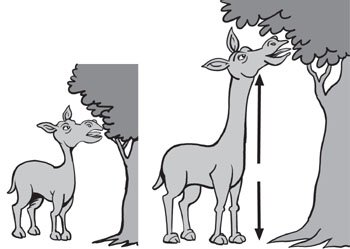
In France, and at the same time as Erasmus, Jean Baptiste Lamarck developed his theories of the origin and evolution of life. Initially, he had argued for the immutability of species, but in his later works he laid out a clear alternative to the special creation of plants and animals. Lamarck believed that the geology of the Earth was the result of gradual processes acting over vast periods of time—a view later to be known as uniformitarianism. Lamarck developed four laws of evolution and put them forward in his Philosophie Zoologique published in 1809. Lamarck proposed that an internal force and the need for new organs caused creatures to develop new characteristics. Once developed, the use or disuse of the organs would determine how they would be passed on to a creature’s offspring. This idea of the transmission or inheritance of acquired characteristics is the hallmark of this model of evolution.

Lamarckian EvolutionIn Lamarckian evolution, animals change due to environmental factors and the use or disuse of a feature. For example, a giraffe’s neck will get longer over time as it continually stretches it to reach higher leaves on trees.

Lamarck’s mechanism of use and disuse of characters was widely rejected in his lifetime, especially by the prominent French naturalist Georges Cuvier, and was never supported by observations. Lamarck did attempt to explain how the characteristics were inherited, but there was still no clear biological mechanism of inheritance that would support his claims. Lamarck also proposed a tree of life with various branching structures that showed how life evolved from simple to complex forms. Much of what Lamarck proposed seems unreasonable to us today with a modern understanding of genetics. A husband and wife who are both bodybuilders will not have an extraordinarily muscular child—that acquired trait does not have any affect on the genetic information in the germ cells of the parents’ bodies. However, recent research has revealed instances of bacterial inheritance that appear to be very Lamarckian in nature. Future research in this area may reveal that Lamarck was correct to some degree. But there are many good reasons to expect that this would provide no support for the idea of molecules-to-man evolution.8

Darwinian Evolution

Charles Darwin was at least familiar with all of these different views, and their influence can be found throughout his writings. Darwin often referred to the effects of natural selection along with the use or disuse of the parts. The legs and wings of the ostrich, the absence of feet and wings in beetles, and the absence of eyes in moles and cave-dwelling animals are all mentioned by Darwin as a result of use or disuse alongside natural selection.9 Exactly how this process happened was a mystery to Darwin. He proposed the idea of “pangenesis” as the mechanism of passing traits from parent to offspring. This idea is not significantly different from Lamarck’s, for it relies on the use and disuse of organs and structures that are passed on to offspring through pangenes over vast ages.

Natural Select + Millions of YearsDarwin originally proposed that natural selection would be the primary mechanism acting to change organisms over millions of years. He was not aware of the role of mutations in heredity.

In his work The Variation of Animals and Plants under Domestication, Darwin suggested that gemmules are shed by body cells, and that the combination of these gemmules would determine the appearance and constitution of the offspring. If the parent had a long neck, then more gemmules for a long neck would be passed to the offspring. In Darwin’s defense, he was not aware of the work of his contemporary, Gregor Mendel. In his garden in the Czech lands, Mendel was studying the heredity of pea plants. Neither man knew of the existence of genes, or the DNA genes are composed of, but both of them understood there was a factor involved in transmitting characteristics from one generation to the next. Despite evidence from experiments conducted by his cousin Francis Galton, Darwin clung to his pangenesis hypothesis and defended it in his later work Descent of Man.

Darwin believed that all organisms had evolved by natural processes over vast expanses of time. In the introduction to Origin of Species he wrote the following:

As many more individuals of each species are born than can possibly survive; and as, consequently, there is a frequently recurring struggle for existence, it follows that any being, if it vary however slightly in any manner profitable to itself, under the complex and sometimes varying conditions of life, will have a better chance of surviving, and thus be naturally selected. From the strong principle of inheritance, any selected variety will tend to propagate its new and modified form.10

Darwin’s belief that slight modifications were selected to produce big changes in organisms over the course of millions of years was the foundation of his model for the evolution of life on Earth. We know today that Darwin’s notion of gemmules and pangenes leading to new features or the development of enhanced characteristics is a false notion. However, that does not mean, by itself, that Darwin’s conclusion is wrong—just that his reasoning was faulty.

Neo-Darwinian Evolution and the Modern Synthesis

The discovery of DNA and the rediscovery of Mendel’s work on heredity in pea plants have shown that Darwin’s hereditary mechanism does not work. But his conclusion of molecules-to-man transformation over millions of years is still held as true by proponents of evolution. In the early 20th century, Mendelian genetics was rediscovered and it came to be understood that DNA was responsible for the transmission and storage of hereditary information. The scientific majority was still fixed on a naturalistic explanation for the evolution of organisms. That evolution happened was never a question—finding the mechanism was the goal of these naturalistic scientists.

Mutation of genetic information came to be viewed as the likely mechanism for providing the raw material for natural selection to act on. Combining genetic studies of creatures in the lab and in the wild, models of speciation and change over time were developed and used to explain what was seen in the present. These small changes that resulted from mutations were believed to provide the genetic diversity that would lead to new forms over eons of time. This small change was referred to as “microevolution” since it involved small changes over a short amount of time. The evolutionists claim that the small changes add up to big changes over millions of years, leading to new kinds of life. Thus, microevolution leads to “macroevolution” in the evolutionary view. However, the acceptance of these terms just leads to confusion, and they should be avoided.

Natural Select + Millions of Years + MutationAfter the discovery of DNA and its role in inheritance, evolutionists pointed to mutations in the DNA as the source for new traits. These accidental mutations provide differences in the offspring that can be selected for. This selection is believed to lead to new kinds of life.
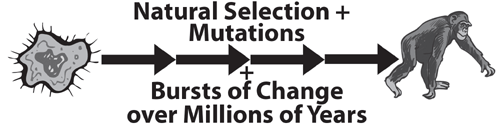
This is not fundamentally different from what Charles Darwin taught; it simply uses a different mechanism to explain the process. The problem is that the change in speciation and adaptation is heading in the opposite direction needed for macroevolution. The small changes seen in species as they adapt to their environments and form new species through mutation are the result of losses of information. Darwinian evolution requires the addition of traits (such as forelimbs changing into wings, and scales turning into feathers in dinosaur-to-bird evolution), which requires the addition of new information. Selecting from information that is already present in the genome and that was damaged through copying mistakes in the genes cannot be the process that adds new information to the genome.

IT HAS BECOME SO PLASTIC THAT IT CAN BE MOLDED TO EXPLAIN ANY EVIDENCE, NO MATTER HOW INCONSISTENT THE EXPLANATIONS MAY BECOME.

Today, evolution has been combined with the study of embryology, genetics, the fossil record, molecular structures, plate tectonics, radiometric dating, anthropology, forensics, population studies, psychology, brain chemistry, etc. This leads to the intertwining of so many different ideas that the modern view of evolution can explain anything. It has become so plastic that it can be molded to explain any evidence, no matter how inconsistent the explanations may become. Even Darwin was willing to admit that there may be evidence that would invalidate his hypothesis. That is no longer the view held by the vast majority of evolutionists today—evolution has become a fact, even a scientific law (on par with the law of gravity), in the minds of many.

To help us see this more clearly, let us take a look at the idea of different races. Darwin published his views on the different races in Descent of Man. Though Darwin spoke against slavery, he clearly believed that the different people groups around the world were the result of various levels of evolutionary development. Darwin wrote the following:

At some future period, not very distant as measured by centuries, the civilized races of man will almost certainly exterminate and replace the savage races throughout the world. At the same time the anthropomorphous apes . . . will no doubt be exterminated. The break between man and his nearest allies will then be wider, for it will intervene between man in a more civilized state, as we may hope, even than the Caucasian, and some ape as low as a baboon, instead of as now between the negro or Australian [Aborigine] and the gorilla.11

This is the conclusion Darwin came to—that different rates of evolution would lead to different classes of humans. He often refers to the distinction between the civilized Europeans and the savages of various areas of the world. He concludes that some of these savages are so closely related to apes that there is no clear dividing line in human history “where the term ‘man’ ought to be used.”12 Consistent with his naturalistic view of the world, Darwin saw various groups of humans, whether they are distinct species or not, as less advanced than others. This naturally leads to racist attitudes and, as Dr. Stephen J. Gould noted, biological arguments for racism “increased by orders of magnitude following the acceptance of evolutionary theory,”13 though this was likely only an excuse to act on underlying social prejudices.

Dr. James Watson (co-discoverer of the double-helix structure of the DNA molecule and a leading atheistic evolutionist) was caught in a storm of evolutionary racism in 2007. The Times of London reported the following in an interview:

He says that he is “inherently gloomy about the prospect of Africa” because “all our social policies are based on the fact that their intelligence is the same as ours—whereas all the testing says not really,” and I know that this “hot potato” is going to be difficult to address. His hope is that everyone is equal, but he counters that “people who have to deal with black employees find this not true.” He says that you should not discriminate on the basis of colour, because “there are many people of colour who are very talented, but don’t promote them when they haven’t succeeded at the lower level.” He writes, “there is no firm reason to anticipate that the intellectual capacities of peoples geographically separated in their evolution should prove to have evolved identically. Our wanting to reserve equal powers of reason as some universal heritage of humanity will not be enough to make it so.”14

Though he later stated that he did not intend to imply that black Africans are genetically inferior, he is being consistent with his evolutionary beliefs. His remarks were considered offensive, even by those who endorse evolution.

THOSE WHO WOULD SUGGEST THAT EVOLUTION CAN EXPLAIN WHY ALL HUMANS HAVE VALUE MUST BATTLE AGAINST THOSE EVOLUTIONISTS WHO WOULD DISAGREE.

This exposes an inconsistency in the thinking of many evolutionists today—if we evolved by random chance, we are nothing special. If humans evolved, it is only reasonable to conclude that different groups have evolved at different rates and with different abilities, and mental ability could be higher in one group than another. If the data supported this claim, in the evolutionary framework, then it should be embraced. Those who would suggest that evolution can explain why all humans have value must battle against those evolutionists who would disagree. This exposes the inconsistent and plastic nature of evolution as an overarching framework—who gets to decide what evolution should mean? Darwin and Watson are applying the concepts in a consistent way and setting emotion and political correctness aside, when it is deemed necessary. Darwin noted that “it is only our natural prejudice and . . . arrogance” that lead us to believe we are special in the animal world.15

Without an objective standard, such as that provided by the Bible, the value and dignity of human beings are left up to the opinions of people and their biased interpretations of the world around us. God tells us through His Word that each human has dignity and is a special part of the creation because each one is made in the image of God. We are all of “one blood” in a line descended from Adam, the first man, who was made distinct from all animals and was not made by modifying any previously existing animal (Genesis 2:7).

Saltation and Punctuated Equilibrium

Contrasted with Darwin’s view of a gradual process of change acting over vast ages of time, others have seen the history of life on Earth as one of giant leaps of rapid evolutionary change sprinkled through the millions of years. Darwin noted that the fossil record seemed to be missing the transitions from one kind of organism to the next that would confirm his gradualistic notion of evolution. Shortly after Darwin, there were proponents of evolutionary saltation—the notion that evolution happens in great leaps. The almost complete absence of transitional forms in the fossil record seemed to support this saltation concept and this was later coupled with genetics to provide a mechanism where “hopeful monsters” would appear and almost instantaneously produce a new kind of creature (e.g., changing a reptile into a bird). These “monsters” would be the foundation for new kinds of animals.

Saltation fell out of favor, but the inconsistency between the fossil record and the gradualism promoted by Darwin and others was still a problem. The work of Ernst Mayr, Stephen J. Gould, and Niles Eldredge was the foundation for the model of “punctuated equilibrium.” This model explained great periods of stasis in the fossil record punctuated with occasional periods of rapid change in small populations of a certain kind of creature. This rapid change is relative to the geologic time scale—acting over tens of thousands of years rather than millions. This idea is not inconsistent with Darwin’s grand evolutionary scheme. However, it seems that Darwin did not anticipate such a mechanism, though he commented that different organisms would have evolved at different rates. Whether evolution has occurred by gradual steps or rapid leaps (or some combination) is still a topic of debate among those who hold to the neo-Darwinian synthesis of mutations and natural selection as the driving forces of evolutionary change.

Natural Select + Millions of Years + Mutation + Bursts of ChangeContrary to Neo-Darwinism, punctuated equilibrium tries to account for the lack of fossil intermediates by appealing to rapid bursts of change interspersed in the millions of years. They still rely on mutations and natural selection, but at a much faster rate.
Conclusion

Sir Isaac Newton provided us with a general theory of gravity (and described laws in support of that theory) based on observational science. Even in light of modern understandings, those laws still apply today. Einstein did expand the concepts, but the functionality of Newtonian physics still applies today as much as ever.

WHAT IS CALLED DARWINISM TODAY BEARS LITTLE RESEMBLANCE TO WHAT DARWIN ACTUALLY WROTE.

The same cannot be said for Darwin’s ideas. Darwin’s hypothesized mechanism of natural selection (even with the added understanding of mutations) has failed to provide an explanation for the origin and diversity of life we see on Earth today. His confident expectation that the fossil record would confirm his hypothesis has utterly failed, and the mind-boggling irreducible complexity seen in biological systems today defies the explanations of Darwin or his disciples. To say that evolutionary thinking today is Darwinian in nature can only mean that evolutionists believe that life has evolved from simpler to complex over time. Beyond that, what is called Darwinism today bears little resemblance to what Darwin actually wrote.

All of these ideas of the evolution of organisms from simple to complex are contrary to the clear teaching of Scripture that God made separate kinds of plants and animals and one kind of man, each to reproduce after its own kind. As such, these evolutionary ideas are bound to fail when attempting to describe the history of life and to predict the future changes to kinds of life in this universe where we live. When we start our thinking with the Bible, we can know we are starting on solid ground. Both the fossil record and the study of how plants, animals, and people change in the present fit perfectly with what the Bible says about Creation, the Flood, and the Tower of Babel in Genesis 1–11. The Bible makes sense of the world around us.

The New Answers Book 3

The New Answers Book 3

Do you have answers to the big questions about the Christian faith, evolution, creation, and the biblical worldview? Now you get the important information you need regarding the existence of God, global warming and climate change, cloning and stem cells, human and chimp DNA, the importance of Mount St. Helens, and more.

Read Online Buy Book

Footnotes

  1. For an explanation of some of the contradictions between the biblical creation account and the widely held evolution story, see the article “Evolution vs. Creation: The Order of Events Matters!” atwww.answersingenesis.org/articles/2006/04/04/order-of-events-matters.
  2. Sharon Kaye, “Was There No Evolutionary Thought in the Middle Ages? The Case of William of Ockham,” British Journal for the History of Philosophy 14 no. 2 (2006): 225–244.
  3. Henry Fairfield Osborn, From the Greeks to Darwin (London: Macmillan, 1913), p. 43–56.
  4. Erasmus Darwin, The Temple of Nature (London: Jones & Company, 1825), p. 13.
  5. Ibid., p. 14–15.
  6. Modernism was the dominant philosophy in Western culture from the late 18th to the late 20th centuries. This philosophy placed science as the supreme authority for determining truth. Science was viewed as the “savior” of mankind—eventually finding cures for all diseases, ending war, famine, etc. Though it has been largely replaced by post-modernism, this modernist thinking is still very prominent among scientists and many others in our culture. Post-modernism, on the other hand, is a radical skepticism about anyone’s ability to know truth. Post-modernists argue that truth and morality are relative—there are no absolutes. It also reflects disenchantment with the promises made by modernist philosophers and scientists. Both philosophies reject Scripture as authoritative truth and are based on evolutionary thinking.
  7. Erasmus Darwin, Zoonomia, volume 1 (Philadelphia, PA: Edward Earle, 1818), p. 397.
  8. Even if Lamarckian mechanisms are uncovered, the fossil record would not support the evolution story. See Duane Gish, Evolution: The Fossils Still Say No, (Santee, CA: Institute for Creation Research, 1996); Carl Werner,Evolution: The Grand Experiment, vol. 1 (Green Forest, AR: New Leaf Press, 2007); and Living Fossils, vol. 2 (Green Forest, AR: New Leaf Press, 2008). Natural selection can only “select” from existing genetic information (it cannot create new information), and mutations cause a loss or reshuffling of existing genetic information. See Terry Mortenson’s DVD Origin of the Species: Was Darwin Right? (Answers in Genesis, 2007) and John Sanford,Genetic Entropy and the Mystery of the Genome (Lima NY: Elim Publishing, 2005). Also, what bacteria can do should not be directly applied to other forms of life because bacteria are categorically and significantly different. This is explained in Georgia Purdom’s DVD All Creatures Great and Small: Microbes and Creation (Petersburg, KY: Answers in Genesis, 2009).
  9. Charles Darwin, The Origin of Species (New York, NY: The Modern Library, 1993), p. 175–181.
  10. Ibid., p. 21.
  11. Charles Darwin, The Origin of Species and The Descent of Man (New York, NY: The Modern Library, 1936), p. 521.
  12. Ibid., p. 541.
  13. Stephen Jay Gould, Ontogeny and Phylogeny (Cambridge, MA: Belknap Press of Harvard University Press, 1977), p. 127.
  14. Charlotte Hunt-Grubbe, “The Elementary DNA of Dr Watson,” Times Online [London], October 14, 2007, http://www.entertainment.timesonline.co.uk/tol/arts_and_entertainment/books/article2630748.ece.
  15. Darwin, The Origin of Species and The Descent of Man, p. 411–412.

Recommended Resources

Masada

The featured picture is looking down from the top of Masada, in Israel, in the Negev desert. The fortress was built by Herod the Great. Herod earned “The Great”, because of his many impressive structures that he built in many places in Israel. Masada was intended by him as a place of refuge, but ended up being used by Zealots holding out against the Roman army.

The feature right in the center, that looks like a ramp? Well it’s because it is a ramp. The Romans built this ramp in order to get access to the fortress. Which they finally did, only to find that all the defenders had committed suicide. It is staggering to imagine how day after day the Romans are building this ramp, right under the view of the defenders. Equally staggering on the part of the defenders, knowing that day by day their doom was right below them.

14_16The square outlines are where the Roman Army encampments were while they conducted the siege of Masada.

13_15This is a picture of the interior of Masada, at the top of the mountain.

05_7The Negev desert from the top of Masada, in the direction of the Dead Sea.

20_22A storm building over  the Negev and I believe, that this is in the direction of Egypt. While we were there a factory was blown up by a missile fired from the Gaza strip. We could see the smoke, and there were a lot of military aircraft overhead while we were in the area.

04_6I really have a lot of respect for the country and the people of Israel. I still stay in contact with a few people there. They live under tough conditions and I thought this was an inspiring picture, a reminder of those who defended this fortress and their 21st century descendants who defend their tiny country.

Let’s start becoming discerning, serious Christians and push back against the silliness of the world.

Yea, this is going to sound smug and smarmy, well there’s a reason, when this book came out I couldn’t believe that anyone could have taken this whole thing seriously to begin with. Furthermore, I hope that any reader notes the continued hypocrisy of the main steam media. When this book/movie came out, this story was plastered everywhere over the main-stream media. “Hey don’t try to confuse me with the facts”, the story, as most of the main-stream media, was a mile wide and an inch thick. The book was published by Tyndale and I honestly have to wonder what Tyndale was thinking about publishing this nonsense. I know this is low, but I can’t help to make the observation that the author and subject’s last name is Malarkey, hmmm, yea, I know, sorry.

Quoting a story in the Washington Post, Alex’s  mother Beth posted this in her blog back in April:

“Alex’s mother posted a statement on her blog objecting to the memoir and its promotion: “It is both puzzling and painful to watch the book ‘The Boy Who Came Back from Heaven’ not only continue to sell, but to continue, for the most part, to not be questioned.” She goes on to say that the book is not “Biblically sound” and that her son’s objections to it have been ignored and repressed. She also notes that Alex “has not received monies from the book nor have a majority of his needs been funded by it.” (Ron Charles ” The Boy Who Came Back From Heaven” Washington Post Jan 16, 2015  http://www.washingtonpost.com/blogs/style-blog/wp/2015/01/15/boy-who-came-back-from-heaven-going-back-to-publisher/)

The main-stream media looks dumb, but frankly it makes “Christians” look like a bunch of naive suckers who really don’t even buy what they profess and really want a sweet, fluffy, phoney version of Christianity.

I submit the following:

In an open letter, the self-described “boy who did not come back from heaven” wrote:

Please forgive the brevity, but because of my limitations I have to keep this short.

I did not die. I did not go to heaven.

I said I went to heaven because I thought it would get me attention. When I made the claims that I did, I had never read the Bible. People have profited from lies, and continue to. They should read the Bible, which is enough. The Bible is the only source of truth. Anything written by man cannot be infallible.

It is only through repentance of your sins and a belief in Jesus as the Son of God, who died for your sins (even though he committed none of his own) so that you can be forgiven may you learn of heaven outside of what is written in the Bible . . . not by reading a work of man. I want the whole world to know that the Bible is sufficient. Those who market these materials must be called to repent and hold the Bible as enough.

In Christ,

Alex Malarkey

Hey, kudos to the kid for standing up and taking the heat, although I can’t see anyone really holding the kid up to censure, but his father, listed as a Christian counselor. And, not surprising to me, they attend a non-denominational church. The following is the description that’s, still, on Amazon:

“In 2004, Kevin Malarkey and his six-year-old son, Alex, suffered an horrific car accident. The impact from the crash paralyzed Alex—and medically speaking, it was unlikely that he could survive. “I think that Alex has gone to be with Jesus,” a friend told the stricken dad. But two months later, Alex awoke from a coma with an incredible story to share. Of events at the accident scene and in the hospital while he was unconscious. Of the angels who took him through the gates of heaven itself. Of the unearthly music that sounded just terrible to a six-year-old. And most amazing of all . . . of meeting and talking to Jesus. The Boy Who Came Back from Heaven is the New York Times bestselling true story of an ordinary boy’s most extraordinary journey. As you see heaven and earth through Alex’s eyes, you’ll come away with new insights on miracles, life beyond this world, and the power of a father’s love.” I mean WOW, I’m going to have to get my hip-waders to get through that.

Kevin MalarkeyKevin  Malarkey

I found this glowing endorsement for a Christian pastor about an appearance by Kevin:

“We recently had Kevin Malarkey come to speak at our church. We found that as we advertised the story of “The Boy Who Came Back from Heaven” it immediately gripped the community’s attention. People want to know about life after death. This is a fantastic message about God’s awesome power, and the reality of heaven. If you didn’t believe before, you’ll have trouble not believing after. We showed the documentary of Alex’s story to our church two weeks before his father Kevin came to speak at our church and it really stirred up our congregation to invite their friends and family. As a result of all the advertising and personal invitations we drew in the largest crowd of people we have ever had visit our church.”
Pastor Rob Scarallo – Christian Family Outreach Center – Tampa, FL – See more at: http://www.ambassadorspeakers.com/ACP/speakers.aspx?name=Kevin%20Malarkey&speaker=1390#sthash.RbCfiXlK.dpuf

How about just wow. Kind of goes to show you how much uncritical thinking there is out there, I mean really a Christian “pastor”?! So what about “Heaven Is For Real” a four year old boy’s claim of going to heaven? Yea, sorry, not buying, but hey let’s see how that plays out. I mean really? On its face a four year old’s version of anything?

Listen, if you really are a Christian, you are called to be discerning. This goofy idea that as good “Christians” we are just supposed to paste on smiles and buy anything that comes down the pike in the name of “tolerance”. The word “tolerance” is not used in the Bible, the word “tolerate” is used twice, both negatively, Esther 3:8, Revelation 2:20 but it certainly does talk about discernment: “Do not be conformed to this world, but be transformed by the renewal of your mind, that by testing you may discern what is the will of God, what is good and acceptable and perfect.” (Romans 12:2 ESV)

“Let no one deceive you with empty words, for because of these things the wrath of God comes upon the sons of disobedience. Therefore do not associate with them; for at one time you were darkness, but now you are light in the Lord. Walk as children of light (for the fruit of light is found in all that is good and right and true), and try to discern what is pleasing to the Lord.” (Ephesians  5: 6-10 ESV)

Let’s get serious, we are under constant attack. Attack doesn’t mean violence necessarily, usually it’s more undermining. We have to study Scripture, know what we are talking about, go to worship to be built up in our faith. Take the Body and Blood of the Lord. Take serious time in prayer. What we are called to do is to be discerning. We are called to be faithful to the revealed word of God and not to the world’s, let’s start getting serious and get rid of the nonsense in the world.