Category Archives: Uncategorized

A new paradigm of Christian pastoral leadership

Please don’t misconstrue what I’m about, this isn’t bitterness, this isn’t angst. If anything it’s more on the level of  disquiet. You have highly educated pastors, but people who really don’t know how to lead. If anything pastors genuinely feel it’s not up to them to lead, they leave it to laity that are even less qualified and yes, you really get the blind leading the blind. Yes, there are churches that have qualified, experienced lay people in leadership and pastors who can not only preach and teach, and exercise some degree of leadership and there is a mutual respect, the potential to work together effectively. These are very rare situations. It seems to me, as I see other churches, is that there is a laity who really have very little clue and a pastor, who has never done anything else in his life, has been brought up to believe that he really does sit and think great thoughts and then goes back into his pastor’s study until he’s trotted out again on Sundays. Some seem to not even do that.

There has to be some semblance of reality. More and more the church is declining because it is taken less and less seriously and mostly because of such a bankruptcy of leadership. There’s either passivity, shilling, patronizing, or being good time Charlie. It’s pretty hard for men to take seriously the church as it is being presently led. Being a Christian is not about emotionalism, yet most pastors indulge emotionalism as the quick and easy solution. Just as bad, up until the 1960s there were pastors who were the complete opposite, autocrats who were equally unqualified and having some odd self-perception that they did know everything.

OK, I am generalizing, but generalities come about because the evidence starts to become compelling. The church has lurched from one silly extreme to another. Too many pastors took advantage of uncritical congregations because neither knew any better. The pastors went about imposing petty nonsense as “Christianity” and expected the congregation to jump through hoops. The tide turns and now the congregations expect the pastor to jump, the laity exercise leadership and are at least just as clueless. In the last fifty years we have congregations who were/are theologically clueless and expected to impose on a clueless/compliant pastor their each individual whims, businesspeople who “knew” the church should be run like a business, all expected to be entertained and not accept leadership or instruction from the pastor (who way too often only had academic qualifications and nothing else), who didn’t know how to practically apply the academic training, so no need for it and never grew out of it.

One can see why people, accomplished in other fields (or at least who thought they were), who were loathe to accept directions from an otherwise incapable pastor. Instead of pushing the pastor to exert ecclesiastical leadership, and Luther certainly expected pastors to exercise leadership, he did and by example, the laity filled the vacuum, despite lack of qualification. Since the pastor couldn’t/wouldn’t, the laity did, having some belief to the effect “how hard could it by?”. You had people who couldn’t tell you the “solas”, the basics of the faith, but since the pastor was an entertainer and not a teacher, the fundamentals of the faith just couldn’t be that important.

The new paradigm has to be this and especially in terms of renewal efforts being undertaken in the downtown old “cathedrals”. It is time for pastors to step up, be professional pastors, versus the smiley/accommodating stereotype. Pastors need to knowledgeably assert control, lead, push when necessary all those in the church to start becoming mature Christians, even, wow, disciples of Christ. The “Old Guard” laity and yes even some clergy needs to understand that the old paradigm has been failing for decades, backoff and support the new paradigm, even through the “discomfort”. Might that require breaking up the old guard? Certainly the desirable outcome would be overall acceptance and a unified front to move the church ahead. Certainly it’s up to the pastor to be open, accessible, willing to go as far as possible, but not back to the old paradigm or the failed practices of the last fifty years. Certainly we want to try to balance the old and new, do as much as can be done, but to what end, giving up on the faction that just won’t move and accept?

The pastor needs to keep asserting leadership towards a positive goal, quit playing, accept that there are going to be losses and yes, even up to conflict. The church is not a business, we’re not in the people pleasing business, we’re in the building mature Christian disciples business. While we’re trying to be faithful, that entails trusting God while we deal with whatever the fallout. Are we going to be serious, or continue to slide into country clubs that have been failing for fifty years.

Paul certainly had no compunction calling out the Corinthians and Galatians, at least. They had all kinds of issues and Paul did not pull any punches holding them accountable. We have to follow Paul’s model and stop trying to be the intellectual, complacent, indulgent patsy that too many people see pastors as now, a model that has just wreaked havoc on the church. Paul certainly demanded those churches to cut the nonsense and doing what he could to lead churches back to true Christian integrity. Playing church is not doing anyone any favors. I frankly take seriously that I’m going to be held even more accountable and I intend to be able to tell God I exercised as much integrity as I could to build disciples and not patronize audiences. It’s up to the pastor to lead the church to be a genuine Christian catholic and apostolic church and not just a “feel good” zone.

Lay people do yourself a big favor, expect to be led by a pastor who will assert true pastoral leadership a la St Paul of Tarsus, to make true Christian disciples. Support him and encourage him. It worked for Paul it can work for you. If he is just going to be an enabling, feel good guy, get yourself another man, yes a man!

This Tortise finally won one!

I did it! I’ve been competing (putting it charitably), in triathlons since 1985, and I finally medaled! I accomplished another goal in this particular race too. I drove all the way to Hammond, In. to do Leon’s Triathlon. I have now done races from Maine to Kansas and south to North Carolina. Leon’s Triathlon has also been the site of the U.S. Military triathlon championship and also as part of the race spotlighted the anniversary of the USO. Being retired military I did appreciate the emphasis on military in this race.

Now triathlons have different categories, not always the same, but age group categories always. Some races, like Leon’s, has a military and/or public safety category and many have a Clydesdale category, I finished second in the Clydesdale category. Hey it’s something and I finally hit it. Clydesdales are triathletes that are over 200 lbs and yea I more than qualify. Leons Tri 2nd place medal clydesdale divisionThe medal in the middle is the finishers medal, the medal off screen is the silver medal (I’ve been messing with it and I can’t line it up).


It was a lake swim and nice flat run and bike. Doing all my training in the hills all around me in south/central Pennsylvania, it is definitely pushing me. Leon’s was a really well run race. I’d like to do it again, but driving all the way to Indiana isn’t real practical and there are other states (West Virginia, Kentucky, South Carolina) that are closer that I haven’t done. Hey maybe I can follow up this medal win with a sponsor, a summer of triathlons starting in the south, through the midwest, ending in Bermuda, oh yeah!!

I would like to thank the folks at Leon’s for a really good race and a nice excuse for a short getaway with my wife. And very thankful for helping me finally get something for the mantle after 30 years of trying.

Leons ILeons II


Leons III(Please note the flags that were all around the course) I am not trying to say that I all of a sudden received a huge influx of energy or talent, but I just finished reading Meredith Atwood’s inspirational article in Triathlete Magazine (September 2016, p 23). “The Hare sometimes allows the ego and objective speed to get the best of him. the Tortoise can get discouraged for a million other reasons. The best bet is to have faith in yourself, [as a Christian I would also say God’s will for me too] and be proud of all of your efforts and races – but to always ask yourself if you are doing the best you can with what you have. I challenge my fellow Tortoises of the world to really push themselves in the next running race or workout. Ask yourself if you can channel your inner Hare, just for a little while, and see what you are made of. You might be surprised and learn to believe that ‘fast for you’ is sometimes exactly all the fast you need.”  Leons IV

I stuck with it and because of a few factors, yea I finally did it. I would hope that people would pick a passion and really stick with it. Even if “channeling” doesn’t get you a medal, I have really enjoyed triathlon and the other goals that I’ve set for it. I guess I could add to my trophy mantle of 1 (including a few finishers medals), a map of the U.S. showing the states that I have competed in. I’m going to keep doing it, maybe things will line up again, but just as important, I’m doing it.

Leons Tri VI


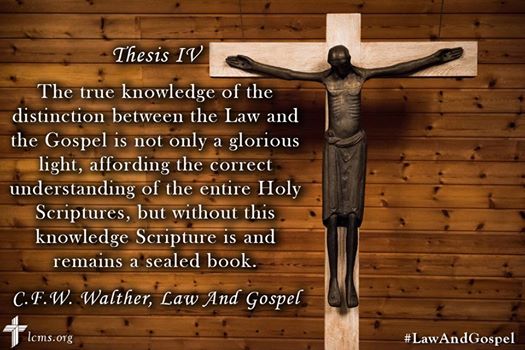
How to Read Your Bible: Law and Gospel By Nicholas Davis on Jul 31, 2016 in Bible

930x480_ImpWordsLawGospelThere are two words that every Christian needs to know in order to rightly interpret the Scriptures and live the Christian life without confusion. These two words are Law andGospel. They belong in everyone’s vocabulary for the Christian life and are the key to opening God’s Word.

1. Law

930x480_ImpWordsLawGospel_1

The law is a word that comes to us from within, and it is written on everyone’s heart (Rom. 2:15). It was once written on stone tablets in Israel’s history, and in the history of man it is inscribed on the conscience. Everyone gets law, and everyone prescribes law to others. When you ask a friend for some advice, the first words spoken are often words of doing. Do this. Don’t do that. The law brings no hope of relief but only tells us where we’ve gone wrong and what we need to do in order to make things right (Rom. 3:19–20). The law says, “Do this and live” (Lev. 18:5; Gal. 3:12).

It’s not that the law is bad. In fact, the law itself is good because it comes from God and is a reflection of his good character. The apostle Paul even says, the “law is spiritual” (Rom. 7:14). So we know that the problem is not with the law, but the problem is with us. As Paul concludes, although “the law is spiritual” but “I am of the flesh, sold under sin” (Rom. 7:14). We are bad—the law exposes our sin—and that’s why the law becomes bad news for us.

2. Gospel

930x480_ImpWordsLawGospel_2

The gospel is a word that comes to us from outside of us, and it has been revealed by God in his Christ. This word must be spoken, and it is the good news of what God has done in Christ to reconcile us to himself—to satisfy all of the demands of the law and to make atonement for all sins committed. What the law required, Jesus Christ has accomplished. What the law demanded, Jesus has satisfied. The gospel says, “Believe this, and it is done already.” Jesus’ final words on the cross are appropriate to summarize the good news of the gospel: “It is finished!” (John 19:30).

Whenever you read a verse, you can immediately tell whether it is law or gospel by either the demands it makes upon you or the promise it offers you. The law commands you to do something, or to stop doing something. The gospel, however, tells you what God has done for you, or what he will do for you. What separates the teaching ofChristianity from every other world religion is that the Bible reveals to us how the law can never save us; only Jesus can. No other religion tells us that God has done what we could not do for ourselves. No other religion offers us the gospel: the free grace of God in Jesus Christ. “Thanks be to God through Jesus Christ our Lord!” (Rom. 7:25).

Scientism, Values, and the Public Interest Sarah Chaffee July 29, 2016 10:44 AM | Permalink

Tyson_&_Kepler_team.jpg

Over at The American Conservative, Rod Dreher comments on a recent post by John Michael Greer, who writes The Archdruid Report. Despite their vastly differing worldviews (conservative Christian vs. druid!), Greer and Dreher agree on this: There are many questions that science can’t answer, not least about politics. Neil deGrasse Tyson is a case in point. Dreher’s headline says it all: “Scientists Make Terrible Politicians.”

Why should this be?

First, scientific and political reasoning are very different. Democracy is based on compromise between competing interests and values. One cannot use scientific reasoning to arrive at values. What science does is continually try to disprove hypotheses. It’s not about finding a workable compromise. Greer:

If you’re Lavoisier and you’re trying to figure out how combustion works, you don’t say, hey, here’s the oxygenation theory and there’s the phlogiston theory, let’s agree that half of combustion happens one way and the other half the other; you work out an experiment that will disprove one of them, and accept its verdict. What’s inadmissible in science, though, is the heart of competent politics.

One of the great intellectual crises of the ancient world, in turn, was the discovery that logic was not the solution to every human problem. A similar crisis hangs over the modern world, as claims that science can solve all human problems prove increasingly hard to defend, and the shrill insistence by figures such as Tyson that it just ain’t so should be read as evidence for the imminence of real trouble.

In other words, he’s talking about scientism, which is something we’vecommented on extensively in the past. Dreher also cites science writer Thomas Burnett:

Scientism today is alive and well, as evidenced by the statements of our celebrity scientists:

“The Cosmos is all that is or ever was or ever will be.” — Carl Sagan, Cosmos

“The more the universe seems comprehensible, the more it also seems pointless.” — Stephen Weinberg, The First Three Minutes

“We can be proud as a species because, having discovered that we are alone, we owe the gods very little.” — E.O. Wilson, Consilience

While these men are certainly entitled to their personal opinions and the freedom to express them, the fact that they make such bold claims in their popular science literature blurs the line between solid, evidence-based science, and rampant philosophical speculation. Whether one agrees with the sentiments of these scientists or not, the result of these public pronouncements has served to alienate a large segment of American society.

Maybe this is a good reason to think twice about controversial scientific issues. Scientism, which Dreher calls “the ideologically charged fallacious belief that science is the only legitimate way of knowledge,” animates those large scientific bodies that marginalize scientists with dissenting views on certain controversial questions. Discriminating against these minority scientists helps alienate that “large segment of American society” that Burnett worries about.

A 2016 survey probing attitudes about academic freedom suggests as much. Of respondents, 84 percent said that “attempts to censor or punish scientists for holding dissenting views on issues such as evolution or climate change are not appropriate in a free society.” Similarly, 86 percent affirmed that “disagreeing with the current majority view in science can be an important step in the development of new insights and discoveries in science.” And 88 percent said that “scientists who raise scientific criticisms of evolution should have the freedom to make their arguments without being subjected to censorship or discrimination.”

Scientism, it seems, is more problematic, in more ways, than some observers have realized.

Photo: Neil deGrasse Tyson, by NASA Ames Research Center [Public domain],via Wikimedia Commons.

Christ and the Office of the Holy Ministry by Rev James Lee

Posted July 9, 2016

by Rev. James Lee

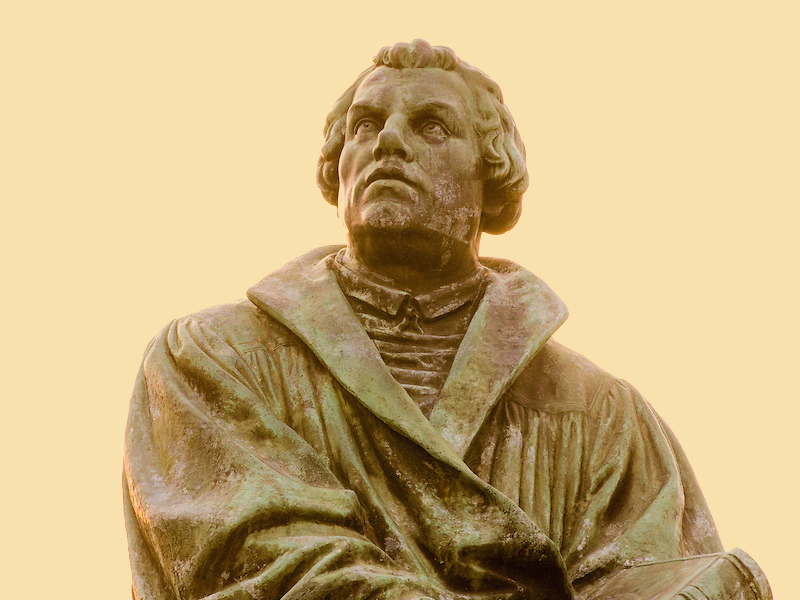
ref-reformationrememberedHistorical caricatures of Martin Luther often emphasize certain dramatic moments in the life of the Augustinian friar, such as the posting of the 95 Theses, or Luther’s defense of his teaching at the Diet of Worms. While these scenes are fun to imagine and present easy factoids about Luther, they often fail to address the heart of Luther’s thought. A person might know the date of these events, perhaps even the role they played in the history of the Reformation, but that person would not necessarily understand Luther’s teaching and doctrine—what he believed was necessary to uphold and confess. In order to understand this, it is helpful to consider Luther’s 1537 Smalcald Articles, where Luther writes that the first and chief article of the Christian Church is Jesus Christ, and the doctrine of justification: “That Jesus Christ, our God and Lord, died for our sins, and was raised again for our justification.” Luther argues everything that the Church believes, confesses, and practices rest upon the Church’s confession of Jesus Christ and His work of justification.[1] Luther even goes as far as to advise the pastors of Lübeck, who are eager to correct errors and false teaching of the medieval Mass, to first give attention to Christ and justification. Luther writes,

“You should deal first with the center of our teaching and fix in the people’s minds what [they must know] about our justification; that is, that it is an extrinsic righteousness— indeed, it is Christ’s given to us through faith which come by grace to those who are first terrified by the law and who, struck by the consciousness of [their] sins ardently seek redemption.”[2]

Only after people have been instructed in the central article of Christ and justification, is any true reform possible.

Luther’s words to the clergy of Lübeck suggest an ordering and connection of the articles of faith. The life and essence of the Christian Church is found in Jesus Christ and His work of justification. The Reformation scholar and Lutheran theologian Robert Preus summarizes Luther in this manner:

“According to Luther, then, the justification of a sinner before God for Christ’s sake is not only the principal doctrine of Christianity, but also the very essence of it. Furthermore, it is really the essence of the gospel itself and of all Christian faith, the Leitmotiv of the Christian life and the reason for all that exists. It is the only doctrine or message which can offer a poor sinner hope, salvation, and life and fellowship with God.”[3]

Thus for Luther the confession of the person and work of Jesus Christ—His justification of sinful humanity—forms the heart of theology, and informs all of the Church’s confession and practice: it is the heart of the Church and it helps to shape and order the confession of the Church.

The centrality of the confession of Jesus and His work and its relationship to the whole of the Church’s confession is not simply an quirk of Luther’s own thought, but it becomes a hallmark of the Lutheran Church. In fact, the interrelationship of the person and work of Christ to the entirety of the Church’s confession shapes and structures the preeminent Lutheran text, the 1530 Augsburg Confession.

book-of-concord-faqThe Augsburg Confession begins with two preliminary articles on the Triune God and the nature of original sin (A.C. I and II). From here Philip Melanchthon, the author of the Augsburg Confession, directly moves to the person of Jesus Christ (Article III: Of the Son of God) and Christ’s proper salvific work (Article IV: Of Justification). At the forefront of the Augsburg Confession is a dual profession of faith in the person and work of Christ: “they teach that men cannot be justified before God by their own strength, merits, or works, but are freely justified for Christ’s sake, through faith. . . This faith God imputes for righteousness in His sight.”[4] Christ and the salvation won by Him are front and center in the Augsburg Confession. The Reformers see that there is an integral relationship between who Christ is and the work that He accomplishes. The Church’s confession follows this pairing of Christology and justification. To confess Christ also means to confess His justifying work.

Christology and justification go together—but the Augsburg Confession does not end there. Melanchthon ends the articles on Christ and justification on the subject of faith, specifically the imputation of justifying faith for the sake of Christ. And here it is necessary to follow Melanchthon’s theological path. Faith is presented at the end of the discussion of Christ and justification, Melanchthon uses the subject of faith and transitions into the next article:

“That we may obtain this faith, the Ministry of Teaching the Gospel and administering the Sacraments (Latin: institutum est ministerium docendi evangelii et porrigendi sacramenta; German: hat Gott das Predigtmant eingesezt, Evangelium und Sakramente gegeben) was instituted. For through the Word and Sacraments, as through instruments, the Holy Ghost is given, who works faith.”[5]

For Melanchthon and his fellow confessors of the Augsburg Confession the articles of Christology and justification are connected to the article on the Holy Ministry—and its points of connection are Christ and faith. Jesus is the one who has established the holy Office, and Christ has instituted this office for the purpose of faith; that is, the Holy Ministry is the means that Jesus uses to create faith through the preaching of His Word and the administration of His holy sacraments. This purpose is evident in the German term used for the office: das Predigtamt (the preaching office).

ref-anniverarypostThe ordering and connection of the articles of faith that was seen in Luther is also present in the Augsburg Confession. The Augustana is not arranged in a haphazard or arbitrary manner. On the contrary, Melanchthon presents a unified confession of Christ, justification, faith, and the Office of the Ministry. Order is important: Jesus is first. Christ and His justifying work are always chief. It is Christ who justifies. To Christ and His work is joined the Office of the Ministry, as the means through which this faith in Christ and His life-giving work is distributed. The Office of the Ministry—through the preaching of the Word and the administration of the Sacraments— is the tool that God uses to bring one into the relationship of faith in Jesus Christ.

The ordering of articles III, IV, and V in the Augsburg Confession is not immaterial. Our Lutheran Confessions and our Lutheran Fathers confessed Christology, justification, and the Office of the Ministry together. To be Lutheran, to join in confessing the Augsburg Confession, thus means to participate in jointly understanding and confessing together Christ, His work, and His Holy Ministry.


The Reverend James Ambrose Lee II is the assistant pastor of Trinity Lutheran Church, Worden, IL and doctoral candidate at Saint Louis University.

– See more at: http://lutheranreformation.org/theology/christ-office-holy-ministry/?utm_content=buffera69b7&utm_medium=social&utm_source=facebook.com&utm_campaign=buffer#sthash.jH8hLWBj.dpufhttp://buff.ly/29rSUgv

Martin Luther On Depression — More Than Coping

I’d like to drive home the point that depression and other mental illnesses are not an indictment on the person who is experiencing them. I’m following up words Charles Spurgeon had to say with another giant of the faith, Martin Luther. It is a fascinating read when you consider that Martin Luther came to […]

via Martin Luther On Depression — More Than Coping

Cristianos, nunca está solo 1 Reyes 19 First St John 26 de de junio de, el año 2016

[for the audio version click on the above icon]

Hacemos nuestro comienzo en el Nombre de Dios el Padre y en el nombre de Dios el Hijo y en el nombre de Dios el Espíritu Santo, y todos aquellos que saben que nunca están solos cuando están en Jesús dijo … AMEN!

Este domingo es reconocer Fondo de Extensión de la Iglesia Luterana. Con respecto a que yo quiero hablar de lo que LCEF hace en relación con el apoyo iglesias locales específicamente en términos de la administración. Tenemos muy buenos recursos asociados con la LCMS, todos son muy local y las fuentes de financiación y apoyo para las congregaciones locales. LCEF ofrece varios vehículos de inversión que también se utilizan para proporcionar programas como consagradas Stewards un programa que nos ayudará a crecer en nuestra administración de una manera más intencional y regular. Tenemos muy buenos recursos que creo que no son realmente utilizado tanto como deberían, a otro ser Thrivent Financial. Thrivent ofrece subvenciones de las actividades que están disponibles para los miembros de apoyo para ayudar a los alcances aquí, en primer lugar Saint Johns. Nos hemos beneficiado de esos programas, si usted es un miembro de Thrivent y no ha utilizado estos programas, por favor hágamelo saber y estaré encantado de ayudarle a acceder a estos programas en beneficio de los ministerios que estamos haciendo aquí. Si usted no utiliza esas oportunidades de regalo, que será un beneficio perdido, dinero que queda sobre la mesa.

El Presidente de Thrivent, Brad Hewitt, escribió un libro sobre la administración y hay un montón de buenos consejos y conocimientos sobre nuestra relación con el dinero. Pero recuerde, la administración no es sólo cuestión de dinero, sino que también se trata de su tiempo y talentos también. En este día y edad, el tiempo es un recurso escaso. Estoy teniendo un montón de días en los que sólo tienes que arrastrar a mi casa y puedo empatizar con aquellos que se encuentran justo acaba el tiempo. Una vez dicho esto, su inversión de tiempo y talentos, para apoyar los diferentes alcances que estamos haciendo es enorme y te pido que, además de considerar el aumento de su apoyo financiero, que también considerar la búsqueda de maneras que usted puede invertir su tiempo en actividades de la iglesia . A menudo, la declaración a tiempo y la interacción de los miembros de la iglesia en los resultados de ministerio en una vuelta enorme en términos de ayudar a los nuevos miembros a crecer, ayudando a llegar a los miembros de la iglesia prospectivos y en general nos ayuda a beneficiar y servir a los que nos rodean.

Sr. Hewitt señala que a menudo es nuestro estado de ánimo, problemas de confianza entre nosotros y Dios sobre nuestros recursos, escribe: “… nuestra investigación sugiere que las personas tienen más probabilidades de disfrutar de una sensación de libertad con respecto al tiempo, energía y dinero cuanto más se comprar en estas declaraciones positivas: – Dios se encuentra con mis necesidades -No creo en el dinero a menos que se está ejecutando corto. – No suelo preocupa el futuro, Tomo cada día como viene. – Me dará a las personas necesitadas, incluso si apenas tengo suficiente a mí mismo. – Yo oro sobre las grandes decisiones de mi vida. – La profundización de la relación con Dios me ayuda a sentirme tranquila sobre mi futuro “Sr. Hewitt señala” … estas actitudes son un regalo de Dios, una señal de su transformándonos y la construcción de nuestra confianza en él para usar sus dones para nosotros para apoyar lo que el. iglesia de Jesús hace en el mundo y confiar en Él para cubrir nuestras necesidades. “Después de haber confiado en Dios a mí mismo para ir al seminario, donde pasamos un montón de dinero, Dios ha seguido proporcionando para nosotros así como Marge y yo somos entrar en las etapas posteriores de la vida nosotros mismos. LCEF es en gran medida un ministerio de la Iglesia Luterana y ofrece muchas maneras, consagradas comisarios, es el que nos ayuda a ser mucho más intencional de compartir nuestros recursos. David Stambaugh es nuestro representante LCEF, puede pedir uno de nosotros para obtener más información.

Hay momentos en los que sólo parece como si las cosas no salen como se esperaba a Dios que haga, el ministerio no era realmente en nuestro radar y sin embargo, Dios proveyó para que por Marge y yo. La Biblia está llena de veces, donde Dios tipo de problemas de confianza en su fiel Sprang. Cuando parece como si Dios acaba de dejar el edificio y te sientes como Wile E. Coyote pasando por un precipicio, pensando que estás colgando en algo y luego la sensación de que el mundo apenas se ha abierto y que se ingiere. Hay problemas de confianza. Estoy seguro de que todos hemos tenido esos momentos en los que usted ha puesto mucha confianza en alguien y luego simplemente has desierta y sin razón aparente. Nosotros, pecadores, vamos a hacer eso, dejar a alguien en la estacada. Y aunque parece como si Dios lo hace para nosotros, Él realmente no lo hace. Tenías que estar en una situación, jugado fuera a la medida de su capacidad y luego darse cuenta de que Dios realmente ha estado en control y está guiando la situación. Como Elías que está de pie allí, mirando al cielo, sus brazos extendidos, su tipo de colgar boca abierta, el corazón en la boca y luego …

Cada vez más estoy encontrando como pastor el mundo es intención de ignorar todo lo que Dios tiene que decir, y espera que lo que quisieran hacer, se supone que Dios lo bendiga y al final les recompensa por hacer ellos mismos su propio ídolo. Hey todos hacemos cosas que sabemos, todo punto de vista, es incorrecta, se llama pecado. Sin embargo, mientras que otros hacen excusas o, peor aún, justificar el comportamiento impío, los que somos cristianos, que sabemos que somos salvos por la muerte sacrificial de Jesús, que se guarda en la nueva vida en nuestro bautismo, que toman el verdadero cuerpo y sangre de Jesús que nos libre del pecado, nos acercan a Él y alimentar nuestro cuerpo y alma con el alimento que necesitamos para estar en comunión con él, sabemos que no podemos hacer nosotros mismos un ídolo de culto. Sabemos que no podemos decidir lo que es correcto y lo incorrecto. Sabemos que sólo podemos adorar a Dios Hijo y no hacernos nuestro propio ídolo, adorando a nuestros deseos y orden del día y esperar que serán bendecidos por Dios Padre. Pablo nos dice que Cristo nos ha hecho libres, nosotros no hemos sido condenado y perdido en el yugo de la esclavitud, que es el pecado nos convertimos en esclavos en. Ya se trate de nuestro deseo de que hemos sujetado al, o la agenda que hemos decidido es el curso de acción correcto, pero no puede conciliar nuestra agenda con Jesús ‘. Pablo escribe: “Pero yo os digo, y andando por el Espíritu, y no satisfagáis los deseos de la carne. Porque el deseo de la carne es contra el Espíritu es contra la carne … “Para asegurarse de que no hay duda, Pablo enumera nuestra idolatría, nuestros deseos y asegurarse de que esta lista no es exhaustiva:” Las obras de la carne son evidentes: fornicación, impureza, sensualidad, idolatría, hechicerías, enemistades, pleitos, celos, arrebatos de ira, rivalidades, disensiones, divisiones, envidias, borracheras, orgías … “Sin embargo, se espera que simplemente ignorar que, cuando la gente e incluso iglesias, se ven nosotros directamente a los ojos, nos dicen que debemos ser más “tolerante”, más “cristiana” y aceptamos que estas cosas son simplemente bien. No podemos, y en un mundo donde los fieles cristianos están disminuyendo en un remanente, como en tiempos de Elías, estamos presionados por el mundo para cumplir con lo que otros nos dicen que debemos hacer, hacer caso omiso de lo que auténticos hermanos y hermanas cristianos están haciendo frente y seguir con nuestra propia agenda.

Elías era realmente al final de su cuerda. En 1 Reyes 15:29 Acab se ha convertido en el rey de Israel: “. Y Acab hijo de Omri hizo lo malo ante los ojos de Jehová, más que todos los que estaban delante de él” (1 Reyes 16:30) Y los reyes anteriores de Israel había hecho algún mal real. Si eso no es suficiente, de todas las mujeres a las que podría tener casada y de acuerdo con la dirección de Dios que se iba a casar con una mujer israelita, él sale y encuentra a una mujer que es la hija del rey de los sidonios, llamada Jezabel, que doesn ‘t adoran a Jehová, y lograron recoger el peor de los “dioses” paganos Baal. Por si fuera poco Acab apoyado Jezabel en su culto. Tenemos un montón en la iglesia liberal que, como Acab, continúan hablando Jesús, pero mucho más preocupados con la agenda del mundo, su propia Jezabel, que Jesús ‘y si admitimos que están adorando su propio baales. Es difícil como fiel, enseñanza de la Biblia / creencia cristiana para mantenerse fuertes en lo que enseña la Iglesia Luterana, Ley y Evangelio, y sentir, como Elías que son un remanente. Elías ha recogido y correr a esconderse. Jezabel ha dejado perfectamente claro que ella va a hacer lo que Elías fue llevado por Dios para hacer, para matar a los sacerdotes de Baal que Jezabel había introducido en Israel, una violación a cabo directamente de la alianza de Dios con Israel “No tendrás otros dioses delante de mí. “Hay una gran cantidad de cuevas en Israel, si desea ocultar, se puede encontrar un lugar en Israel para hacerlo, si usted está viviendo en una cueva de Elías como hacerlo, se esconde claramente en el miedo. Mientras que él está acurrucado en su cueva, con el temor de la reina Jezabel, Dios le llama, “¿qué haces aquí, yo no te dije de huir de aquí.” Elías está convencido de que se ha dejado completamente solo y le dice a Dios: “. ESV 1 Reyes 19:10” he sentido un vivo celo por Jehová Dios de los ejércitos para el pueblo de Israel han dejado tu pacto, han derribado tus altares, y han matado a tus profetas con la espada, y yo, yo solo he quedado, y me buscan mi vida … “Dios le respondía en uno de los versos más conmovedores de la Biblia, una demostración de su poder, pero en” el sonido de un susurro “Dios pide a Elías de nuevo y Elías le da la misma respuesta. Dios no va a permitir que Elías acaba de encogerse en una cueva, Elías, como todos nosotros, tiene la responsabilidad de hacer frente a la maldad que vemos a nuestro alrededor. Dios le da una misión para llevar a cabo, el arranque Elías salir de la cueva y lo centra en el hecho de que él, y todos nosotros, son responsables de colocarse fuerte para Dios y llevar a cabo las responsabilidades que nos ha dado. Pero Dios también da tranquilidad Elías: “. ESV 1 Reyes 19:18 Me dejará en Israel siete mil, cuyas rodillas no se doblaron ante Baal, y cuyas bocas no lo besaron” Siete mil hombres no son muy numerosos en una nación que tenía por lo menos cientos de miles, tal vez más de un millón. Pero sigue siendo un remanente fiel.

En el tema de la administración y Elías podemos sentir como si estamos siendo minimizado y marginados en nuestra sociedad actual, la sensación de que hay cada vez menos cristianos auténticos, como si de alguna manera podemos estar fuera de paso. Pero tenemos que volver a nuestro bautismo, a los votos que tomamos como miembros de esta iglesia y por su pastor los votos adicionales que tomó por un ministro del Evangelio, que tomamos el verdadero Cuerpo y la Sangre de Jesucristo para fortalecer nosotros en nuestro cuerpo y el espíritu, para fortalecer nuestra relación con Dios el Padre, a confiar en el oír la palabra de la Escritura. Es difícil y nos hará sentir como queremos correr y esconderse, o dar cabida a aquellos que quieren que aceptemos un falso evangelio, un paradigma humanista. Tenemos que mantener la concentración del poder de Dios y “… el sonido de un susurro” “la pequeña voz” en la versión RV, que es Dios nos dice que no estamos solos, que en Jesús el Espíritu Santo está mirando siempre sobre nosotros y nos guía, incluso cuando nos sentimos como Elías “… y yo, yo solo he quedado, y procuran matarme …” no estamos, estamos en presencia del todopoderoso creador, sustentador y Salvador de todos creación.

La paz de Dios que sobrepasa todo entendimiento, guardará vuestros corazones y vuestros pensamientos en Cristo Jesús. Amin y Shalom