Category Archives: History/Apologetics

Masada

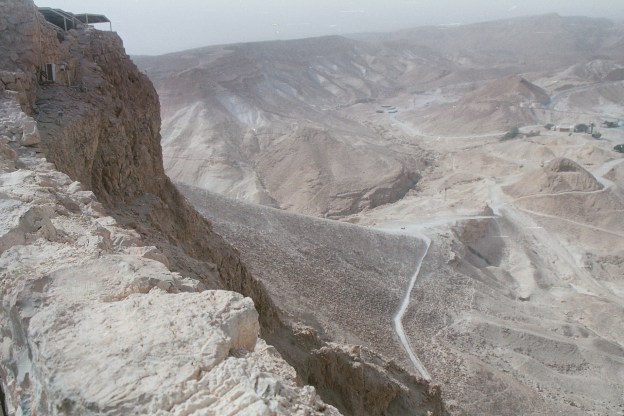
This is a view from Masada. Herod the great had started building this as a fortress. Jews who had been forced out after the fall of Jerusalem made a stand here and they held off the Romans for a few months here. But when it became obvious that the Romans were about to break in five men were chosen to kill the people who were left, about 960 people, then killed each other and the last one left committed suicide. In the middle of the picture you can see an incline, this was a ramp built by the Romans to break in and capture the fortress. From the top of Masada, you can also see big squares at the bottom of the mountain. These were the encampments of the Roman legions who had laid siege to the fortress. The following is a link to Wikipedia for more information on Masada. http://en.wikipedia.org/wiki/Masada

Pontius Pilate a very real historical figure

Up until recently the historicity of Pontius Pilate was doubted, critics of the Bible pointed to this “doubt” as another “proof” that the Bible was not historically accurate. Up until the stone’s discovery in 1961, Pilate was thought to be fictional, that is until the stone (pictured) was found. The stone was a dedication to the building of Caesarea Maritima and refers to Pilate as Prefect of Judaea. The stone is generally accepted to be authentic. This is a display at Caesarea Maritima, the stone there is a replica, the original is in the Jerusalem Museum. Archaeology continues over and over to confirm facts, not just from Jesus’ time, but for all the Bible.

The Jezreel Valley, better known as the Plain of Armageddon

Yes, this is where the final battle described in the Book of Revelation. This picture is from the hill where Elijah faced off against the prophets of Baal. This area is especially interesting not for what will happen, but what has happened, there have been battles fought on this plain from the earliest time of history up to World War I. If the mountain could talk it could tell of us a fascinating history, if not bloody and frightening. Our tour guide also told us that this area is among the most fertile framing areas in the world, that farmers can often produce two separate crops in one season. How and why? I don’t really know and yea, just don’t feel a need to elaborate.

Article in local newspaper about Ben-Ghazi

https://www.facebook.com/notes/jim-driskell/freedom-of-religion-and-speech-ydr-article/4635805386025

Freedom of religion and speech YDR article

December 19, 2012 at 12:52pm

York academics, clergy disagree over limitations on freedom of speech

By JOHN HILTON

Daily Record/Sunday News

<!–date–> Updated: 09/25/2012 05:21:10 PM EDT Does freedom of speech have limitations when words prove capable of inciting deadly violence?One area academic says yes, while a York pastor isn’t so sure.

They responded to mixed reports that an anti-Muslim video led to deadly violence in Benghazi. American ambassador to Libya Christopher Stevens and four other consulate staff were killed Sept. 11 in the violent uprising.

The Rev. Jim Driskell said the American media was too quick to blame the attack on the low-grade anti-Muslim video, “Innocence of Muslims.”

Driskell, pastor of First St. Johns Lutheran Church at 140 W. King St., doubts the movie fueled the attack. U.S. officials are still determining how much of the attack was preplanned.

“It seems clear that this was a terrorist plot and not some spontaneous act of violence,” Driskell said. “But let’s focus on where the violence is coming from and how to stop that, instead of trying to find ways to shut Americans up.”

The onus, he stressed, should be placed on the perpetrators of the violence, not on those exercising their First Amendment rights.

Lee Barrett, professor of theology at Lancaster Theological Seminary, said the First Amendment includes no absolute protection. Comparing it to laws against shouting fire in a crowded theater, Barrett said free speech in the religious realm should have restrictions as well.”Freedom of speech is not the only moral value and it’s not the only political value,” he said. “Often moral and political values don’t harmonize nicely and you have to make some choices.”

For Barrett, the choices are simple. He believes the video had some role in the violence, just as general religious oppression has promoted unrest in the Middle East for centuries.

“If you weigh on the scales dozens of dead Americans, Libyans and Egyptians over the right of one jerk to say outrageous things, then I think the rights of the dead take precedence,” he said.

What about Christians?

For Driskell, the concern is one of consistency. Numerous Christian-based films have caused controversy over the years – “The Last Temptation of Christ,” for example – and he said the media generally tends to give these filmmakers a pass.

Directed by Martin Scorcese, “Last Temptation” depicts the life of Jesus Christ and his struggle with various forms of temptation including fear, doubt, depression, reluctance and lust.

The book and 1989 film depict Christ being tempted by imagining himself engaged in sexual activities, a notion that outraged some Christians. The movie includes a disclaimer explaining that it departs from the commonly accepted biblical portrayal of Jesus’ life, and is not based on the Gospels.

Still, Scorcese was nominated for an Academy Award for the film.

“If any of the people who made some of these anti-Christian movies were shouted down … I can only imagine the wailing and gnashing of teeth that would result,” Driskell said

But Barrett sees it differently.

“I don’t really think there is a double standard in the way the media covers Christianity and Islam,” said Barrett, who holds four degrees from Yale University, including a Master of Divinity conferred in 1975. “The mainstream media has been pretty even-handed in covering terrorism of any religion, be it Christianity, Islam or any other religion.”

The fact is the vast majority of Americans recognize that Christian terrorists in the United States are a tiny minority, Barrett said, “so that message does not need to be repeated.”

Polls tell a different story when it comes to Islam, he added, with many Americans still viewing the religion with distrust and doubt.

‘One of those gray areas’

Imam of the congregation Masjid At-Tawheed in York, Mujahid “Rick” Ramos values freedom of speech and calls the issue “one of those gray areas.”

“Freedom of speech is something we all cherish and appreciate,” he said. “But at the same time, a person has to be responsible.”

Ramos does not think the video, or the coverage of it, was anything more than a contributing factor in the recent violence. While he does not believe Islam has a propensity toward violence, followers are definitely frustrated, Ramos said.

“There’s this widespread frustration among Muslims, this sense of feeling helpless,” he said. “Throughout history we see that violence tends to be the reaction of a person who feels helpless.”

Jesus married? No….

The following is an article from the Huffington Post, which is not a credible source of much of anything, no less history, religion, philosophy. If you want inflammatory headlines, you definitely want this, and not credible journalism. At the very best I would describe the following as disingenuous, at best complete ignorance of any of the applicable scholarly subject. So read this and then I have my comments following:

“An ancient, business-card-sized papyrus fragment that appears to quote Jesus Christ discussing his wife is real, Harvard University announced Thursday. The fragment caused international uproar when it was revealed by a Harvard historian in September 2012, with prominent academics and the Vatican swiftly deeming it a forgery.

Harvard officials said scientists both within and outside the university extensively tested the papyrus and carbon ink of the badly aged fragment, dubbed the “Gospel of Jesus’ Wife.” The document, written in Coptic, a language of ancient Egyptian Christians, is made up of eight mostly legible dark lines on the front and six barely legible faded lines on the back. The handwriting and grammar were also examined over the last year and a half to confirm its authenticity. Scientists have concluded the fragment dates back to at least the sixth to ninth centuries, and possibly as far back as the fourth century.

The document was never meant to prove Jesus was married, Harvard Divinity School professor Karen L. King emphasized Thursday. Instead, she argued, it’s meant to highlight that some early Christians may have believed Jesus was married. The distinction is significant because debates over sexuality and marriage have dominated contemporary discussions about Christianity; the Catholic Church cites Jesus’ celibacy as one reason its priests must not have sex or marry.

“The main topic of the fragment is to affirm that women who are mothers and wives can be disciples of Jesus — a topic that was hotly debated in early Christianity as celibate virginity increasingly became highly valued,” King, whose specialties include Coptic literature, Gnosticism and women in the Bible, said in a statement Thursday. “This gospel fragment provides a reason to reconsider what we thought we knew by asking what the role claims of Jesus’ marital status played historically in early Christian controversies over marriage, celibacy, and family.”

The legible lines on the front of the artifact seem to form a broken conversation between Jesus and his disciples. The fourth line of the text says, “Jesus said to them, my wife.” Line 5 says “… she will be able to be my disciple,” while the line before the “wife” quote has Jesus saying “Mary is worthy of it” and line 7 says, “As for me, I dwell with her in order to …”

“The main topic of the fragment is to affirm that women who are mothers and wives can be disciples of Jesus…” First, of course women can be disciples of Jesus’. Any who are in Jesus should be His disciples. Who ever said they weren’t? You really have to reread this article with a critical eye.

Because this is an ancient document does not make it factual, the Bible is an ancient document, based on Bible copies going back to at least the 5th century (around the same time as this fragment) we know that the Bible we have today is very well documented. Why is this one fragment credible, and a document (the Bible) that can be traced back to the earliest times not credible?

The proponents of this are trying to say that the rap against this is a forgery. I haven’t read anyone that takes issue with whether it’s a forgery or not, the issue is whether it’s credible. Anyone could write something to be found hundreds of years later, the fact that it was discovered doesn’t make it fact. We are supposed to change all of history, theology because one scrap of paper was found??? Really!!! We have credible evidence of Scripture and writers dating back to the beginning, in straight succession to today. How does one unassociated scrap of paper change anything? During this period there were other writings that have shown to have no basis in fact. My fun example is always the “Gospel of Judas”. Help me out folks, the man was a traitor, he ran off and hung himself, and he still had time to write his gospel? Actually “gospel” means “good news” in Greek, so in Judas’ case it’s “not so gospel”. I don’t know? Fact is there are a lot of people out there with an agenda, with little scruples who will try to make a case out of anything they oppose. Also please note, this was written in Coptic. The language Jesus and His apostles spoke was Aramaic, essentially all their writings were in Greek, which was the common academic language of the time. Coptic is an Egyptian language, relatively speaking, israel and Egypt were a long ways a way. Why something written in a language that had nothing to do with Jesus’ contemporary life, at least four hundred years after Jesus, is being given any kind of credibility is, again, a mystery to me. A scrap of paper, in Coptic no less, doesn’t prove a thing, doesn’t change a thing. Someone back in that time wrote down their opinion, in a country very distant from Israel, and as far as I can tell would have no reason to have any first hand knowledge of Jesus’ life at all. Now Matthew, Mark, Luke, John, Peter, James, Jude, did and they don’t mention anything of the sort. Well yea, I guess we’re going back to fiction in the DaVinci Code. Hey Dan Brown said it was entirely fiction, yet we have people who worship his book/movie. Yea, don’t try to confuse me with the facts, just tell me what I want to believe.